Alejandro Valverde was one of the defining Ardennes specialists of his era, but even that description does not fully capture his range. He built his reputation on explosive uphill finishes and his command of races such as Liège-Bastogne-Liège, yet he was also a Grand Tour podium rider, a Vuelta a España winner and, eventually, a world champion. His career was unusually long, unusually productive and, because of the doping ban that interrupted it, unusually divided. Even with that complication, his record leaves him firmly among the most significant riders in men’s cycling history.
Rider history
Valverde announced himself early. He finished 3rd overall at the 2003 Vuelta a España, then 4th overall in 2004, showing almost immediately that he was much more than a one-day specialist in the making. In 2005, he joined Caisse d’Epargne, one of the earlier incarnations of the current Movistar structure, and that move set up the most important phase of his career. A year later, he made his first major mark on the Spring Classics by winning both La Flèche Wallonne and Liège-Bastogne-Liège, an Ardennes double that established him as one of the sport’s most dangerous puncheurs.
He won Liège again in 2008 and then took the Vuelta a España in 2009, adding a Grand Tour overall title to a palmarès that was already unusually broad. That first phase of his career then came to a halt when his connection to the Operación Puerto case led to a suspension. Valverde was banned from the start of 2010 until the end of 2011, which split his career into two distinct eras. That matters when judging him historically, because he returned from that absence not as a fading veteran but as a rider who could still compete with and beat the best.
In some ways, the post-ban version of Valverde was even more remarkable. He won La Flèche Wallonne four years in a row from 2014 to 2017, taking his total in the race to five, which is the men’s record. He also won Liège-Bastogne-Liège again in 2015 and 2017, bringing his total there to four victories. Those results came while he was already deep into his 30s, which only added to the sense that he had become one of the sport’s most durable elite riders.
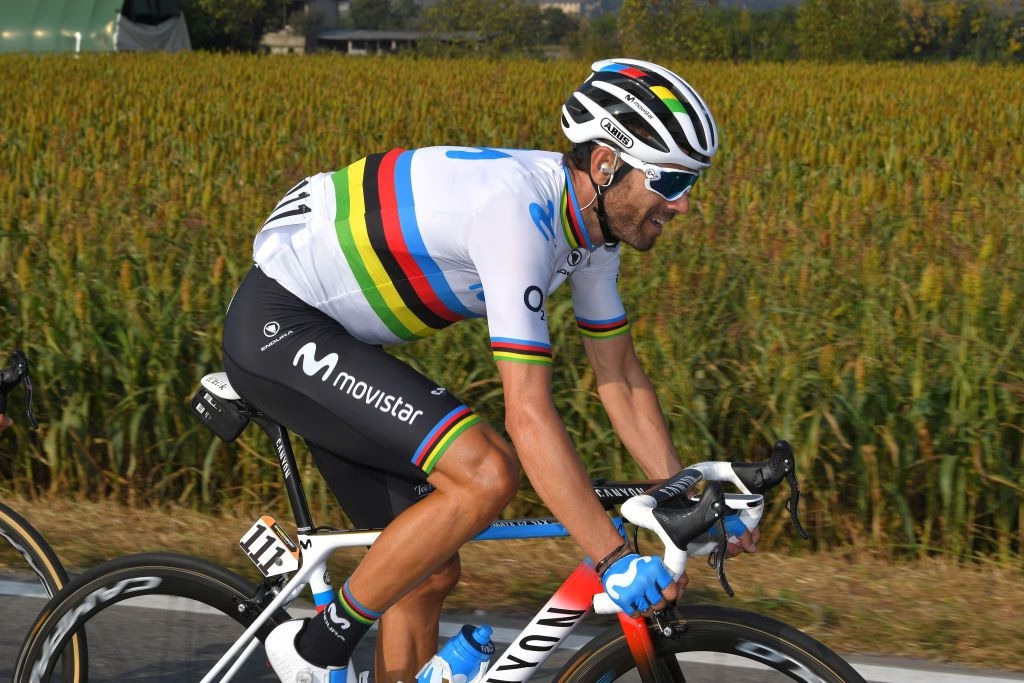
The final major confirmation of his place near the top of the sport came in 2018, when he became world champion. By then, Valverde had already spent years assembling one of the deepest collections of podiums and major results in modern cycling, but the rainbow jersey filled the most obvious gap. He remains a controversial figure because of the ban, and that cannot be ignored, but judged purely on racing ability and results, he was one of the great all-rounders of his generation.
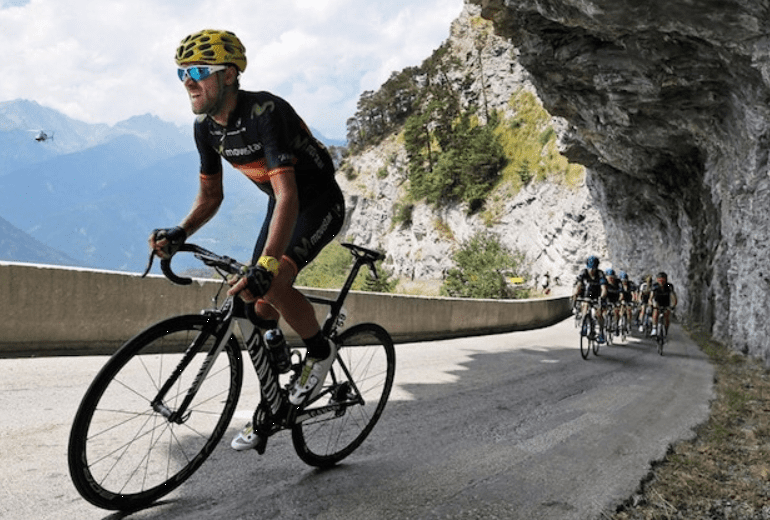
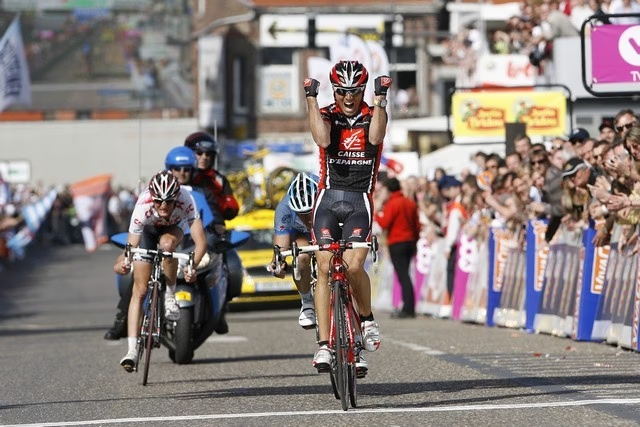 Photo Credit: Luc Claessen/ISPA
Greatest race victory
2008 Liège-Bastogne-Liège
There are several Valverde victories that could be chosen here, but the 2008 Liège-Bastogne-Liège is a strong pick because it showed him at the height of his first peak against a high-quality group of rivals. The decisive move formed after the Côte de la Roche-aux-Faucons, when Valverde, Davide Rebellin, Frank Schleck and Andy Schleck emerged at the front, with Joaquím Rodríguez briefly involved before dropping back. It set up exactly the sort of selective, tactical finish that suited Valverde’s strengths.
The finale unfolded in stages. Andy Schleck attacked, forcing Valverde and Rebellin to work, while Frank Schleck could sit on and wait. Once Andy was brought back on the Côte de Saint-Nicolas, the front of the race narrowed again and the finish in Ans became a contest of timing and nerve. Rebellin drove the pace into the final stretch, but Valverde held his position and launched late enough to come around both rivals and win the sprint. It was not a long-range solo or a brute-force demolition. It was a race won through control, patience and a finishing kick that very few riders could match on that sort of uphill run-in.
That victory also works as the clearest symbol of Valverde’s best qualities. He could climb with the pure puncheurs, survive the repeated accelerations of a hard Monument, and still beat elite rivals in the final metres. That combination is why he was so hard to beat in the Ardennes and why Liège, in particular, became such a central part of his legacy.
Spring Classics palmarès
Monuments
Liège-Bastogne-Liège
2006, 2008, 2015, 2017
Classics
La Flèche Wallonne
2006, 2014, 2015, 2016, 2017