
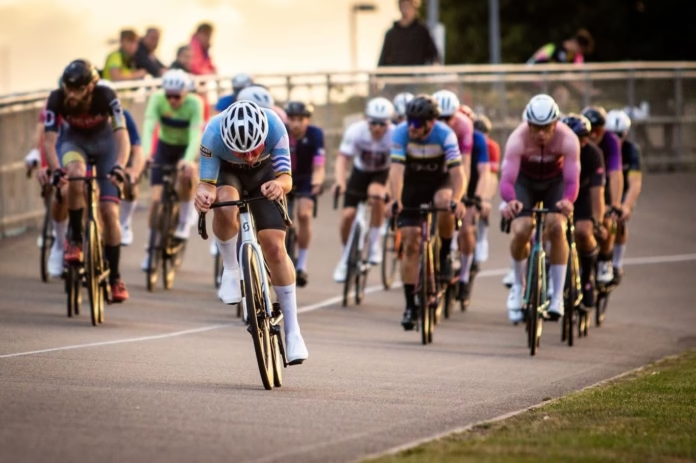
Britain’s velodromes tend to divide neatly into two eras. There are the hyper-modern indoor cathedrals of the 1990s onwards, built in the slipstream of Manchester’s rise and later fuelled by Olympic fever. And then there are the hardy survivors of the Victorian and Edwardian boom years, outdoor tracks that predate the concept of standardisation and reflect the local engineering quirks of their era. Portsmouth’s velodrome, tucked into Alexandra Park beside the Mountbatten Centre, belongs firmly in the latter category. Its long, looping curve and single straight are a reminder that track cycling in the UK was once a much wilder, more experimental landscape.
What makes Portsmouth compelling today is the extent to which its heritage remains visible. You can still sense the Edwardian optimism that accompanied its opening in 1900, even as modern safety fencing, leisure facilities and contemporary club racing shape its present. This is a venue where early British champions raced in front of huge crowds, where Olympic medallists once honed their craft, and where community leagues have kept the sport alive through war, decline and revitalisation.
A uniquely shaped track born from 19th-century engineering
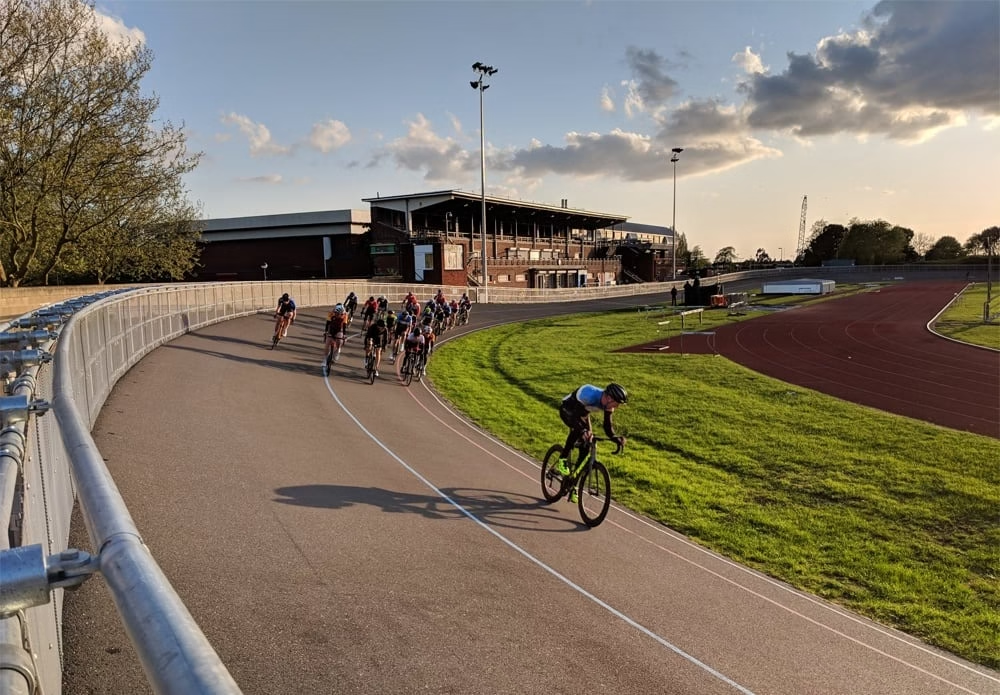
The story begins in 1888, when Portsmouth Corporation purchased land at North End with a view to building a recreation ground. The cycle track that followed was the work of Percy Boulnois, the city’s Regional Engineer, who later wrote about the challenge of designing one of Britain’s first banked circuits. With few precedents to draw on, he used a tricycle and a hypothetical speed of 25 mph to estimate the required banking. What emerged was a D-shaped circuit with a single straight and one long, sweeping curve, an unusual layout even by the standards of the day.
When the finished track opened in 1900, it measured 586 yards, surfaced in asphalt and banked to around 12 degrees. Wide at 24 feet, it offered space for mass-start racing and ambitious event organisers. The surrounding area gradually became Alexandra Park, officially opened in 1907, and the track soon became one of the south coast’s key sporting venues.
In an era before 250-metre indoor tracks, consistency wasn’t the priority. Character was. And Portsmouth’s design still stands out: a circuit that breaks from the symmetrical rhythm we now associate with track racing, requiring riders to adapt their lines and pacing to the long arc on one side and the brief, decisive straight on the other.
A stage for early champions and national prestige
The track’s heyday began almost immediately. Portsmouth North End CC, a dominant force in local and national cycling, organised regular events throughout the 1900s. The Portsmouth Mercury hosted evening meets, and competition for club championships became fiercely contested. Clarence Brickwood Kingsbury, a towering figure in early British cycling, won the mile title there in 1900 and soon moved into the history books.
Kingsbury’s exploits would eventually stretch far beyond Portsmouth. At the 1908 Olympics, he claimed two gold medals, winning both the team pursuit and the 20 km race. From 1907 to 1912, he appeared untouchable domestically, sweeping national championships from a quarter-mile to 50 miles and frequently appearing at the world championship level. Many of those performances were rooted in the racing culture that had grown at Alexandra Park.
By 1909, the track was prestigious enough to host “The National Amateur Cycling Championships open to the world”. The race card was extraordinary: Vic Johnson, already an Olympic and world champion, defended the quarter-mile; Kingsbury fronted the mile; and Olympic champion Ben Jones held the five-mile title. The corporation even widened parts of the track to accommodate the event, a rare example of civic investment in cycling during that period.
Star-studded line-ups became the norm. The 1910 August Bank Holiday meet drew Bill Bailey of the Polytechnic, who dominated the card, as well as Leon Meredith, who lowered his motor-paced five-mile record to 8 minutes 48.6 seconds. These were world-class names on a coastal track that had rapidly become one of Britain’s go-to venues for high-level competition.
A track that never stopped adapting
Racing at Alexandra Park continued through turbulent decades. During the First World War, events still drew sizeable fields, with women’s racing proving particularly popular. The postwar period kept the momentum alive, and after the 1948 Olympics, Portsmouth welcomed an international field of newly minted Olympians to a major celebratory meet.
By the 1950s and 60s, the track league scene was thriving. The NCU Racing Handbook from 1955 lists regular midweek leagues for Portsmouth and Gosport riders. Nine clubs formed the backbone of the Alexandra Park Track League during the 1960s, helping to nurture grassroots talent at a time when indoor velodromes didn’t yet exist in the UK.
A major turning point came in 1979, when the Mountbatten Centre opened and the velodrome became part of a broader multisport complex. A pool, gym, racket sport facilities and later an extended leisure centre helped secure the future of the track as a community venue. The circuit retained its unusual shape and original position within the park, but its function widened, with a running track installed inside the cycling oval and wider sporting usage integrating with the park’s evolving role.
Tragedy, transformation and renewed purpose
The modern era of the Mountbatten velodrome is shaped, inevitably, by the tragedy of 2014, when Richard Phillips-Schofield died following a 35mph crash during a race. The accident triggered a reevaluation of safety standards across the UK, as British Cycling began assessing outdoor tracks against contemporary guidance. Portsmouth, like many older velodromes, failed the initial inspection because its perimeter fencing didn’t meet modern design criteria.
Riding was halted. Racing ceased entirely. For a time, the future of the velodrome looked uncertain.
But the community surrounding the track mobilised, and in 2016, new fencing was installed by Arbus, bringing the venue back into compliance. Training resumed, followed by racing, and the circuit returned to its place as a hub for South Coast cycling. Racing Club Omega now spearheads competitive activity at the Mountbatten Centre, hosting events that blend youth development, club racing and accessible entry points for new riders.
The velodrome also remains part of a wider sporting landscape. Alexandra Park is used by the Plymouth Dreadnoughts American football team, and every day runners use the athletics track that sits inside the cycling oval. The shared environment mirrors the multifunctional character of many early velodromes, where cycling was one element of a broader public park.
Why Portsmouth still matters today
The Mountbatten Centre velodrome stands alongside Herne Hill, Preston Park and Carmarthen Park as one of the last surviving early outdoor tracks still in regular use. Its value lies not just in its longevity but in the insight it offers into British cycling’s formative years.
You don’t ride Portsmouth to simulate Manchester or Glasgow. You ride it to experience a lineage that predates them. The long continuous curve forces riders into an unusual flow; the wide asphalt surface rewards positioning and tactical movement; and the exposed setting captures the elements in a way that indoor velodromes never can. If visiting, there is more information about Portsmouth at Portsmouth Hub.
For many, the appeal is simply that the track is still alive. Despite wars, financial pressures, shifting fashions and the tragedy that forced its temporary closure, Portsmouth remains a functioning, community-oriented velodrome. It survives because people continue to race on it.
The south coast’s link between past and present
In an era where new indoor velodromes define elite performance, the Mountbatten Centre track offers something different: continuity. It is a reminder that British track cycling didn’t begin with Manchester’s 250 metre boards. It began outdoors, on cinders and asphalt, shaped by civil engineers experimenting with banking angles and ambitious clubs drawing huge local crowds.
Portsmouth’s velodrome still carries the imprint of that era. When the evening sun drops over Alexandra Park, shadows stretching across the tarmac arc that has seen more than a century of racing, it feels less like a relic and more like a survivor. A venue that has seen champions rise, records fall, communities gather, and cycling evolve.
If Britain’s velodromes map the history of the sport, then Portsmouth is one of the most compelling points on the chart. Not because it is the fastest or the most famous, but because it tells a story no other track quite can.
Many of the historical details in this article are referenced from OldVelodromes. Main photo credit to Wightlink CRT.

