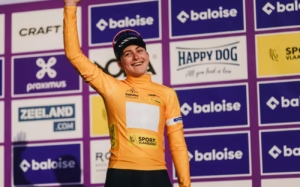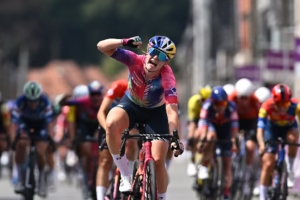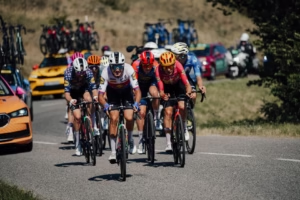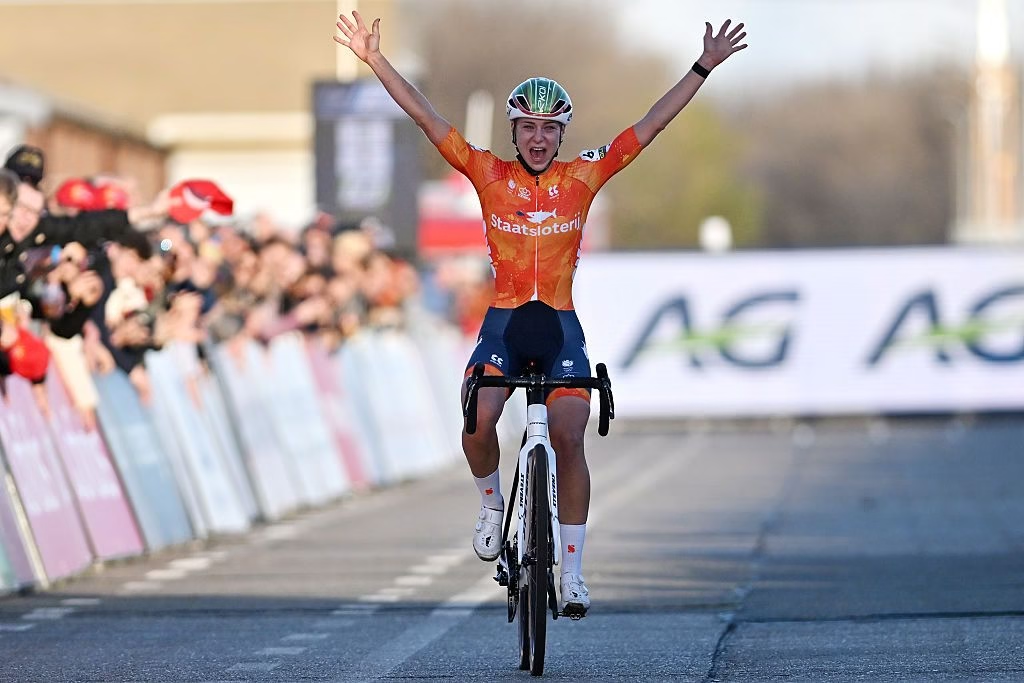
On a course built almost entirely from dunes, beach and loose sand, Inge van der Heijden produced the performance of her life to win the elite women’s European title in Middelkerke and lead a Dutch clean sweep with Lucinda Brand and Aniek van Alphen.
With defending champion Fem van Empel absent through illness, plus Ceylin del Carmen Alvarado, Annemarie Worst and Puck Pieterse all missing, Brand started as the obvious favourite. But the race belonged to another Crelan-Corendon rider. Van der Heijden, long known as one of the best sand riders in the field, seized her opportunity and never once let go.
Holeshot, first sand, first gap
The circuit around the military domain of Lombardsijde wasted no time. Barely ninety seconds after the start the bunch were pitched straight into a steep drag and the first sand section, and van der Heijden knew that was her moment.
“I knew it was really important to have a good start,” she said afterwards. “You get a steep section immediately, so I went very hard to the first corner, came over the top in first and then rode my own pace.”
That pace already hurt everyone else. While Brand was boxed in and shuffled back into mid-pack, van der Heijden floated through the first sandy passages and opened a serious gap before the opening lap was done. After one of six laps she already led by 21 seconds, with a chase group of four forming behind: Sara Casasola for Italy, plus the Dutch trio of Brand, Van Alphen and Manon Bakker. Blanka Vas and French champion Amandine Fouquenet followed further back.
Brand quickly moved up, trying to stabilise the situation, and her first acceleration in lap two dispatched Bakker from the group. But in that second lap the rhythm in the chase never settled. Whenever it stalled, van der Heijden’s advantage ticked upwards again. Two laps in, the gap was 26 seconds.
Dutch tactics and a fragile chase
Midway through the third lap Brand finally halved the deficit, using one of the firmer lines through the dunes to claw time back. Casasola read the moment and went over the top, briefly setting off alone in pursuit when Brand dabbed and had to dismount. At the end of lap three, the gap was down to 17 seconds to the Italian and 21 to Brand.
Behind them, Van Alphen refused to let the chance of a medal go and clawed her way back in lap four, a clear sign that the chase was not fast enough. Out front, van der Heijden simply kept tapping out her tempo. By the end of that fourth circuit she had extended the lead to 44 seconds. On a course where every foot in the wrong rut cost energy, that was almost decisive.
In the chase, the dynamics were as interesting as the time gaps. Brand and Van Alphen, both in Dutch orange, clearly did not want to be seen dragging Casasola across to their own teammate, especially after the Dutch set-up had already been criticised for how it raced the Gravel World Championships. On the finish straight at the end of lap two Brand physically waved Casasola through, inviting her to work.
“On any championship the plan is not to close the gap to a teammate with a rival in your wheel,” Brand explained afterwards. “I urged Sara to ride, but she said she could not chase Inge. Fine, then you will not have a medal, I thought. And that is exactly what happened.”
Casasola crashes, van der Heijden finishes the job
Into the final two laps, van der Heijden’s advantage hovered in the forty to forty-five second range. From there the race forked into two stories: a cool, controlled solo and a messy, nervous battle for silver and bronze.
Van Alphen began to test her companions and put both Brand and Casasola under pressure. The Italian, who had been smooth and aggressive in the early chase, finally overstepped the limit on the beach. Hitting a rut at speed, she slid out and hit the sand hard. The crash blew the chase group apart and effectively ended her podium hopes.
At the head of the race van der Heijden never once faltered. She picked her lines through the now deeply tracked sand, ran where she needed to, rode where she could, and kept the effort right on the limit without tipping over it.
“I did not expect to hold it to the finish,” she admitted. “It was really hard to make the gap in the first lap. I knew this course with the sand pits suited me, but to ride alone from start to finish, I still cannot quite believe it. This means a lot to me. I have a world title as an under-23, but now the goal was just to be on the podium at the Europeans or Worlds. Now I have the jersey.”
Brand and Van Alphen sort out the medals
While the new European champion rode serenely towards the finish, the race behind remained edgy right to the final lap. Van Alphen again forced a gap on Brand in the closing circuit, trying to lock up silver and test whether the former world champion had anything left after several big efforts.
Brand, though, is rarely beaten in a tactical endgame. She closed the gap, then countered at precisely the right moment. On the ramp leaving the beach she surged clear, using her experience in the wind and her descending skills on the grassy banks to turn a small gap into a decisive one.
Silver for Brand, bronze for Van Alphen, and fourth place for a bruised and frustrated Casasola, who finished off the podium at the Europeans for the second year in a row.
For the Netherlands, it was a perfect outcome: three riders, three medals, and a fresh champion in a discipline where the depth of talent is already intimidating. For van der Heijden, it was something far more personal: confirmation that the rider who once won a rainbow jersey as a promising under-23 has now fully stepped into the front rank of the elite.
European Cyclocross Championships Middelkerke 2025 Women result
Results powered by FirstCycling.com
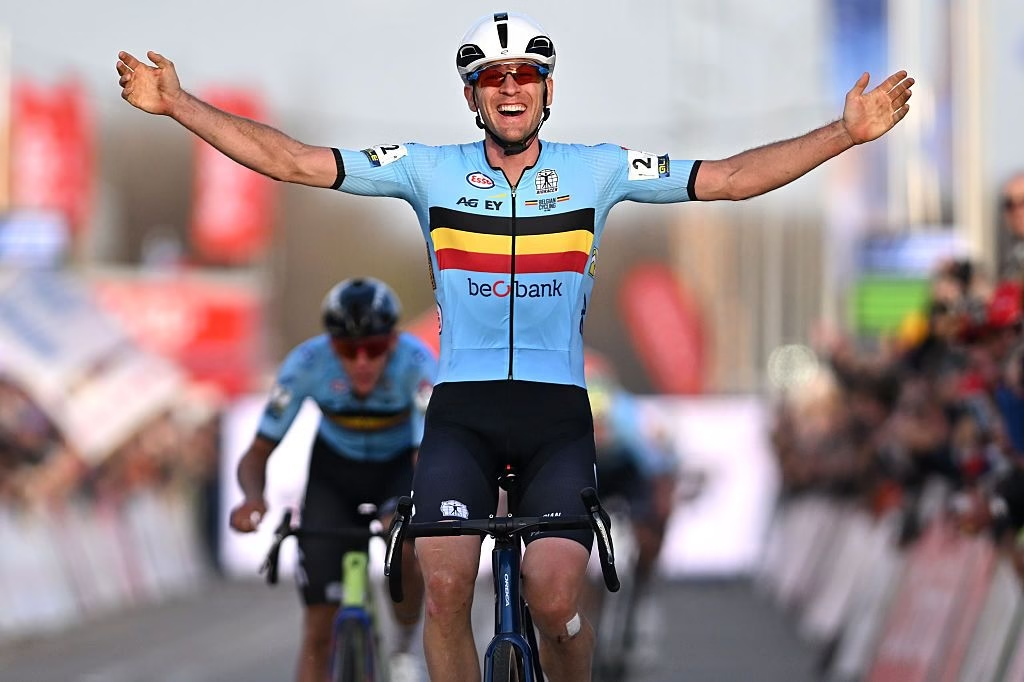 Photo Credit: Getty
Aerts edges Nys in a six-up thriller to reclaim the stars
If the elite women’s race was decided early, the men turned Middelkerke into a ninety per cent war of attrition and ten per cent pure theatre. On a course that constantly shifted under the tyres, Toon Aerts dug himself out of trouble, surfed every key sand section to perfection in the final laps and then out-sprinted defending champion Thibau Nys to reclaim the European title nine years after his first.
It completed a Belgian sweep with Joran Wyseure in third, and delivered Aerts the most emotional win of his second career.
Belgian power, Dutch disruption
The men’s race opened at a furious pace. Twenty-six riders took the start, with eight Belgians and six Dutch riders filling the front rows. The first sand arrived less than two minutes into the race and immediately stretched the field into a single file.
Aerts grabbed the holeshot, but it was Michael Vanthourenhout who soon took over on the front, setting a fierce rhythm into the beach section. Belgian riders chose the lower line right on the water’s edge, using the firmer wet sand to keep riding while others were forced to run the higher, softer line.
The picture at the front constantly shuffled as the laps ticked by. The Dutch trio of Mees Hendrikx, Joris Nieuwenhuis and Pim Ronhaar did everything they could to disrupt the Belgian train, punching holes in the rhythm whenever they could. Vanthourenhout and Aerts shared the workload for Belgium before Aerts slipped back after a bike change and had to restart his race from behind.
By lap four, a selection had formed: a leading group of eight, trading blows before every key feature. First came the beach, with its steep, brutal exit ramp. Then a bumpy, twisting section where any surge could snap the elastic. Every time they hit those zones, someone tried something.
Ronhaar attacks, the Belgians bend but do not break
On the next lap Vanthourenhout, Ronhaar, Nys and Wyseure nudged clear, holding a 13 second gap over what remained of the chasers, Hendrikx digging deep behind. Ronhaar in particular was aggressive, throwing in repeated accelerations in an attempt to smash the Belgian block apart and prevent them from dictating the final.
He could get gaps, but never quite hold them. The course simply did not allow one rider to ride off alone unless the others cooperated, and nobody in that group of four was in the mood to do that. Behind, the chase fragmented and reformed as riders tried to bridge or simply survive the pace.
Aerts, meanwhile, had to do things the hard way. Stuck in traffic during one of the sand sections, he lost contact but never panicked. Lap by lap he chipped away at the gap, using every strong passage through the dunes to slide past another rider.
With two laps to go he finally made it back to the front, swelling the lead group to five. Mason, who had been riding a clever, patient race, then produced an enormous effort to bridge across from behind, dragging himself up to the leaders just before the beach and briefly making it six.
On the climb back out of the sands Aerts gave the first real hint of what was coming, taking over on the front and showing just how much power he still had in reserve.
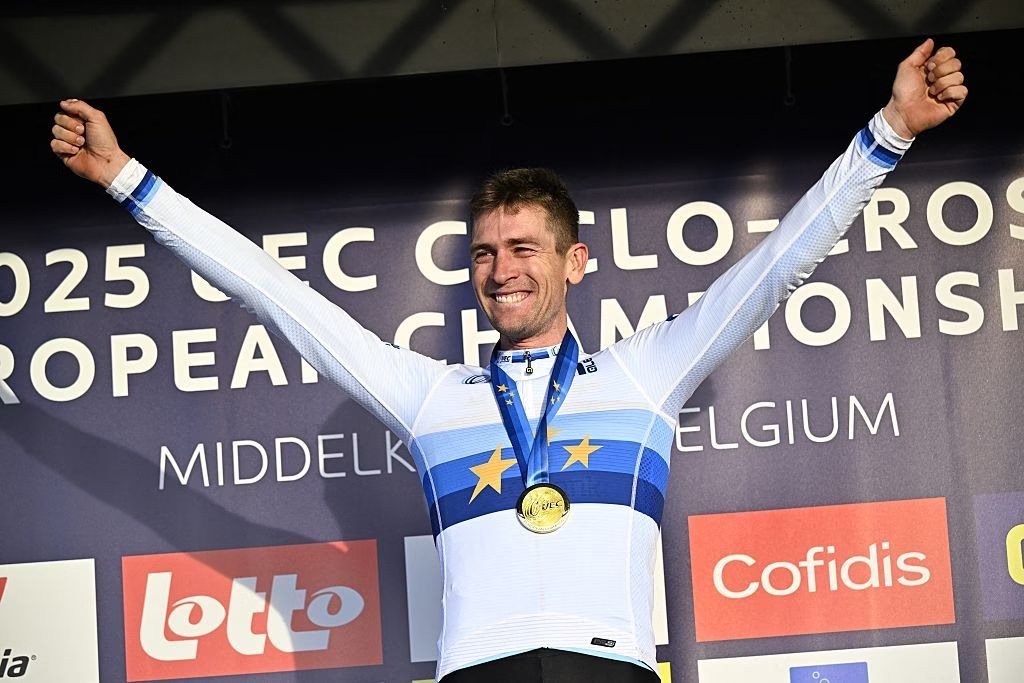 Photo Credit: Getty
Final lap, fine margins
The bell lap began with six riders still in the mix: Nys, Aerts, Wyseure and Vanthourenhout for Belgium, Ronhaar for the Netherlands and Mason for Great Britain. The race was no longer about nations. It was about who had any strength left and who could play the final corners to perfection.
Wyseure initially took the lead, then Nys moved through, trying to control the approach to the decisive sand. Aerts muscled his way up, literally bumping shoulders with Ronhaar as they jostled for position before the beach entrance. Once again the entire group chose the low line on the wet sand, strings of foam washing around their tyres as they powered along the water’s edge.
Ronhaar was first to swing off the beach and clip back in, but as they fanned across the exit Aerts made sure he was exactly where he needed to be. Nys took an outside line to slot into second wheel behind his Belgian rival. It was clear that the medals would be decided among these two and Wyseure, with Ronhaar and Mason just a fraction too far back to influence the sprint.
From there to the finish the entire race condensed into a handful of corners and one long drag. Nys led over parts of the final technical section, forcing Aerts to react, but the older Belgian refused to yield position. Onto the last straight he was exactly where he wanted to be, on the front but still with enough in the legs to launch.
Nys is usually the faster finisher, but this time he could not come past. Aerts opened his sprint from the head of the group and simply would not let anyone draw level. Nys swung out of the slipstream and threw his bike at the line, yet the blue stars went to the man in front. Wyseure secured third for a fully Belgian podium, Ronhaar’s aggression rewarded only with fourth place on the day.
“My second career begins today”
The moment Aerts crossed the line the emotion washed over him. He wept openly in the finish zone and again on the podium, this win carrying a weight that went far beyond another jersey and anthem.
His two year suspension for a letrozole positive in 2022 cut his career in half. He has always maintained the substance came via a contaminated product, and the sanction was reduced from a potential four years, but he still missed an entire season and spent more than a year fighting his way back to the level he once took for granted.
Since his return he had taken only one smaller win and a stack of top tens. Middelkerke was something entirely different.
“My second career begins today,” he said, voice cracking. “Once, almost ten years ago, my career started at the European Championships. So many years later, I think I can launch my second career again. The last years were so difficult. I did not expect everything to fall into place like this. I do not know what to say.”
He admitted that the setbacks of the early winter, including a broken chain in Overijse, had actually forced him to rethink how he raced.
“I was racing too much on aggression, from everything that happened. That makes you more likely to make mistakes. Today I had to fight back from a losing position. Then you are not thinking ‘I will win here’, it is more ‘what else can I still do’. Only in the last two minutes did it flip to ‘maybe it is my turn today’. Then I thought: come on, Toon, this is your moment, take it.”
He did, and with it he took back the European stars he first wore in 2016. For Nys there was the frustration of losing a title in a sprint he might normally win, but also confirmation that he remains the reference rider of his generation. For Aerts, this was something else entirely, a line drawn under two bruising years and proof that, at 32, he still has a story to write at the very top of cyclocross.
European Cyclocross Championships Middelkerke 2025 Men result
Results powered by FirstCycling.com