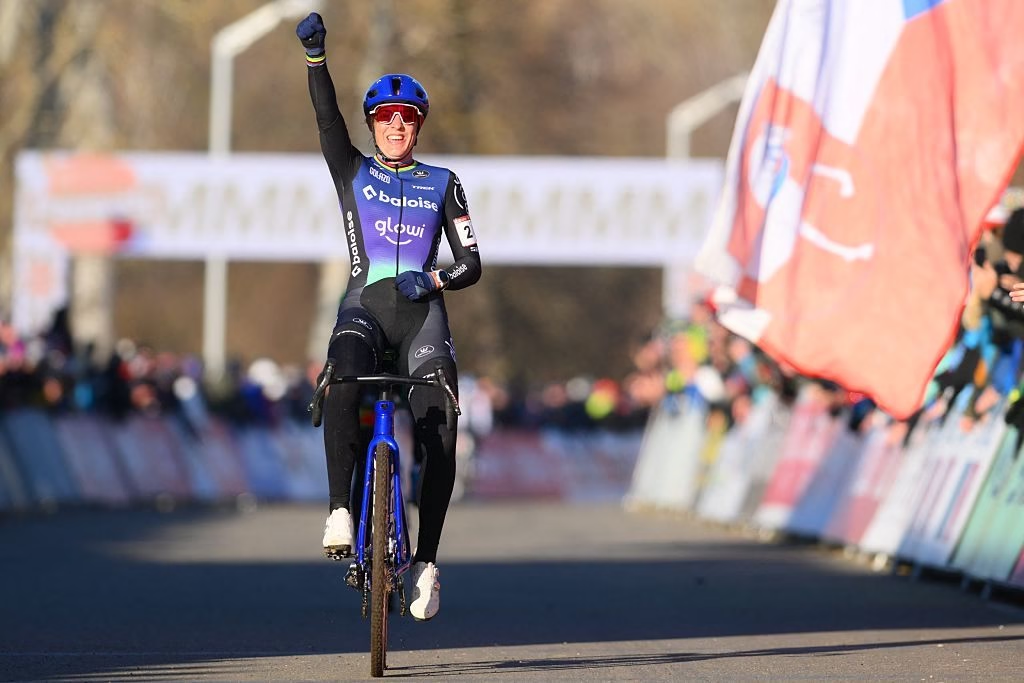
Lucinda Brand and Thibau Nys opened the 2025-26 UCI Cyclo-cross World Cup in ruthless fashion in Tábor, each soloing to victory on a rock-hard, icy course that punished hesitation as much as it rewarded power. Brand held off a revitalised Sara Casasola to equal Marianne Vos’ all-time podium streak, while Nys blew the men’s race apart on the second lap and never let anyone back into contention.
Brand resists Casasola to draw level with Vos
Tábor has long been one of cyclo-cross’ spiritual homes and, fittingly, the first women’s World Cup of the winter delivered a classic. In the absence of Fem van Empel, Puck Pieterse and Ceylin del Carmen Alvarado, it fell to Lucinda Brand, Sara Casasola and European champion Inge van der Heijden to set the standard – and they did exactly that.
On a frozen, slippery circuit, Brand wasted little time in applying her familiar suffocating pressure. The Baloise Glowi Lions leader hit the front early and immediately stretched the field, with only Van der Heijden, Leonie Bentveld, Aniek van Alphen and local favourite Kristýna Zemanová able to go with the initial acceleration. Behind, the Crelan-Corendon pair of Manon Bakker and Casasola worked to limit the damage, while Shirin van Anrooij’s much-anticipated return to ‘cross turned into a long chase from the back row, still mired in the 30s after the opening laps.
Van der Heijden clearly felt at ease on the punchy climbs and tried to turn the screw herself, ramping up the pace so that the front group gradually thinned. Bentveld, Zemanová, Casasola, Van Alphen and Bakker clung on, but Brand and the European champion looked a level above on the uphill drags.
The tone of the day quickly became clear: every time Brand lifted the pace, Van der Heijden and Casasola clawed their way back. The Dutchwoman could not shake her two most dangerous rivals, and the race settled into a tense stalemate. Casasola, returning after her crash and subsequent respiratory infection at the European Championships, rode with a buff pulled up over her face for warmth, an unusual sight that underlined just how cold Tábor really was.
Only in the final lap did the picture change. Van der Heijden, who had already admitted she had lost confidence in the icy corners after a couple of near crashes early on, finally started to pay for the repeated accelerations and began to drift a few seconds back. Casasola, however, refused to yield. She matched Brand on the climbs, answered every change of pace and even came through occasionally to test the Dutchwoman.
Brand, though, had done her homework. After his victory in the under-23 men’s race, team-mate David Haverdings had talked her through where he felt the decisive move could be made.
“I knew where I had to put the pressure in the last lap,” Brand explained afterwards. “It was really hard to make a difference, there was a lot of sliding and we were very evenly matched uphill, so it was difficult to ride away. That made it quite a tactical race. I tried the same thing David did and I heard quickly that I had a gap. After a few corners I could see it as well.”
Casasola slipped slightly by the pits and dropped a small but crucial gap that she simply could not close. Brand drove that advantage all the way to the line, rounding the final bends alone and sprinting in upright, arms pumping, for her eighth win from ten starts this season.
Behind her, Casasola crossed the line just behind, taking a superb second place – her first ever World Cup podium after three previous fourth places. “To be honest, I hoped to be a bit closer to the win,” the Italian admitted. “I slipped near the pits and that opened a gap. Lucinda was already very fast, so I could not close it any more. But I am happy with second place, it is my first World Cup podium. I am still recovering from illness, so I started a little slower than normal and could come back when the race became more tactical. My legs were good, but my breathing was not yet at one hundred per cent.”
Van der Heijden, who had repeatedly climbed her way back into contention over the course of the race, eventually had to settle for third. “I always come to win, but with third place I can be very happy,” she said. “In the first two laps, I almost crashed a few times on the icy ground and I lost my confidence in the corners and descents. Uphill I had time to close the gap, maybe I was the best there, but I lost it in the downhills and the turns.”
For Brand, the win meant more than another World Cup leader’s jersey. Her podium in Tábor was her 51st in a row, a run that stretches back to January 2024 and now equals the record set by Marianne Vos. With Vos yet to make her own seasonal debut, Brand will have the chance to stand alone in Flamanville next weekend.
“As people keep reminding me, every race it gets a bit crazier,” she smiled. “I am not someone who is usually into statistics, but this is really special. For some people, it seems almost normal now that I am always on the podium, but it is really not. I am very happy with it. Now that we have reached 51, we can focus on other things again.”
There was less fortune for others. Marie Schreiber, whose sprint on foot to secure fourth place in Hamme left her with a psoas muscle problem, abandoned after crashing near the planks, landing on the same leg and losing all strength. SD Worx-Protime coach Sanne Cant admitted that the sprint in cyclo-cross shoes “is not good for muscles and joints”, but insisted that Schreiber’s winter is not in danger and that she has already shown promising signs in her first races back.
2025 Tábor World Cup Women result
Results powered by FirstCycling.com
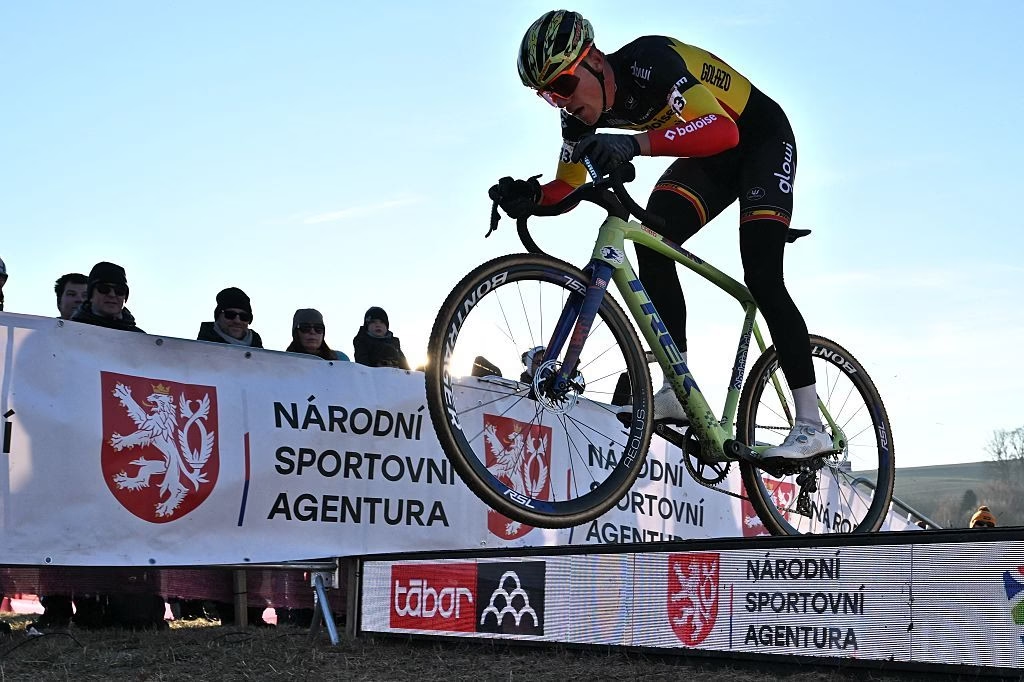 Photo Credit: Getty
Nys channels his father in solo masterclass
If the women’s race was all about tiny gaps and tactical feints, the men’s World Cup opener became a demonstration of what happens when one rider can simply ride away. Thibau Nys, in a Belgian champion’s jersey and a special helmet modelled on the one his father Sven wore in his own national colours, turned a tight race into a procession as soon as opportunity presented itself.
The mercury hovered below zero as the 44-rider field rolled off under bright winter sunshine. Swiss champion Kevin Kuhn took the holeshot, stringing the bunch into a long line as wheels scrabbled for grip on icy cambers and frozen ruts. British champion Cameron Mason’s race seemed to be over before it began when he was forced to put a foot down and slipped to the back of the field, leaving him facing a long afternoon of damage limitation.
By the end of the opening lap, the first selection had already been made. Nys and Joris Nieuwenhuis had prised out a slim advantage, chased by a group containing Emiel Verstrynge, Lars van der Haar, Pan American champion Andrew Strohmeyer and World Cup title holder Michael Vanthourenhout.
The key moment came almost as soon as the second lap started. Nieuwenhuis crashed, remounting quickly but losing just enough time for Nys to sense his chance. The Belgian champion surged clear, instantly turning a small gap into a chasm that would define the rest of the race.
“I already had a good feeling yesterday in recon, that I could really sprint from corner to corner,” Nys said. “When I saw the races this morning I thought it would be very difficult to take an advantage, but I immediately felt the legs and I just went for it. When Joris crashed in the second lap I got a small gap. I tried to keep pushing and told myself that if they came back, they came back. Halfway through the race I was thinking, ‘What am I actually doing here,’ because I was not making it easy, but I was in control and I had the right legs.”
From there, the pattern never truly changed. Nys rode clean lines and pushed hard out of every corner, using the frozen surface to his advantage. Behind, the chase flickered and reshuffled constantly. Vanthourenhout, Verstrynge and Nieuwenhuis briefly formed a trio, with another group featuring Jente Michels, Van der Haar, Laurens Sweeck and Strohmeyer hovering behind them.
Disaster struck Vanthourenhout with three laps to go when he crashed heavily on the tarmac finishing straight, forcing Van der Haar to brake hard and costing the Dutchman several positions. The defending overall World Cup winner would never recover, eventually finishing well outside the top 10.
With two laps remaining, Nys held a lead of around 40 seconds, a cushion that allowed him to ride his own tempo, choose his own lines and stay clear of other riders’ mistakes. Behind him, Sweeck began to make his experience count, forcing clear in the fight for second, while Nieuwenhuis and Michels duelled for the final podium spot.
By the bell, the race had settled into its final configuration. Nys, now almost out of sight, could afford to enjoy the moment, lifting his specially painted helmet slightly as if to acknowledge the family story unfolding. The win came almost exactly ten years after Sven Nys’ final World Cup victory in Koksijde, and the homage was no accident.
“This week he suddenly came home with a photo of me with bright orange glasses and exactly the same helmet,” Sven told Belgian broadcaster Sporza. “He had it secretly made, found similar glasses and combined them with the Belgian tricolour. It is exactly like seeing myself ride. It is quite special, it really does something to you when he refers to the past like that.”
Thibau himself admitted the symbolism mattered. “It was ten years ago that Dad won his last World Cup, so it all went very fast,” he said. “To ride the whole cross in this jersey today with such a helmet is great, I really enjoyed it.”
Sweeck held on comfortably for second, while Nieuwenhuis finally shook off Michels to take third. Mason’s afternoon-long comeback ended with an impressive ninth place, just 37 seconds down, underlining both how fast Nys was going and how well the Brit handled the conditions once he found his rhythm.
For Nys, the win was about more than nostalgia. It came on the back of his European Championships silver and his victory in Hamme, slotting neatly into a winter that is already being used as a springboard towards the road season with Lidl-Trek and another tilt at the Ardennes Classics. Coach Paul Van Den Bosch has openly acknowledged that every session this winter carries those spring ambitions in the background, with long road rides following big ‘cross efforts to build depth without losing explosiveness.
In Tábor, though, there was nothing in the background. Just a frozen course, a special helmet, and a rider with the legs – and confidence – to turn the first World Cup of the season into a statement.
Between Brand’s record-equalling eighth win of the season and Nys’ emphatic solo, Tábor felt like the moment when this ‘cross winter truly stepped up a level. Flamanville will not be short of storylines.
2025 Tábor World Cup Men result
Results powered by FirstCycling.com