

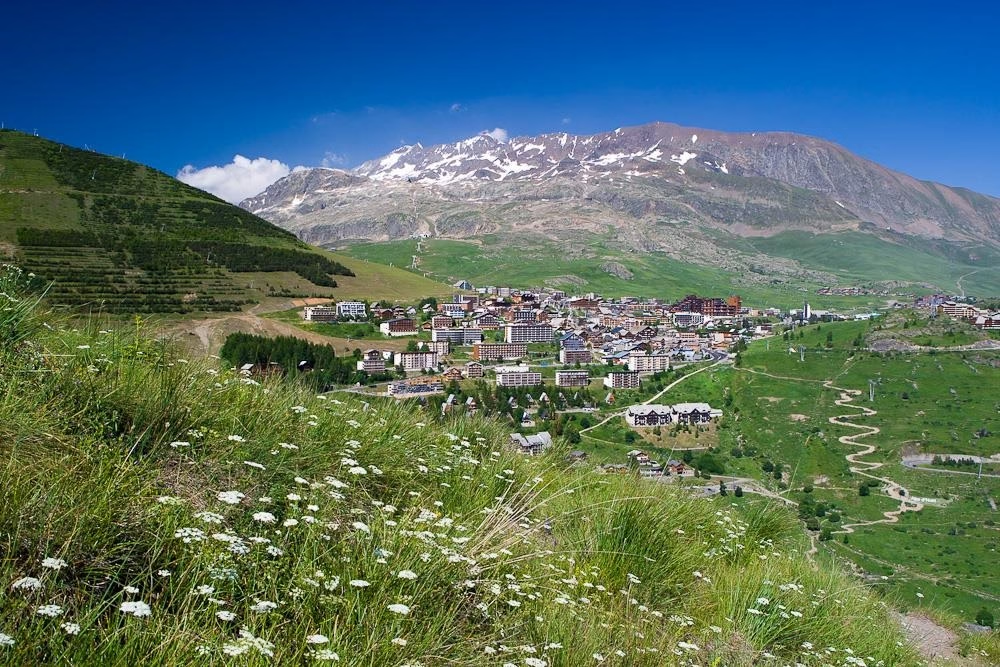
Bourg d’Oisans sits low and quiet beneath the surrounding walls of the Alps, a place that feels deliberately understated given what rises directly above it. The valley floor is broad and green, the air warm even early in the day, and the mountains seem almost too steep to be practical. Alpe d’Huez dominates everything. You can see it from almost anywhere in town, a staircase of rock and road climbing abruptly out of the valley.
Mornings here are purposeful. Riders roll through town with the same calm focus, bottles filled, layers adjusted, the knowledge of what lies ahead sharpening rather than dulling the senses. This is not riding that needs discovery. The challenge is already written into the landscape.
Rolling out from Bourg d’Oisans
The road out of Bourg d’Oisans offers little time for hesitation. A short, flat lead-in gives way quickly to the first ramp, the valley floor falling away almost immediately. The temperature changes as you climb, warm air lingering below while cooler currents drift down from higher up the mountain.
Traffic can be present, particularly later in the day, but early starts reward you with space and quiet. The road surface is excellent, wide and predictable, a reminder that this is not just a famous climb, but a functional one, engineered to handle decades of racing and tourism.
The first hairpins and the shock of steepness
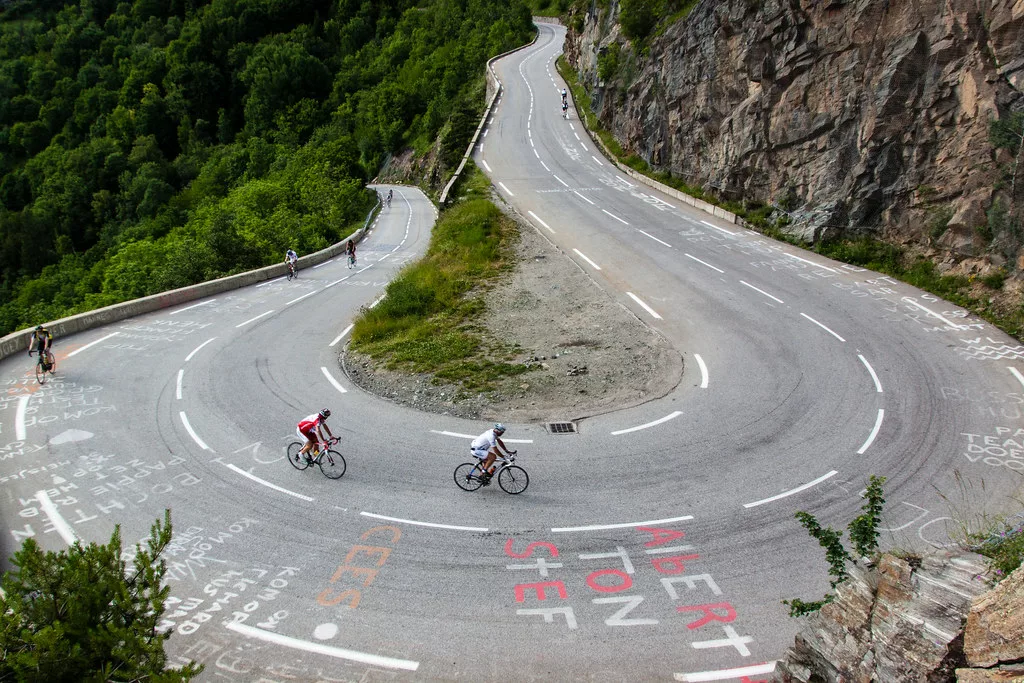
The opening hairpins arrive fast and without ceremony. There is no easing into Alpe d’Huez. The gradient bites immediately, forcing rhythm before the legs have fully settled. Each bend is numbered, a countdown that feels comforting and cruel in equal measure.
The road snakes back on itself tightly here, the valley stretching out below with every turn. Heat reflects off the rock face, effort becoming physical and immediate. This lower section is often the hardest psychologically, the climb still young, the summit impossibly distant.
As altitude increases, the climb begins to change character. The gradient remains demanding, but steadies enough to allow control. Hairpins open out, the views broaden, and the air cools noticeably. The effort shifts from survival to management.
There is history embedded in every corner. Names painted on the tarmac, worn and refreshed year after year, hint at the battles fought here. Even without crowds, it is impossible not to feel part of something larger. The climb invites comparison, but rewards focus. Riding your own pace is the only way it makes sense.
The final kilometres to Alpe d’Huez
The last section of the climb is deceptively difficult. The road straightens, the shelter of the rock face gives way to open slopes, and the wind often makes its presence felt. What looked manageable from below now demands full attention.
Buildings appear gradually, the resort revealing itself in fragments rather than a single reveal. The summit does not arrive with drama. It simply happens. One moment you are climbing, the next you are rolling through streets that feel oddly normal after so much effort.
Stopping here brings relief more than celebration. The legs throb quietly, breathing slows, and the view back down the valley reframes the climb instantly. What felt overwhelming below now looks almost reasonable.

Descending back towards the valley
The descent from Alpe d’Huez is fast, flowing and deeply satisfying. Corners link together naturally, visibility is generally good, and the road invites confidence without demanding recklessness. Speed builds quickly, wind noise rising as effort fades.
Concentration remains essential. Traffic increases as you drop lower, temperatures rise, and the body begins to feel the cumulative effect of the climb. Yet the sense of release is undeniable. Each hairpin passed on the way down feels like a quiet victory.
Alpe d’Huez endures because it is honest. It does not rely on surprise or scenery alone. It is steep, sustained and unyielding, but fair. The climb rewards pacing, patience and restraint, the same qualities demanded by the races that have made it famous.
Bourg d’Oisans works so well as a base because everything revolves around this road. You are never far from the challenge, and never far from the satisfaction that follows it. The simplicity of that relationship is part of its appeal.
Practical information
Location
Bourg d’Oisans lies in the French Alps at the foot of Alpe d’Huez, in the Isère department. The town sits at the centre of several major Alpine climbs, with Alpe d’Huez rising directly above it.
Riding
The climb from Bourg d’Oisans to Alpe d’Huez is around 13.8 kilometres with an average gradient just over 8 per cent, featuring 21 numbered hairpins. The road surface is excellent throughout, but gradients are steep from the outset. Early starts help avoid traffic, particularly in peak summer months.
When to go
Late spring through early autumn is the main riding season. Summer brings the best road access but also higher temperatures and more traffic. Morning rides are strongly recommended. Weather can change quickly, particularly higher up the mountain.
Accommodation
Pop Alp Huez is a cycling-specific hotel located at the top of Alpe d’Huez and designed with riders in mind. It offers secure bike storage, a relaxed, bike-friendly atmosphere and immediate access to the climb, whether you are riding it fresh or returning after a long day in the valley.
Staying at altitude allows riders to experience Alpe d’Huez outside peak hours, with quieter roads early and late in the day. Pop Alp Huez understands the rhythm of cycling days, making it a practical and welcoming base for tackling one of the most famous climbs in the sport.
Want more French ride ideas like this? Head to our Cycling in France hub for the best bases, must-ride climbs, and practical trip planning tips across the Alps, Pyrenees, the Riviera, and beyond.

