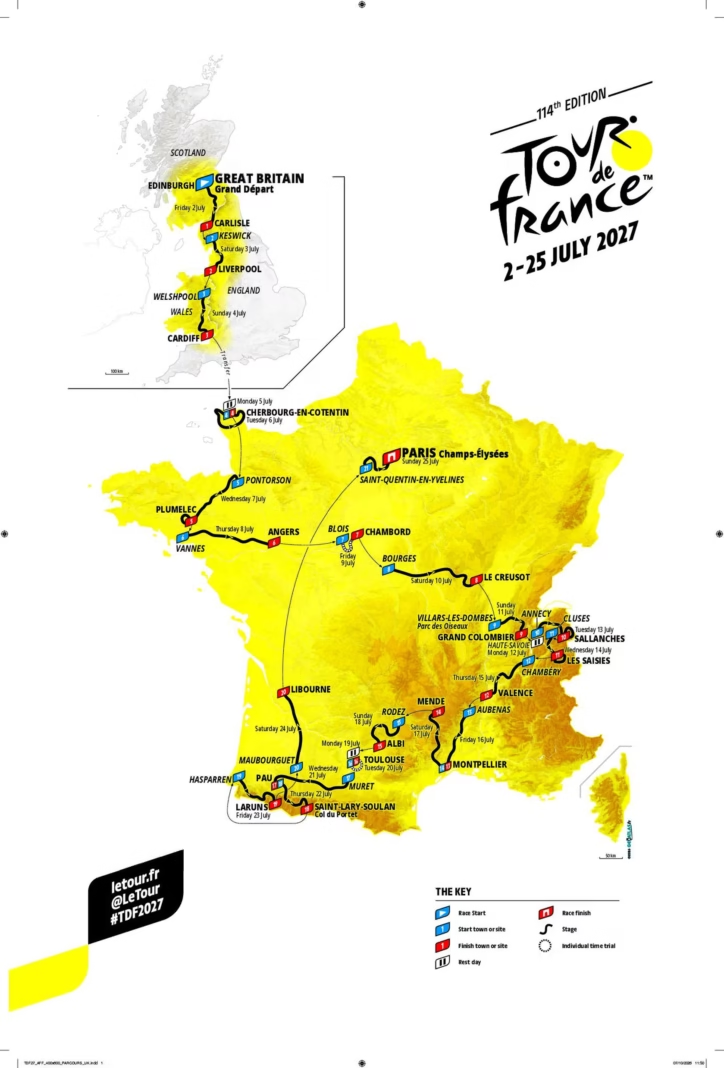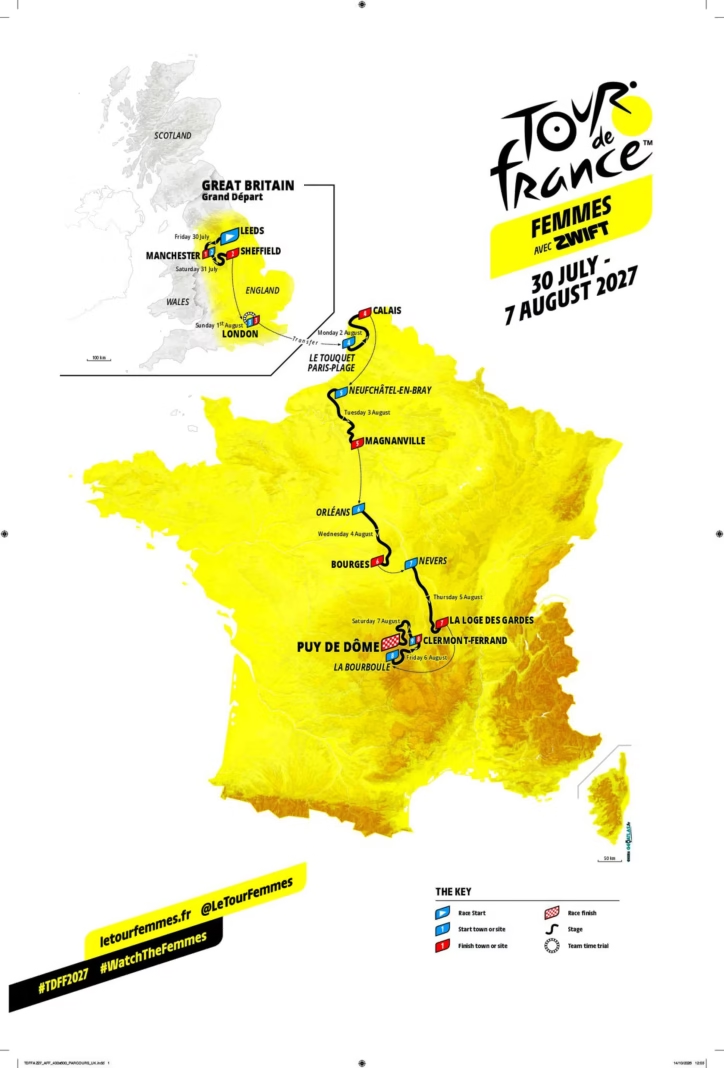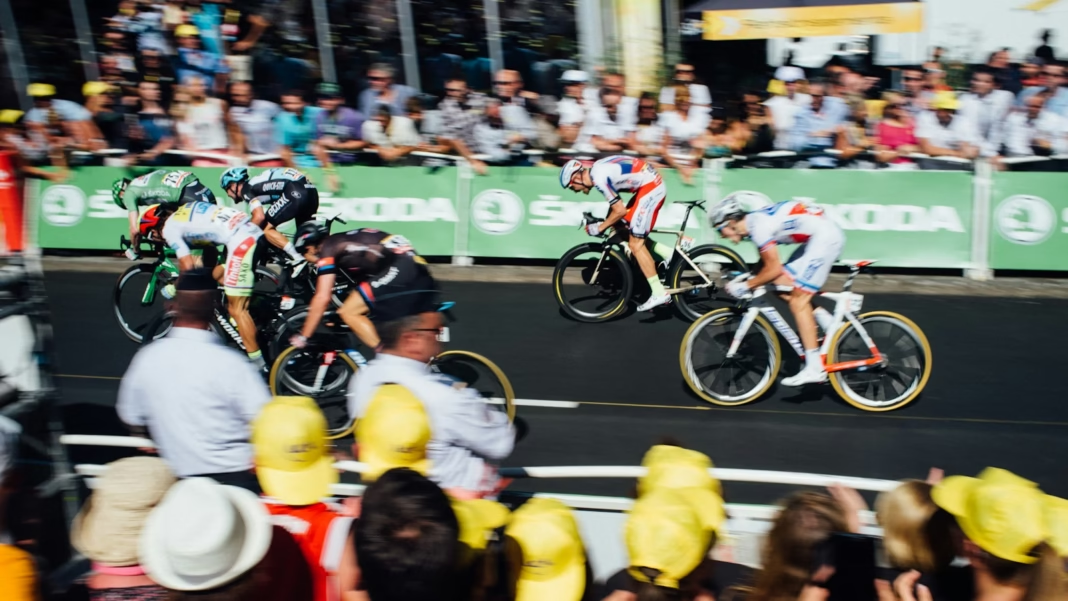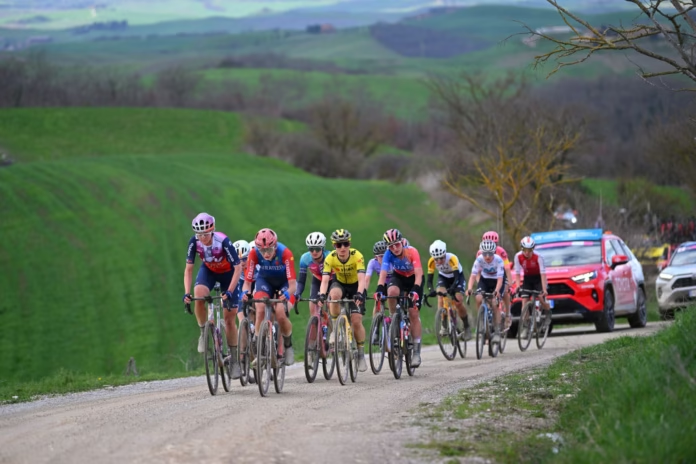
The Women’s WorldTour is no longer a simplified mirror of the men’s peloton. It is its own ecosystem, shaped by a smaller calendar, tighter squads, and a points system that quietly dictates behaviour across the season. For new followers of women’s racing, understanding how it works requires more than knowing the big names or recognising a few iconic races. It means understanding incentives.
At its core, the Women’s WorldTour is a season-long negotiation between ambition and survival. Teams chase victories, but they also chase points. Riders seek results, but they also seek relevance. What you see on the road is often the visible layer of a deeper strategic calculation.
 Photo Credit: A.S.O./Pauline Ballet
What the Women’s WorldTour actually is
The Women’s WorldTour is the top tier of women’s professional road racing, governed by the UCI. It brings together the highest-ranked teams and the most important races on the calendar, spanning one-day classics, multi-day stage races, and the sport’s most visible showcase events.
At its core, the Women’s WorldTour is defined by a relatively small number of races that carry disproportionate competitive and symbolic weight. One-day events such as Strade Bianche Women, the Tour of Flanders Women and Paris-Roubaix Femmes act as early-season reference points. They reveal which teams have recruited well, which riders are already near peak condition, and which squads are still searching for cohesion.
Stage races provide a different lens. Events like Itzulia Women, the Tour de Suisse Women and the Giro d’Italia Women test a team’s ability to manage leadership over several days, protect riders through varied terrain, and adapt tactically as race situations evolve. Performances here tend to carry more long-term significance than isolated one-day results.
The structure of the Women’s WorldTour is more compressed than in men’s racing. There are fewer Women’s WorldTeams, fewer race days, and fewer opportunities to score large points. That compression raises the stakes. A missed opportunity in April cannot always be recovered in September, particularly for teams operating near the bottom of the rankings.
This also means certain races function as pivot points within the season. Strong results at key spring classics or early-stage races can stabilise a team’s campaign, while repeated underperformance at these moments often forces a shift in objectives. Teams may pivot away from wins towards points accumulation, or reassign leadership roles earlier than planned.
For teams, participation comes with obligations. Women’s WorldTeams are expected to race the calendar, even when a race does not suit their strengths. A sprint-focused team must still line up for hilly classics. A GC-oriented squad cannot skip flatter one-day races simply because the terrain is unfavourable. This requirement shapes recruitment, squad depth, and in-race decision-making, rewarding teams that can field adaptable riders rather than narrow specialists.
For new followers, this is a crucial distinction. The Women’s WorldTour is not just a list of races. It is a system where presence matters, adaptability is rewarded, and absence is often punished as much as failure.
 Photo Credit: A.S.O./Thomas Maheux
Understanding the races and their competitive weight
All Women’s WorldTour races award points, but they do not all shape the season in the same way. Some races define hierarchies, others reveal form, and a few act as reference points that quietly influence how teams are judged for months afterwards.
One-day races form the backbone of the spring and early summer. Events such as Strade Bianche Women, the Tour of Flanders Women, Paris-Roubaix Femmes, Amstel Gold Race Women, Flèche Wallonne Féminine and Liège-Bastogne-Liège Femmes tend to establish which riders and teams are capable of handling repeated high-intensity efforts under pressure. These races are rarely about one decisive moment. Instead, they are shaped by positioning, timing, and the ability to respond to multiple accelerations over several hours.
Cobbled races like the Tour of Flanders Women and Paris-Roubaix Femmes place a premium on depth and resilience. Teams that can protect leaders through chaos often outperform squads built around a single standout rider. Hilly classics such as Amstel Gold Race Women and Liège-Bastogne-Liège Femmes reward sustained power and tactical patience, with small groups often deciding the outcome rather than large bunch sprints.
Stage races introduce a different competitive logic. Races such as Itzulia Women, Vuelta a Burgos Feminas, the Tour de Suisse Women and the Giro d’Italia Women combine general classification battles with opportunities for stage hunters and opportunists. Because women’s stage races typically feature fewer high-mountain stages and shorter distances, time gaps are often limited. This reduces the value of conservative riding and encourages repeated attacks.
The Giro d’Italia Women, in particular, remains a benchmark. It is one of the longest and most demanding events on the calendar, and performances there are often used as a shorthand for overall capability. Riders who can compete consistently across its varied terrain tend to be trusted leaders elsewhere.
Not all WorldTour races are designed to select the strongest rider overall. Some, particularly early-season stage races and transitional one-day events, act as form indicators rather than definitive tests. Teams often use these races to experiment with leadership, test new combinations, and give riders responsibility in controlled environments.
For new followers, it is useful to separate races that reveal hierarchy from those that generate opportunity. Both matter, but they matter in different ways. The former shape reputations and expectations. The latter shape points totals and squad confidence.
2026 Women’s WorldTour calendar
- 17–19 January – Women’s Tour Down Under (Australia)
- 31 January – Cadel Evans Great Ocean Road Race – Women (Australia)
- 5–8 February – UAE Tour Women (United Arab Emirates)
- 28 February – Omloop Het Nieuwsblad Women (Belgium)
- 7 March – Strade Bianche Women (Italy)
- 15 March – Trofeo Alfredo Binda – Comune di Cittiglio (Italy)
- 21 March – Milan–San Remo Women (Italy)
- 26 March – The Great Sprint Classic (Belgium)
- 29 March – Gent–Wevelgem Women (Belgium)
- 1 April – Dwars door Vlaanderen Women (Belgium)
- 5 April – Tour of Flanders Women (Belgium)
- 12 April – Paris–Roubaix Femmes (France)
- 19 April – Amstel Gold Race Women (Netherlands)
- 22 April – Flèche Wallonne Féminine (Belgium)
- 26 April – Liège–Bastogne–Liège Femmes (Belgium)
- 3–10 May – La Vuelta Femenina (Spain)
- 15–17 May – Itzulia Women (Spain)
- 21–24 May – Vuelta a Burgos Feminas (Spain)
- 30 May–7 June – Giro d’Italia Women (Italy)
- 13 June – Copenhagen Sprint (Denmark)
- 17–21 June – Tour de Suisse Women (Switzerland)
- 1–9 August – Tour de France Femmes (France)
- 19–23 August – Tour of Britain Women (Great Britain)
- 29 August – Classic Lorient Agglomération (France)
- 4–6 September – Tour de Romandie Féminin (Switzerland)
- 13–15 October – Tour of Chongming Island (China)
- 18 October – Tour of Guangxi Women (China)
The Women’s WorldTour points system explained
The points system underpins almost everything teams do, even when it is not immediately obvious from how races are ridden.
At WorldTour level, points are awarded for placings in races, with the scale weighted heavily towards the biggest events. Major one-day WorldTour races such as Strade Bianche Women, the Tour of Flanders Women, Paris-Roubaix Femmes and Liège-Bastogne-Liège Femmes award points deep into the classifications, and the reward for the very top placings is significant. For teams, these races are not just prestigious, they are efficient opportunities to secure a large points return in a single day.
Stage races carry even greater strategic value. Overall classification at WorldTour stage races delivers the biggest points hauls across multiple days, and it is one of the reasons teams place such emphasis on building a functional GC support structure. A rider finishing on the GC podium at races like the Giro d’Italia Women or the Tour de Suisse Women can transform a team’s points picture in one week.
Individual stage wins also award points, though fewer than GC placings. This creates an important dynamic. A team without a realistic overall contender can still extract value by targeting stages aggressively, especially in races where breakaways are more likely to succeed or where sprint opportunities are limited. Over a season, those smaller gains add up.
To understand how this works in practice, imagine a rider has a strong spring without actually winning. She finishes fifth at Paris-Roubaix Femmes, one of the highest-value one-day races on the calendar, earning 360 points. Later in the season, she rides a solid stage race, finishing tenth overall at the Giro d’Italia Women, which brings in a further 180 points. Across two results that never reach the podium, she has accumulated 540 points. That total is already more than the 500 points awarded to the winner of a standard mid-tier Women’s WorldTour one-day race, and it illustrates why teams place such emphasis on repeatable top tens and steady GC performances.
These points accumulate across the season into three parallel rankings:
- Individual rider rankings, which influence reputation and contract value
- Team rankings, which determine a squad’s competitive standing
- Multi-year licence evaluations, which ultimately decide Women’s WorldTeam security
This last element is crucial. WorldTour licences are assessed over rolling periods, not single seasons. Teams that consistently underperform across that window risk losing their place at the top level, regardless of how ambitious their projects appear. This reality explains much of the defensive racing, calculated risk-taking, and focus on minor placings that can otherwise look puzzling to new followers.
Once understood, the points system becomes one of the clearest lenses through which to read intent. It explains why some teams chase tenth place as hard as others chase victory, and why consistency is often valued as highly as brilliance.
Teams and strategy: why balance beats brilliance
Women’s WorldTour squads are smaller, both in total roster size and in race-day numbers. That makes balance essential.
A team built entirely around one leader is fragile. Injury, illness, or a poorly timed mechanical can unravel months of planning. By contrast, teams with multiple riders capable of scoring points across different race types are more resilient.
Recruitment often reflects this reality. New signings are rarely just about headline talent. Teams look for riders who can:
- Finish races consistently
- Contribute in breakaways
- Support leaders while still scoring when opportunities arise
Contract extensions are equally telling. Retaining riders who understand the team’s tactical approach often signals long-term planning and financial stability. In a sport where resources are unevenly distributed, continuity can be a competitive advantage.
There are 14 teams in the 2026 Women’s WorldTour, with all expected to race every race in the WWT calendar bar one. This is a new rule that forces WWT teams to take part in a great number of the major races, with a financial penalty if they miss more than one race this year.
- AG Insurance-Soudal Team
- Canyon SRAM zondacrypto
- EF Education-Oatly
- FDJ United-Suez
- Fenix-Premier Tech
- Human Powered Health
- Lidl-Trek
- Liv AlUla Jayco
- Movistar Team
- Team Picnic PostNL
- Team SD Worx-Protime
- Team Visma | Lease a Bike
- UAE Team ADQ
- Uno-X Mobility
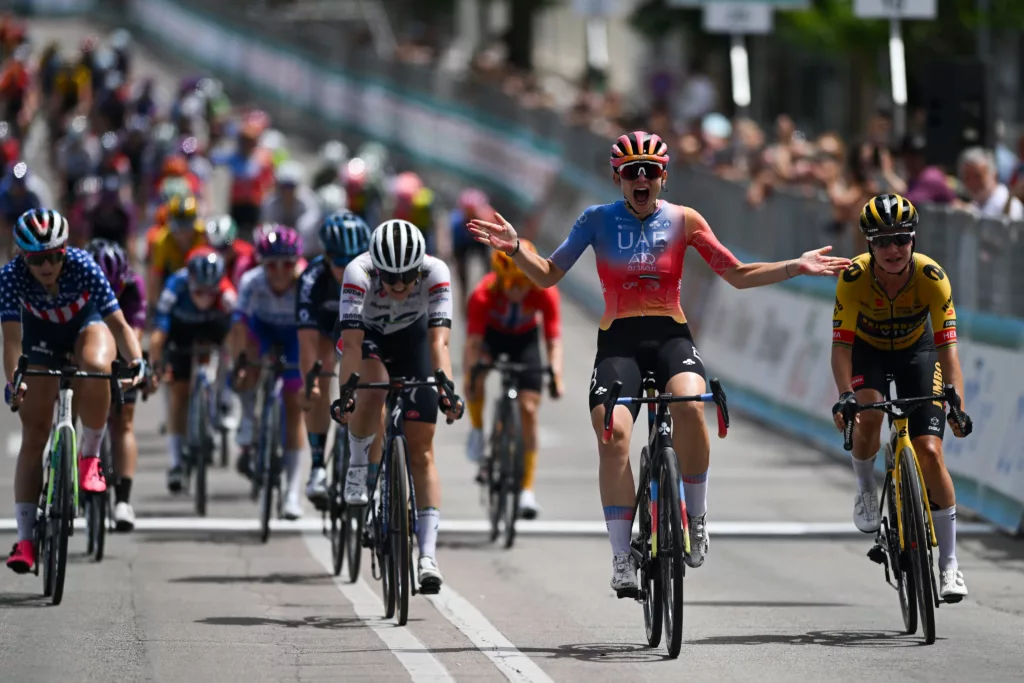
How to read a Women’s WorldTour season
For new followers, the instinct is often to focus on wins. That can be misleading.
A more accurate way to read a season is to watch for patterns rather than isolated results.
First, look at presence in finales. Which teams consistently place riders in the final selection, even if they do not win? Repeated top tens across different race types often indicate strong internal structure.
Second, watch role allocation. Notice which riders are protected, and when that protection shifts. A rider suddenly given freedom in finales is often being tested for a larger role later in the season.
Third, pay attention to defensive riding. Teams riding aggressively to defend eighth or ninth place late in races are often protecting valuable points, not chasing glory. This is especially common among teams near the bottom of the rankings.
Finally, consider calendar choices. Some teams target specific blocks of races where they can realistically score, rather than spreading themselves thin. When a team peaks repeatedly at the same type of event, it is rarely accidental.
Taken together, these patterns reveal far more than a highlights reel ever could.
 Photo Credit: Cor Vos
Where the Women’s WorldTour stands heading into 2026
Heading into 2026, the Women’s WorldTour is defined less by outright dominance and more by competitive depth and strategic clarity. The strongest teams are no longer simply those with the biggest names on the start list, but those that understand how to convert opportunities across the full calendar. Consistency, adaptability, and points awareness now separate the top tier from the rest.
The gap between the best and the middle of the peloton still exists, but it narrows in specific contexts. One-day races with technical courses or aggressive profiles often neutralise raw hierarchy, while stage races with limited time trial kilometres reduce the margin for control. As a result, more teams enter each race believing they can influence the outcome, even if outright victory remains unlikely.
Certain parts of the calendar now act as informal reference points for judging competitive health. The spring classics block remains crucial for establishing form and intent, while early-season stage races often reveal how well teams have integrated new signings and adjusted leadership structures. Later events tend to reward teams that have managed fatigue, injury, and rotation more effectively than those chasing early peaks.
For new audiences, this is an unusually good moment to engage. The racing rewards attention rather than passive viewing. Narratives are rarely decided in a single weekend and instead build through repeated decisions, small gains, and visible learning curves. Riders move between roles, teams adapt objectives mid-season, and success is increasingly measured in sustained influence rather than isolated highlights.
Once you understand how the system works, the unpredictability does not disappear. Instead, it becomes more legible. The apparent chaos of women’s racing often reflects underlying logic, shaped by points pressure, squad depth, and calendar constraints. Recognising those forces makes the sport easier to follow, and more rewarding to watch.