
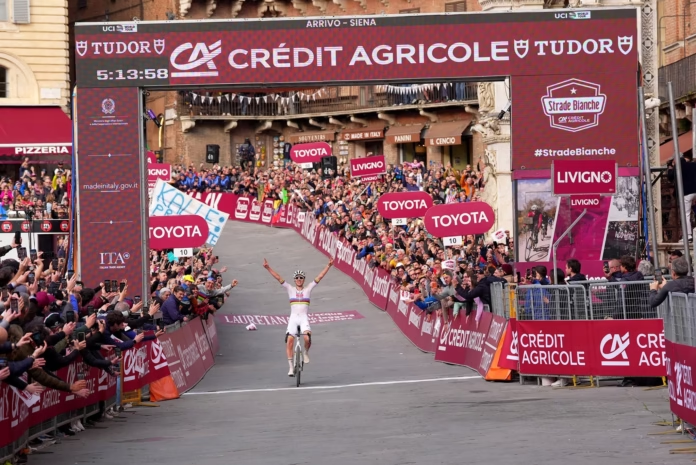
The appointment is set for March 7th, when Strade Bianche and Strade Bianche Women Elite open the Italian UCI WorldTour calendar. The weekend begins on March 6th with the presentation of the men’s and women’s teams inside Siena’s Fortezza Medicea.
RCS Sport unveiled the details in Milan today, framing 2026 as an evolution rather than a reinvention on the changes made to the race in 2025. The organisers are changing the routes for both races, but they are adamant the essence remains untouched: the alternation between gravel and asphalt, the repeated changes of rhythm, and the selective finale that has made Siena’s Piazza del Campo one of the most distinctive finishes in the sport.
Route changes, without changing the race’s identity
Both the men’s and women’s races will feature two fewer gravel sectors than last year’s races. On paper, that can read like a softening, but RCS is clearly pitching the opposite: fewer sectors does not mean fewer stress points. The aim is to preserve the technical identity of the event, keep the spectacle, and still produce a finale that rewards complete riders who can handle both the sterrato and the sharp accelerations that follow.
Giusy Virelli, the project manager for the event, put it plainly: the reduction in sectors “does not compromise the race’s toughness or spectacle”, describing the 2026 courses as demanding routes built for riders who can excel across varied terrain.
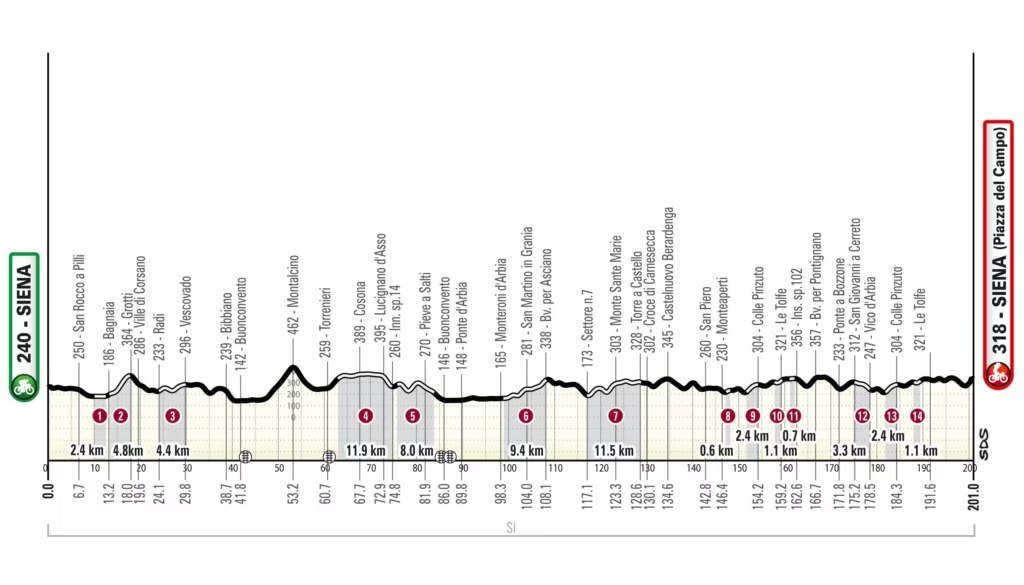
Men’s Strade Bianche 2026: 201 km, 14 sectors, 64.1 km of gravel
The men’s race will cover 201 km, with 14 gravel sectors and 64.1 km on white roads. The course remains twisty and constantly undulating, without long climbs but with a steady supply of punchy efforts, especially on the unpaved sections.
The opening phase leads riders out from Siena and quickly onto the first gravel, a straight sector that introduces the surface but does not yet define the race. Sector two arrives soon after and is presented as the first proper warning: a descent followed by a long climb with ramps over 10%. From there, the route continues to layer difficulty, with sequences of sterrato separated by only short stretches of tarmac.
The middle portion is designed to drain legs rather than deliver one single, decisive climb. Two long sectors in particular are described as hard, hilly and relentlessly punchy, with repeated bends, climbs and descents that make positioning and bike handling as important as pure power. Later, the Crete Senesi provides a long sector that blends rolling terrain with a twisting climb back to paved roads, before the race begins to turn back towards Siena and the final circuit.
One of the defining moments remains the sector highlighted as the hardest of the race, largely uphill and marked by severe slopes near Monte Sante Marie. After that, the course continues to throw short, sharp gravel ramps at riders, including sections that greet them with double-digit gradients even though they are measured in hundreds of metres rather than kilometres.
The final circuit and the decisive run-in
The final part of the men’s race is built around a circuit that repeatedly brings key sectors back into play. The route features climbs where gradients peak at 15% and 18%, turning late-race positioning into a full-body fight. In practical terms, it is the kind of sequence that can reward a solo attacker, punish riders who hesitate, and make domestique support fragile because the decisive moves often come on narrow, steep, dusty roads where one mistake becomes a split.
The closing kilometres into Siena are described as demanding even before the final ramps. With 2 km to go, the gradient rises again, then the stone paving begins inside the city. The steepest pitches reach 16% before the race drops into Piazza del Campo for the finish. It is a finale that has become an identity in itself: short, brutal, and visually iconic, but also tactically unforgiving.
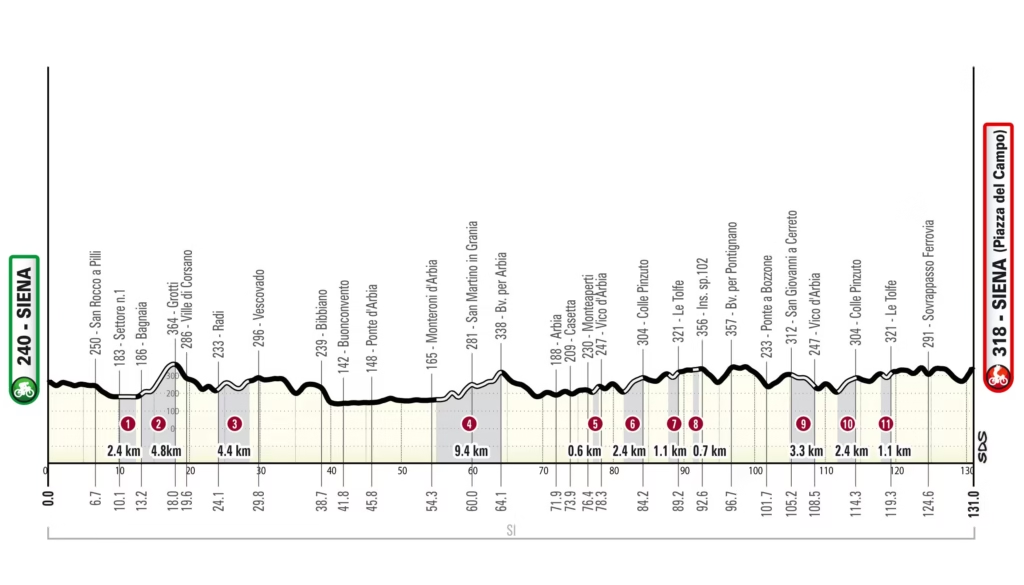
Women’s Strade Bianche 2026: 131 km, 33 km of gravel
The women’s race will be 131 km with 33 km of gravel across 11 sectors, all shared with the men’s route. The character is described in the same way: constantly rolling, no extended climbs, but plenty of sharp efforts where the surface makes every acceleration more expensive.
The course again moves out from Siena and onto early gravel that introduces the race’s rhythm, before sector two delivers the first real test with a descent and then a long climb featuring ramps over 10%. After that, the route threads towards the Crete Senesi for a long sector where the terrain undulates before twisting upwards back to tarmac. A later short sector is flagged as small in distance but big in consequence: a brief gravel ramp that hits riders with double-digit gradients.
The final kilometres for the women are the same as the men’s course, and that matters. It means the same tightening pressure on approach, the same steep paved ramps, and the same requirement to still have a decisive effort left for the stone and gradients of Siena.
The organisers’ message for 2026
RCS and local officials leaned hard into the idea that Strade Bianche is not just a race but a showcase: sporting excellence paired with the landscape, monuments, and atmosphere of Siena and the Crete Senesi. From the organisers’ point of view, the route tweak is an adjustment that keeps the event modern and manageable while protecting what makes it unique: an extremely selective finale that produces memorable winners, and a course that repeatedly forces riders into choices, risks, and decisive moments.
Moreno Moser, still the only Italian winner of the men’s race, captured the essence in his own way: Strade Bianche, he said, brings together all the elements of cycling, and that is precisely why it is so loved by spectators, especially with a finale that funnels riders into an arena like Piazza del Campo.

