
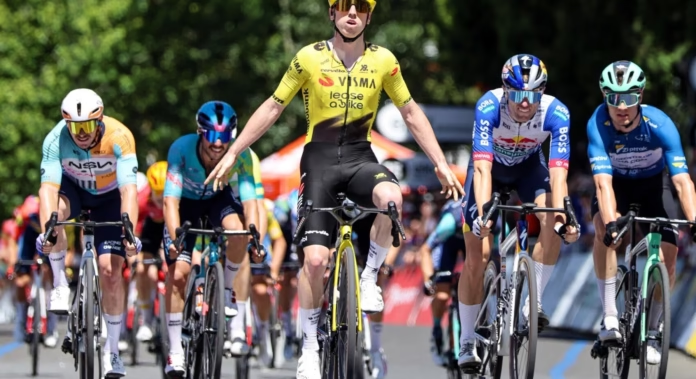
The final stage of the 2026 Men’s Tour Down Under was built to remove the comfort blanket of a single decisive climb. Over 169.8km around Stirling, the peloton faced eight laps of an undulating circuit with four classified ascents and a finishing rise on Mount Barker Road that looked benign on paper but steepened sharply in the final pitches.
It ended with two outcomes that had felt increasingly plausible as the week unravelled. Jay Vine held on to win the race overall for the second time in his career after surviving a crash, a bike problem, and a finale that never settled. Matthew Brennan won the stage for Visma-Lease a Bike after a late break nearly stayed away, and a chaotic lead-in forced the fast men to make decisions on the fly rather than follow a perfect train.
A circuit designed for chaos delivers it from the start
The instruction from the cars was simple, and it shaped the opening hour: do not miss the break. Attacks came in layers from the moment the flag dropped, with short-lived moves shut down as teams hunted a combination that could survive on repeated climbs and still matter for the intermediate seconds.
The eventual move that stuck started as a trio and then morphed into something more useful. Robert Stannard, Luke Plapp and Pascal Eenkhoorn created the first clear gap, and once Pavel Novák bridged across, it became a four that made sense for different reasons. Plapp was there to animate on home roads, Stannard to represent Bahrain’s late options, Eenkhoorn to take seconds and force others to chase, and Novák to turn EF’s and others’ GC positions into something they had to defend rather than simply hold.
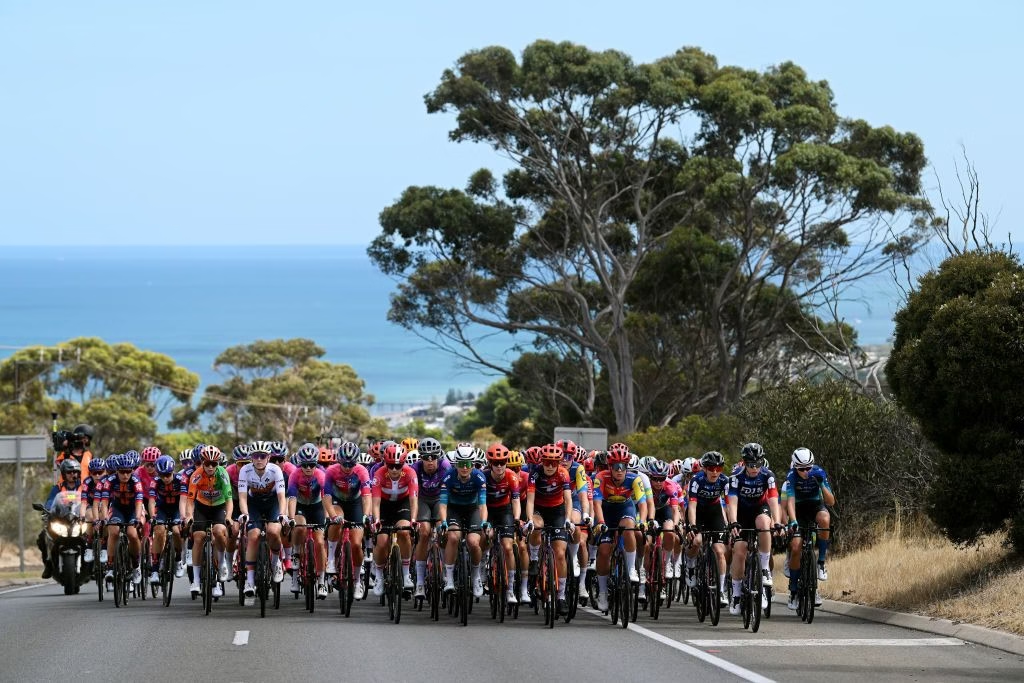 Photo Credit: Getty
The break gathers seconds and forces the GC teams to show their hands
Eenkhoorn’s approach to the intermediate sprints was not subtle. He rolled through first more than once to collect bonus seconds, an important detail because the gaps behind Vine were tight enough that even small swings could change the podium fight.
Behind, the chase was never the work of one team. UAE Team Emirates-XRG used Sebastian Molano as the metronome early, with Visma hovering behind in anticipation of a sprint they wanted to win, and EF adding manpower to protect Harry Sweeny’s position on the podium. Jayco had reason to keep the race honest too, with Mauro Schmid sitting second overall and vulnerable to any late reshuffle.
A kangaroo, a crash, and Vine suddenly isolated
The race’s turning point arrived in the most Australian way possible. A kangaroo ran into the road mid-stage, causing a significant crash. Vine went down and had to remount in a moment when the peloton was already strung out and the circuit offered little space to recover calmly.
The consequences were immediate and practical. Vine needed a bike, briefly riding on a teammate’s machine before getting back onto his own after another swap. More importantly, it reduced UAE’s already dwindling resources. He was left with fewer teammates to shepherd him through the remaining laps, and every acceleration over Stirling suddenly carried a sharper risk.
Vine later summed it up with a line that captured both the absurdity and the danger: “Everyone asks me, what’s the most dangerous thing in Australia? And I always tell them, it’s kangaroos.”
EF and Visma take control for different reasons
As the circuit ate into the break’s advantage, the chase became more structured. EF and Visma took longer turns at the front, not out of shared ambition but shared necessity. EF needed the stage to be hard enough that Sweeny’s podium was defended through effort rather than luck, while Visma needed the gap manageable to keep Brennan in play for a sprint that would still be selective.
That meant the race never drifted into a neutralised holding pattern. The tempo rose and fell, but it never dropped enough for the leaders to relax. Each lap ended with the Stirling climb, and each time the bunch hit that ramp the field stretched, snapped, and re-formed with slightly fewer riders feeling comfortable.
The final lap attacks and the move that almost stole the stage
The decisive attacking phase began as the race entered the eighth and final lap. A scramble of moves went clear and regrouped in front, with riders jumping across in ones and twos as the peloton hesitated for a split second too long.
The most dangerous version of it became a four, then quickly a more cohesive trio. With around 17km to go, a group containing Pablo Cepeda, Santiago Buitrago and Gal Glivar had real daylight. Iván Romo was involved initially, and the threat was not just the stage. Romo’s presence also pressured the battle behind Vine, because he sat close enough on GC to make teams chase for more than a sprint.
UAE moved into a defensive posture with what they had left. Ivo Oliveira and Adam Yates were used as buffers around Vine, not to control the race in the old sense, but to keep him positioned and calm as the front group dangled at 20 to 30 seconds and the peloton searched for a clear responsibility.
Vine’s last kilometres are about survival, not control
Inside the final five kilometres, the stage compressed into pure positioning stress. Vine was briefly left on his own when Yates went down late, stripping UAE of the last layer of protection at the worst possible time.
That moment mattered because it changed what Vine could do. He could not follow every wheel and still sprint. He had to pick the safe lanes, stay upright, and trust that the chase behind the break would complete the job without him taking unnecessary risks.
The fact he emerged intact was the final proof of his race management. The time gaps were small enough that a bad moment could have cost him the jersey, but he finished the week still in control of what mattered.
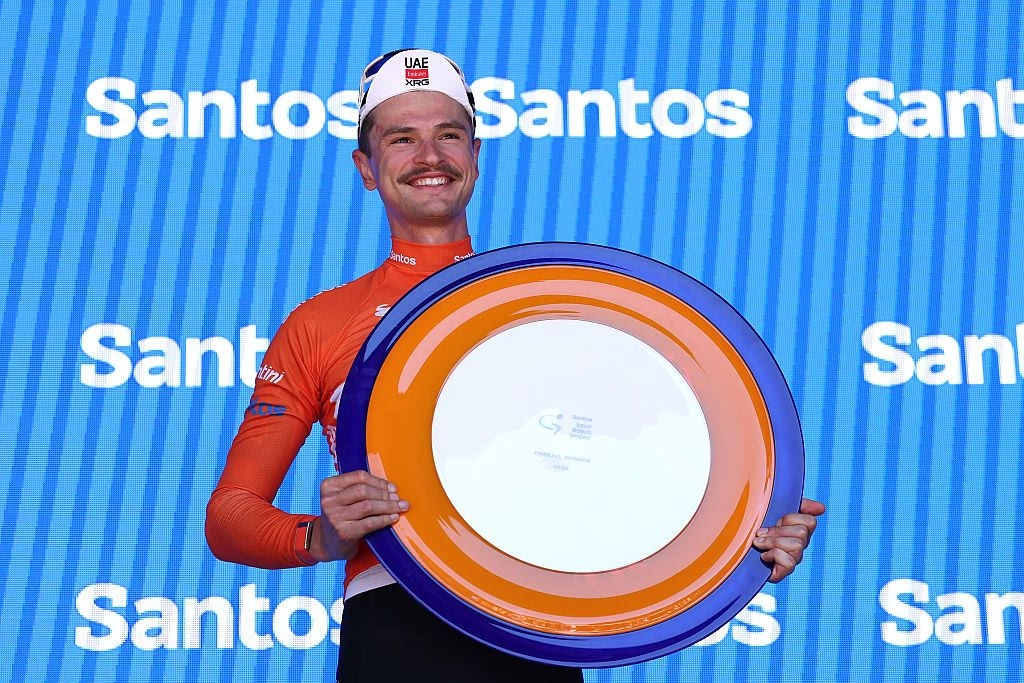 Photo Credit: Getty
Brennan times it right when the sprint finally opens
The late break was caught inside the final kilometre, but not early enough for an orderly run-in. Teams arrived at the flamme rouge with riders scattered, some after long turns in the chase, others after being forced to burn matches just holding position on the climbs.
Visma-Lease a Bike found the shape they had been missing earlier in the week. Brennan held his nerve, stayed close enough to the front to avoid being swarmed, and launched at the right moment on a finish that rewarded timing more than pure top speed. He later admitted the finale was not ideal, referencing the chaos and the loss of a key organiser after the kangaroo incident, but also made the key point: they adjusted, and this time the timing was right.
Finn Fisher-Black followed for second on the stage, with Tobias Lund Andresen third, but the day belonged to Brennan’s precision and Vine’s resilience. Vine called it “never over till it’s over” racing, and over five stages and a prologue, he had lived that reality more than once.
2026 Men’s Tour Down Under Stage 5 result
Results powered by FirstCycling.com
2026 Men’s Tour Down Under GC result
Results powered by FirstCycling.com
Main photo credit: Cor Vos

