
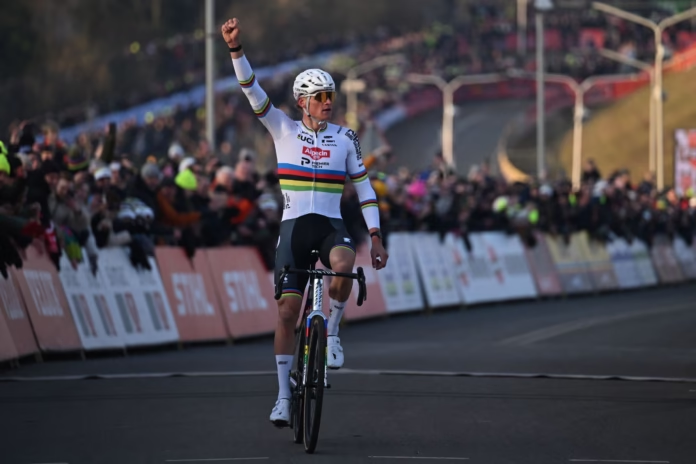
Hoogerheide closed the World Cup season on a course that rarely gives anyone time to think: fast, technical, and strung together by an uphill asphalt finish that punishes hesitation. With the World Championships in Hulst a week away, the final round became as much a rehearsal in decision-making as it was a test of legs.
Mathieu van der Poel dominated to win solo in the men’s race, but the defining drama unfolded behind him. Thibau Nys read the sprint for second correctly until the final metre, sat up fractionally on the rise, and watched Tibor Del Grosso and Niels Vandeputte come over the top to turn his lead-out into fourth. In the women’s race, Puck Pieterse confirmed her timing ahead of Worlds by backing up her Maasmechelen victory with another win, again turning a cagey race into a final-lap statement.
Nys gambles on the last lap, then pays for one moment of release
Nys’ frustration made sense because the mistake was not tactical in the broader sense. He had placed himself where he needed to be in the chase group, survived the repeated changes of tempo, and arrived at the finish with the speed to be on the podium. The error was smaller and, in a way, more painful: he stopped sprinting before the line.
“There wasn’t really a plan; it was so fast that I had to gamble for the last lap,” Nys said afterwards, framing the finale as a calculation rather than a simple drag race. He also suggested he had the best legs in the group behind Van der Poel, but acknowledged how little that matters if you do not convert it. “I had the feeling that I was the strongest behind Mathieu, but that doesn’t buy you anything.”
When Vandeputte came past in the last metres, Nys did not reach for excuses. “It was my own fault, I had to sprint until the line. I thought I had it, but he came with a lot of speed. There is no excuse for that.”
Why the uphill finish flipped the order of the sprint
The Hoogerheide finish looks straightforward until you race it. The run-in is fast, the final corner encourages an early launch, and then the tarmac rises just enough to punish anyone who peaks too soon or relaxes for a breath.
Nys described it as an “annoying sprint to start from the front”, and his logic was sound. The riders behind can time their acceleration later, carry more speed into the slope, and use the leader as a reference. Del Grosso and Vandeputte did exactly that, waiting for the moment Nys committed, then bringing momentum past him when the gradient magnified every small drop in cadence.
Vandeputte’s explanation was essentially the same, delivered from the other side of the result. He said he started the sprint a few metres back and simply committed to riding through the line because the uphill drag makes it “easy to lose a few metres once you stop pedalling”. That was the race in one sentence.
Alpecin-Premier Tech turn the chasing group into their podium, again
Van der Poel’s win was never in doubt once he had daylight. The bigger story, tactically, was how Alpecin-Premier Tech controlled the secondary battle without ever needing to ride it like a conventional lead-out.
Del Grosso and Vandeputte did not need to take responsibility early. They only needed to arrive with enough composure to sprint, because they knew Nys would be forced into the hardest role: launching from the front when the finish invites late speed.
Del Grosso, who has made an impressively quick transition into the elite category, called it a “really tricky one to start from the front” and admitted it was tighter than Maasmechelen the day before. The detail that matters is that he did not frame it as a surprise. It sounded rehearsed, which is exactly what a strong team looks like in a sprint for second place.
The women’s race: Pieterse completes the perfect weekend as Zemanová confirms her rise
On the women’s side, Pieterse confirmed that her Maasmechelen win was not an isolated spike. Hoogerheide demanded patience early and precision late, and she delivered both before detonating the race on the final lap to take back-to-back World Cup victories.
The shape of the race mattered. A large front group traded turns and short accelerations across the middle laps, with riders testing each other rather than committing to a long move on a circuit that rewards speed through corners as much as power on climbs. Pieterse repeatedly positioned herself near the front in the sections where flow matters, then waited for the moment when rivals were most likely to hesitate.
Kristýna Zemanová’s second place was the clearest sign that the race was not won by reputation alone. She followed the key phases, survived the decisive attacks, and still had enough left to defend the podium when the selection broke apart. She said she did not feel good during the race and was surprised to finish second, which only underlined how well she managed the final lap when the elastic snapped.
Lucinda Brand’s absence, due to calf pain, shaped the context without changing the day’s winner. She still had the overall wrapped up, but Hoogerheide removed a key reference point from the race and left the final pre-Worlds picture looking more open behind Pieterse’s current form.
2026 Men’s UCI Cyclo-cross World Cup Hoogerheide result
Results powered by FirstCycling.com
2026 Women’s UCI Cyclo-cross World Cup Hoogerheide result
Results powered by FirstCycling.com

