The UCI has launched a formal call for expressions of interest aimed at accelerating the development of protective equipment for riders, with a particular focus on airbag systems and technical apparel that could reduce injury severity in crashes.
The initiative was agreed at the UCI Management Committee meeting held on 29 and 30 January in Beveren, Belgium, and sits within a broader package of safety measures being pushed through the SafeR framework, the body responsible for safety in men’s and women’s road cycling. In practical terms, the UCI is trying to move cycling’s safety conversation from ad hoc innovation towards something closer to a shared industrial standard: clear rules, testable performance targets, and equipment that can be integrated into racing without creating new risks or competitive distortions.
The deadline for interested manufacturers and research institutes to respond is 15 March 2026. The UCI says working groups will follow during 2026, bringing together respondents and independent experts.
What the UCI is actually asking for
This is not a product launch, nor a commitment that airbags will appear in racing tomorrow. It is a structured attempt to broaden the pool of companies involved and to define what “good” looks like before teams and riders begin adopting systems that may differ wildly in performance, reliability, trigger logic and integration.
The UCI frames the call around two linked areas.
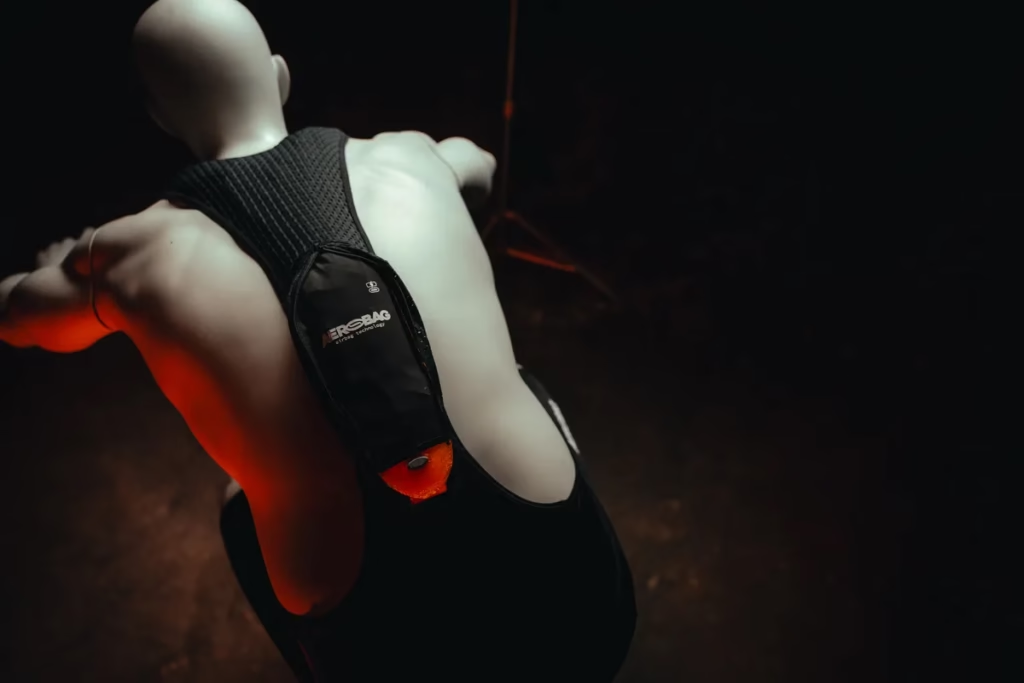
First, airbag systems themselves. The stated aim is to define a clear framework and appropriate standards so devices can be developed and integrated into cycling, in both competition and training. That wording matters because cycling’s risk profile is not confined to race day. Riders crash in training, and some of the worst injuries happen away from television cameras.
Second, technical apparel. The UCI wants to explore how airbag solutions might be integrated into clothing and how textiles could offer stronger protection in their own right. In other words, this is as much about how equipment is worn as what the equipment does.
Why this is complicated in cycling
Airbag vests are not new in sport, but cycling presents a distinct set of problems that makes “copy and paste” from other disciplines unrealistic.
A crash in road racing can be a high-speed slide, a direct impact into street furniture, a pile-up, or a slow-speed topple that still results in a collarbone fracture. A useful system has to protect against a wide range of scenarios without false deployments that could cause harm, distraction, or tactical chaos. It also has to function across different rider positions and bike handling demands, and cope with rain, heat, sweat, and repeated impacts over long race days.
Then there is the question of integration. Road cycling is not a single discipline with one set of movements. Sprinting, descending, climbing out of the saddle, time trialling, riding in a bunch at high density, and off-road disciplines all stress equipment differently. That is why the UCI explicitly talks about assessing the relevance of this equipment across disciplines and building standards that make sense for competitive cycling rather than a generic “safety garment” standard.
Finally, there is the industrial reality. Teams, riders and sponsors will only adopt kit that is serviceable, reliable, and practical. If maintenance is too complex, if battery life is fragile, if fit compromises performance, or if the equipment introduces heat stress, uptake will be limited no matter how good the concept looks in isolation.
What happens next and what the UCI wants to deliver
The UCI’s stated goal is to bring the relevant parties into one process so the sport does not drift into a fragmented market where multiple systems exist but no one can clearly compare them.
The work programme described by the UCI points towards three outcomes.
A standards-led regulatory framework that defines what is allowed and what is required if airbags and integrated protective clothing move into the sport.
A coherent development pathway that matches what riders and teams actually need, rather than what looks impressive in a lab.
A consultation process during 2026 through topic-specific working groups, involving respondents to the call and independent experts.
The UCI is careful with its language here, but the direction is clear: create the basis for rules that can be applied consistently, rather than leaving organisers, teams and commissaires to improvise as new products appear.
How this fits into the wider 2026 safety push
The airbag initiative has been presented alongside a much broader safety update, which helps explain the UCI’s wider strategy. Rather than relying on a single headline change, the organisation is pushing multiple smaller interventions that aim to change behaviour, improve course preparation, and tighten technical standards.
One of the clearest indicators is the yellow card system, now a year into full rollout. The UCI’s own assessment for 2025 notes 270 yellow cards issued, with 42 per cent going to riders and the remainder involving team staff, vehicle drivers and motorcycle riders linked to organisation and media. More than 90 per cent of individuals received only one yellow card, which the UCI frames as evidence that the system improves behaviour by discouraging repeat offences. Three suspensions were imposed during 2025, two involving media representatives and one involving a rider.
The UCI also signals a tougher, more standardised approach to how races are built and managed. Standardised signage guidelines for courses and dangerous points are set to be incorporated into organisers’ specifications, with the intention of application from 2027 onwards. Guidelines for protective measures in critical course areas are also set to be added.
There is also a staffing angle: former professional sprinters are set to assist commissaires in assessing delicate sprint situations, a move that tacitly acknowledges how difficult it is to judge fast, crowded finishes without specialist perspective.
Alongside that behavioural and organisational work, the UCI is pointing to research and engineering projects designed to underpin future standards. These include a barriers study entering its final phase, a collaboration with Politecnico di Milano on wheel and tyre detachment and rim-tyre combinations, and a crash dynamics and aerodynamics study led by Heriot-Watt University in Edinburgh, supported by Ansys, tied to a PhD project focused on numerical simulations for improved rider safety.
Even equipment rules outside road racing have been touched, with the UCI noting a decision to add the 200m time trial in track cycling to the list of events where time trial helmets are authorised, following a request from the majority of nations at the 2025 Track World Championships.
What this could mean for teams and riders
The airbag call is best understood as the start of a process rather than a finished policy. The UCI is signalling that it wants to prevent a situation where safety technology enters the peloton through uneven adoption and unclear performance, leaving riders unsure what protection they are actually getting and regulators unsure what they should be approving.
If the working groups produce credible, testable standards and a workable regulatory pathway, the long-term outcome could be straightforward: equipment that becomes normal rather than novel, adopted because it is reliable and clearly defined, not because it is fashionable. If the process produces standards that are too rigid, too expensive, or too detached from how riders actually race, it risks stalling.
Either way, the UCI has planted a flag for 2026: safety is being treated as a system, not a single fix. Airbags and protective apparel are now part of that system, and the next few months will determine whether the sport can turn a promising concept into something that works in the messy reality of racing.