Opening Weekend did not need easing in. Omloop Het Nieuwsblad Women delivered the full dose of wet roads, crosswinds, cobbles and late-race panic that makes this race a genuine marker for who is ready to suffer, and who can still make decisions when the legs and the brain are both screaming.
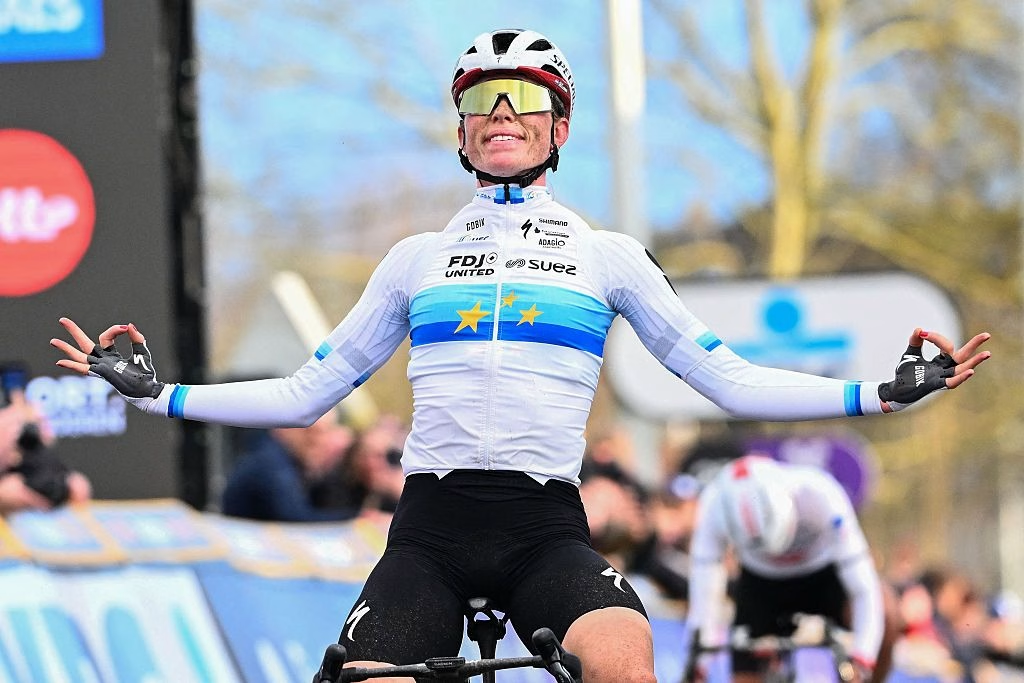
This time, the favourites did not repeat last year’s mistake of giving the break too much freedom. The early move was kept on a tight leash, the pace was high, and the race was already stretched before the final 60 kilometres began. The decisive difference came when FDJ United-SUEZ built a multi-layer plan and executed it cleanly. Elise Chabbey went forward to shape the finale, Franziska Koch delivered a crushing lead-out on the Muur van Geraardsbergen, and Demi Vollering used the perfect launchpad to go clear with Kasia Niewiadoma-Phinney. From there, it became a straight fight to Ninove, where Vollering sprinted from the front and finally added Omloop Het Nieuwsblad to her palmares.
“It feels good, it was really nice to finish it off here today. I thought that I would do it, but still to do it makes me proud,” Vollering said afterwards. “On the Muur, it was the plan to do full gas. In the end, we were a bit stuck, but then Franzi came from the back and she did the first part of the Muur perfectly.”
A fast start, an early break, and the peloton refusing to gift another shock result
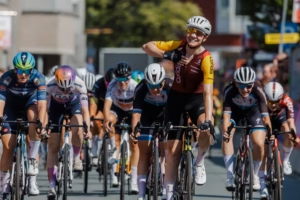
From the moment the flag dropped, the pace reflected the memory of 2025. Attacks came immediately and the race quickly formed its first clear shape with a four-rider breakaway: Lea Lin Teutenberg, Britt de Grave, Jony van den Eijnden and Emilie Fortin. They were given room, but not comfort. The gap rose, yet it never felt like the kind of freedom that invites complacency, because the bunch behind kept the effort steady and the distance manageable.
That mattered for the whole narrative of the day. When you keep a break within touching distance, you keep the race in a state of readiness. Nobody is allowed to drift, nobody gets to save too much, and the teams with ambitions are forced to show themselves early, even if only through positioning and presence.
 Photo Credit: Getty
The final 60 kilometres, cobbles and climbs that grind the field into smaller, sharper groups
The race changes character once the cobbled sectors and the short climbs arrive in rapid succession. Lange Munte is the first shock to the system, then the sequence tightens: Holleweg, Kerkgate, Jagerij, Haaghoek, and then the run of climbs that always decides Omloop, including the Molenberg, Berendries, Tenbosse, the Parikeberg, and the Muur and Bosberg pairing that sits over the finale like a guillotine.
By the time the race reached the point where last year’s outcome was shaped, the peloton was already thinner and more nervous. The break began to fracture under pressure, the gap was shrinking, and the race was starting to look for its second story, the one that forms when strong riders anticipate rather than wait.
Chabbey lights the fuse and four riders form the move that forces everyone to react
With the first break finally being reeled in, the moment of real tactical intent arrived. Elise Chabbey attacked and a quartet formed that immediately looked more dangerous than the early move: Eleonora Gasparrini, Kamilla Aasebø, Nina Berton and Chabbey herself. It was the kind of combination that makes teams uncomfortable because it has engines, it has riders who can handle the cobbles, and it has enough representation across teams to complicate the chase.
The group’s advantage hovered around a minute as the race moved deeper into the run-in to Geraardsbergen. Behind, teams like SD Worx-Protime and AG Insurance-Soudal had to contribute to the control because a lead of that size, so close to the Muur, is not something you can calmly allow to roll.
Berton’s ride stood out because it was more than just getting in the move. She followed Chabbey’s acceleration, committed to the effort, and then still had enough to hold on when the race became brutal behind. Ninth place from that kind of day is the sort of result that hints at a rider’s next step, not just a one-off.
 Photo Credit: Getty
The crash before the Muur and the bad luck that removes Kopecky from the decisive moment
As the peloton closed in on the Muur, the tension finally snapped. A large crash in the run-in took down a sizeable part of the bunch and split the race at the worst possible time, when positioning is everything and recovery is almost impossible. The wet roads amplified the chaos, one touch of wheels becoming a chain reaction.
Most of the main favourites were ahead of it, but not everyone got a clean exit. Zoe Bäckstedt and Chiara Consonni were among the most notable riders caught in the fallout, and the incident also reshaped SD Worx-Protime’s day. Lotte Kopecky, one of the expected centrepieces of the finale, suffered a damaged bike and lost her chance to match the winning move. In a race where the Muur is the gate to the finish, that kind of bad luck is not a small detail, it is the story ending.
Koch’s lead-out, Vollering’s attack, and Niewiadoma-Phinney as the only rider who can go with it
FDJ United-SUEZ did not wait for the Muur to decide itself. As the race hit the Vesten and dropped towards the cobbles, Franziska Koch came from the back and hit the front with a full commitment effort. It was not just fast, it was violent, the kind of pace that forces everyone to either be in position already or lose the race in seconds.
Vollering launched from that platform and immediately created separation. The late break was swallowed, the front of the race compressed into a handful of riders, and then the crucial detail emerged: only Kasia Niewiadoma-Phinney could follow. The rest were left to regroup, reorganise, and chase, but by then the race had already become a two-up duel between two riders who understand exactly how to win from this kind of terrain.
From the top of the Muur to the Bosberg, and then out towards Ninove, Vollering and Niewiadoma-Phinney worked hard enough to keep the gap stable, but not so hard that either could turn the final kilometres into a solo. Behind, Anna van der Breggen drove the chase for SD Worx-Protime, trying to bring the leaders back for Lorena Wiebes, and in the tailwind run-in it kept the pressure on. But the gap never truly collapsed.
Ninove, the subtle battle inside the break, and Vollering finishing it the hard way
As the line approached, the dynamic was clear. Niewiadoma-Phinney needed the break to survive because a regroup would have handed Vollering extra options through her teammates behind. Vollering’s position was calmer because FDJ United-SUEZ had numbers in the chase group and could have played the race again if required.
There was a moment of conversation between the two leaders inside the final kilometres, the kind of brief exchange that happens when riders are both calculating and suffering. Niewiadoma-Phinney stayed on the wheel when Vollering flicked the elbow, then the sprint became inevitable. Vollering went first and committed, choosing the long, slightly rising drag to the line to turn it into a power effort rather than a pure jump.
She did not crack. Niewiadoma-Phinney could not come around, and Vollering finally had her Omloop win.
“It’s really nice to finish it off here today,” she said. “The team did an amazing job all day. Elise was in the leading group, and Franzi did a perfect lead-out for the Muur for me. She rode so hard I felt like I hardly had to do anything.”
Behind them, Wiebes won the sprint for third from the chasing group. Cat Ferguson’s fourth place, in her first Omloop Het Nieuwsblad, was another sign of how quickly she is adapting to this level of racing. And for FDJ United-SUEZ, the deeper story was the collective, Chabbey animating the tactical plan, Koch delivering the decisive work, and multiple riders backing up the win with strong placings.
2026 Omloop Het Nieuwsblad Women result
Results powered by FirstCycling.com
Main photo credit: Getty