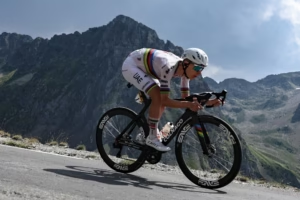
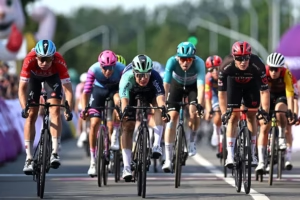
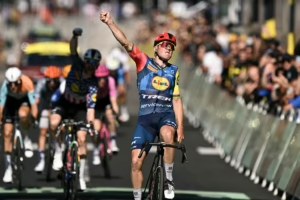
Omloop van het Hageland has a very specific way of making riders look uncomfortable. Not because there is one giant climb or one famous cobbled berg that decides everything, but because the whole day is built around friction. Narrow concrete lanes, constant corners, short ramps that force repeated accelerations, and cobbles placed just close enough to the finish to keep everyone nervous.
That mix is why the race has grown from a local Hageland event into a reliable early-season test for the strongest one-day riders in the women’s peloton. In 2026, the course leans even harder into the region. It is 141.8 km from Aarschot to Tielt-Winge, with a new passage through Scherpenheuvel-Zichem and its basilica, then the familiar late pressure points on Roeselberg and the cobbled Kerkstraat.
The most important thing for fans is this: it is a race that rarely “settles”. Even when the bunch is together, it feels like it is one mistake away from splitting.
Where to watch Omloop van het Hageland 2026 live
You can watch Omloop van het Hageland live online and free via Proximus with no geo-blocks.
Official live stream (web only):
https://cycling.pickx.be/nl/
Live coverage times (UK)
| Coverage | Time (GMT) |
|---|---|
| Live starts | 2:00pm |
| Live ends | 5:15pm |
What kind of race is Omloop van het Hageland?
This is not a pure cobbles race in the Tour of Flanders mould, and it is not a clean sprint race either. It sits in the middle, which is exactly why it produces such varied winners.
The terrain forces constant effort rather than one decisive climb. Riders are repeatedly asked to accelerate out of corners, surge over short ramps, then fight for position again before the next pinch point. That pattern is brutal on legs and even worse on team organisation.
If you are a general fan tuning in for the first time, here is the best way to read the race:
- If teams keep control and keep numbers, you often get a reduced sprint.
- If one or two teams commit to pressure on the key sectors, it can finish from a small group.
- If everyone hesitates and one rider hits the right moment, a long solo is always possible.
Which riders might win the 2026 Omloop van het Hageland?
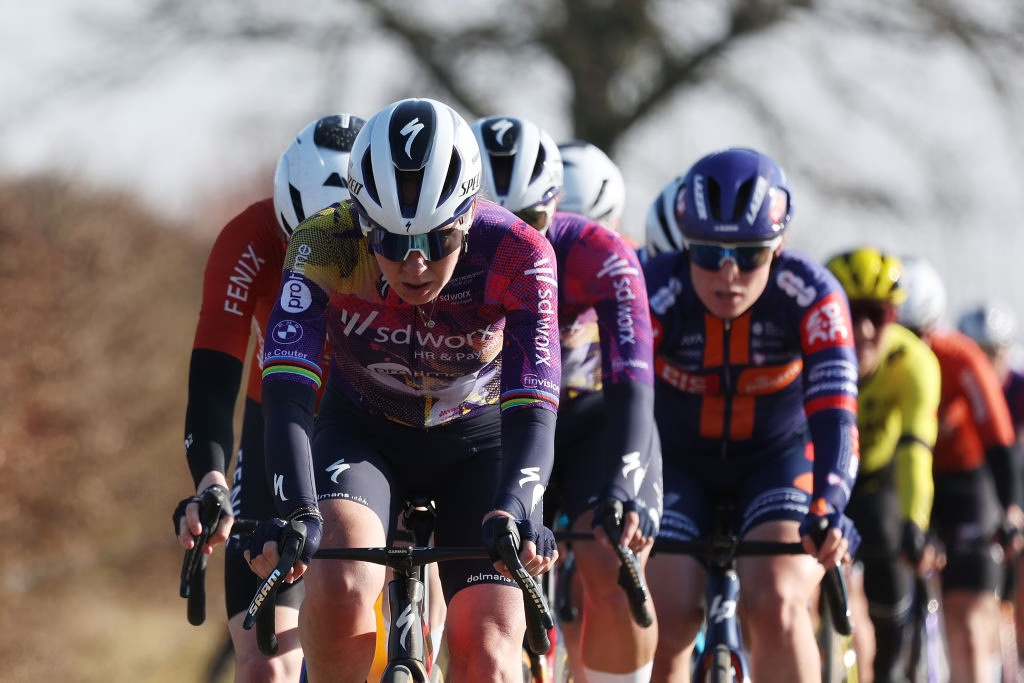
Team SD Worx-Protime look built to decide how hard the race is. Femke Gerritse returns as defending winner, and she is exactly the kind of rider who benefits when the finale becomes selective rather than controlled. The big difference this year is the depth behind her. Anna van der Breggen brings the sort of calm authority that can make the final circuits feel like a long squeeze, and if she rides aggressively over Roeselberg and Kerkstraat it can strip away a lot of pure sprinters. Marta Lach is another strong card for a reduced sprint or a late move, while Elena Cecchini is the kind of road captain who keeps a team at the front when positioning becomes the race within the race.
If the finish comes down to speed after repeated pressure, Elisa Balsamo is the most obvious pure finisher in the startlist. Lidl-Trek can also play the race in more than one way, and that matters here. Shirin van Anrooij gives them a serious option to force selections on the key sectors, while Anna Henderson is the rider who can surf the chaos and still be there when the race splits, especially if it turns into a small group rather than a clean sprint. Loes Adegeest is another name to keep in mind if the day becomes attritional and the sprint field shrinks.
Charlotte Kool is the clearest “if it is a reduced sprint, she can win” rider on the sheet. What makes her particularly interesting at Hageland is that the sprint is rarely textbook, and her best route to victory often comes from surviving a messy final hour with enough team-mates left to deliver her into position. Fenix-Premier Tech have useful support for that scenario too, with Christina Schweinberger a strong classics engine who can help keep Kool in the right place and still threaten a result if the sprint plans break.
Lara Gillespie has already shown she can thrive when this race turns selective, and that combination of durability and finishing speed is exactly what Hageland asks for. UAE Team ADQ also have multiple riders who fit the “survive and race” profile. Karlijn Swinkels can cope with repeated ramps, Sofie van Rooijen is well suited to reduced-group finales, and Elynor Backstedt gives them a rider who can make the race hard rather than wait for it.
The dangerous outsiders who fit Hageland perfectly
Cofidis have a genuinely interesting mix for this parcours. Amalie Dideriksen is a proven finisher when the sprint comes from a smaller, tired group, and she is often at her best when the approach is chaotic and positioning is everything. Valentine Fortin is another rider who can handle a hard one-day race and still finish strongly. Martina Alzini gives them a punchy option if the race breaks into a small group and the sprint is more about legs than lead-outs.
Alison Jackson is a rider you never ignore on this kind of day. She reads the chaos well, and Hageland often rewards that instinct. If the strongest teams start looking at each other late, she is exactly the kind of rider who can slip into the move that sticks, then make the sprint awkward.
Arianna Fidanza is a name to watch if the day ends in a reduced sprint rather than a full bunch finish. This race is often won by riders who can handle repeated accelerations and still produce a clean kick, and she fits that brief well if she arrives in the front group.
 Photo Credit: Cor Vos
Route profile and the sectors that matter most
The route is designed to stack fatigue. It is longer in 2026, and the repeated circuit structure means the peloton sees the same danger points again and again.
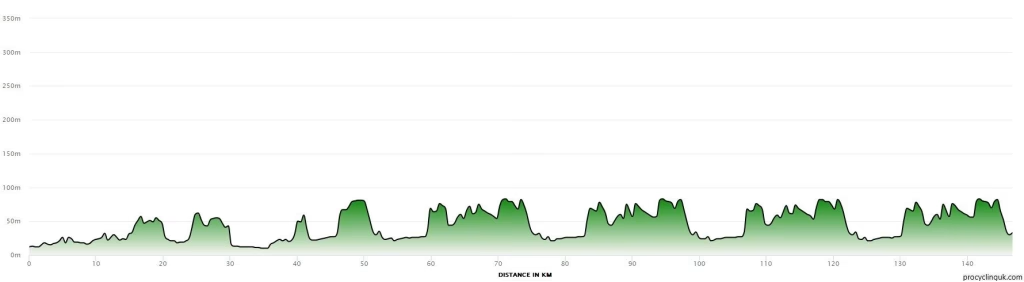
Route structure at a glance
| Element | Detail |
|---|---|
| Total distance | 141.8 km |
| Start | Aarschot |
| Finish | Tielt-Winge |
| Build of the day | 47.4 km opening section, then a 23.6 km local circuit repeated four times |
| New 2026 feature | Passage through Scherpenheuvel-Zichem (basilica landmark) |
Key sectors and why they bite
| Sector | What it is | Why it matters in the race |
|---|---|---|
| Roeselberg (Houwaart) | Short, steep ramp | The effort is sharp and repeated, which makes it a classic place for the bunch to snap if positioning is messy |
| Kerkstraat (Molenbeek-Wersbeek) | Cobbled sector on a slope | Traction and line choice matter, gaps open fast, and chasing is hard on narrow lanes |
| The connecting lanes | Concrete farm roads, frequent corners | This is where organisation breaks down, riders get caught behind splits, and teams lose helpers without realising it |
What to watch for on the live broadcast
- The first time the key sectors are hit at full speed, because it shows which teams are committed to making the race selective.
- The final circuits, when repeated accelerations turn “good legs” into “survival legs”.
- The last run through the cobbles, because hesitation is punished instantly and gaps grow quickly when the road narrows.
How the race is usually won in Hageland
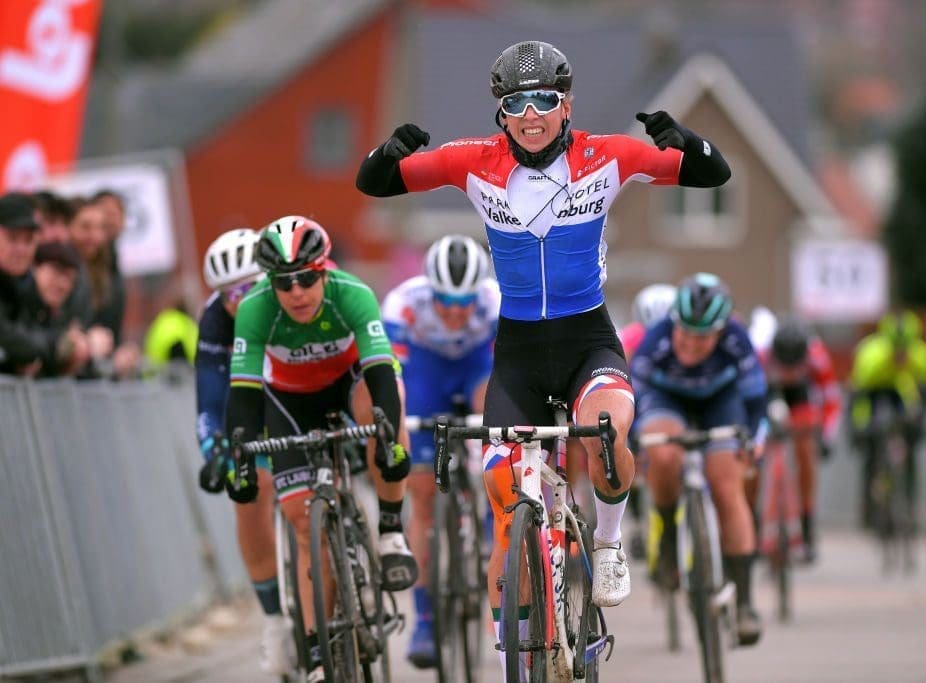
Omloop van het Hageland is often described as selective, and that is accurate, but the selection is rarely clean. It is more like a slow squeeze that suddenly becomes a snap.
Three likely race scenarios
| Scenario | What it looks like | Who it suits |
|---|---|---|
| Reduced sprint | 20 to 40 riders arrive together, already tired, with lead-outs fractured by narrow roads | Fast finishers who are durable over repeated ramps and comfortable fighting for position |
| Small-group finish | A move goes on the final circuits and gets daylight because the bunch is disorganised | Classics riders and strong finishers who can cooperate, then sprint from a handful |
| Long solo | One rider commits at the right moment and the chase never fully commits behind | Big engines who time it perfectly and thrive when teams watch each other |
A key detail for fans is that even the “sprint” version of this race rarely looks like a neat sprint. The roads are too tight, the approaches are too technical, and the final kilometres tend to feel frantic.
 Photo Credit: Getty
A short history of Omloop van het Hageland
Omloop van het Hageland is presented by the organiser as founded in 2005, with roots in local club organisation and a clear progression toward international status. Over time, it became a recognisable early-season date, one that sits neatly in the spring rhythm because it rewards the same skills that matter later in the cobbled classics.
The event also went through a fragile moment recently, with a change in organisational structure that is framed as a rescue and relaunch. For fans, the practical impact is straightforward: the race has stabilised, kept its identity, and continued to grow its footprint on the calendar.
Winners and podiums: what the palmarès tells us
The palmarès is a reminder that Omloop van het Hageland is not one-dimensional. Yes, fast finishers feature heavily. But the race also leaves room for late attacks, small-group tactics, and the occasional long-range statement.
Recent editions (2020 to 2025)
| Year | Winner | Second | Third |
|---|---|---|---|
| 2025 | Femke Gerritse | Lara Gillespie | Susanne Andersen |
| 2024 | Kristen Faulkner | Mischa Bredewold | Pfeiffer Georgi |
| 2023 | Lorena Wiebes | Marta Bastianelli | Audrey Cordon-Ragot |
| 2022 | Marta Bastianelli | Emma Norsgaard | Floortje Mackaij |
| 2021 | Cancelled (COVID-19 pandemic) | ||
| 2020 | Lorena Wiebes | Marta Bastianelli | Emma Norsgaard |
Full palmarès (2005 to 2019)
| Year | Winner | Second | Third |
|---|---|---|---|
| 2019 | Marta Bastianelli | Lotta Henttala | Leah Kirchmann |
| 2018 | Ellen van Dijk | Chloe Hosking | Jolien D’hoore |
| 2017 | Jolien D’hoore | Chloe Hosking | Sarah Roy |
| 2016 | Marta Bastianelli | Leah Kirchmann | Lotta Henttala |
| 2015 | Jolien D’hoore | Chantal Blaak | Sara Mustonen |
| 2014 | Elizabeth Deignan | Emma Johansson | Audrey Cordon |
| 2013 | Emily Collins | Shelley Olds | Emma Johansson |
| 2012 | Elizabeth Deignan | Pauline Ferrand-Prévot | Elisa Longo Borghini |
| 2011 | Emma Johansson | Adrie Visser | Sjoukje Dufoer |
| 2010 | Emma Johansson | Martine Bras | Grace Verbeke |
| 2009 | Andrea Bosman | Martine Bras | Mascha Pijnenborg |
| 2008 | Liesbet De Vocht | Birgit Soellner | Ilse Geldhof |
| 2007 | Louise Moriarty | Yolandi Du Toit | Lieve Koninkx |
| 2006 | Ilse Geldhof | Anja Nobus | Karen Steurs |
| 2005 | Ludivine Henrion | Ilse Geldhof | Anja Nobus |