Milan-Sanremo Women 2026 is one of the easiest races to explain and one of the hardest to predict.
That is part of its charm. On paper, the route looks simple enough. A long run along the Ligurian coast, three modest coastal capes, then the Cipressa and the Poggio before the finish on Via Roma in Sanremo. But that simplicity is deceptive. This is a race built on patience, restraint and the idea that a whole afternoon can hinge on the final 25 km.
For new fans, that makes it one of the best races on the calendar to learn from. You do not need to memorise dozens of climbs or a maze of circuits. You only need to understand one central truth: the route keeps asking whether the attackers can break the race before the sprinters, or the fast finishers, bring it back under control.
If you want the wider context for why this race matters so much, ProCyclingUK’s guide to the best women’s cycling races in 2026 for new fans explains why Milan-Sanremo Women is such a strong entry point into the spring Classics.
What is the route for Milan-Sanremo Women 2026?
The 2026 race keeps the same broad design that made the revived event such an immediate success. It is again a coastal route of around 150 km, effectively mirroring the men’s famous finale rather than trying to invent an entirely separate identity.
That matters because the identity is already there. Milan-Sanremo, even in its shorter women’s form, is still a race of waiting and compression. The route does not try to wear riders down with endless climbing. It stretches the tension instead. The whole day narrows toward a very specific endgame.
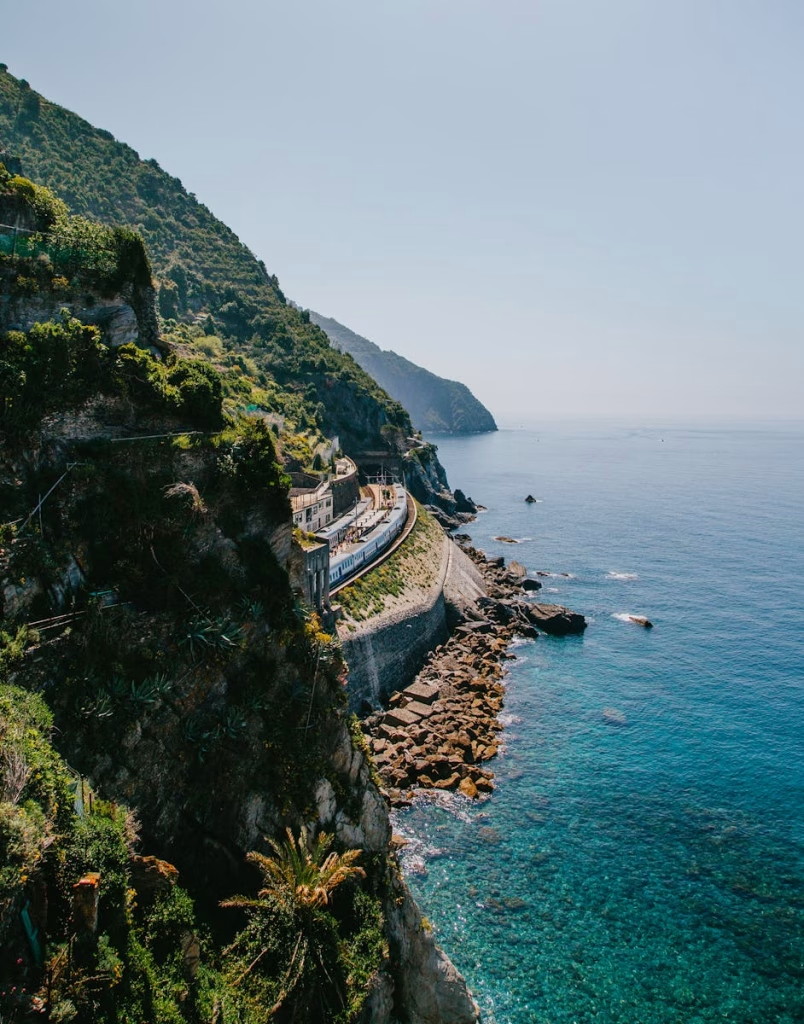
The race runs from Genoa along the Ligurian coast toward Sanremo, using the Via Aurelia corridor before the key final sequence begins. That sequence is everything: the Tre Capi, then the Cipressa, then the Poggio, then the descent and run to Via Roma.
 Photo Credit: LaPresse
Why the route is so different from most major one-day races
Most major one-day races make their intentions obvious early. Paris-Roubaix Femmes shows you the cobbles. Strade Bianche shows you the gravel. Flèche Wallonne points directly at the Mur de Huy.
Milan-Sanremo Women does something else. It withholds the decisive part of the race for as long as possible.
That creates a very different sort of tension. Teams spend most of the day asking not just who is strongest, but when the race should properly begin. If the pace is too controlled, the finish can still favour the quickest riders left standing. If the strongest teams push hard enough on the Cipressa, or commit fully on the Poggio, the race can flip into something more selective.
That is why this route matters so much. It is not just a list of roads and climbs. It is a route designed to force a tactical argument.
The early and middle part of the route
The opening and middle phases are not there just to fill distance. They serve an important purpose.
First, they make the race long enough for patience to matter. Milan-Sanremo Women is not a short, explosive one-day race where everyone can simply wait for the final climb. Riders still have to manage energy, positioning and team support across a substantial distance.
Second, the long coastal run keeps the race feeling deceptively calm. That can be dangerous in itself. Flat roads and long straights often make positioning battles more subtle rather than less important. A rider who keeps drifting backwards through the middle of the race may discover too late that the finale begins much earlier than the television pictures suggest.
Third, the route gradually moves the bunch toward terrain where small losses of position become much more expensive. That is one of the defining themes of Sanremo. You can survive being slightly out of place on open roads. You usually cannot survive it once the race hits its decisive sequence.
The Tre Capi: where the route starts to tighten
Before the two famous finishing climbs, the riders face the Tre Capi: Capo Mele, Capo Cervo and Capo Berta.
These are not enormous climbs in isolation, and that is precisely why they are often misunderstood. Their value lies less in their absolute difficulty and more in how they begin to change the race’s rhythm. The flat run-in starts to fracture. Positioning becomes more urgent. Teams begin to use riders not just to control the bunch, but to protect leaders for what comes next.
Capo Berta is usually the most significant of the three because it is the point where the race starts to feel genuinely serious. Not necessarily decisive yet, but serious. The route is telling the peloton that the easy part of the day is over.
For new fans, this is a good place to start watching more closely. The race may still look calm, but by then riders are already thinking several moves ahead.
The Cipressa: the first real chance to break the race
The Cipressa is 5.6 km long at an average gradient of 4.1 per cent, and it begins the truly decisive phase of Milan-Sanremo Women.
On paper, those numbers do not look extreme. In reality, the Cipressa is one of the most important climbs in the sport because of where it sits and what it invites. It arrives late enough for fatigue to matter, but early enough for teams and riders to wonder whether this is the moment to go all in.
That question has become more central in recent years because the Cipressa now feels less like a prelude and more like a launch point. If a strong team drives the pace there, the race can open dramatically. If the bunch hesitates, riders with punch and courage can try to force a split before the Poggio even begins.
The Cipressa is where patience starts to run out.
That is why it matters so much tactically. Riders who want a reduced sprint need to survive it without spending too much. Riders who want to win solo, or from a very small group, know this may be the place to begin the damage.
 Photo Credit: LaPresse
The Poggio: the most famous question mark in the race
If the Cipressa starts the argument, the Poggio usually decides it.
The Poggio di Sanremo is 3.7 km at roughly 3.7 per cent on average, but like so much of Milan-Sanremo, those numbers only tell part of the story. The climb is not long enough to guarantee a clean selection, and not steep enough to hand the race automatically to the pure climbers. Instead, it produces a perfect grey area.
That is why the Poggio is so compelling. Every type of rider can still believe in it, at least briefly.
The strongest attacker sees it as the final place to break free. The fast finisher sees it as the last obstacle to survival. The tactically smart rider sees it as a moment of hesitation, where one clean move can matter more than a dozen small ones. The descent then adds another layer, because a rider who crests with a small gap still has to hold nerve and line choice all the way down.
For many races, the decisive climb tells you clearly who should win. The Poggio does not. It tells you only that the final answer is very close.
The descent and run to Via Roma
From the top of the Poggio, the race is not over. In some ways, it becomes even more tense.
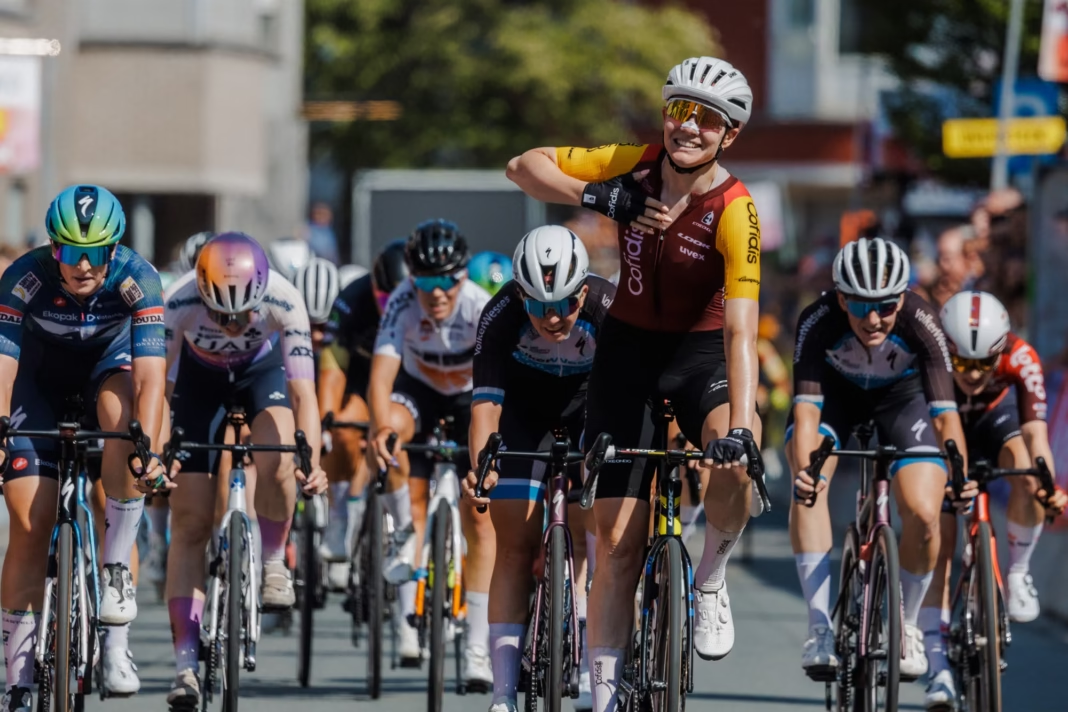
The descent is technical and fast enough to reward commitment, but not so extreme that a small group is guaranteed to stay away. Then comes the final run into Sanremo and the Via Roma finish, where the race can still tilt one last time depending on who has survived, who is chasing and who still has teammates left.
That uncertainty is the soul of Milan-Sanremo Women. A reduced sprint can happen. A late attacker can stay clear. A tiny group can arrive together after the descent. The route is designed to leave all three outcomes alive deeper into the race than most one-day events manage.
For newer fans, this is what makes the race so watchable. It does not force one single script on the riders. It keeps several endings open until very late.
What kind of rider does the route suit?
That is the key question, and the answer is deliberately broad.
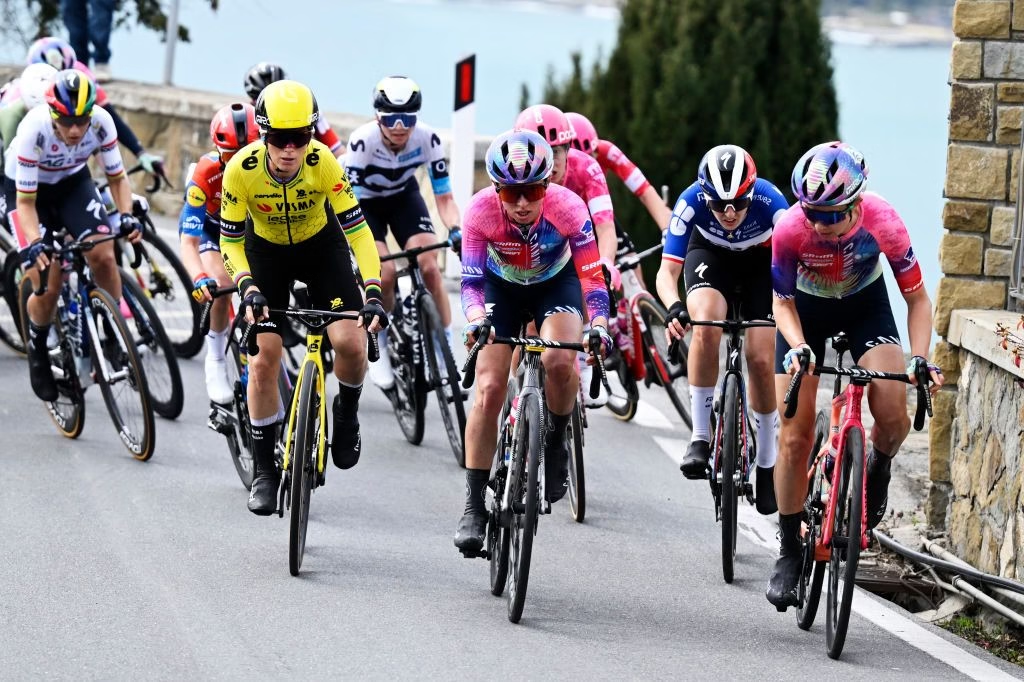
A pure climber is not ideal here because the climbs are too short and the finish too flat. A pure sprinter is not ideal either unless she can climb efficiently enough to survive the Cipressa and Poggio. The best fit is usually a fast all-rounder, a rider with enough punch to stay with the best over the climbs and enough speed or tactical sharpness to finish the job afterwards.
That is why Milan-Sanremo Women is so interesting. It sits between categories. It does not belong fully to the sprinters, the climbers or the Classics specialists. It belongs to the riders who can read a very specific race shape and still perform when the road asks for several different things at once.
What should new fans watch for?
Watch the race in layers.
First, pay attention to team behaviour before the Tre Capi. Who is already guarding the front? Who is spending riders early? That often tells you which teams expect to make the race hard.
Second, watch how the bunch hits the Cipressa. If a team commits fully there, the race can change immediately. If the pace is more measured, more riders stay in play and the Poggio becomes even more important.
Third, watch for hesitation on the Poggio. Milan-Sanremo Women is one of those races where indecision can be as decisive as strength. The rider who commits at exactly the right moment can gain more than the rider who simply has the best numbers.
Finally, do not assume the winner is decided at the top of the Poggio. The descent and final run into Sanremo are still part of the race’s answer.
 Photo Credit: LaPresse
Why the 2026 route is such a good guide to the race itself
Some route guides are really just lists of sectors and distances. Milan-Sanremo Women is different because the route tells you almost everything about the race’s philosophy.
It is a route built on suspense rather than blunt force. It creates pressure through timing rather than extreme gradients. It rewards riders who understand when to wait and when to stop waiting.
That is why Milan-Sanremo Women 2026 is such a good race for both new fans and long-time followers. The course is easy to understand, but the outcome is never easy to settle in advance.
If you want a useful companion piece, ProCyclingUK’s article on how Sanremo Women returned with the confirmed Cipressa and Poggio finale helps explain why those final climbs matter so much, while the 2025 Sanremo Women race preview is still a good reference for the broader logic of the race.
So what should you expect from Milan-Sanremo Women 2026?
Expect a race that feels controlled until it suddenly does not.
Expect the Tre Capi to raise the pressure, the Cipressa to open the real debate, and the Poggio to force the final answer.
Expect multiple rider types to still believe they can win much deeper into the race than in most major one-day events.
And expect a finish that remains beautifully unresolved until very late. That is what this route is designed to produce, and that is why Milan-Sanremo Women already feels so important.