
Paris-Nice stage 4 was supposed to be the race’s first proper uphill GC test, a long day to Uchon where the climbers and overall contenders would finally start sorting themselves out.
Instead, it became one of those stages where the route almost stopped mattering on its own. The weather was savage, the race split repeatedly, crashes tore through the bunch, and by the time the final climb arrived the field was already in pieces. Jonas Vingegaard won the stage, took the yellow and, more importantly, came through the chaos better than anyone else.
To understand why the gaps were so enormous and why so many big names disappeared from the race, it helps to break the day down properly.
 Photo Credit: Anne-Christine Poujoulat/AFP
Why did the stage blow apart so badly?
Because it was not one moment. It was several stacked on top of each other.
The stage had exposed roads, strong crosswinds, cold rain and greasy surfaces, which meant the bunch was already under pressure before the final climb really came into play. Once the peloton begins splitting in those conditions, everything gets harder very quickly. Riders are freezing, the roads are slick, every acceleration costs more, and getting back to the front becomes much more expensive than it would be on a normal day.
That is why the time gaps looked absurd by the finish. This was not a simple case of Vingegaard climbing everyone off his wheel on the final ascent. By the time the race reached Uchon, the stage had already been shredded by weather, crashes and the effort of simply surviving in those conditions.
The final result reflected that. Vingegaard won, but 5th place was already nearly three minutes down, 10th was over five minutes back, and riders who had started the day as genuine GC names were suddenly finishing several minutes behind or leaving the race altogether.
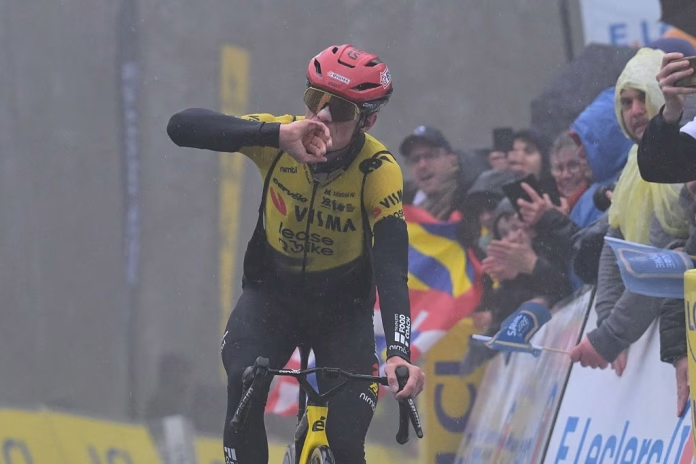
Why was Vingegaard wearing bib shorts over his jersey?
Because the conditions were so bad that riders were improvising just to stay functional.
What looked like an extra set of bib shorts worn over his jersey was basically an emergency cold-weather solution. Vingegaard had an additional modified pair of team-issue bib tights layered over his normal kit, along with extra protection on his feet, because the weather was brutal and there was no realistic chance to stop and reset once the racing went full gas.
That is why the image stuck so quickly. It looked strange, but it made complete sense in context. This was not a polished, textbook GC day. It was survival racing. Riders were making practical decisions just to keep enough warmth in their bodies to function properly.
It also said a lot about the stage in one glance. When the eventual winner looks as though he has dressed in a hurry out of sheer necessity, you know the day has gone somewhere well beyond normal March discomfort.


Could the extreme weather protocol have been used?
Yes, it could have been.
And that is one of the big questions left hanging over the stage.
The UCI’s extreme weather protocol exists precisely for days like this, when cold, rain, wind and dangerous road conditions start creating serious safety concerns. Stage 4 was absolutely severe enough for people to ask whether some sort of intervention should have happened, whether that meant neutralisation, modification or a stoppage.
But it never came. The stage ran in full.
That does not automatically mean the organisers got it wrong, but it does mean the debate is unavoidable. Paris-Nice has already seen weather intervention in recent editions, so this was not some unimaginable step. On this occasion, though, the race was allowed to continue exactly as planned, and the result was a stage in which the attrition became the story almost as much as the sporting outcome.
 Photo Credit: Szymon Gruchalski
What happened to Juan Ayuso?
Ayuso’s crash changed the entire race.
He started stage 4 in yellow after the team time trial and was one of the two central GC favourites alongside Vingegaard. In other words, this was supposed to be one of the key stages in a direct duel between the two most important men in the race.
Instead, Ayuso crashed hard in the wet with around 45 km remaining. He initially tried to continue, but the damage and the conditions proved too much, and he abandoned.
That mattered far beyond one rider leaving the race. Ayuso was not just the leader on the road. He was one of the main structures holding the GC together. Once he was gone, the race stopped being a head-to-head contest and became more of a survival exercise around whoever was still upright, warm enough and strong enough to race properly.
Why did so many riders abandon?
Because this was not one isolated incident. It was a stage that kept removing riders all afternoon.
Ayuso was the biggest name, but he was not the only important rider to disappear. Brandon McNulty, Davide Piganzoli and several others also left the race, while more riders who did finish came in with their GC hopes effectively destroyed.
That is what makes stage 4 different from a normal hard day. Usually, a GC stage sorts riders by strength. This one sorted them by a much harsher mix of strength, positioning, crash luck, weather tolerance and simple survival. The DNFs were not random, but they were not all caused by one single event either. They were the cumulative result of a race that kept punishing the bunch in different ways.
For McNulty, it meant a major loss for one of the teams that might have hoped to reshape the GC after Ayuso. For Piganzoli, it wiped out what could have been one of the more interesting outsider stories in the race. For the event itself, it turned stage 4 from a sporting test into something much closer to a mass cull.
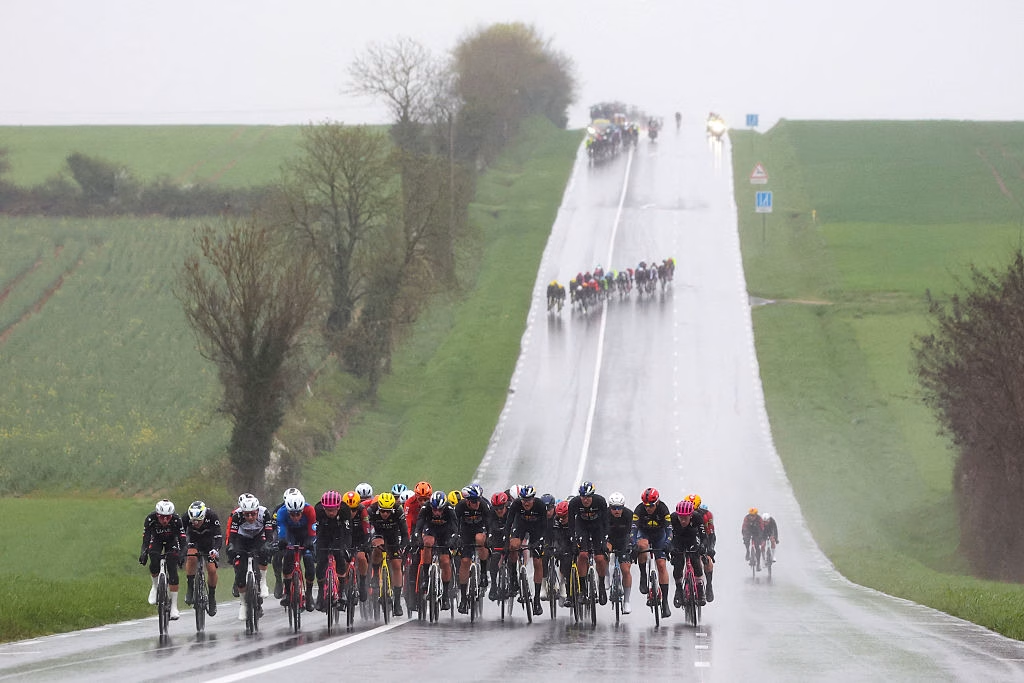 Photo Credit: Anne-Christine Poujoulat/AFP
Why were the time gaps so huge?
Because the stage worked like a sequence of filters.
First came the crosswinds and rain, which began splitting the race. Then came the crashes, which removed contenders and shattered the rhythm of the bunch even further. Then came the cold, which made every chase more difficult and every mistake more expensive. Only after all of that did the final climb truly decide the stage.
That is the part that matters most. The day was not blown apart by one attack. It was blown apart by the conditions first, then settled by the strongest survivor at the end.
That is why the gaps look so extreme in hindsight. They were not simply climbing gaps. They were the residue of a stage that had already emptied the riders before the official decisive point on the route.
What did the stage mean for the GC?
It completely rewrote the race.
Vingegaard did not just win the stage. He came out of the stage with yellow and, more importantly, with a race that suddenly looked far more manageable than it had the day before. Ayuso was out. Other serious names were gone or heavily damaged. Riders who had been close on GC were now minutes behind.
That is what gave stage 4 its real force. It was not just an eventful day. It was the day Paris-Nice 2026 stopped being one race and became another.
The simple version
If you want the shortest explanation, it is this:
Vingegaard’s unusual extra bib layer happened because the conditions were brutally cold and wet, and riders were improvising just to stay warm enough to function.
The race exploded because of crosswinds, rain, crashes and cold, not simply because of the final climb.
The extreme weather protocol could have been used, but it was not.
Ayuso crashed out in yellow, and his abandonment changed the whole shape of the GC.
McNulty, Piganzoli and others also abandoned because this was not a normal hard stage, it was a stage that kept stripping riders away all afternoon.
And by the finish, Vingegaard was not just the strongest rider left. He was the clear winner of the chaos.

