
The Men’s Milano-Sanremo 2026 is one of the easiest races in cycling to explain and one of the hardest to predict. It is still the longest Monument, still built around a day of accumulation rather than constant spectacle, and still decided by a final sequence where timing matters more than brute force alone. The Cipressa and Poggio remain the hinges of the race, but what makes Milano-Sanremo so compelling is that multiple rider types can still believe right to the end.
We’re still waiting for the finalised start list for the 2026 edition, so some names below may end up not taking the start line.
If you want the broader route and race identity first, ProCyclingUK’s Beginner’s guide to Men’s Milano-Sanremo 2026 and A brief history of the Men’s Milano-Sanremo both help frame why this Monument keeps producing such tense, compressed finales.
Alpecin-Premier Tech
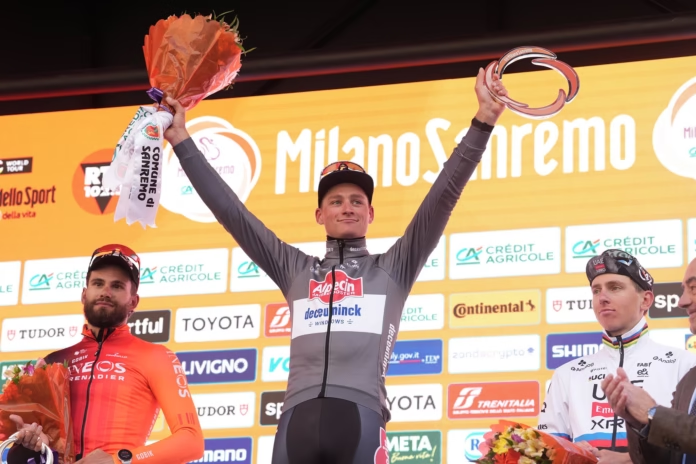
No team arrives with a more obvious recent claim on the Men’s Milano-Sanremo than Alpecin-Premier Tech. Mathieu van der Poel won in both 2023 and 2025, while Jasper Philipsen took the 2024 edition. That alone tells you how well this team understands the race and its final sequence.
The tactical appeal is obvious. Van der Poel can turn the Poggio into a launchpad, while Philipsen gives them a rider who can still win if things come back together into a reduced sprint. Few teams can cover both scripts so naturally. This is not just a team with options; it is a team whose options have already won this race repeatedly.
Bahrain Victorious
Matej Mohorič remains the defining figure here because his 2022 win is still one of the purest examples of how the Men’s Milano-Sanremo can be stolen by nerve and precision. He did not just descend aggressively off the Poggio that year; he redefined the gap between possible and impossible.
That makes Bahrain Victorious easy enough to read tactically. They do not need to dominate the race from a distance. They need to keep Mohorič in contact until the last climb and trust his judgment when the race starts to splinter. On a day like this, prior knowledge of how to win matters.
Bardiani CSF 7 Saber
For Bardiani, the realistic target is not control but presence. An Italian ProTeam in the Men’s Milano-Sanremo always has a reason to ride visibly, and the long first half of the day usually offers chances for breakaway exposure.
That does not mean the race is meaningless for them. Milano-Sanremo is one of those Monuments where a smaller team can still shape part of the narrative, even if not the final result. The trick is to turn the sheer length of the race into an opportunity rather than simply surviving it.
Cofidis
Cofidis have a useful balance for the Men’s Milano-Sanremo. Bryan Coquard brings finishing speed for a reduced sprint, while Alex Aranburu gives them a more aggressive angle if the finale becomes fractured and tactical.
They are not built to dictate the race against the biggest squads, but this is a race where reading moments well can matter just as much as setting tempo. Cofidis look more like a team that wants to stay flexible and profit from hesitation late on.
-
 Photo Credit: Getty
 -
Photo Credit: Unipublic/Naike Ereñozaga



Decathlon CMA CGM Team
Paul Lapeira makes sense here because the Men’s Milano-Sanremo often rewards riders who can stay composed through hours of positioning stress and still respond on the final climbs. Tobias Lund Andresen gives them a faster option if the race remains slightly more controlled.
The challenge for Decathlon is that they are up against teams with more obvious recent winning history in this race. Their route into contention probably comes from staying close enough to profit if the top favourites neutralise each other.
EF Education-EasyPost
EF Education-EasyPost look like a team built for opportunism. Kasper Asgreen and Neilson Powless both fit a selective, aggressive version of the race, while Vincenzo Albanese and Marijn van den Berg give them faster finishers if the race does not completely explode.
That spread of options suits the Men’s Milano-Sanremo well. The finale often rewards teams who are willing to improvise rather than overcommit to a single scenario. EF may not have the central favourite, but they do have several ways to matter.
Groupama-FDJ United
Romain Grégoire is the rider who makes this team interesting. Milano-Sanremo can elevate riders with punch, race craft and the nerve to move at exactly the right moment, and that profile suits him well.
For Groupama-FDJ United, the race probably comes down to how close Grégoire can stay to the biggest names over the Poggio. If he is still there into the final few kilometres, the race starts to look much more open than the betting hierarchy suggests.
INEOS Grenadiers
Filippo Ganna has twice finished second in the Men’s Milano-Sanremo, in 2023 and 2025, which tells you both how well suited he is to this race and how fine the margins can be. He does not need a steep climb to make a difference. He needs momentum, timing and enough daylight to let his engine matter.
INEOS Grenadiers also have the experience of Michał Kwiatkowski, who finished third here in 2019, and that matters in a race as nuanced as this. They know how to make the race hard, and Ganna in particular is one of the few riders capable of turning the finale into a sustained power test rather than a pure game of jumps and counters.
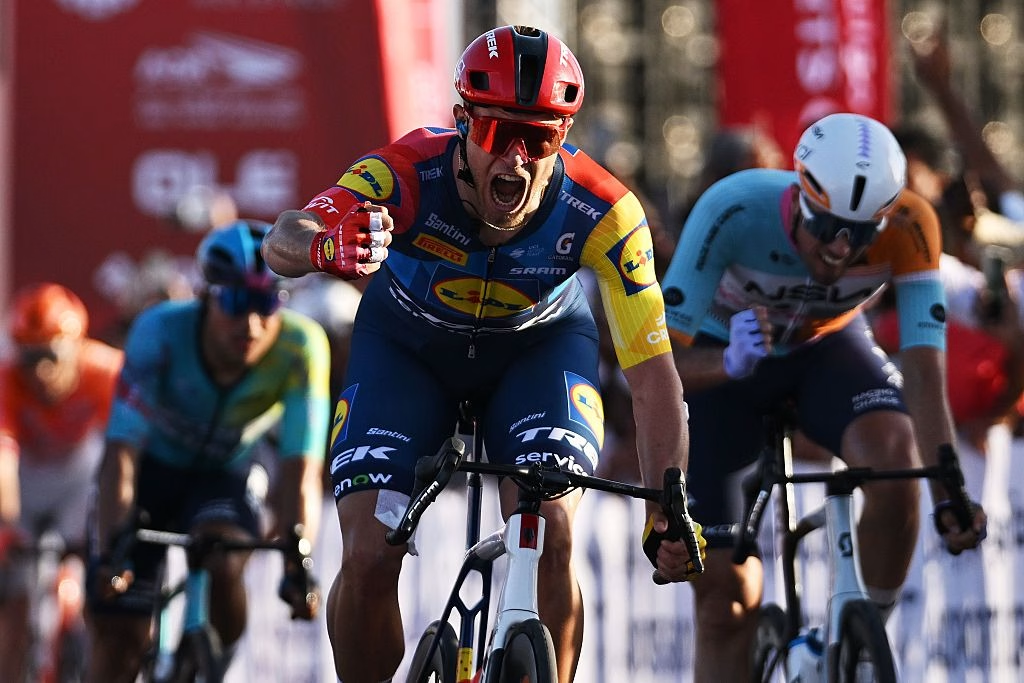 Photo Credit: Getty
Lidl-Trek
Lidl-Trek arrive with Jonathan Milan as their clearest headline name, and that alone makes them a serious factor in the Men’s Milano-Sanremo. If the race is only selective enough on the Cipressa and Poggio, Milan has the raw speed to finish the job on Via Roma. The wider challenge for Lidl-Trek is to keep him in the right place deep into the finale, because Sanremo is never just about top-end speed, it is about surviving the stress before that speed can matter.
That shapes the team tactically. Rather than splitting responsibility between contrasting leaders, Lidl-Trek are more likely to centre the race around protecting Milan, managing positioning and making sure he reaches the Poggio with a real chance still intact. If they can do that, they will back one of the fastest riders in the race against almost anyone.
Lotto-Intermarché
Lennert Van Eetvelt and Georg Zimmermann are useful names, but this is a team whose path to a top result is less direct than some others. The Men’s Milano-Sanremo is not always kind to riders whose strengths are better expressed on harder climbing terrain.
That means their best chance may come through disruption rather than patience. If they can anticipate rather than follow, they may yet find a way to force stronger teams into uncomfortable decisions.
Movistar Team
Movistar do not come in with the same obvious weight of expectation as UAE, Alpecin or INEOS, but the Men’s Milano-Sanremo can still reward a team willing to race a little ahead of the script. Iván Romeo gives them a rider capable of riding boldly if the opportunity opens.
The problem is not quality so much as match-up. This race often compresses the decisive fight into a handful of elite wheels, and Movistar’s challenge is to make sure one of theirs is there when it matters.
NSN Cycling Team
This looks more like an ambush team than a controlling one. If Biniam Girmay is part of the final picture, that immediately gives them a rider with the kind of speed and resilience that can suit Milano-Sanremo well.
Teams like this can benefit from arriving with slightly less pressure. The Men’s Milano-Sanremo does not always reward the side that controls the most. Sometimes it rewards the one that stays calmest while others try to do so.
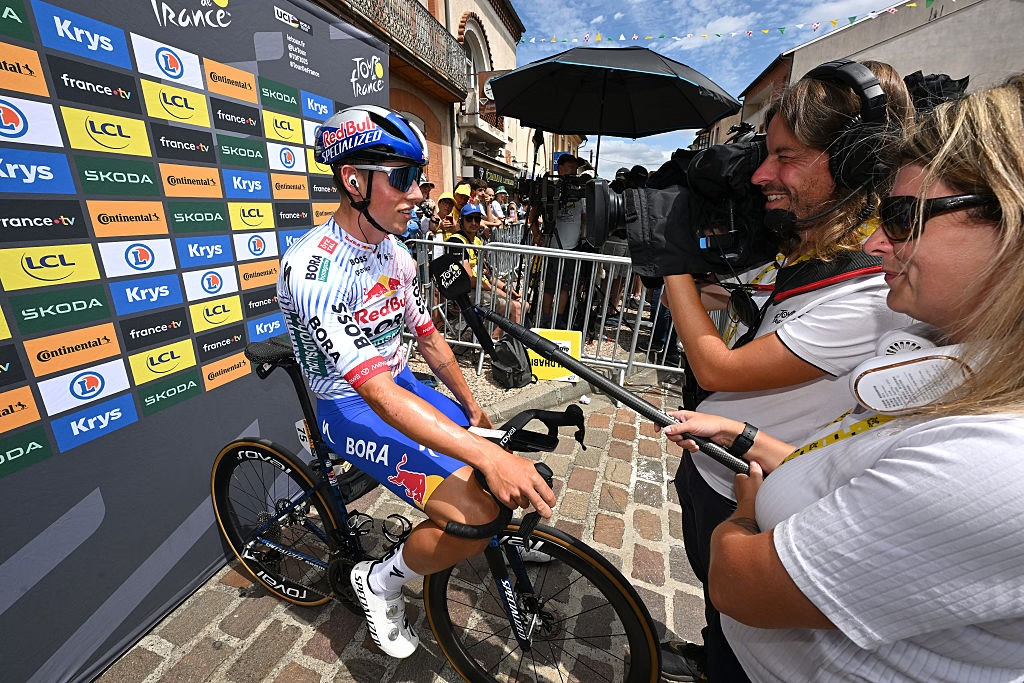 Photo Credit: Getty
Red Bull-BORA-hansgrohe
Danny van Poppel gives Red Bull-BORA-hansgrohe a sprint option, while Laurence Pithie has the kind of hard one-day engine that could make him relevant in a more fractured finale. They do not arrive with a recent winner of this race, but they do have enough tools to stay involved.
What they may lack is the singular card that others have. In a race shaped by stars who have already won Monuments or podiumed this one, that can matter. Even so, if the race turns slightly messy, they have riders capable of exploiting it.
Soudal Quick-Step
This team carries one of the strongest veins of previous Men’s Milano-Sanremo knowledge in the race. Julian Alaphilippe won the Monument in 2019, while Jasper Stuyven, if part of their final line-up as some provisional listings have suggested, won it in 2021.
Paul Magnier adds a more modern angle, because he has the speed and resilience to survive further into these long races than many pure sprinters. That makes Soudal Quick-Step tactically interesting. They can race through experience, speed, or a late surprise, which is not a bad place to be in a Monument like this.
Team Jayco AlUla
With Michael Matthews not racing, Team Jayco AlUla lose the rider who has come closest to winning the Men’s Milano-Sanremo in recent years, so the team’s shape changes quite a bit.
Rather than building around a proven podium finisher, this now looks more like a squad that will need to race opportunistically and try to anticipate the finale instead of waiting for a reduced sprint. Matthews has been second once and third twice in this Monument, which underlines the scale of the gap Jayco are trying to fill here.
Team Novo Nordisk
For Team Novo Nordisk, simply being on the Men’s Milano-Sanremo startline is already significant. Their goals are necessarily different from the top teams. Presence, visibility and aggression matter more than a placing deep into the finale.
Still, this Monument’s length gives smaller teams space to make a mark. Getting into the right move early and staying visible for as long as possible would already make for a successful day.
Team Picnic PostNL
John Degenkolb still brings a serious layer of Men’s Milano-Sanremo knowledge because he won the race in 2015. Even a decade later, that sort of experience matters in a Monument where the final kilometres can hinge on one decision.
Picnic are unlikely to control much of the race, but Degenkolb’s understanding of how the finale breathes could still help them stay relevant late. If the front group hesitates, riders like him know how to read that instantly.
Team Polti VisitMalta
For Polti, this is likely to be a race about animation rather than domination. Italian teams in Italian Monuments rarely waste the opportunity to be seen, and the Men’s Milano-Sanremo offers a long window in which to do that.
Their best route is probably to shape the early break and then hope one rider can survive longer than expected once the race starts tightening towards the coast.
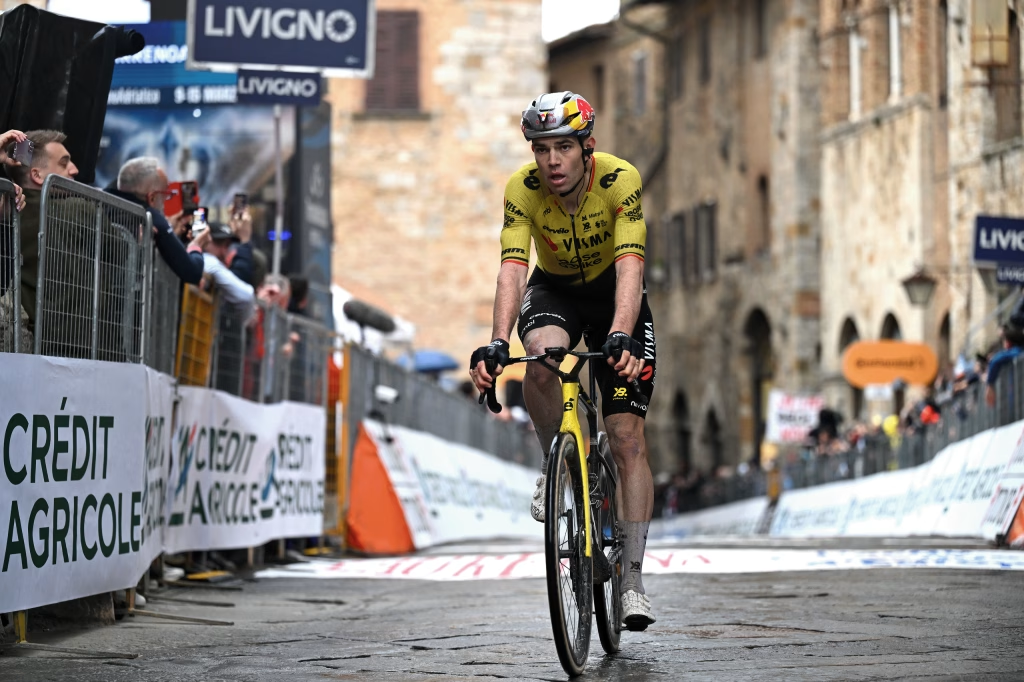 Photo Credit: Getty
Team Visma | Lease a Bike
Few teams can point to a richer recent Men’s Milano-Sanremo record than Team Visma | Lease a Bike through Wout van Aert alone. He won in 2020 and then finished third in 2023. That tells you exactly why he remains such a central figure in this race.
The broader line-up makes them even more dangerous. Matteo Jorgenson and Christophe Laporte both deepen the tactical possibilities, while Matthew Brennan adds a fresher, faster option if the race remains just controlled enough. Visma do not have only one way to win, and that matters in a race like this.
Pinarello-Q36.5 Pro Cycling Team
Tom Pidcock is the reason this team matters in the Men’s Milano-Sanremo. The race suits his blend of punch, descending and instinct, and it is not hard to imagine him finding the right wheel over the Poggio and suddenly becoming a genuine winning threat.
Quinten Hermans strengthens that picture further. This is not a team with the depth to impose itself all day, but Milano-Sanremo does not always demand that. Sometimes it asks only for one rider to arrive at the right point with enough clarity and enough legs.
Tudor Pro Cycling Team
Julian Alaphilippe’s presence gives Tudor immediate Monument credibility because he is not only a former winner of the Men’s Milano-Sanremo, from 2019, but also exactly the kind of rider this race has historically rewarded. Aggressive, sharp and willing to commit.
They may not start as favourites, but they are the sort of team that can make the finale unstable. That alone gives them a place in the serious conversation.
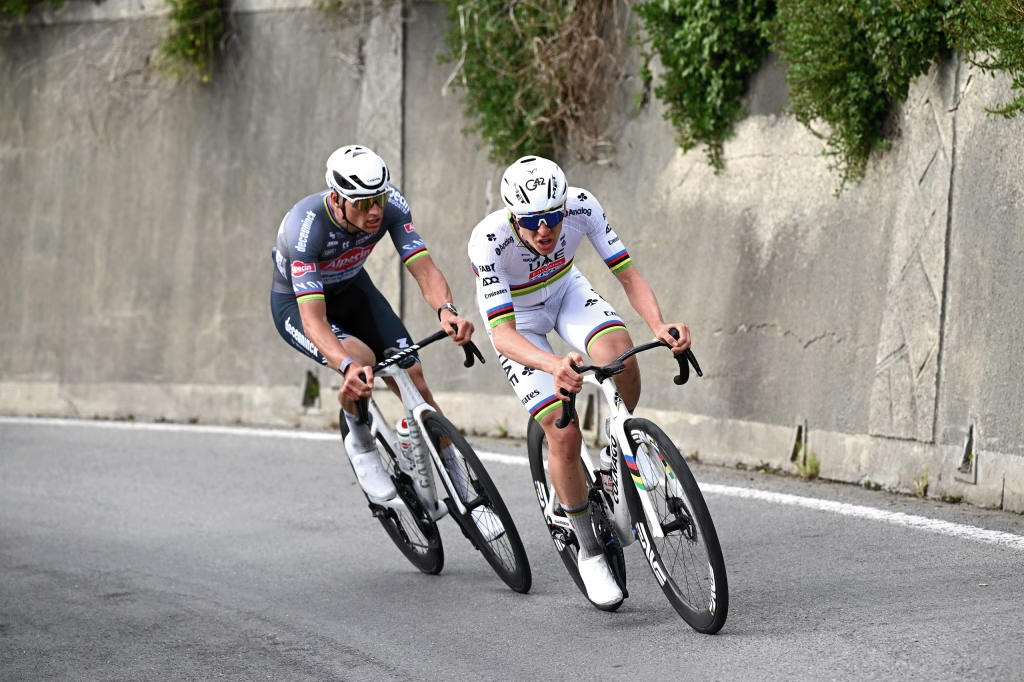 Photo Credit: Getty
UAE Team Emirates-XRG
Tadej Pogačar has not yet won the Men’s Milano-Sanremo, but he has already been on the podium twice, finishing third in both 2024 and 2025. That is the strange tension around his relationship with this race. He is clearly strong enough to win it, yet the race still keeps finding ways to remain just out of reach.
UAE Team Emirates-XRG remain the team most likely to try to redraw the normal rhythm of the race. Their challenge is always the same, make the Cipressa selective enough that the Poggio becomes a launchpad rather than a holding pattern. When they succeed in making the race feel different, the whole Monument shifts.
Unibet Rose Rockets
This is another team for whom visibility is central. The Men’s Milano-Sanremo gives smaller squads a rare chance to be seen for hours on one of cycling’s biggest days, and that usually shapes how they race it.
The final result may be beyond reach, but the race still offers enough space for a smaller team to become part of the day’s story if they are bold enough early on.
Uno-X Mobility
Magnus Cort gives Uno-X Mobility a genuinely intriguing Men’s Milano-Sanremo card because he can survive a hard race and still finish quickly. Jonas Abrahamsen adds aggression and raw durability, while Søren Wærenskjold offers another faster option if the race stays slightly more controlled.
They are unlikely to bully the major favourites, but they could easily profit if the biggest teams spend too long watching each other on the final climbs. Sanremo has always had room for that kind of opportunist.
XDS Astana Team
Davide Ballerini, Mike Teunissen and Alberto Bettiol give Astana a useful classics profile, and Bettiol’s fifth place in the 2024 Men’s Milano-Sanremo is a reminder that this race can open up well for him if the finale is selective but not completely broken apart.
Astana may lack the singular star card of some rivals, but they do have multiple riders who understand chaotic one-day racing. In a Monument where being in the right place at the right time is half the job, that keeps them relevant.
 Photo Credit: LaPresse
Who looks strongest in the Men’s Milano-Sanremo 2026?
On paper, Alpecin-Premier Tech still look the most complete team because they bring the last three winners of the race between Mathieu van der Poel and Jasper Philipsen. Team Visma | Lease a Bike has a former winner in Wout van Aert and more than one tactical route into the finale. INEOS Grenadiers have Ganna, who has already finished runner-up twice, while UAE Team Emirates-XRG again look like the team most likely to try to force the race into something harder and less conventional thanks to the presence of Pogačar.
Lidl-Trek, Bahrain Victorious and Team Jayco AlUla also stand out because they bring riders who have already shown, in very concrete terms, that this race suits them. Stuyven has won it, Mohorič has won it, and Matthews has repeatedly gone close.
The teams most likely to disrupt the script
If the Men’s Milano-Sanremo drifts even slightly away from the expected script, Bahrain Victorious, Pinarello-Q36.5 Pro Cycling Team, Tudor Pro Cycling Team, Uno-X Mobility and XDS Astana Team all look capable of taking advantage. That is the beauty of this race. Even when the favourites are obvious, the finale rarely feels settled.
For more on how this Monument works, ProCyclingUK’s Beginner’s guide to Men’s Milano-Sanremo 2026 and A brief history of the Men’s Milano-Sanremo give the broader picture behind one of cycling’s most elusive races.

