
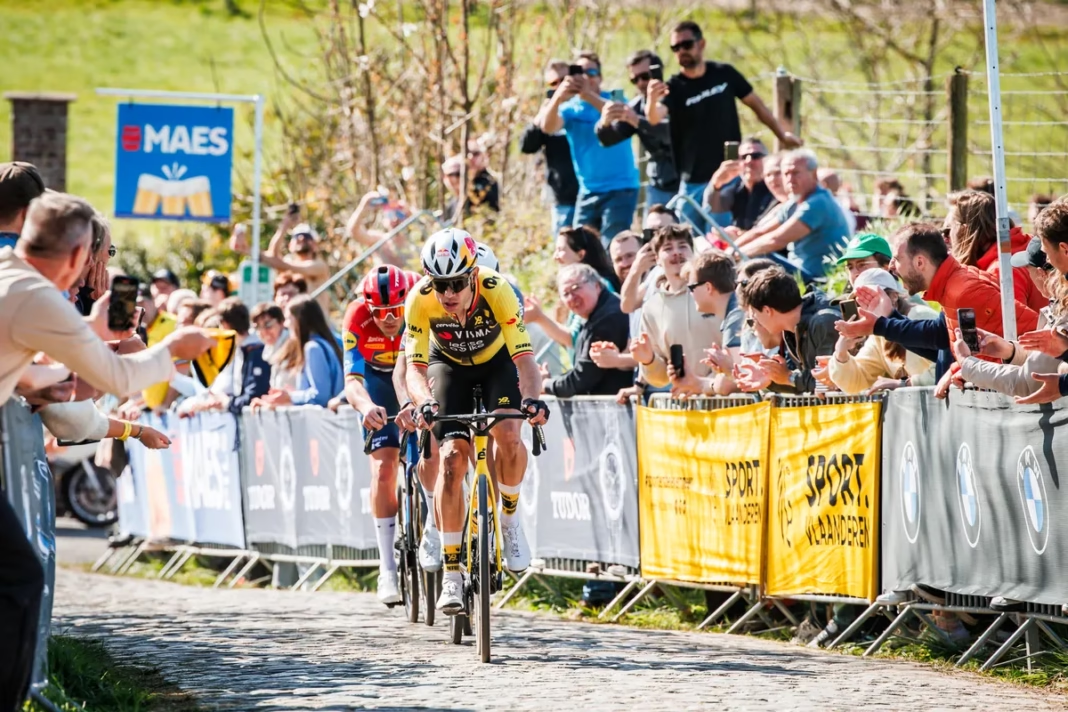
Men’s Ronde van Vlaanderen is one of the great centrepieces of cycling. First held in 1913, it grew from a Flemish sporting project into one of the five Monuments and one of the defining races of the spring. By 2026, the men’s race reaches its 110th edition, which says a great deal about both its longevity and its place in the sport.
What makes the race so important is not only age or prestige. It is the way the route expresses a very specific kind of cycling difficulty. Flanders is not built around one giant mountain or one single sector of pavé. It is a race of repeated cobbled climbs, narrow roads, constant positioning fights and a finale that keeps asking for one more effort when most riders are already close to empty. That is why the race has always rewarded complete one-day riders rather than pure specialists.
If you want the current race shape alongside the history, ProCyclingUK’s Beginner’s guide to Men’s Ronde van Vlaanderen 2026 is the natural companion piece.
How the race began
The race was first organised in 1913, with Paul Deman winning the inaugural edition. It was created in a period when cycling and Flemish identity were becoming increasingly intertwined, and over time Ronde van Vlaanderen came to represent much more than a sporting contest. It became a cultural marker as well as a race, one that Belgians and international fans alike came to treat as a reference point of the spring.
That deeper meaning is part of what separates Flanders from many other Classics. Plenty of races are hard. Fewer carry the same sense of place. Even now, the race is inseparable from the Flemish Ardennes, from the bergs, from the cobbles and from the atmosphere that gathers around the course every April. The name Ronde van Vlaanderen is not simply a label. It describes a race that has always felt rooted in a region.
From broad route to modern Flanders formula
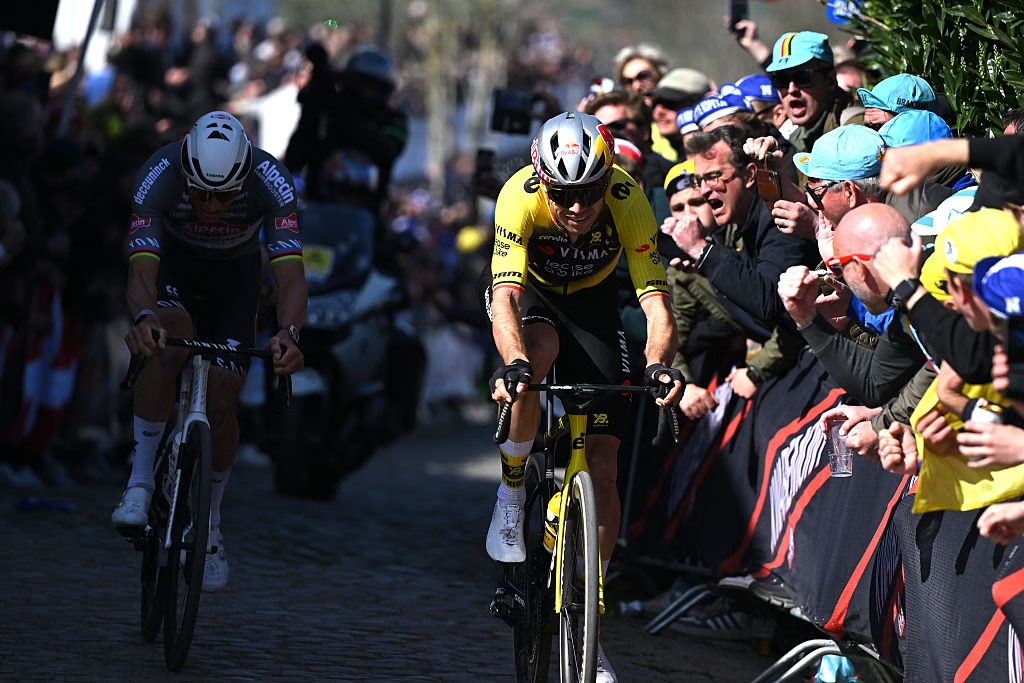
The route has changed repeatedly across the race’s history, but the broad identity has stayed recognisable. Older editions were often longer, more sprawling and shaped by different finishing patterns. In more recent decades, the race has settled into the now familiar structure built around repeated climbs in the Flemish Ardennes and a finish in Oudenaarde, with the men’s start alternating between cities such as Antwerp and Bruges. For 2026, the men start in Antwerp and finish in Oudenaarde.
The big route-era shift most fans recognise came with the move away from the old Muur van Geraardsbergen-Bosberg finale towards the modern Oude Kwaremont-Paterberg sequence. That altered the race’s rhythm, making it more circuit-based and more focused on repeated pressure in the final phase. Some older fans still see the Muur as the spiritual image of Flanders, but the Kwaremont-Paterberg era has now been established long enough to define the race for a newer generation.
Why the race became one of cycling’s biggest prizes
Ronde van Vlaanderen built prestige because it has always been hard to win in a convincing way. The route exposes weakness brutally. Riders need endurance for a near-270km day, handling over cobbles, sharp acceleration on steep bergs and the tactical awareness to stay near the front without wasting too much energy. That combination makes it one of the clearest tests of classics greatness.
That is also why winning Flanders can define a career. Plenty of elite riders have had remarkable seasons. Far fewer have been able to say they mastered this race. The honour roll is full of names who were not just talented, but dominant in the specific language of northern one-day racing.
Previous winners of Men’s Ronde van Vlaanderen
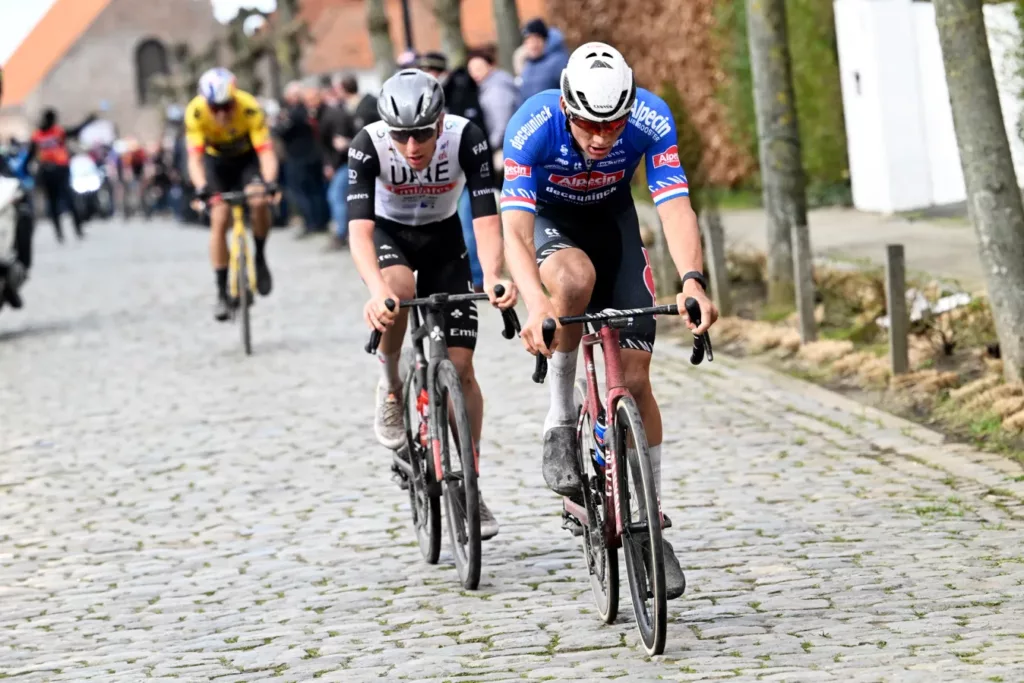
The winners list tells the story of the race almost by itself. Recent winners are:
- 2025 – Tadej Pogačar
- 2024 – Mathieu van der Poel
- 2023 – Tadej Pogačar
- 2022 – Mathieu van der Poel
- 2021 – Kasper Asgreen
- 2020 – Mathieu van der Poel
- 2019 – Alberto Bettiol
- 2018 – Niki Terpstra
- 2017 – Philippe Gilbert
- 2016 – Peter Sagan
- 2015 – Alexander Kristoff
- 2014 – Fabian Cancellara
- 2013 – Fabian Cancellara
- 2012 – Tom Boonen
- 2011 – Nick Nuyens
- 2010 – Fabian Cancellara
Go further back and the list becomes even more loaded. Riders such as Johan Museeuw, Eddy Merckx, Tom Boonen and Fabian Cancellara helped define entire eras of the race. Six riders share the record with three wins each: Achiel Buysse, Fiorenzo Magni, Eric Leman, Johan Museeuw, Tom Boonen and Fabian Cancellara. That shared record says something important too. Flanders is so difficult, and so tied to eras of route design and tactical style, that even the very greatest rarely dominate it endlessly.
-
 Photo Credit: Cor Vos
The champions who shaped its identity
Every major period of the race seems to have had its own reference figures. Fiorenzo Magni’s three wins in the late 1940s and early 1950s gave the race one of its first great repeat champions. Eddy Merckx winning twice confirmed that Flanders belonged on the palmarès of cycling’s biggest all-round stars. Johan Museeuw became almost inseparable from the race in the 1990s, while Tom Boonen turned it into one of the central Monuments of his career. Fabian Cancellara then carried that same weight into the 2010s.
More recently, Mathieu van der Poel and Tadej Pogačar have helped give the race a new kind of high-profile rivalry. Their wins have reinforced what the modern route still demands – not just raw strength, but the ability to use it at exactly the right moment on the right climb. Even in an era of highly controlled racing, Flanders still has a way of forcing the strongest riders into the open.
What Men’s Ronde van Vlaanderen represents now
Today, Men’s Ronde van Vlaanderen sits at the point where history, regional identity and modern racing all meet. It is one of the oldest major races in the sport, one of the biggest one-day targets on the calendar, and still one of the most tactically rich. The 2026 route details again show the familiar formula: Antwerp start, Oudenaarde finish, and a finale built around the bergs and cobbles that make the race so distinct.
That is what makes its history worth knowing. Men’s Ronde van Vlaanderen is not simply a famous old race that survived. It is a race that has kept renewing itself while staying true to its essential character. The roads and climbs may change in emphasis, and the finishing patterns may evolve, but the core challenge remains the same. To win Flanders, a rider has to be strong enough, sharp enough and brave enough to master chaos better than everyone else.
For more on how it fits into the wider spring, ProCyclingUK’s Beginner’s guide to E3 Saxo Classic 2026, A brief history of Men’s In Flanders Fields and A brief history of Men’s Dwars door Vlaanderen are the best next reads.

