E3 Saxo Classic 2026 felt important before the race had even reached its decisive phase, because it arrived with the usual reputation as the clearest dress rehearsal for the Ronde van Vlaanderen 2026. It felt even more important afterwards because Mathieu van der Poel won it in a way that sharpened several storylines at once. He took a third straight E3 title despite still dealing with the hand injury he suffered at Milan-San Remo, and he did it after looking vulnerable enough in the closing kilometres for the race to briefly feel open again. Then the chase hesitated, the moment passed, and Van der Poel won anyway.
That combination is what gives the race real seasonal meaning. This was not a routine demolition from a rider who never looked under pressure. Nor was it a defeat that suggested the balance of the cobbled spring had suddenly shifted. Instead, E3 Saxo Classic 2026 showed something more useful than either extreme: Van der Poel is still the rider the rest have to beat, but he is not beyond being stressed, isolated or dragged into the red if the race around him is judged well enough. That broader spring context also links naturally with ProCyclingUK’s E3 Saxo Classic 2026 team-by-team guide and the Men’s In Flanders Fields 2026 contenders preview.
Van der Poel is still the benchmark, even when less than perfect
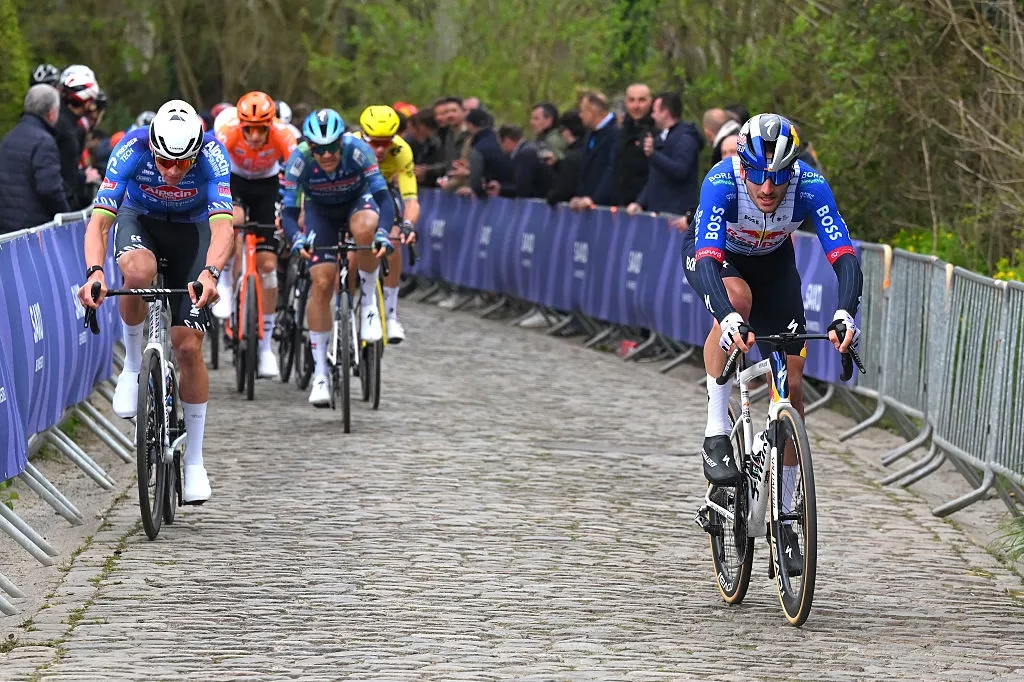
The first and most obvious conclusion is that Van der Poel remains the central reference point for the cobbled spring. That was already broadly true before Friday, but E3 reinforced it in a more convincing way than a simple, clean solo would have done. He came into the race with a hand injury serious enough to have affected his grip at Milan-San Remo, and reporting in the build-up made clear he was still feeling it during recon earlier in the week. Even so, he won the biggest Flanders-style race held so far this spring.
That matters because it shifts the conversation away from ideal-condition dominance and towards resilience. A fully fit Van der Poel winning E3 would have told us he was in form. An injured or compromised Van der Poel winning E3 says something harsher to the rest of the field: even when conditions are not perfect for him, he can still be the strongest or, at the very least, the most decisive rider in the race.
For the rest of the season, that means rivals cannot rely on the hope that a disrupted preparation or a minor physical issue will naturally bring him back to the pack. If they want to beat him at De Ronde or Paris-Roubaix, they will probably have to beat him properly.
The race also showed he can still be pressured
That said, E3 did not say Van der Poel is untouchable. One of the most revealing parts of the race came in the final kilometres, when the gap visibly shrank and the chase looked as though it might bring him back. The live race discussion and post-race reaction focused heavily on the hesitation behind him, and that is the key analytical point. Van der Poel was close enough to being caught that the finish briefly became a test not just of his strength, but of the quality of the pursuit behind him.
That is useful for the rest of the spring because it identifies the kind of pressure that still matters against him. He can be made to wobble, at least relatively speaking, if the race behind him is cohesive and ruthless enough. The problem on Friday was not that nobody had the legs to challenge him. It was that the final organisation behind him broke down at exactly the wrong moment.
So the lesson for rivals is not that Van der Poel cannot be beaten. It is that beating him requires collective clarity as well as individual strength. If the next race becomes tactical too early, or if several contenders start riding for the podium instead of the win, he remains the rider most likely to profit.
 Photo Credit: Getty
E3 still matters as a Flanders guide, but not in the old way
Pre-race analysis had already made the case that Tadej Pogačar has changed E3’s old status as the definitive Tour of Flanders form guide. That is fair, partly because Pogačar’s selective race calendar and disruptive style mean the exact overlap between Harelbeke and Oudenaarde is no longer as neat as it once was. But Friday still proved that E3 matters, just in a slightly more nuanced way.
It still tells you who is handling the terrain, who is reading the race well, and who can survive repeated cobbles and climbs in the final third of a hard Belgian one-day race. What it no longer guarantees is a straight line from Harelbeke to the Ronde van Vlaanderen result. Flanders is longer, bigger, more chaotic and more likely to attract additional layers of aggression.
So what E3 Saxo Classic 2026 means for the season is not that Van der Poel is now certain to win De Ronde. It means he has again established himself as the rider most likely to shape it.
The absence of Van Aert mattered, and it still matters now
One of the awkward truths about reading E3 this year is that the race was missing one of its most important reference points. Wout van Aert did not start, with Team Visma | Lease a Bike having already confirmed beforehand that his next race would be In Flanders Fields rather than E3.
That absence matters because Van Aert is one of the few riders whose best version consistently changes the tactical rhythm of these races. Without him, the race lost one of the most credible rivals to Van der Poel on exactly this kind of terrain. That does not cheapen Van der Poel’s win, but it does make the wider seasonal reading slightly more complicated.
In practical terms, E3 told us a great deal about Van der Poel and the level of the chasing contenders, but it did not fully answer the Van der Poel versus Van Aert question for this spring. That means the next races still carry extra value, because one of the biggest variables in the cobbled season has not yet been properly tested in direct comparison. That is part of why the How to watch Gent-Wevelgem Women 2026 in the UK guide and the In Flanders Fields build-up matter as more than stand-alone pieces. They now sit inside a bigger question about the balance of power.
 Photo Credit: Getty
Mads Pedersen’s comeback is real, even without the win
There is another important thread running through E3, and that is the continued confirmation that Mads Pedersen is back much sooner, and much stronger, than many expected. Pre-race coverage had already highlighted both his accelerated return from injury and his aggressive attitude towards that comeback. E3 did not produce the headline win for him, but it reinforced that he belongs right back in these conversations.
That matters for the season because Pedersen is exactly the sort of rider who can exploit a race if the biggest names focus too heavily on one another. He does not need a pure bunch sprint, and he does not need a solo from 40km. He simply needs a hard enough race that his combination of endurance and finishing speed becomes decisive.
So one of the quieter lessons of E3 is that the cobbled spring probably has a stronger second line than it first appeared. Van der Poel may still be the benchmark, but he is not standing alone above a weak field.
The route mattered, and so does what it suggests
This year’s E3 route was slightly tougher and more layered than before, with an extra ascent of the Oude Kwaremont and a second passage of the E3-Col among the key tweaks. Reporting before the race made clear that the organisers were not presenting it as dramatically harder overall, but the increased density of climbs in the critical phase still contributed to the kind of selective, attritional race E3 is known for.
That matters when reading forward into the rest of the season. The harder the race becomes, the less room there is for bluffing. E3 once again rewarded riders with genuine Flanders-level condition, not merely strong early-spring form. In that sense, it worked as a useful filter.
If a rider was exposed here, that exposure probably means something. If a rider looked strong here, that almost certainly means something too.
-
 Photo Credit: A.S.O./Charly López
The biggest seasonal takeaway is psychological
The clearest tactical lesson is that Van der Poel can still be pressured if the pursuit behind him stays committed. The clearest physical lesson is that his injury has not stopped him winning. But the biggest lesson may be psychological.
E3 Saxo Classic 2026 told the rest of the peloton that Van der Poel remains the rider around whom the cobbled spring is still organised. Even when he looked vulnerable, he still won. Even when the race gave others a window, they could not turn it into a result.
That changes how future races are ridden. Rivals now know two things at once: he is still strong enough to beat them, and he is beatable only if they stay fully committed to the catch. That is a hard balance to hold under pressure, especially in races where everyone also has their own podium, points and season goals to think about.
What E3 Saxo Classic 2026 means for the season
In the simplest terms, E3 Saxo Classic 2026 means the cobbled spring still runs through Mathieu van der Poel. It also means the gap between dominant and beatable is smaller than the final result alone suggests. He won, so the headline says continuity. But the way he won says opportunity still exists for those strong enough, and disciplined enough, to take it.
For the weeks ahead, that is probably the right way to read the season. Van der Poel is still the favourite’s favourite. Van Aert remains a missing but crucial part of the picture. Pedersen looks like a genuine threat again. And the races to come will not be decided simply by who has the best legs, but by who can turn brief moments of vulnerability into something real. For readers moving through the rest of the spring on ProCyclingUK, this piece sits naturally beside the How to watch Ronde van Vlaanderen 2026 in the UK guide and the wider cobbled-to-Ardennes coverage.