
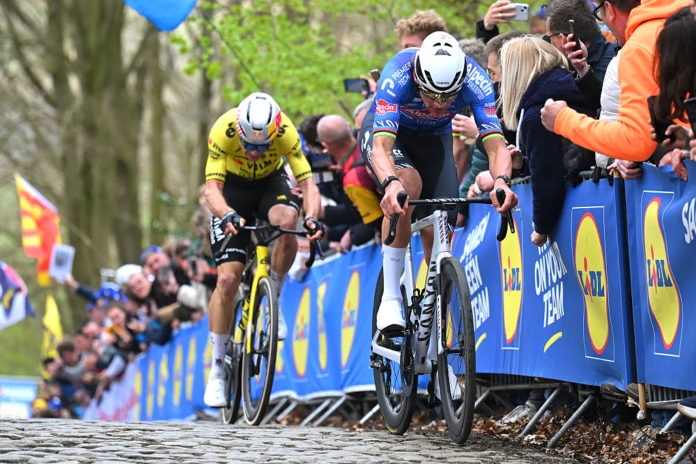
Jasper Philipsen of Alpecin-Premier Tech won In Flanders Fields 2026 on Sunday after a remarkable finale in Wevelgem saw the late escape of Mathieu van der Poel and Wout van Aert finally brought back inside the final 2km. What had looked, at one stage, like a head-to-head duel between the two biggest names in the race turned into a very different finish as the chase closed fast, Alec Segaert bridged across in the closing kilometres, and Philipsen then proved the quickest in the sprint from the reduced front group.
A calm opening gives way to the first real split
The race began in relatively controlled fashion, at least by the standards of this event. An eight-rider breakaway formed early and was given plenty of freedom, with Dries De Bondt, Julius Johansen, Frits Biesterbos, Camille Charret, Victor Vercouillie, Jules Hesters, Wessel Mouris and Hartthijs de Vries building a lead that pushed beyond five minutes while the peloton remained measured behind.
That calm did not last all day, but it lasted longer than some might have expected. De Moeren, so often the place where the race explodes in crosswinds, did not have enough wind to force the issue decisively. Red Bull-Bora-Hansgrohe raised the pace on the exposed roads and briefly thinned things out, but the bunch largely stayed intact. The more meaningful early damage came instead from crashes and mechanical problems. Laurenz Rex and Max Kanter were both forced out after a fall, while the growing tension around positioning kept several teams under pressure even before the hills arrived.
The first genuine split came later, with around 130km to go, when the peloton unexpectedly broke into two groups of roughly 40 riders and the rest behind. That move mattered because it put several major names in the front section. Van der Poel, Van Aert, Philipsen, Arnaud De Lie, Paul Magnier, Matteo Trentin and Florian Vermeersch were all present there, while Jonathan Milan was among those caught behind.
That front split did not decide the race on its own, but it shaped the remainder of the afternoon. Riders who missed it were forced to chase before the hill phase had even properly begun, and those who made it could approach the key climbs on far better terms.
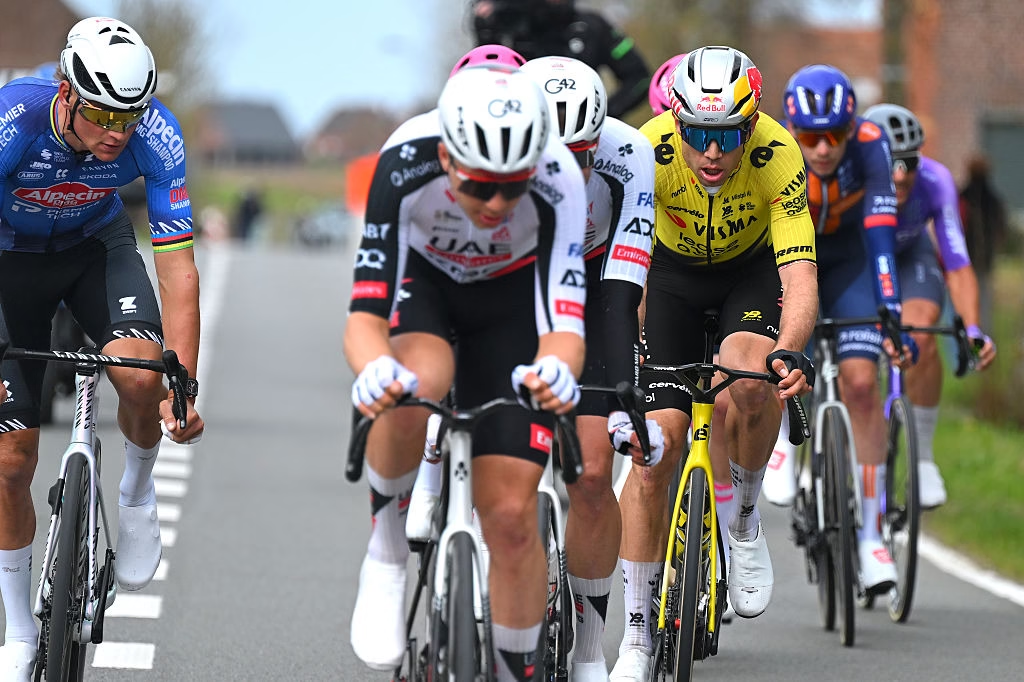 Photo Credit: Getty
The race opens up on the hills and Plugstreets
Once the race reached the climbs, the rhythm changed completely. The Scherpenberg, Baneberg, Monteberg and first ascent of the Kemmelberg did not immediately hand anyone the race, but they stripped away the illusion that this would be controlled by teams for their sprinters. The pace lifted, the peloton stretched, and riders started to go clear in smaller groups.
Van Aert was the first of the main favourites to truly force the issue on the Kemmelberg. He led the bunch up, split it apart, and with Van der Poel and Florian Vermeersch only just able to hold on, bridged into the remnants of the break over the top. That created a new leading group of nine, made up of six from the original escape plus Van der Poel, Van Aert and Vermeersch.
Behind them, Decathlon, Ineos Grenadiers and others attempted to organise the chase, but the race was now in the hands of the strongest riders on the key sectors rather than the teams with the deepest sprint trains. The Plugstreets added another layer of instability. Jasper Stuyven accelerated there, Van der Poel was forced to close one split himself, and Paul Magnier suffered a badly timed mechanical that left him chasing from behind. By that stage, any rider with ambitions of winning needed not just legs, but resilience against the repeated disruptions.
Van der Poel and Van Aert go clear on the Kemmelberg
The decisive move came on the final ascent of the Kemmelberg, this time from the steeper side. The leading group reached it together, but only briefly. Van der Poel took over on the cobbled slopes and immediately reduced the front of the race to just three riders, himself, Van Aert and Florian Vermeersch.
For a moment it looked as if Van der Poel might crack Van Aert there and then. The Dutchman increased the pressure hard enough to drop Vermeersch and almost dislodge Van Aert as well, but the Belgian just about held on and crested alongside him. Vermeersch came over around 10 seconds later, while the peloton was already more than a minute behind.
That was the crucial tactical point of the race. Once Van der Poel and Van Aert were clear together, the finish became a question of whether the two rivals could cooperate well enough to stay away. Vermeersch, trapped between the front pair and the bunch, had little realistic chance of closing the gap on his own, and the chase behind still had too much work to do to look like the main story. For a while, it seemed entirely possible that the race would end in a two-up sprint between the sport’s most familiar rivals.
The race turns again inside the final 20km
The final 20km changed that picture. The peloton, still numbering around 30 riders, began to organise far better than expected. Decathlon were especially prominent in the chase, with support also coming from Lotto and Red Bull-Bora-Hansgrohe. The gap started to come down much faster than the leaders would have liked.
Vermeersch continued his pursuit between the two leaders and the peloton for a while, but was eventually reabsorbed. More importantly, several fast finishers remained in the chasing group. Philipsen was there, as were Tobias Lund Andresen, Jordi Meeus, Biniam Girmay, Christophe Laporte, Davide Ballerini, Matteo Trentin and Anthony Turgis. That gave the chase both motive and firepower. If they could make the catch, the balance of the race would swing firmly away from the two leaders and towards the sprinters who had survived the climbs.
By 15km to go, Van der Poel and Van Aert were only 35 seconds clear. By 10km to go, it was 20 seconds. The change was stark. What had looked like a likely duel at the front now seemed increasingly fragile, and the two leaders could see the bunch behind. For all their pedigree, they were no longer riding towards a private finale. They were trying to hold off a reduced peloton packed with riders who could finish fast.
Segaert adds one more complication before the sprint
The final twist came with around 5km to go when Alec Segaert attacked from the chasing group and bridged across to Van der Poel and Van Aert. It was an outstanding ride, made all the more striking by the timing. Rather than joining them when the move still looked safe, he did so just as the race was tilting back towards the bunch.
That created a strange three-man lead group. Segaert initially did not take turns, which made sense given the threat of the bunch behind, and the gap to the chasers hovered around 10 seconds before shrinking again. Filippo Ganna led much of the charge from behind and, for a moment, the catch looked inevitable.
Inside the final 2km, that became reality. Van der Poel and Van Aert were brought back, and the race suddenly transformed from a selective classic duel into a reduced-group sprint. Segaert tried to salvage something by attacking again under the 1km banner and briefly led alone, but he too was swept up as the sprint trains formed behind him.
Philipsen proves quickest in the sprint
Once the catch was made, the finish became a question of who still had the speed after such a hard race. Philipsen and Andresen were the two names most obviously in the frame as the sprint opened, and it was Philipsen who handled the chaos best. With Van der Poel and Van Aert no longer clear, Alpecin-Premier Tech still had their other winning card in the race, and Philipsen finished the job.
It gave the Belgian a major victory from a reduced front group after a race that had repeatedly shifted shape, first around the splits before the hills, then on the Kemmelberg, and finally again in the last 10km when the bunch refused to concede.
For Van der Poel and Van Aert, there will be frustration. Their move was good enough to break the race open, but not quite good enough to stay clear to Wevelgem. For the teams behind, the key was persistence. They kept enough fast riders in contention, organised the chase at the right moment, and turned what looked like a lost cause into a sprint they could actually win.
2026 In Flanders Fields Men Result
Results powered by FirstCycling.com
Main photo credit: Getty

