
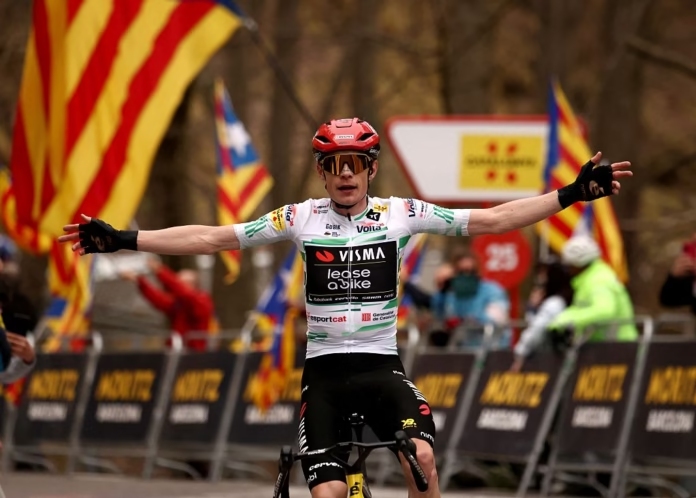
Jonas Vingegaard of Team Visma | Lease a Bike won stage 6 of the 2026 Volta a Catalunya on Saturday, attacking late on the final climb to Queralt to take his second consecutive mountain stage victory and strengthen his grip on the overall race lead. Lenny Martinez of Bahrain Victorious finished second on the stage ahead of Florian Lipowitz of Red Bull-Bora-Hansgrohe, while Remco Evenepoel was distanced in the decisive final kilometres after an aggressive ride across the penultimate descent and onto the summit finish.
A disrupted start gives way to a violent opening hour
Stage 6 was meant to be the final major mountain test of this year’s race, and even before the start there was a sense that it would not unfold quietly. The route had already lost some earlier high-mountain severity because of bad weather elsewhere in the week, but this was still a 158.2km stage with four categorised climbs, more than 3,600 metres of climbing, and an uphill finish to the Santuari de Queralt.
The race also began with more damage to the start list. Tom Pidcock did not start because of the knee injury he suffered after his crash the previous day, while six riders had already abandoned on stage 5. That left a peloton of just 146 riders.
Even then, the stage did not begin cleanly. Michel Hessmann crashed in the neutral zone, required a neck brace and stretcher, and the race was briefly stopped so the ambulance could take him to hospital. Once racing finally began, the tone changed immediately.
There was no calm opening phase. Baptiste Veistroffer was quickly on the move again, joined by Jonas Hvideberg, before the attacks escalated and the race began to fragment almost at once. Several splits opened before any move properly settled, and at one point Jonas Vingegaard himself was caught in a second split while many of his main GC rivals were up the road. That alone showed how hard the opening hour had been ridden.
Soudal-QuickStep appeared especially keen to force the race through Pascal Eenkhoorn, clearly trying to set up Filippo Zana for a move into the break. Instead, the stage kept mutating.
-
 Photo Credit: Getty
The key break forms, and the KOM battle sharpens
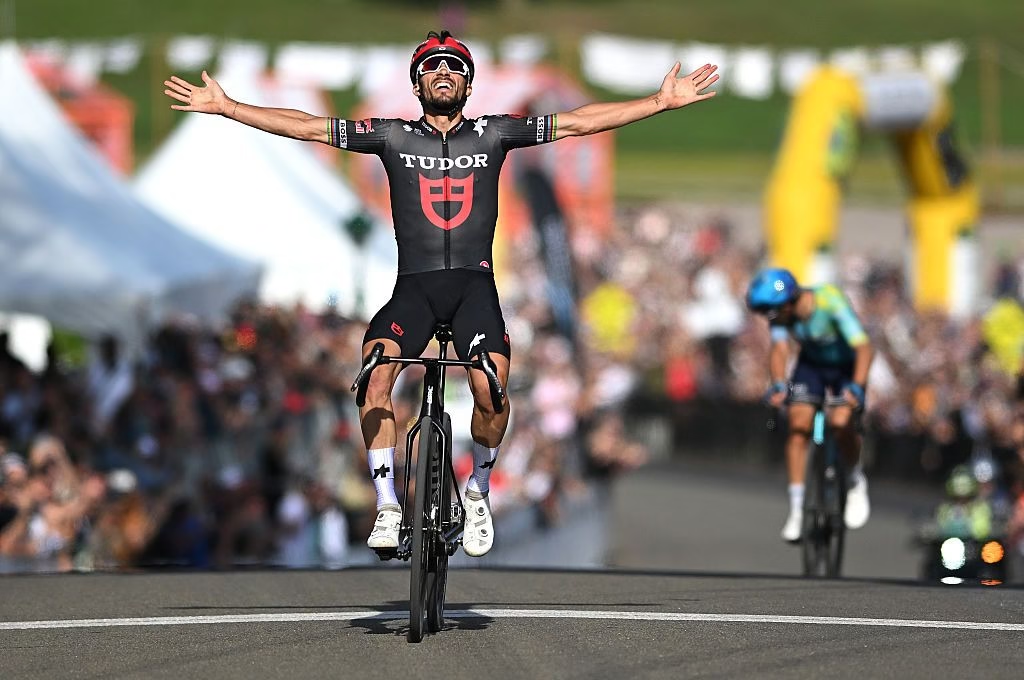
Eventually a dangerous front group did form. Marc Soler and Byron Munton were first to gain daylight, and then they were joined by a large bridge group featuring Mattia Cattaneo, Brandon McNulty, Bart Lemmen, Giulio Ciccone, Andrea Raccagni Noviero, Michael Leonard, Nairo Quintana, Embret Svestad-Bårdseng, Andreas Leknessund, George Steinhauser, Jake Stewart and others.
By the time the situation stabilised, the lead group contained major climbers, dangerous break specialists and, crucially, Giulio Ciccone. That mattered because Veistroffer had missed the move, and the mountains competition suddenly opened up.
The break’s composition became clearer as the day settled. Soler, Carapaz, Cattaneo, Lemmen, Ciccone, Staune-Mittet, Quintana, Howson, Uriarte, Munton and others were represented, and the move quickly built more than two minutes. With the first proper climb, the Coll de la Batallola, still to come, the peloton had a choice to make. Visma-Lease a Bike chose not to panic. They controlled rather than chased wildly.
That gave the break enough room to matter but not enough to become a threat to the overall lead. It also allowed the stage to develop two parallel stories. One was the GC battle. The other was the KOM fight between Veistroffer and Ciccone.
Ciccone took maximum points on the Coll de la Batallola ahead of Soler and Quintana, moving to within one point of the mountains lead. From there, the stage naturally bent towards the next decisive location, the Coll de Pradell, the Especial climb that offered the biggest points haul of the day and the hardest gradients before the finish.
Soler attacks, Ciccone follows, and the race begins to fracture
The Coll de Pradell was where the break finally broke apart. Soler and Munton attacked first, forcing a split among the leaders, with Cattaneo trying to organise the chase behind. Then Soler dropped Munton, and Ciccone, Carapaz and Svestad-Bårdseng came across to him in a strong four-man selection.
Behind them, the peloton was steadily shrinking under the pace of Visma-Lease a Bike. UAE Team Emirates-XRG were losing riders. Carlos Rodriguez was dropped. João Almeida also began to lose touch. The climb was not just sorting out the breakaway. It was quietly exposing the limits of several riders further back.
At the front, Soler and Ciccone fought over the top of the Pradell in what was effectively a photo finish for the KOM points, with Svestad-Bårdseng and Carapaz following. Ciccone did not need to win the climb outright to make the mountains competition swing. By the time the points were eventually confirmed, Soler had taken the maximum 26 and Ciccone 20, but the Italian’s steady accumulation across the day meant he had still moved into the overall KOM lead.
That was one of the stage’s most important side plots. Veistroffer had started the day in red, but once he missed the decisive move, his position became vulnerable. Ciccone took advantage exactly as he needed to.
Evenepoel splits the race on the descent and creates the winning group
If the Coll de Pradell and Collada de Sant Isidre were the hardest climbs on paper, the most tactically important part of the stage may have been the descent and transition after them. Ciccone attacked again on the Sant Isidre, Carapaz initially followed, and Soler and Svestad-Bårdseng tried to hold on. Behind, the peloton was being thinned hard by Red Bull-Bora-Hansgrohe.
Oscar Onley attacked from the reduced bunch. Then Lipowitz, Martinez, Gall and Paret-Peintre moved as well. None of those accelerations immediately blew the group apart, but they kept the race under pressure. Then Remco Evenepoel took over.
Once over the top of the Sant Isidre, Evenepoel led the descent so aggressively that the GC group was cut to pieces. Riders such as Uijtdebroeks, Onley and Riccitello started to lose contact. Gall and Skjelmose, both well placed overall, were among the major losers as the front group surged clear. The breakaway remnants were swept up in that same violent passage, and suddenly the stage had changed from breakaway chess into a direct GC war.
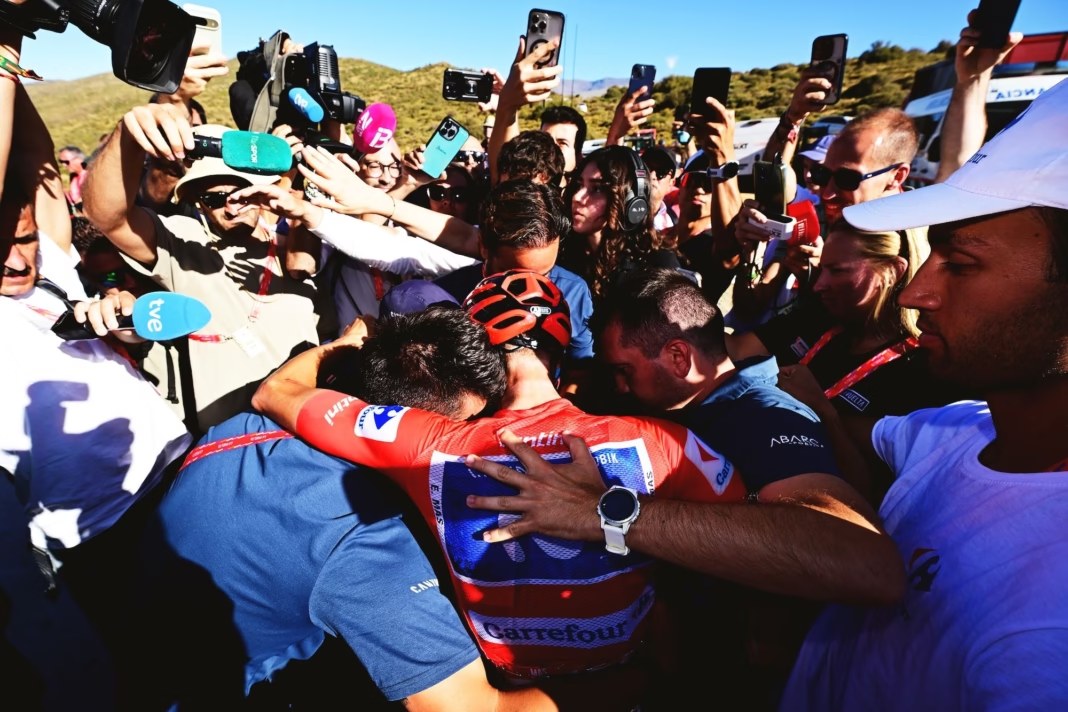
With 10km to go, the decisive front group consisted of Vingegaard, Lipowitz, Martinez, Paret-Peintre, Evenepoel, Carapaz and Bahrain’s Afonso Eulalio, who had emptied himself on the front for Martinez. That group reached Berga together, took the intermediate sprint, and then hit the final climb to Queralt with the stage win and the biggest time gaps of the day on the line.
-
Photo Credit: Getty
Vingegaard waits, then strikes twice
The final climb to Queralt was only 5.9km long, but after almost four hours of hard racing it was steep enough to settle everything. Carapaz was the first to fade from the front group, and Eulalio soon swung off after his long pull. That left Vingegaard, Martinez, Lipowitz, Paret-Peintre and Evenepoel as the five realistic candidates for the stage.
Evenepoel did much of the early pacing, with Lipowitz on his wheel, but the balance of power had already shifted. Vingegaard had looked calm rather than passive all day, and once the road turned properly uphill he only needed one clear opening.
His first acceleration was seated and sharp enough to drop Evenepoel and Paret-Peintre immediately. Lipowitz and Martinez managed to respond at first, but it was already obvious the race leader had the best legs. Then came the second move, out of the saddle and far more decisive. That one finally broke the elastic. Lipowitz and Martinez hesitated just enough, looked at each other just enough, and Vingegaard was suddenly gone.
By the flamme rouge, the gap was still small, around seven seconds, but it was already enough. Vingegaard kept pressing and extended his lead all the way to the line. He took the stage cleanly and without any real threat of being caught in the final few hundred metres.
Martinez won the sprint for second ahead of Lipowitz, which mattered almost as much as the stage itself given the GC consequences. Paret-Peintre followed, then Evenepoel, who paid for his long effort earlier in the finale.
The GC picture changes again
The stage did more than hand Vingegaard another summit finish. It widened the overall race in important ways. Martinez’s second place moved him into second overall, while Lipowitz also gained ground. Evenepoel climbed a place too, but the time loss on the final ascent left the impression of a rider who had raced boldly but not quite effectively enough.
Gall was one of the day’s major casualties. After his strong ride the previous afternoon, he lost heavy time because of the descent split before Queralt and dropped to sixth overall. Skjelmose also slipped back, while Vingegaard now carried a much firmer advantage into the final day.
This was not quite the same kind of overwhelming mountain stage performance as at La Molina. It was more complicated than that, with the breakaway, the KOM battle and the descent all shaping the outcome. But when the moment came to decide the stage, Vingegaard still ended it the same way he had ended the previous one – by riding away from everyone else.
Volta a Catalunya 2026 stage 6 Result
Results powered by FirstCycling.com

