
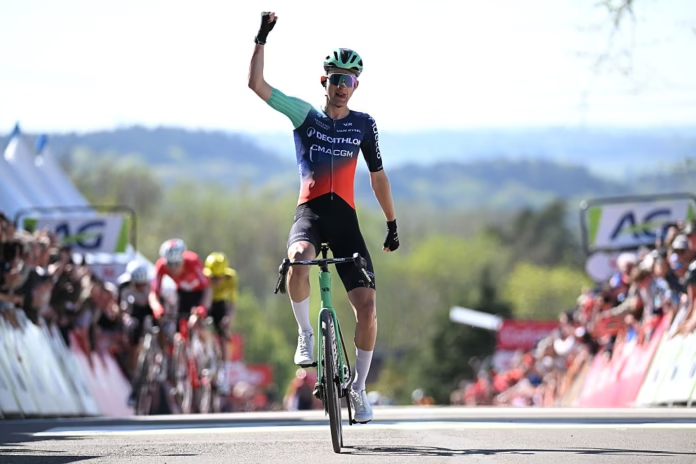
Men’s La Flèche Wallonne 2026 was won by Paul Seixas after the 19-year-old Decathlon-CMA CGM rider delivered a commanding performance on the Mur de Huy. Already one of the sensations of the spring after his overall victory at Itzulia Basque Country, Seixas arrived in Wallonia carrying expectation and left with a landmark Ardennes victory.
The Frenchman led onto the final climb from the front, resisted the early pressure from Ben Tulett of Team Visma | Lease a Bike, then surged clear with around 200 metres remaining. Mauro Schmid of Jayco-AlUla came through late to take 2nd, three seconds down, with Tulett fading to 3rd after being one of the few riders able to stay close to Seixas deep into the climb.
Benoît Cosnefroy of UAE Team Emirates-XRG finished 4th, while Mattias Skjelmose of Lidl-Trek completed the top five. The day belonged to Seixas, who became the youngest winner in the 90-year history of the race, taking that record from inaugural 1936 winner Philémon De Meersman.
“This is truly unbelievable. Last year, I was still watching the TV broadcast of this race. Now I am here, and I’ve won it. But as I said, this is a victory for the team.”
A fast start before a six-rider break settles the race
The 90th edition of the men’s La Flèche Wallonne followed the familiar pattern of the Walloon midweek Classic, with 200km from Herstal to the Mur de Huy and close to 3,000 metres of climbing across the rolling Ardennes roads. The route was built around three ascents each of the Côte d’Ereffe, Côte de Cherave and Mur de Huy, giving the race a controlled rhythm early on before the repeated climbs of the final circuit.
Alexey Lutsenko was the only non-starter, and the race began with 174 riders. The opening attacks came quickly, with TotalEnergies among the first teams trying to spark the breakaway. After an early two-rider move was caught, a more serious escape formed with Sjoerd Bax of Pinarello-Q36.5, Andreas Leknessund of Uno-X Mobility, Vincent Van Hemelen of Flanders-Baloise, Jakub Otruba of Caja Rural-Seguros RGA, Jardi Christiaan van der Lee of EF Education-EasyPost and Alan Jousseaume of TotalEnergies.
The peloton accepted the composition of the move, allowing the six riders to build a lead of around 2:30 and then three minutes as they pushed south-west of Liège towards Huy. UAE Team Emirates-XRG, Tudor, Lidl-Trek, Ineos Grenadiers and Decathlon-CMA CGM all took early responsibility behind, making sure the break never gained a race-changing advantage.
The first hour was ridden at more than 44kph, a sign that the bunch had no intention of letting the day drift. The break could choose its lines on the rolling descents, but the peloton remained close enough to manage the race on its own terms.
Seixas carries the weight of expectation
Much of the pre-race attention was fixed on Seixas. At 19 years and 210 days old, he was the youngest rider on the start list and already the standout French talent of the season. His victory at Itzulia Basque Country had turned him from a promising rider into a genuine WorldTour reference point, and that changed the way the race was expected to unfold.
Before the start, Seixas had tried to lower expectations, saying he had come to test himself on this type of effort rather than arriving with an obligation to win. Yet he also made clear that he had worked specifically on the explosive demand of the Mur de Huy, a climb that does not simply reward climbing strength, but timing, positioning and the ability to keep producing power when the gradient bites hardest.
“I specifically worked on this before Pays Basque. I don’t know how good I will be compared to the rivals I’ll face in Huy, but I know I can do well.”
There were other contenders with strong claims. Kévin Vauquelin of Ineos Grenadiers arrived after finishing 2nd in the previous two editions, while Cosnefroy had UAE Team Emirates-XRG support and Skjelmose represented Lidl-Trek’s best option. Even so, the tactical gravity of the race increasingly pointed towards Decathlon-CMA CGM and their teenage leader.
The first circuit reduces the margin
The race began to sharpen as the Côte d’Ereffe approached with around 100km remaining. Decathlon-CMA CGM lifted the pace, bringing the break’s lead down to around two minutes. The first ascent of the Côte d’Ereffe gave the peloton its first proper look at the closing circuit, while the break continued to hold together at the front.
Jousseaume led over the first ascent of the Côte d’Ereffe with around 95km to go, and Van Hemelen took the break over the Côte de Cherave. The first passage of the Mur de Huy saw the six attackers cheered through by large crowds, but it also showed the strain beginning to build. Van Hemelen was soon distanced, leaving five riders to continue up the road.
Behind them, the peloton began to split and reform under pressure. Raúl García Pierna tried to open the race on the easing gradient after the Mur, while Movistar and other teams attempted to disrupt the controlled pattern. Julian Alaphilippe, a three-time winner of the race, was dropped around this phase, a reminder of how unforgiving the repeated climbs had become.
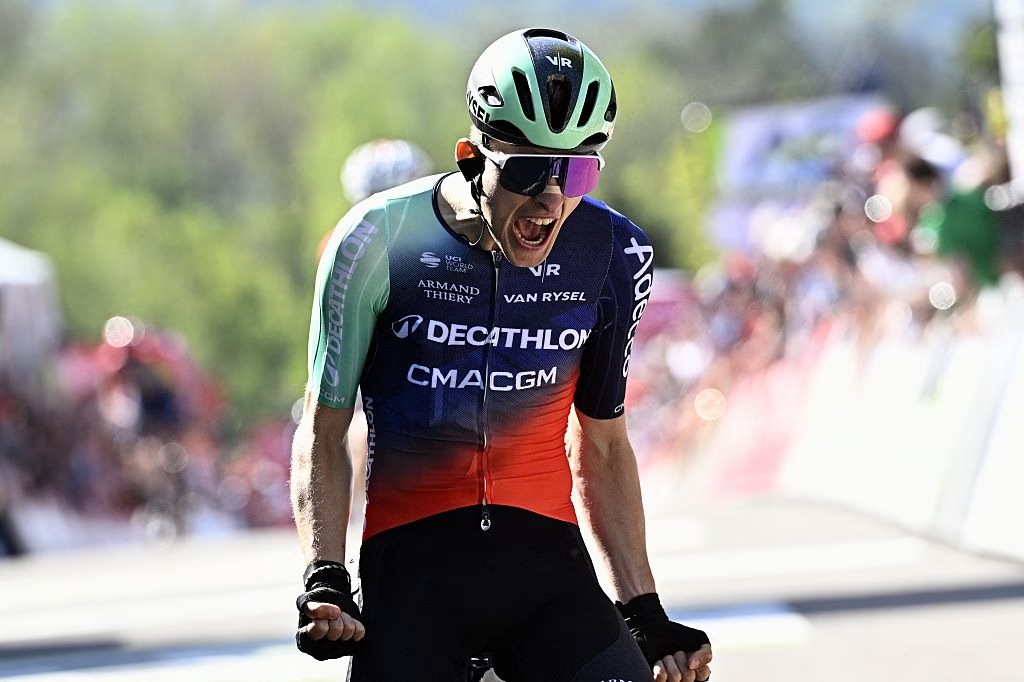 Photo Credit: Getty
Crashes and crosswinds raise the tension
Crosswinds on the exposed hilltop roads added another layer to the race. Lidl-Trek used a half-road echelon to stress the peloton, lining the bunch out and forcing riders to fight for position long before the final Mur de Huy.
The second passage of the Côte de Cherave brought the gap to the break below a minute. On the descent that followed, Tobias Halland Johannessen of Uno-X Mobility and Finn Fisher-Black of Red Bull-Bora-Hansgrohe crashed at speed, with Johannessen forced into a bike change before chasing back. The incident added to the sense of unease as the race moved towards its final lap.
Further chaos followed around 20km from the finish. Marc Hirschi was among the riders caught in a multi-rider crash, appearing to hurt his shoulder, while Brandon Rivera and Anton Schiffer were also involved. A separate moment saw Axel Laurance give his bike to Ineos Grenadiers leader Vauquelin, leaving Laurance to run down the road while waiting for his own replacement.
These interruptions did not stop the front of the race from accelerating. Leknessund, Van der Lee and Bax continued to defend their margin, with Otruba also fighting on, but the peloton was closing fast and the break’s survival was becoming increasingly unlikely.
Leknessund fights on alone before the final climbs
On the final lap, the break began to fragment. Leknessund pushed on alone from the move, while Bax, Van der Lee and Otruba slipped back towards the peloton. With 15km remaining, the Norwegian still had close to 30 seconds, but the chase behind was now much more organised.
French teams came to the fore in the final 10km. Decathlon-CMA CGM massed near the front to protect Seixas, while Groupama-FDJ United also committed riders to the run-in. Leknessund reached the Côte de Cherave still ahead, but the gap was only around 15 seconds. Once he took a drink on the climb, the peloton swept him up with 7.5km to go.
That left the favourites in control. The Côte de Cherave narrowed the options without producing a decisive move, and Ewen Costiou tried a flyer on the approach to the Mur de Huy. The attempt was short-lived. Red Bull-Bora-Hansgrohe took over late, with Jan Tratnik helping position their riders, while Decathlon-CMA CGM kept Seixas in the front places.
Seixas leads from the front on the Mur de Huy
Position was everything at the base of the Mur de Huy. The peloton still contained around 60 riders as it dropped towards the Meuse and swung into the final climb, but only a handful were genuinely in the right place once the gradient ramped up.
Seixas was exactly where he needed to be. He led from the bottom, with Tulett alongside him in the early metres. Schmid and Cosnefroy followed closely, but the climb quickly narrowed into a contest of pure strength and timing.
The decisive acceleration came around 200 metres from the finish. Seixas lifted the pace on the steepest part of the Mur and opened a clear gap. Tulett, who had looked well placed, could not hold the wheel. Behind them, Schmid found a late burst and came past the Briton in the dying metres to take 2nd, but Seixas was already clear.
“The last climb was hard. I tried to pace it, to use my power because I know I’m strong when it’s hard. I saw they were struggling behind, so I just went full gas to the line.”
Seixas crossed the line alone, pointing to his chest as he celebrated a victory that confirmed the scale of his spring breakthrough. After winning the overall at Itzulia Basque Country, he had now added one of the Ardennes Classics, and done so in a way that suggested the pressure around him had not weighed heavily at all.
A podium of three different stories
The final podium told three different stories. Seixas represented the arrival of a new French star at the very top of one-day racing. Schmid’s 2nd place was a sharp late rescue from Jayco-AlUla, built on timing and a strong finish after others had faded on the Mur. Tulett’s 3rd confirmed his quality on steep Ardennes terrain, even if the final metres cost him a higher step.
Cosnefroy’s 4th continued UAE Team Emirates-XRG’s presence near the front, while Skjelmose’s 5th ensured Lidl-Trek still had a strong result from a race they had tried to shape late with crosswind pressure and positioning. Vauquelin’s hopes were disrupted by the bike-change drama around Laurance, while Alaphilippe and Hirschi, both former winners, were out of contention before the final reckoning.
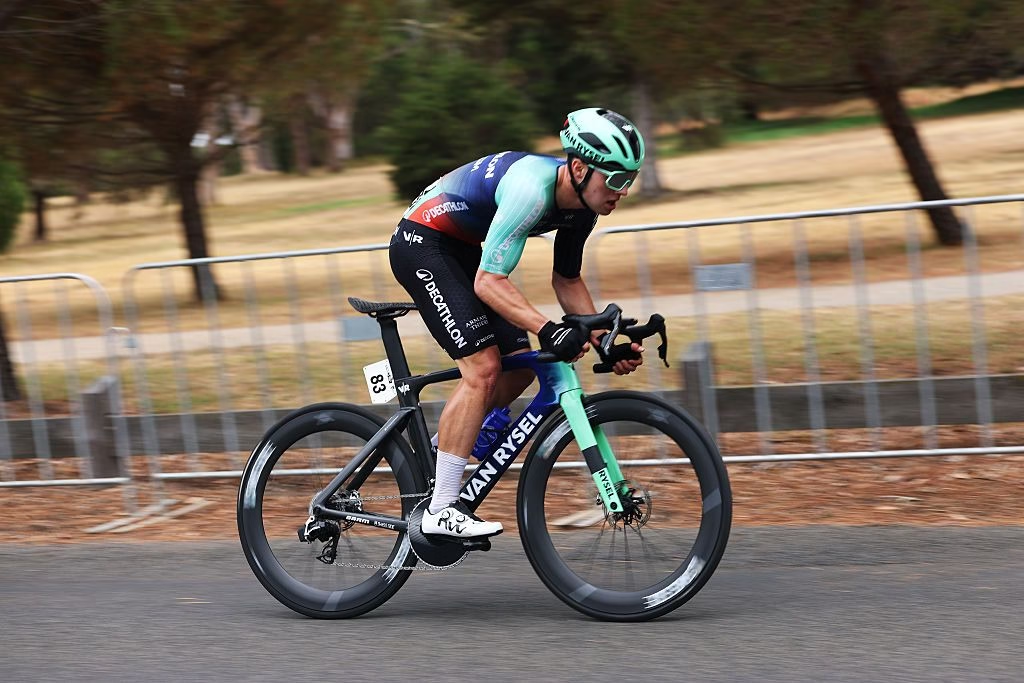
For Seixas, the victory was more than a result. It was another step in a spring that has rapidly changed how the rest of the peloton must treat him. His win also sets up a fascinating Liège-Bastogne-Liège, where the Frenchman is expected to line up alongside Tadej Pogačar and Remco Evenepoel in one of the most anticipated final Classics of the season.
Men’s La Flèche Wallonne 2026 Result
Results powered by FirstCycling.com
Main photo credit: Getty

