
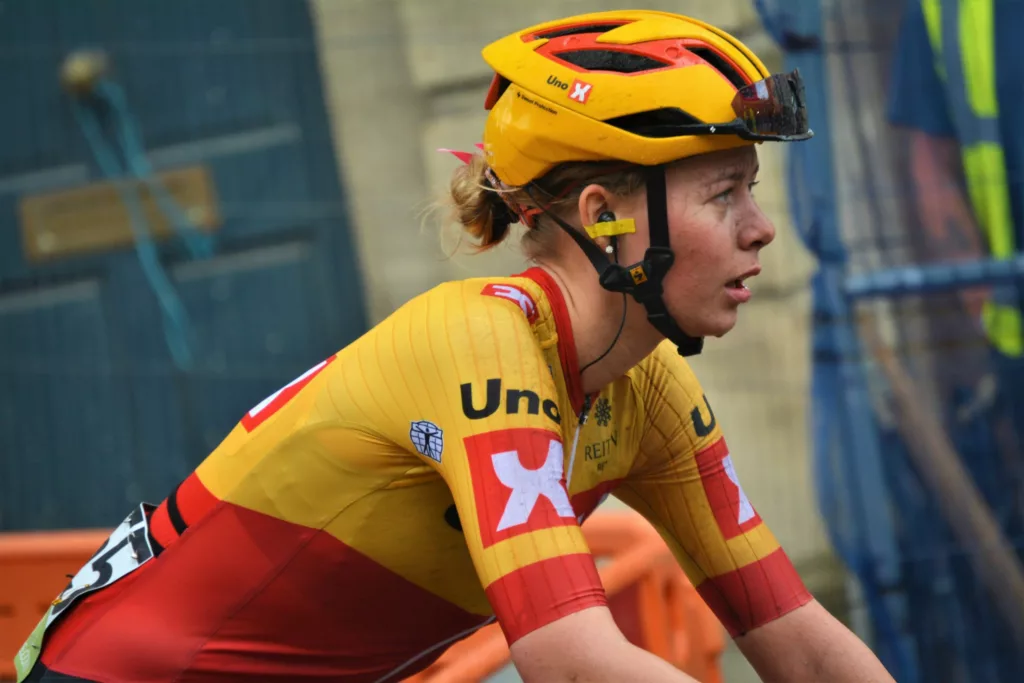
Anne Dorthe Ysland has been forced to retire from professional cycling at the age of 23 after almost four years of battling ulcerative colitis, a chronic inflammatory bowel disease that has made it impossible for her to continue racing at the top level.
The Uno-X Mobility rider, from Trondheim, has followed medical advice to stop professional cycling after years of trying to manage the condition while continuing her career. Ysland had missed large parts of the 2023 and 2024 seasons, rebuilt through 2025 and then travelled to Australia at the start of 2026 to test whether her body could still cope with elite racing. The answer, painfully, was clear.
“The doctors have advised me to stop professional cycling ever since I got the diagnosis of ulcerative colitis,” Ysland said. “I have tried for years to show them that I can make this work, and I have got so much support from the team. But after this season’s opener in 2026, I understood that this couldn’t work out for me.”
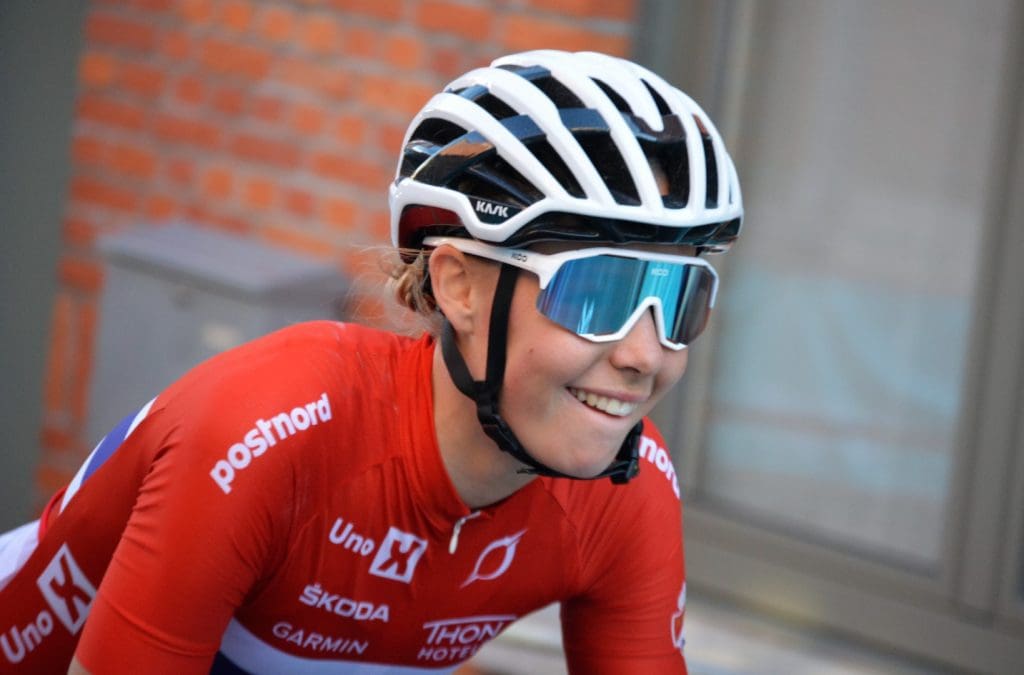
Ysland unable to return to previous level
Ysland first began struggling in the latter part of the 2022 season, at a time when she had looked like one of the most exciting young riders in the peloton. The diagnosis that followed was ulcerative colitis, a chronic inflammatory disease affecting the bowel.
For a long period, medication helped manage the symptoms enough for her to train and race, but it did not stop the illness from progressing. Over time, the inflammation increased, even while she was on treatment.
“For a long time, the medication worked as symptom relief,” Ysland said. “It allowed me to train and compete, and I thought I had things under control. But in reality, the disease was still developing. Eventually, the medication stopped working the way it had before, and my symptoms got worse again.”
After long spells away from racing through 2023 and 2024, Ysland began rebuilding her foundations in 2025. She then had what she described as a good winter of training, at least within the limits of her new health reality, before travelling to Australia for the 2026 season opener.
The experience became the point where hope gave way to acceptance.
“I had stayed positive for so long, but the feeling of racing in Australia was horrible,” she said. “Actually, I didn’t feel like I was participating at all. I had done so much work, I used all the medicine I could to avoid symptoms, but I was still one of the first riders to get dropped. I felt horrible on the training rides and even worse in the races. It was a massive blow that my body didn’t respond to the good work and the good period I had. At that point, I started to give up.”
Health issues made elite training unsustainable
The difficulty for Ysland was not only the symptoms themselves, but the way the illness affected her ability to absorb training. Her body was already using energy to deal with inflammation and general health, meaning that the added stress of elite-level training made the symptoms worse.
Those symptoms included stomach pain and diarrhoea with blood, while the treatment also involved medication that suppressed the immune system. That left her more vulnerable to colds and other infections, adding another layer to the challenge of staying healthy enough to train, recover and race.
“After coming home from Australia, my symptoms became much worse and the medication stopped working the way it had before,” Ysland said. “Following new examinations at the hospital, I was told that the inflammation in my bowel had never been more extensive, even while on full treatment. That was a turning point for me.
“I realised that the medication had mainly been managing the symptoms, while the disease itself had continued to progress. When the treatment stopped working, I had no choice but to take a step back and listen to my body. This, combined with the fact that I wasn’t able to perform at the level required, I knew it was time to stop. I finally understood that I wouldn’t be able to return to my previous level.”
Hushovd pays tribute to one of the peloton’s biggest smiles
Ysland’s retirement is a sporting loss for Uno-X Mobility, but the team’s reaction also made clear the personal impact of her departure. General manager Thor Hushovd described her as one of the brightest personalities in the squad and a rider who continued to support those around her despite the severity of her own situation.
“First of all, we really feel for Anne Dorthe here,” Hushovd said. “She has truly tried everything to get back to racing, and we really wanted to help her get back to her very best. Unfortunately, her health put a stop to that, and we are very sad to lose one of women’s racing’s biggest smiles and best laughs. No matter what hit her, Anne Dorthe kept smiling and helped the team with a great attitude.”
That outward positivity was not always the full picture. Ysland admitted she had spent a long time trying to maintain the appearance of progress, partly because she did not want the illness to define her.
“Outwardly, I stayed positive for a long time,” she said. “Even when my body was struggling, I kept telling people that things were going well. Looking back, I think I was also trying to convince myself. I didn’t want the illness to become my identity or something people constantly associated with me. I just wanted to be seen as a normal athlete again.”
Breakthrough 2022 showed her WorldTour potential
The sadness of Ysland’s retirement is sharpened by how quickly she had appeared to be moving towards the top level. In 2022, her first season with Uno-X, she finished 13th at Omloop Het Nieuwsblad while still only 20 years old.
“How is this even possible?” she remembers thinking at the time. “I was only in my second year as an elite rider, and I felt like a machine.”
That year also brought selection for the Tour de France Femmes, where Ysland created what she now describes as her favourite memory from her career. On the opening stage around the Champs-Élysées, she went in the breakaway and fought for points in the mountains classification while the race took place in front of huge crowds gathered before the men’s Tour de France finale.
“We rode around the Champs-Élysées on the first stage,” Ysland said. “I was in the breakaway and fighting for points for the mountains jersey, and there were so many people cheering us on. We were racing just before the men were finishing their three weeks, so it was absolutely packed with Danish fans cheering for Vingegaard. In the middle of all the chaos, I also had my parents, grandparents and my boyfriend cheering for me.”
Hushovd had known of Ysland even before joining Uno-X, having first encountered her through Equinor’s talent programme when she was still a junior. He said the stories he later heard about her as a professional rider matched the impression he had formed early: energetic, tough and always smiling.
On the women’s side of the team, rainy weather was even referred to as “Anne-Dorthe type of weather”. Hushovd pointed to the 2022 Women’s Tour in Britain as an example of the rider she was.
“During the Women’s Tour in Britain in 2022, the weather on the first stage was terrible,” Hushovd said. “Our team, like all the others, was questioning whether it was safe to sprint because of the technical finish. Ysland, though, never had any doubt. She put all that aside and sprinted to 8th place, still her best WorldTour result. For me, that says a lot about the kind of rider Anne Dorthe is.”
‘Living with my disease is like having an invisible handicap’
Ysland’s symptoms began later that same 2022 season. At first, she hoped the issue could be managed over the winter and that she would return normally the following year. Instead, a short break gradually became a much longer absence, and the rider who had looked so strong in her breakthrough season never fully returned.
Now, as she steps away from cycling, Ysland wants to be open about the reality of living with ulcerative colitis and the invisible burden it can place on an athlete.
“Living with my disease is like having an invisible handicap, and I am not going to be able to remove that,” she said. “Even though I have tried to get back to my best self, to what I performed like in 2022, it is demotivating to see how big a risk it creates for my life outside cycling.
“By pushing as hard as I have, it has sometimes really put me in a worse place than I want to be in. I know it is quite a taboo thing to talk about, but if my symptoms are at their worst, I can’t go outside without knowing I have a toilet close by.”
Ysland also explained how far she went in trying to avoid reaching this point. She initially resisted biological treatment because it would mean long-term medication, instead trying other local treatments first.
“I didn’t want to start biological treatment, as I would need to be on it for life,” she said. “Therefore, I tried every other local treatment there was. I was even so desperate that I fasted for two weeks to give my bowel some rest and stop the bleeding. In the end, I only got worse, and I was admitted to hospital because my blood values were low. I was diagnosed with anaemia, and then I understood that I had to get biological treatment, because by then I had been diagnosed with the chronic illness ulcerative colitis.”
Ysland leaves the professional peloton far earlier than her talent suggested she should have done. Her 2022 season showed a rider with WorldTour durability, bad-weather resilience and the confidence to race aggressively on the biggest stage. Her retirement now is not a question of desire, commitment or support. It is the result of a body that could no longer safely carry the demands of professional cycling.

