
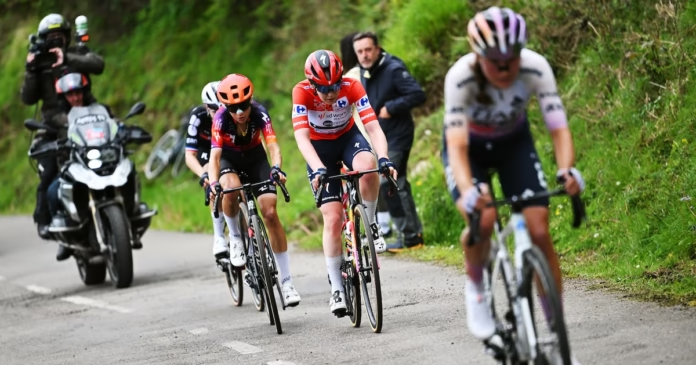
Petra Stiasny climbed to the biggest win of her career on stage 7 of La Vuelta Femenina 2026, timing her effort perfectly on the brutal slopes of the Angliru to take the stage ahead of Paula Blasi. The Spaniard finished second on the day but achieved the bigger prize, securing the overall title and becoming the first Spanish rider to win her home Grand Tour since the race was created in 2015.
Juliette Berthet took third on the stage at 43 seconds, alongside Marion Bunel on the same time, while Anna van der Breggen cracked on the final climb and slipped to fifth on the day at 59 seconds. That was enough to hand the race decisively to Blasi after the first real summit finish on Les Praeres had already weakened the field the previous day.
Aggressive start on the queen stage
The final stage was always going to decide the race. At 132.8km, it was the longest day of the week, the hardest on paper and the one that finished on the Angliru, a climb that can destroy almost any rider even on fresh legs, never mind after six days of racing.
That tension showed straight away. The opening kilometres were aggressive, and the race hit the first climb, Alto de Santo Emiliano, almost immediately. Lidl-Trek made the pace hard early on, splitting the bunch and keeping the speed high enough to discourage any easy move from getting clear.
Eventually, the race did settle, but not before the day had already taken shape. Femke Markus was the first rider to force a meaningful split, Riejanne Markus bridged across to her sister, and then Liane Lippert joined them to form a dangerous three-rider move.
It was an intriguing combination. Femke Markus was no GC threat and could ride freely for SD Worx-Protime, while both Riejanne Markus and Lippert sat close enough on overall to make the peloton pay attention. Lippert in particular became the virtual race leader once the gap grew beyond three and a half minutes.
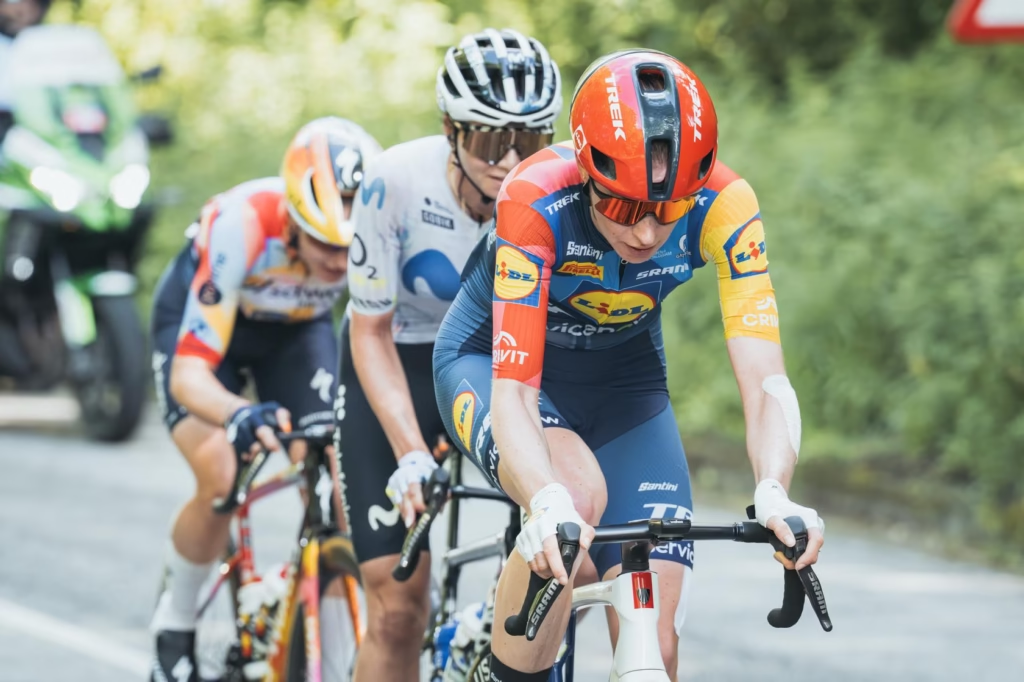 Photo Credit: Toni Baixauli
Lippert and the Markus sisters put pressure on the bunch
The trio worked well and built one of the biggest breakaway leads of the entire week. At one point they were close to four minutes clear, and the pressure fell onto the teams behind to decide whether to keep the stage under control or let the race drift into a more chaotic situation before the Angliru.
FDJ United-SUEZ were visible for long stretches, while Visma-Lease a Bike and later UAE Team ADQ also came through. SD Worx-Protime had a complicated role in all this. With Van der Breggen in red and Femke Markus up the road, they had every reason not to panic, but the presence of Lippert meant the move could not simply be allowed to ride away unchecked.
The stage kept swinging between tension and temporary calm. Riders fed, changed clothing and prepared for what was still to come, but the race never really settled. By the time the break reached the Alto del Tejera and then the steeper Alto del Tenebreo, the advantage was beginning to come down under pressure from the bunch.
Lippert still looked the strongest rider in the move, particularly on the descents, where she often had to wait for the Markus sisters. But once the race hit the more serious climbing, the gap began to melt. The stage was moving away from tactical bluff and towards the point where the best climbers would simply have to show themselves.
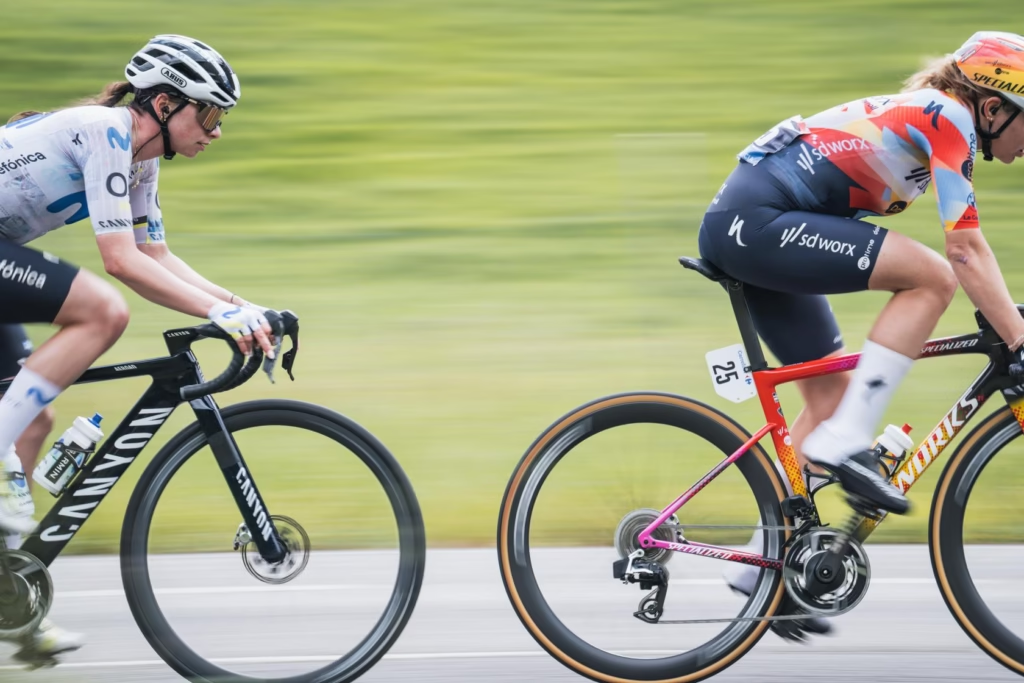 Photo Credit: Toni Baixauli
The penultimate climb starts the selection
The Alto del Tenebreo was the first proper sorting point. UAE Team ADQ, SD Worx-Protime and other major teams massed near the front, and the bunch shrank noticeably. Lippert led over the top of the climb, but the time gap was already dropping, and the break’s chance of survival was clearly fading.
After the descent, there was still no chance to relax. The road kept rising and dipping, and the stage offered an awkward bonus sprint before the final ascent of the Angliru. Koch took that sprint from the bunch, while the break still held enough ground to reach the climb in front, but by then it was obvious the stage would be decided behind them.
Lippert was alone out front by the time the Angliru really began. Both Markus sisters had dropped away, and behind her the favourites’ group was starting to lose domestiques at an alarming rate. Riders who had survived the first six stages well were suddenly being detached one by one.
That included several notable names. Pauline Ferrand-Prévot was already in visible difficulty before the steepest ramps of the Angliru. Lotte Kopecky had been dropped earlier. Even before the main showdown began, it was clear the final climb would be ruthless.
Angliru exposes the race leader
The Angliru remains one of the sport’s great climbing tests for a reason. The official average of 9.7 per cent barely captures how savage it is, because the middle part of the climb is much steeper, with repeated ramps above 20 per cent. On those slopes, pacing becomes everything.
Lippert started the climb alone, but her advantage was never secure. Behind, UNO-X Mobility and others helped drive the chase, and the favourites closed in steadily. Once Lippert was caught, the battle for the stage and the GC began for real.
Petra Stiasny came to the front and set a hard rhythm in a reduced lead group that included Van der Breggen, Bunel, Blasi, Berthet and Cavallar. It quickly became obvious that this was no longer a climb for bluffing or tactical hesitation. Riders were being forced into their limit almost instantly.
The decisive crack came from Van der Breggen. Despite starting the day in red, she began to struggle once the gradient bit deepest. Bunel moved up, sensing weakness, and Blasi also pushed on. Within a few hundred metres, the race leader was in trouble and the whole balance of the Vuelta shifted.
Blasi was the rider who responded most effectively. She moved clear of Van der Breggen and set off after Bunel, while Stiasny continued to ride her own pace at the front. As the climb steepened again, Stiasny came back to Blasi and then edged past her.
From there, the final stage became two races at once. Stiasny was riding for the stage win, while Blasi was riding for history.
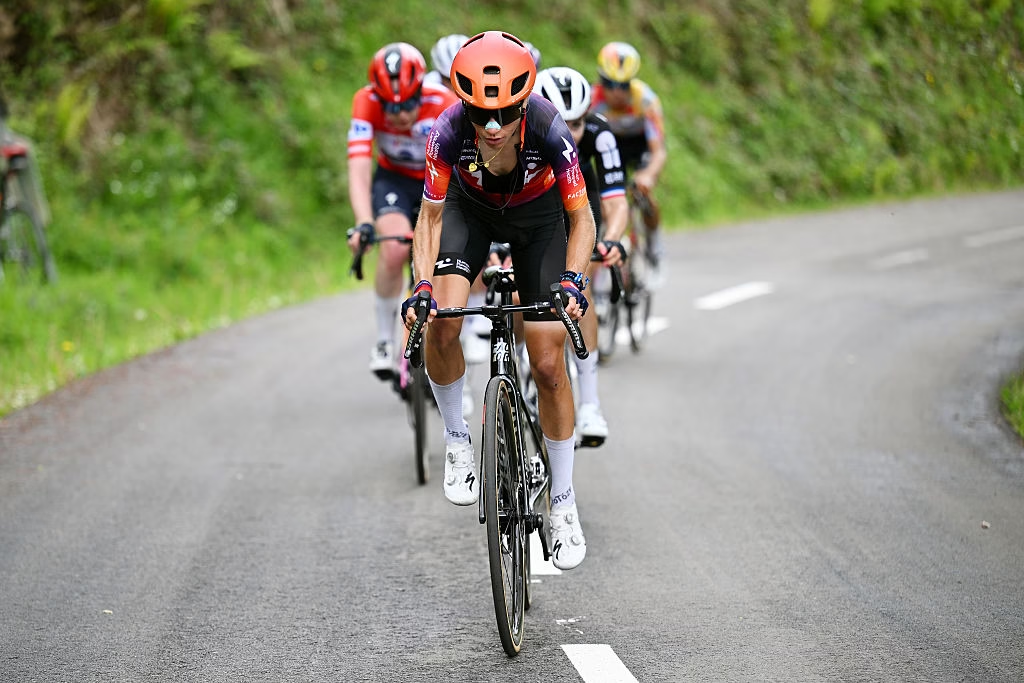 Photo Credit: Getty
Stiasny wins the stage, Blasi wins the race
Inside the final 3km, Stiasny and Blasi had distanced the rest. Van der Breggen was already losing large chunks of time, while Bunel and Berthet fought to limit their losses behind.
Stiasny looked the smoother of the two leaders on the steepest ramps. Blasi never completely cracked, but once the Swiss rider drew level and then came past, the difference in rhythm was clear. Stiasny was able to keep turning the pedals as the gradients eased slightly near the top, while Blasi was increasingly riding on determination alone.
By the final kilometre, the stage win was in Stiasny’s hands. She still looked deep in the effort, her breathing clearly ragged, but the gap was solid and the steepest part of the climb was behind her. Blasi, meanwhile, had done more than enough. She no longer needed to win the stage. She just needed to keep Van der Breggen behind, and she was doing exactly that.
Stiasny crossed the line first in 4:09:40, taking a superb mountain win for Human Powered Health. Blasi followed 23 seconds later to secure the overall title. Berthet and Bunel both finished at 43 seconds, Van der Breggen came in at 59 seconds, and Cavallar was sixth at 1:10. Urška Žigart finished seventh at 1:30, with Usoa Ostolaza eighth at 1:41.
A historic home victory for Blasi
For Stiasny, this was a brilliant stage win built on patience and climbing strength. She was not a GC threat, which gave her a little more room to ride her own tempo, and once the favourites began to crack around her, she took full advantage.
But the lasting image of the day belongs to Blasi. She had already been one of the revelations of the spring, winning Amstel Gold Race and backing that up with strong Ardennes form. On the Angliru, she confirmed that her range now extends well beyond punchy one-day racing.
She did not need a dramatic solo move or a last-minute attack to win this Vuelta. She did it by staying calm when Van der Breggen began to falter, by climbing at her own limit without exploding, and by turning a hard final day into a defining result. In doing so, she became the first Spanish rider to win La Vuelta Femenina since the race’s creation in 2015.
La Vuelta Femenina 2026 Stage 7 result
Results powered by FirstCycling.com
La Vuelta Femenina 2026 GC result
Results powered by FirstCycling.com

