Dwars door Vlaanderen Women has carved out an unusually clear role in the spring, and that is a big part of why the race matters so much now.
It has never needed to be the biggest cobbled Classic on the calendar. Instead, it has become one of the most revealing. Coming in the final days before the Tour of Flanders, it lands at exactly the point where teams can no longer hide behind early-season uncertainty. By then, the legs are there or they are not. Tactics are sharper, leaders are clearer, and every result starts to carry more weight. That has helped Dwars door Vlaanderen Women grow from a useful midweek date into one of the defining races of the Flemish build-up.
The 2026 edition marks another step in that development as the race moves onto the Women’s WorldTour. In one sense, that is a major milestone. In another, it simply formalises something that has already been true on the road for a while. Dwars door Vlaanderen Women had already become a top-level race in all but label. The rest of the sport has now caught up.
If you want the route side of the story as well, ProCyclingUK’s Beginner’s guide to Dwars door Vlaanderen Women 2026 explains why the race works so well for newer fans as well as established Classics followers.
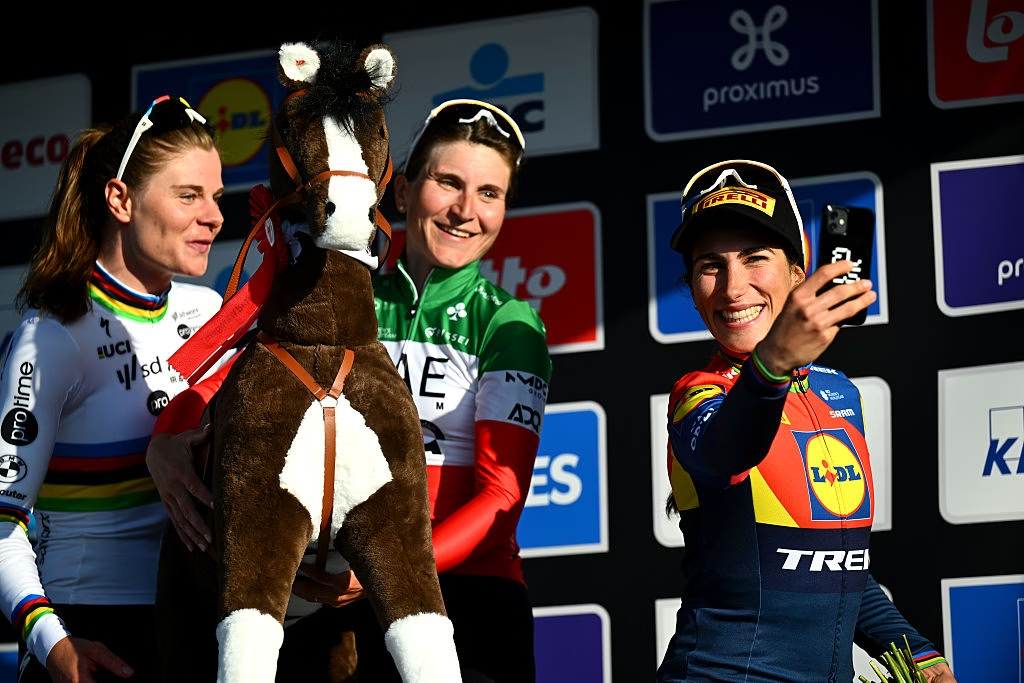 Photo Credit: Flanders Classics
How the women’s race began
The women’s race was first held in 2012, introduced by Flanders Classics as part of the same race day as the men’s Dwars door Vlaanderen. That gave it a strong identity from the outset. This was not an event trying to find space on the margins of the spring. It belonged directly to the same roads, the same racing culture and the same crucial section of the calendar as the men’s race.
That mattered because the event quickly found its purpose. Held late enough in spring for form to be meaningful, but still just before the sport’s biggest cobbled target, it immediately became a race with a double value. Riders could come here to win a major Belgian one-day race, but they could also come here knowing that what happened might shape the tone for the rest of the week.
Its first winner was Ellen van Dijk, which already tells you something important about the sort of rider this race would reward. Even in its early editions, Dwars door Vlaanderen Women was not designed for specialists in a single area. It favoured strength, control, comfort on Belgian roads and the ability to keep producing efforts after the course had already begun to expose weakness.
Dwars door Vlaanderen Women winners
- 2012 – Ellen van Dijk
- 2013 – Marianne Vos
- 2014 – Amy Pieters
- 2015 – Amy Pieters
- 2016 – Amy Pieters
- 2017 – Lotta Henttala
- 2018 – Ellen van Dijk
- 2019 – Ellen van Dijk
- 2020 – race not held
- 2021 – Annemiek van Vleuten
- 2022 – Chiara Consonni
- 2023 – Demi Vollering
- 2024 – Marianne Vos
- 2025 – Elisa Longo Borghini
The roll of honour is one of the quickest ways to understand the race properly.
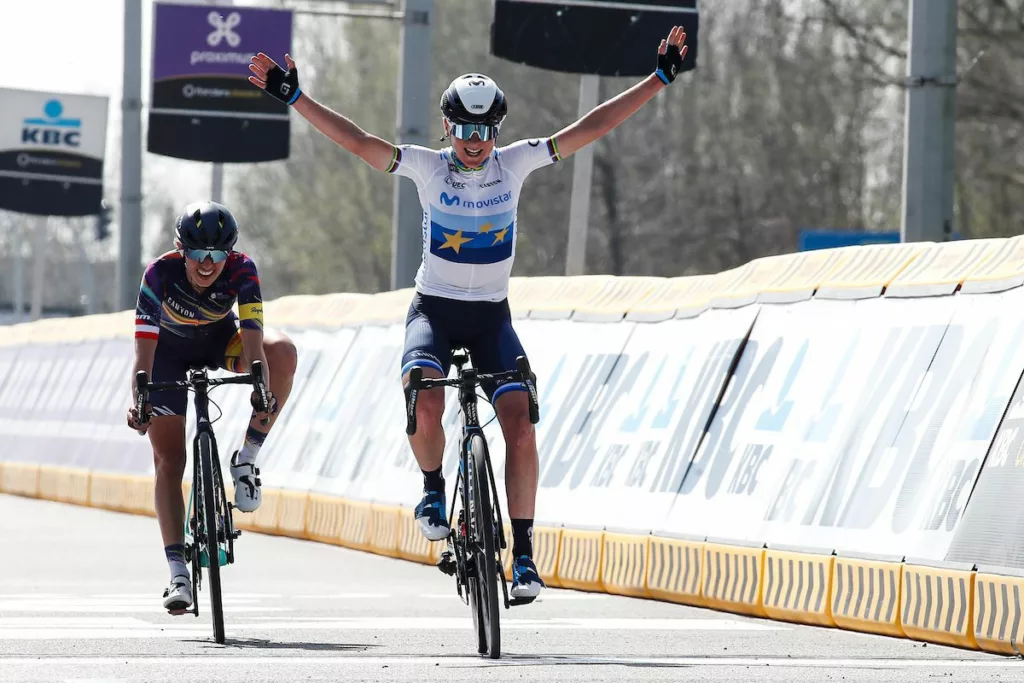
Amy Pieters winning three straight editions underlined just how well Dwars door Vlaanderen Women can suit a rider with power, race intelligence and a finish after a hard day. Ellen van Dijk’s three victories, spread across different phases of the race’s history, made a similar point in a slightly different way. On these roads, raw strength and the ability to impose order can be just as decisive as speed.
Then there is the more recent spread of winners. Chiara Consonni won from a reduced sprint. Annemiek van Vleuten and Demi Vollering won through more selective racing. Marianne Vos and Elisa Longo Borghini took the race in ways that reflected their wider Classics instincts. That range matters. Dwars door Vlaanderen Women has never belonged to one single rider type, and that has always been one of its strengths.
What made the race distinctive
The race works so well because it compresses the logic of the Flemish Classics into a slightly tighter, more approachable format.
The ingredients are all there: climbs, cobbles, narrow roads, repeated accelerations and constant positioning pressure. But it comes without the full scale, history and sheer weight of the Tour of Flanders. That makes it more open in some editions and more readable in others. It is a race where a slightly wider group of contenders can believe they have a chance, and that uncertainty gives it a particular energy.
Some years end in a reduced sprint. Other years reward a late solo attack or a small elite group. The route is selective enough to expose weakness, but not always so brutal that only the most obvious cobbled specialists survive. It lives in that interesting space between full-scale monument and highly tactical spring test.
That is why it has become such a useful race to read. If the Tour of Flanders is the final exam, Dwars door Vlaanderen Women is the fiercely competitive paper that comes just before it and still matters on its own terms.
For the wider Belgian context, ProCyclingUK’s Beginner’s guide to Tour of Flanders Women 2026 and A brief history of Gent-Wevelgem Women show how the biggest races around it ask slightly different questions on similar terrain.
How the race has evolved
Over time, the event has grown in profile without losing the clarity of its role.
In the early years, its importance was closely tied to where it sat in the calendar. That remains true, but the race has steadily become more significant in its own right. As the depth of the women’s spring calendar has improved and the level of the fields has risen, Dwars door Vlaanderen Women has become a race that serious Classics riders cannot afford to treat lightly.
That change is visible in the quality of the winners, but also in the way teams now use the race. It is no longer just a useful stop before Sunday. It is a race where hierarchy can be established, where form can be confirmed, and where tactical sharpness can either reassure a team or leave it with real doubts before the Tour of Flanders.
The move to the Women’s ProSeries in 2023 reflected that progress. The step up to the Women’s WorldTour in 2026 completes it.
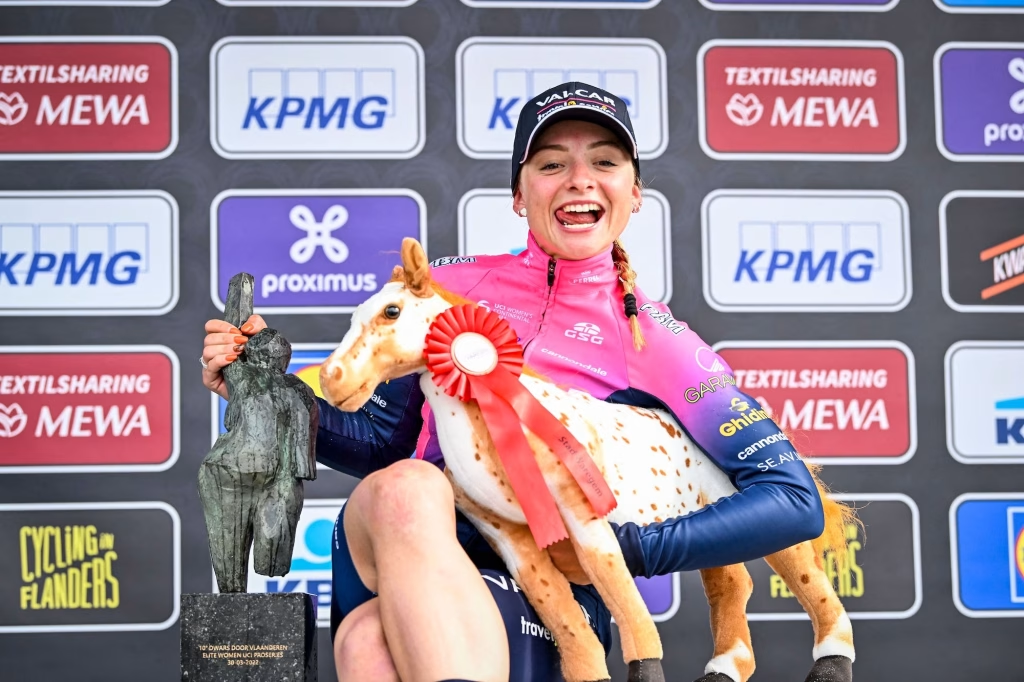 Photo Credit: Getty
Why the race matters so much in the spring
Its timing has always been central to its identity.
Held in the last stretch before the Tour of Flanders, Dwars door Vlaanderen Women captures the exact point where the spring becomes serious. By then, the road has already stripped away some illusions. The riders who are going well know it. The teams that are struggling know it too. That gives the race a particular sharpness and a particular honesty.
It is not just another one-day race in Belgium. It is one of the last major clues before the sport reaches its biggest cobbled Sunday. That has given the race a sense of consequence from very early in its life, even though by Belgian standards it remains a relatively young event.
Why the WorldTour step matters in 2026
The move to the Women’s WorldTour matters because it confirms what the race has become.
For casual followers, WorldTour status signals prestige. For teams and riders, it confirms that this race now sits officially among the top one-day events in the sport. But the more interesting point is that the roads had already made that case. The course, the timing, the fields and the calibre of winners had already pushed Dwars door Vlaanderen Women beyond the level its old status suggested.
So the promotion is important, but it is also logical. It does not change the race’s meaning so much as bring the official label into line with the sporting reality.
Why Dwars door Vlaanderen Women still matters
Its history is short, but it already says something important about the modern spring calendar.
Dwars door Vlaanderen Women matters because it found a precise purpose and kept growing into it. It has never needed to be the biggest race of the spring. It has needed to be the race that tells you who is ready for the biggest race of the spring, while still being prestigious enough to matter entirely on its own.
That is not an easy balance to strike, but this race has managed it well. It has rewarded different kinds of winners, encouraged aggressive and intelligent racing, and steadily established itself as one of the most revealing one-day events on the women’s calendar.
Now, with WorldTour status arriving in 2026, the race moves into another phase of its history. The roads have not changed what Dwars door Vlaanderen Women is. They have simply kept proving it until the rest of the sport had to recognise it.