Milano-Sanremo has always occupied a slightly unusual place in cycling.
It is one of the sport’s great Monuments, but it does not behave like the others. It has none of the repeated cobbled violence of Paris-Roubaix, none of the steep, grinding accumulation of the Tour of Flanders, and none of the drawn-out attrition of Liège-Bastogne-Liège. Instead, it has built its reputation on something subtler and, in its own way, more dangerous: patience, hesitation and the knowledge that nearly 300 kilometres of waiting can still be decided in the final few minutes.
That combination is why Milano-Sanremo feels both ancient and modern at once. It is rooted in the earliest decades of road racing, yet the basic question it asks riders still feels current. Who can survive the long day, read the finale correctly and strike at exactly the right moment?
If you want the current race first, ProCyclingUK’s Beginner’s guide to Milano-Sanremo 2026 explains why the race remains one of cycling’s most beautifully unresolved Monuments. For the women’s side of the same closing sequence, the site’s Milan-Sanremo Women 2026 route guide shows how the same finale works in a shorter format.
The race begins in cycling’s earliest age
Milano-Sanremo was first held in 1907, which immediately places it among the oldest and most prestigious races in the sport.
At that point, professional road racing was still shaping its own mythology. The Tour de France was only a few years old, the Giro d’Italia had not yet begun, and the idea of a very long one-day race linking major Italian cities already carried a certain ambition. That first edition gave victory to Lucien Petit-Breton, one of the defining early figures of cycling, and in doing so began a race that would become one of the sport’s permanent reference points.
In those first decades, the event quickly established its stature. Riders such as Petit-Breton, Luigi Ganna and Costante Girardengo did not just win the race, they helped define it. Girardengo in particular became one of the first great rulers of Sanremo, and his repeated successes in the years after the First World War helped fix the race’s prestige in the public imagination.
Even then, Milano-Sanremo was already developing the quality that still defines it now. It was not just long. It was tactically awkward. Riders had time to think, time to hesitate and time to misjudge the moment.

The interwar years and Italian dominance
As cycling developed between the wars, Milano-Sanremo became more deeply tied to Italian sporting culture.
That made sense. The race connected major points on the map, touched the Ligurian coast and increasingly felt like a national showcase as much as an international contest. This was the era of Alfredo Binda, Learco Guerra and Gino Bartali, riders who helped shape the sport in Italy and beyond.
Bartali’s wins carried particular weight because he was not just a champion, but a rider whose reputation stretched far beyond the road. In a race like Milano-Sanremo, where prestige has always mattered almost as much as the route itself, that sort of figure helped deepen the event’s place in public imagination.
What is striking about this period is that the race was already showing the quality that would keep it relevant in later eras. Even before Milano-Sanremo acquired its most famous modern landmarks, it was a race built around uncertainty. It was long enough to exhaust, but not selective enough to make the winner obvious too early.
The post-war race and Coppi’s great rupture
If the early history of Milano-Sanremo belonged to the pioneers and the first great Italian stars, the post-war era gave it one of its most famous expressions in Fausto Coppi.
Coppi’s 1946 victory remains one of the defining performances in the race’s history, not simply because he won, but because of how he did it. Attacking from an extraordinary distance and arriving alone by a huge margin, he turned a race built on suspense into something closer to a one-man demonstration.
That remains one of the great paradoxes of Milano-Sanremo. It is famous for its narrow, uncertain finales, yet from time to time a rider of exceptional authority can still make the whole thing look brutally simple. Coppi did that more completely than almost anyone else.
The post-war decades also reinforced the race’s international stature. It remained deeply Italian in atmosphere and meaning, but the winners list increasingly reflected a broader world. By then, Sanremo was no longer just a major Italian race. It was one of cycling’s defining one-day prizes.
The Merckx years and Monument authority
If one rider came to symbolise full control of the race in the modern sense, it was Eddy Merckx.
Merckx won Milano-Sanremo seven times, a record that still towers over the event. That figure matters not just because it is large, but because it feels almost impossible in the context of the race itself. Sanremo is unpredictable, tactically compressed and open to different rider types. To dominate it repeatedly in that way suggests not just strength, but an extraordinary ability to solve the same race over and over again even as the riders and conditions around him changed.
By the time Merckx was ruling Sanremo, the race had fully settled into Monument status. It was no longer simply an old prestigious event. It was one of the races, one of the days that could define a rider’s entire career.
And yet even Merckx still had to deal with what makes Sanremo unique. He could overpower other Monuments through sheer force, but here timing still mattered. That is what makes his record feel so daunting.
The Cipressa, the Poggio and the modern race
Modern Milano-Sanremo is impossible to discuss without the Cipressa and the Poggio.
The Poggio was added in 1960, and the Cipressa followed in 1982. Together, they gave the race the finishing architecture it still relies on. They did not replace the old identity of Milano-Sanremo. They sharpened it. The race had always been about timing. Now it had two landmarks that turned that timing into theatre.
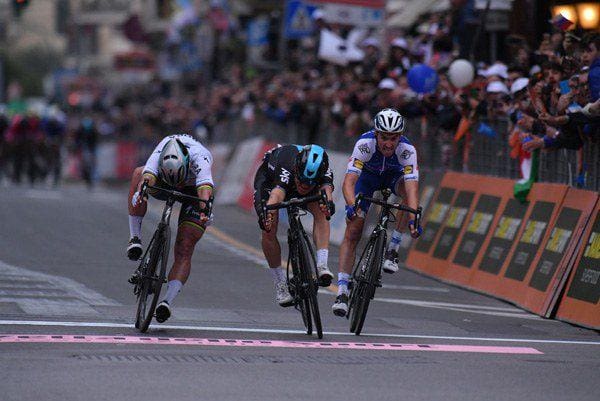
That is why the race now feels so familiar even to casual fans. The Cipressa begins the real argument. The Poggio forces the final answer. The descent and the run to Via Roma decide whether the attackers, puncheurs or fast finishers have read it correctly.
Those additions helped make Sanremo’s drama more legible without changing its core uncertainty. The race was still about waiting for the right moment. It just now had a more recognisable shape on the road.
The age of specialists, sprinters and fast all-rounders
From the late twentieth century into the early twenty-first, Milano-Sanremo kept proving that it could never be reduced to one rider type.
Pure sprinters could still win it, but only if they were durable enough to survive the final climbs. Puncheurs and attacking riders could win it, but only if they judged the Cipressa and Poggio perfectly. That left the race in a very unusual place. It became the Monument where the range of plausible winners often felt widest.
This is part of why the winners list in the modern era is so revealing. You can move from powerful finishers to explosive attackers without breaking the internal logic of the race. Riders as different as Erik Zabel, Óscar Freire, Fabian Cancellara and Simon Gerrans could all make sense in Sanremo, even if they arrived there with very different strengths and reputations.
That is rare in a Monument. Most of the great one-day races narrow the field toward a more specific answer. Sanremo keeps the answer open longer.
 Photo Credit: LaPresse
Milano-Sanremo in the current era
In the most recent era, the race has remained exactly what it has long been: one of the hardest races to control and one of the easiest to lose.
That is why it still attracts such fascination. The strongest rider does not always win in a straight, obvious way. Sometimes the race rewards the rider who attacks at the perfect moment. Sometimes it rewards the one who survives the Poggio with just enough left. Sometimes it rewards the rider who simply understands that everyone else is waiting too long.
That is what keeps the race feeling alive. Milano-Sanremo is too old to need reinvention, but too tactically unresolved to become stale. It still produces winners who feel logical only once the race is over.
If you want to place the race inside the current spring, ProCyclingUK’s Beginner’s guide to Volta Ciclista a Catalunya 2026 helps show how quickly the sport moves from Monument tension into week-long climbing tests once Sanremo is done.
Why Milano-Sanremo still matters
What makes Milano-Sanremo special is not only its age, though that matters. It is not only its winners list, though that matters too. It is the fact that more than a century after its first edition, the race still asks the same kind of difficult question in a way that no other Monument quite does.
Can a rider hold back for long enough, but not too long? Can he survive nearly 300 kilometres, then still make the right decision on the Cipressa, the Poggio or the run to Via Roma? Can he read a race built not on constant violence, but on compressed opportunity?
That is why Milano-Sanremo has endured from the earliest era of road racing to the present day. The names have changed. The bikes, roads and speeds have changed. The race itself, at its core, has not.
It is still the Monument of suspense. It was in 1907, and it still is now.