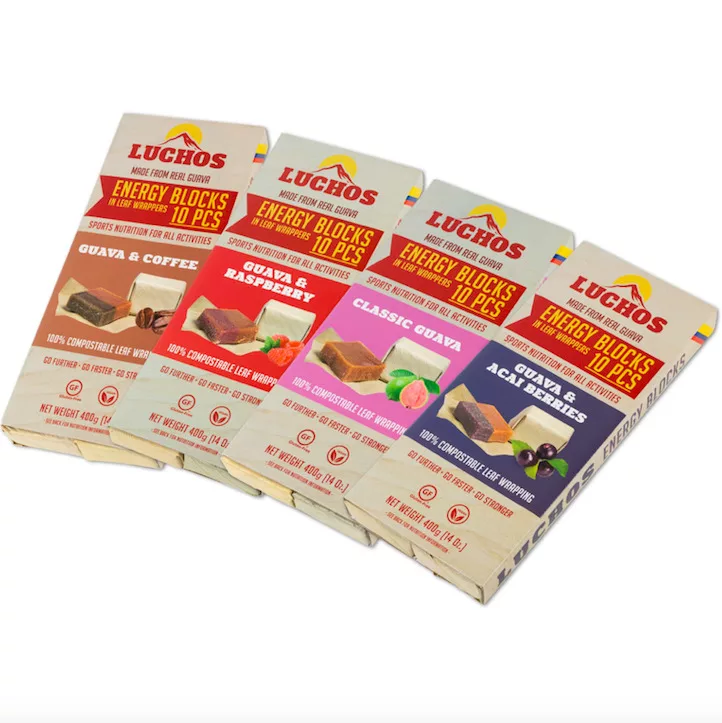
Lucho Dillitos are a slightly unusual sight in a cycling jersey pocket. Instead of a foil-wrapped gel or a conventional energy bar, each block is a dense square of Colombian guava paste wrapped in a dried leaf. The idea is not a modern sports-nutrition invention either. Bocadillo, the Colombian name for this type of guava paste, has been eaten by cyclists in the country for generations.
That heritage is a large part of the attraction, but the more useful question for cyclists is whether Lucho Dillitos work as ride fuel. Nutritionally, the answer is fairly straightforward. They are compact, carbohydrate-rich blocks that can provide roughly the same amount of carbohydrate as many individual sports gels, only in solid form and with a very short ingredient list.
They are not nutritionally magical because they are labelled natural, and they are not a complete answer to hydration, electrolytes or recovery. Used for what they actually are, however, Lucho Dillitos offer an interesting alternative for riders who prefer eating something solid during longer rides.
What are Lucho Dillitos?
Lucho Dillitos are branded versions of Colombian bocadillo, a traditional sweet made primarily from guava and sugar. Colombian cyclists were carrying bocadillo long before modern energy gels became part of professional cycling, which helps explain why the product translates so naturally into an endurance-sport setting.
The Classic Lucho Dillito is made from 85% guava and 15% sugar. There are no added preservatives or artificial flavourings in that version. Flavoured varieties add another ingredient to the same basic idea, with the Raspberry and Coffee versions using 75% guava, 15% sugar and 10% of the respective additional ingredient.
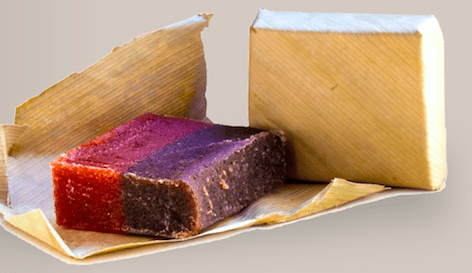
Each block weighs around 40g. It is firm enough to carry in a pocket but softens quickly in the mouth, sitting somewhere between the experience of eating an energy chew and a traditional bar. That texture is one of its more practical advantages on the bike: there is no gel sachet to squeeze and relatively little chewing compared with a dense cereal-based energy bar.
What is actually in a Lucho Dillito?
The appeal of Lucho Dillitos partly comes from how short the ingredient list is. Classic contains just guava and sugar rather than the longer combination of syrups, flavourings, stabilisers and other ingredients found in some specialist sports products.
That simplicity should not be confused with being sugar-free or particularly low in sugar. Quite the opposite. A cycling fuel needs readily available carbohydrate, and Lucho Dillitos contain plenty of it. The concentrated guava paste and added sugar are what make the product useful during exercise.
Lucho Dillitos ingredients
- Classic Guava: 85% guava, 15% sugar.
- Guava and Raspberry: 75% guava, 15% sugar, 10% raspberry.
- Guava and Coffee: 75% guava, 15% sugar, 10% coffee.
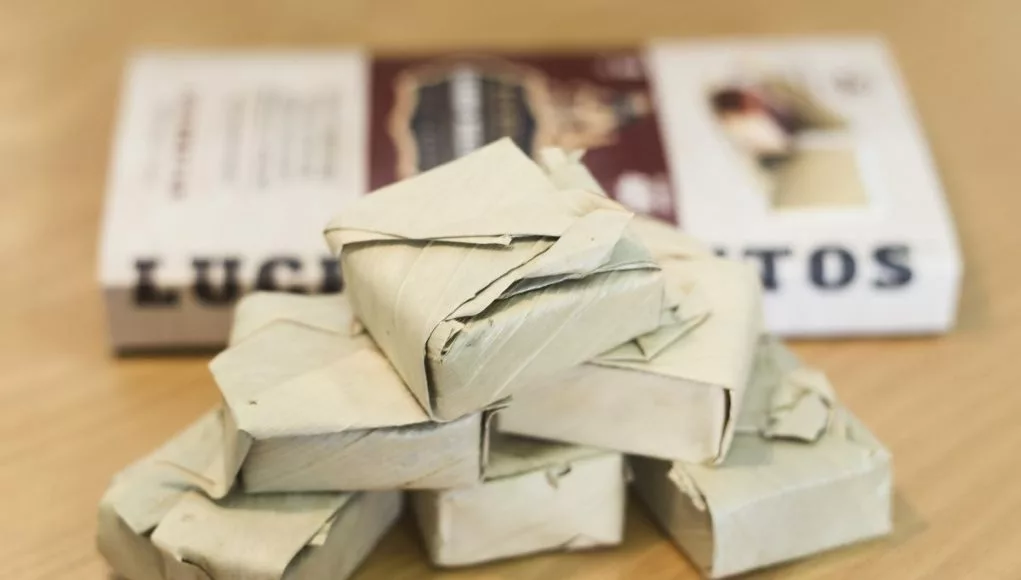
The blocks are produced in Colombia and individually wrapped in a dried biodegradable leaf. That wrapper is one of the product’s most distinctive features and makes opening one on a ride very different from tearing the top off a conventional gel sachet.
How much carbohydrate is in a Lucho Dillito?
This is where Lucho Dillitos make most sense as cycling food. The Classic 40g block provides around 22.5g of carbohydrate, virtually all of it as sugars, for 88 calories. The Raspberry and Coffee varieties are slightly more carbohydrate-dense and are listed at around 120 calories per 40g block.
| Per 40g block | Classic Guava | Guava & Raspberry | Guava & Coffee |
|---|---|---|---|
| Energy | 88 kcal | 120 kcal | 120 kcal |
| Carbohydrate | 22.5g | 29.6g | 30g |
| Of which sugars | 22.5g | 29.6g | 30g |
| Fat | 0g | 0g | 0g |
| Protein | 0g | Minimal | Minimal |
| Fibre | 0g | 0g | 0g |
That puts one block in broadly the same territory as an individual sports gel when the important measurement is carbohydrate rather than calories. The difference is largely in delivery. A gel provides carbohydrate in a semi-liquid form, while a Lucho Dillito gives the rider something more substantial to eat.
It is also worth correcting a common assumption about guava. Fresh guava is naturally rich in fibre, but the finished Lucho Dillito nutrition information lists no meaningful fibre per block. Riders therefore should not think of it as the nutritional equivalent of eating a piece of whole fruit. It is concentrated endurance fuel.
How do Lucho Dillitos fit into a cycling fuelling strategy?
For shorter, easy rides, most cyclists will not need specialist carbohydrate products at all. Lucho Dillitos become more relevant as ride duration and intensity increase and maintaining carbohydrate intake starts to matter.
Current sports-nutrition guidance commonly recommends around 30-60g of carbohydrate per hour for endurance exercise lasting roughly one to two-and-a-half hours, with higher intakes potentially useful during longer events. A Classic Lucho Dillito contributes 22.5g towards that total, while the Raspberry and Coffee versions provide around 30g.
That makes them easy to combine with other food. A rider might use blocks alongside carbohydrate drink, bananas, rice cakes, gels or whatever else they know their stomach tolerates. There is no particular reason why every gram of carbohydrate during a long ride needs to come from the same product.
For riders targeting very high carbohydrate intakes in racing, more specialised glucose-fructose products can be easier to structure around because their carbohydrate composition has been designed specifically for high rates of intake. Lucho Dillitos can still form part of that strategy, but they should not automatically be treated as a direct substitute for a carefully formulated high-carbohydrate drink or gel system.
For help planning food across a longer ride, see our guide to fuelling your rides.
What are Lucho Dillitos like to eat on the bike?
This is arguably where they have their strongest advantage over another technically optimised gel. Eating the same sweet gels for four or five hours can become tiresome, and appetite often becomes part of the fuelling problem on a long ride.
Lucho Dillitos have a dense fruit-paste texture. They are dry enough on the outside to handle without coating your fingers in syrup but become softer as you chew them. The result feels more like eating food than taking a shot of sports gel.
Whether that is preferable is entirely personal. Some riders like having something to chew, while others find swallowing a gel easier when working hard. This is exactly the sort of thing worth testing during training rather than discovering during an event.
What about the biodegradable leaf wrapper?
The dried-leaf wrapper is one of the clearest differences between Lucho Dillitos and most individual gels or energy chews. Instead of each block being sealed inside a small plastic or foil sachet, the food itself is wrapped in a biodegradable natural leaf.
That can reduce the amount of single-use synthetic packaging associated with each individual serving, but it would be a stretch to claim that this automatically makes the whole product environmentally superior. Manufacturing, transport from Colombia and any outer packaging still contribute to its overall footprint, and a proper environmental comparison would require considerably more data than the wrapper alone.
Biodegradable also does not mean cyclists should throw the leaf onto the verge when they have finished eating. Carrying wrappers home remains the sensible approach, particularly in places where leaving any waste behind is prohibited.

Do Lucho Dillitos replace electrolytes or hydration?
No. Lucho Dillitos are primarily a carbohydrate source. They contain very little salt compared with products deliberately formulated to supply sodium, and eating one does not remove the need to drink during longer rides.
That distinction is useful because fuelling and hydration are related but not identical problems. Your carbohydrate requirement is driven largely by the duration and intensity of the ride, while fluid and sodium requirements vary considerably with temperature, sweat rate and the individual rider.
On a warm endurance ride, a Lucho Dillito can therefore provide part of the carbohydrate intake while water or an electrolyte drink deals with hydration. In cooler conditions, the amount of fluid required may be lower. There is no need to force a fixed quantity of water simply because a block has been eaten.
The original idea of treating the sugar in the blocks as a hydration aid is too simplistic. The practical approach is simply to count the block as food and plan fluids separately around conditions and personal needs.
Are Lucho Dillitos vegan and suitable for allergies?
Lucho Dillitos states that its products are suitable for vegetarians and vegans. The core ingredient lists are entirely plant-based.
Anyone managing an allergy should still check the current packaging rather than assuming that a short ingredient list makes the product automatically safe. In particular, Lucho Dillitos says the blocks themselves do not contain nuts but are produced in a facility that also handles nuts, so the company cannot guarantee that they are completely free from traces.
The listed ingredients in the main varieties do not contain obvious sources of gluten or dairy, but anyone with coeliac disease or a serious allergy should rely on the current manufacturer’s allergen statement rather than a general product description.
The high sugar content is not a flaw in the context of endurance exercise; rapidly available carbohydrate is the point of the product. Anyone who needs to manage blood glucose for medical reasons, however, should treat Lucho Dillitos as a concentrated carbohydrate food rather than assuming that the guava makes them equivalent to fresh fruit.
What Lucho Dillitos flavours are available?
The range has expanded beyond the original guava block. Availability varies between countries and retailers, but UK sellers currently list several versions:
- Classic Guava: the original guava and sugar recipe.
- Guava & Raspberry: adds raspberry to the guava base.
- Guava & Coffee: combines the guava block with coffee.
- Guava & Açaí: another fruit-based variation now stocked by some UK retailers.
- Guava & Orange: a citrus version also appearing in the current range.
The Coffee block should not automatically be treated as a precisely dosed caffeine supplement. If caffeine intake matters for racing, check the current product information for the amount supplied rather than relying simply on coffee appearing in the ingredients.
Are Lucho Dillitos good for long-distance cycling?
Long rides are probably where the blocks make the strongest case for themselves. A four or five-hour ride creates two separate challenges: taking in enough carbohydrate and continuing to eat when sweet sports products are becoming increasingly unappealing.
Lucho Dillitos help with the first because each block contains a meaningful amount of carbohydrate in a small package. They can help with the second simply because they offer a different texture from a drink or gel.
They are also compact enough to carry several in a jersey pocket. The leaf can be opened relatively easily and there is no sticky gel sachet afterwards. Riders doing audax, bikepacking, sportive or long training rides may find those practical characteristics every bit as useful as the nutrition numbers.
Claims that fruit-based products are automatically easier to digest than conventional sports nutrition should be treated cautiously, though. Gut tolerance is highly individual. Some riders can eat blocks for hours without any problem; others may prefer liquids or gels as intensity rises. Training the fuelling strategy is more useful than assuming one format will suit everyone.
Are Lucho Dillitos useful after a ride?
They can contribute carbohydrate after exercise, but a Lucho Dillito by itself is not a complete recovery food. The blocks contain effectively no fat and very little protein, so they do not provide everything a rider would normally want from a substantial post-ride meal.
That does not make them useless after riding. If another session is approaching and carbohydrate replenishment matters, the block can simply form part of a broader recovery meal or snack containing protein, fluids and the other nutrients required.
For most recreational cyclists who have finished for the day, there is little need to overcomplicate things. A normal meal will generally be more satisfying than treating another energy block as a specialist recovery product.
Are Lucho Dillitos only for cyclists?
There is nothing cycling-specific about the carbohydrate in a Lucho Dillito. The same blocks can be used by runners, hikers, triathletes or anyone else who wants a compact carbohydrate-rich food during prolonged exercise.
Cycling happens to suit them particularly well because riders can carry solid food easily in jersey pockets and generally have more opportunity to eat than runners working at a similar intensity. During running, some athletes may find chewing a solid block less convenient, while hiking places far fewer restrictions on what food can be carried.
As with cycling, the useful question is not whether the product is labelled for a particular sport but whether it provides the carbohydrate required in a form the athlete can comfortably eat.

Where can you buy Lucho Dillitos in the UK?
Lucho Dillitos are more of a specialist product than the gels and bars found in almost every large cycling shop, but they remain available from several UK endurance-sport and cycling retailers.
They are commonly sold either as individual 40g blocks or in larger multipacks. Current UK listings include specialist cycling and running retailers, while they can also be found through online marketplaces such as Amazon. The Lucho Dillitos website is also worth checking for information about the product and current availability.
Flavour availability can vary considerably between shops, particularly for the newer Açaí and Orange versions, so riders wanting a specific variety may need to shop around rather than assuming every retailer carries the full range.
How should you carry Lucho Dillitos on a ride?
The blocks are well suited to a jersey pocket because they are compact and individually wrapped. Unlike a gel, there is little risk of a sachet bursting and coating everything else in the pocket with syrup.
Keep unused blocks somewhere cool and dry and follow the storage instructions on the packaging. For a ride, they can simply be placed in a jersey pocket, top-tube bag or other easily accessible storage.
If you are using them during a race or fast group ride, it is worth opening one in training first. The leaf wrapper is different from conventional sports-food packaging and learning how to unfold it one-handed is preferable to wrestling with it for the first time while riding in a bunch.
Once eaten, put the leaf back into a pocket rather than dropping it on the road. The fact that the wrapper is biodegradable makes disposal easier later; it is not an invitation to leave it behind.
Lucho Dillitos vs energy gels: which is better?
Neither format is automatically better. A gel is extremely easy to consume at high intensity, requires almost no chewing and can be formulated with a precise mixture of carbohydrates, sodium or caffeine. That makes gels particularly useful when performance is the overriding priority.
Lucho Dillitos offer something different. The ingredient list is short, they feel more like real food, the leaf wrapper avoids an individual plastic or foil sachet, and a single block still provides a useful quantity of carbohydrate.
For a long training ride, sportive or audax, that can make them very appealing. For a flat-out race where a rider is targeting very high hourly carbohydrate intake, a combination of drinks and modern gels may be easier to manage. Plenty of cyclists will find the best answer lies somewhere between the two, using different foods across a long ride rather than committing exclusively to one.
Are Lucho Dillitos worth trying?
Yes, particularly if conventional gels are not something you enjoy eating for hours at a time. Lucho Dillitos provide a genuinely different form of cycling fuel rather than simply another flavour of the same energy bar.
The attraction is also refreshingly straightforward. Classic contains guava and sugar, supplies 22.5g of carbohydrate in a 40g block and is easy to carry. It does not need extravagant claims about being healthier, providing sustained energy or improving hydration to justify its place in a jersey pocket.
The main limitation is equally clear. It is a carbohydrate food, not an all-in-one endurance nutrition product. Riders still need to think about total carbohydrate intake, fluids and, where appropriate, sodium separately. At very high fuelling rates, purpose-designed multiple-carbohydrate products may also be easier to build a race strategy around.
For long rides where taste, texture and simply wanting to eat the food in your pocket matter, though, the old Colombian approach still makes plenty of sense.
For more cycling nutrition, equipment and product coverage, visit ProCyclingUK’s tips and reviews section. You can also find inspiration for your next day on the bike on the ProCyclingUK rides page.
-
 Photo Credit: Luc Claessen/ISPA
 -
 Photo Credit: Unsplash / Chris Linnett