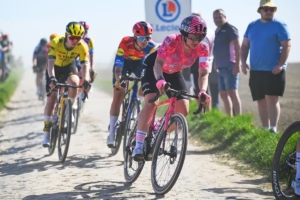
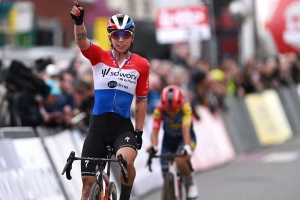
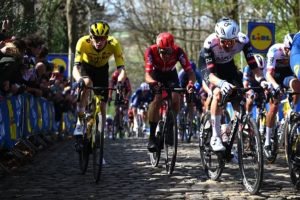
Anna van der Breggen’s spring has a familiar shape in 2026, and that is very much the point. After a year of re-adjustment to the modern peloton, SD Worx Protime are leaning back into what made her one of the defining Classics riders of her era: selective one-day races where repetition, positioning and timing matter as much as raw power.
Her programme runs from Strade Bianche through to Liège Bastogne Liège, with Trofeo Alfredo Binda and Brabantse Pijl acting as the key bridges into the Ardennes. It is a compact block, but it is packed with races where her history is not just strong, it is foundational.
For wider context on how these races fit together in the calendar, ProCyclingUK’s guide to the 2026 Women’s WorldTour and its look at the best women’s cycling races in 2026 for new fans both help explain why this stretch of the season still carries so much weight.
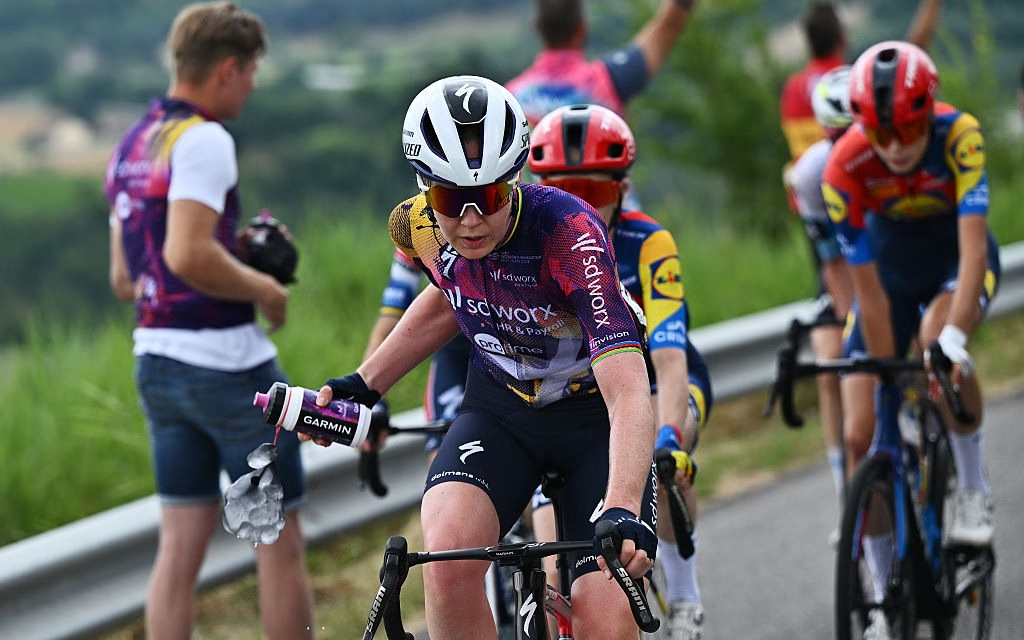
The 2026 classics programme
Van der Breggen is set to race the following one-day events this spring:
- Strade Bianche
- Trofeo Alfredo Binda
- Brabantse Pijl
- Amstel Gold Race
- Flèche Wallonne
- Liège Bastogne Liège
What this schedule says about SD Worx Protime’s plan
This is not a calendar built around seeing how it goes. It is a sequence designed to sharpen the same weapon in slightly different ways.
Strade Bianche and Binda demand control and positioning before the finale starts to bite. Brabantse Pijl is the classic transition race, long enough to blunt pure sprinters, sharp enough to reward punch. Then the Ardennes trio arrive with three different finishing problems: Amstel’s chaos, Flèche’s single explosive wall, and Liège’s long burn.
For Van der Breggen, that progression is ideal because it stacks repeat efforts. Even at her peak she rarely won by one moment alone. She won by making the race difficult in layers, then being the rider who still had an answer on the final layer.
That also fits the broader direction of the team. ProCyclingUK’s look at SD Worx Protime in 2026 framed this season as a classics-first reset, and Van der Breggen’s programme reflects exactly that.
Strade Bianche: a modern classic that suits old-school strength
Van der Breggen has already proved she can win on the white roads, and it is easy to see why. Strade Bianche is a race of constant friction. The gravel sectors amplify every surge, every fight for position, every tiny lapse in concentration. Riders who rely on one perfect acceleration can get trapped. Riders who can manage the race through discomfort and who can keep producing hard efforts late, tend to rise to the top.
If she arrives in Siena with a stable base, Strade is a realistic win target rather than a warm-up. It is also an early yardstick. You rarely fluke a top result there. The legs either respond on the sterrato or they do not.
ProCyclingUK’s 2026 Strade Bianche Donne race preview and the race report on how Elise Chabbey won Strade Bianche Women 2026 both underline how unforgiving that race remains.
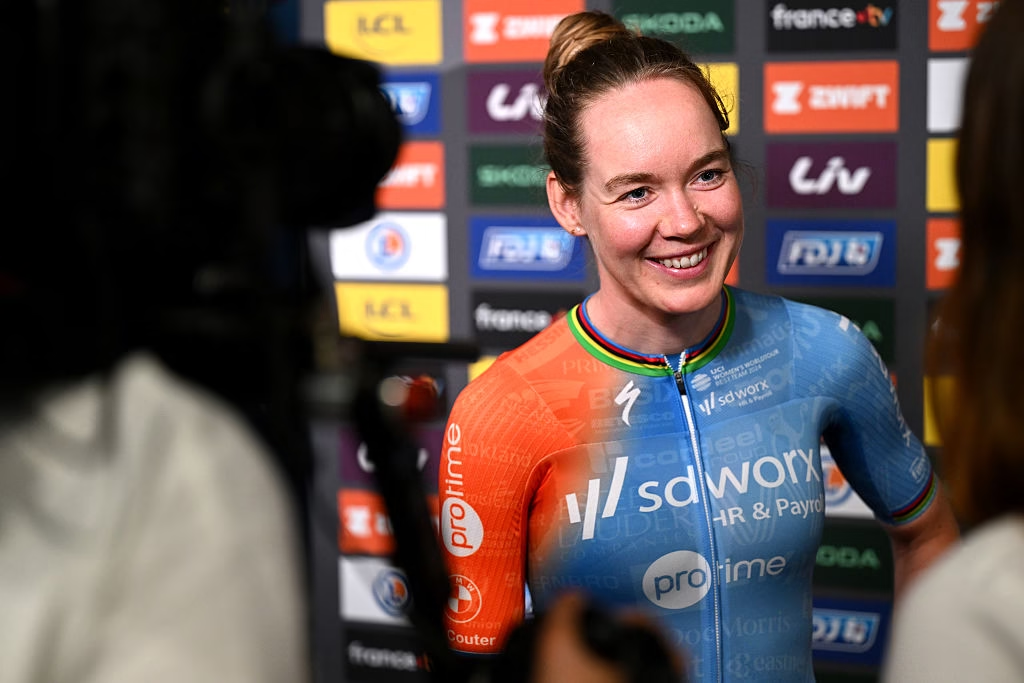
Trofeo Alfredo Binda: more selective than its reputation
Binda is often described as a race that can finish in a reduced sprint, but the key detail is the repeated pressure that creates that reduction. The circuit encourages teams to keep re-loading the pace, and it punishes riders who drift even a handful of positions too far back.
Van der Breggen has won Binda before, and her historical success there reflects the race’s real character. When the rhythm is high, Binda becomes a test of composure and repeatability. Those are her natural currencies, particularly when SD Worx can keep the race structured and prevent it becoming a pure numbers game for rival teams.
The broader shape of the event is covered well in ProCyclingUK’s Trofeo Alfredo Binda 2026 presentation piece, which points to exactly why it remains such an important bridge between early March form and deeper classics sharpness.
Brabantse Pijl: the hinge between cobbles and Ardennes
Brabantse Pijl is the race that tells you whether an Ardennes leader is ready to race for victory, not just for form. The climbs are shorter than what follows in the week after, but they come repeatedly, and the local laps reward riders who can handle both positioning and repeated accelerations.
Van der Breggen has a strong record in Brabantse Pijl, including victories that were built on her classic method: let the race thin itself, then choose the right moment to commit when others are already close to their limit. It remains one of the most natural fits on her calendar.
That is also why ProCyclingUK’s Brabantse Pijl 2026 teams piece described the race as the spring hinge point between Flanders and the Ardennes. For a rider like Van der Breggen, it is almost the perfect transition.
Amstel Gold Race: the tactical minefield Van der Breggen used to solve
Amstel is rarely won by the strongest rider in a straight line. It is won by the rider who spends the least energy in the wrong places, then hits the right place at the right time. The density of climbs creates constant temptation to chase and to panic. The team that controls the finale best is often the team that still has riders to play with in the last hour.
Van der Breggen has won Amstel, and it is a victory that makes sense in the context of her skillset. She has always been an expert in reading when the favourites are hesitating. On the days when the most explosive riders do not get a clean launch, Amstel can be taken by someone who commits earlier and makes everyone else chase into the red.
ProCyclingUK’s 2025 Amstel Gold Race Women preview is still a useful reference point here because it captures both Van der Breggen’s past success and the tactical complexity that keeps making the race so awkward to control.
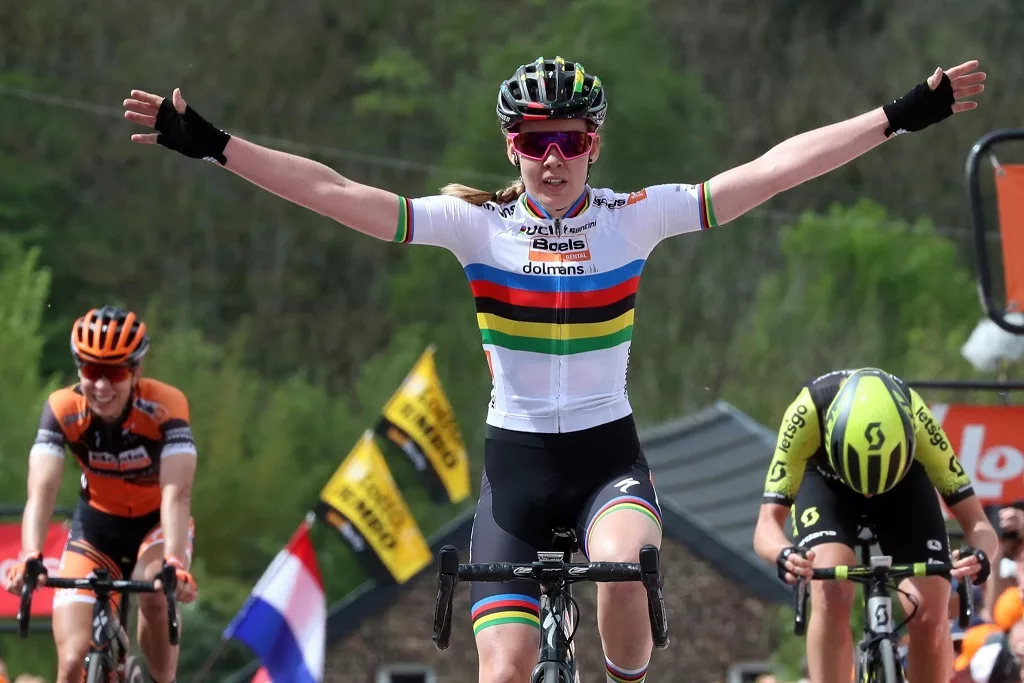
Flèche Wallonne: the race that defined her prime
Flèche Wallonne is the most straightforward race on the list in terms of what it asks. You arrive at the Mur de Huy with position, then you produce one brutally hard effort. There is no hiding.
Van der Breggen’s history here is exceptional. She won Flèche Wallonne seven times, a record that still sits as one of the defining stats of women’s one day racing. The reason it worked so consistently is that she did not just have the punch, she had the control to arrive at the base of the Mur in the right place, again and again, across different editions, different rivals, different race scenarios.
If she is close to her best level in 2026, Flèche remains the clearest win opportunity of the entire block.
For anyone wanting a reminder of just how dominant she was, ProCyclingUK has both a race report on her seventh Flèche Wallonne win and a separate piece on her concerns over the route changes. The broader historical frame is also there in the site’s 2025 Flèche Wallonne Féminine preview.
Liège Bastogne Liège: where spring becomes legacy
Liège is the biggest and broadest test in her programme. It is long, it is attritional, it is tactically layered, and it rewards riders who can keep making decisions while tired.
Van der Breggen has won Liège twice, and those wins were classic examples of her ability to turn a hard race into a selective race. Liège often comes down to who can still attack after the race has already been decided once or twice. That has always been her territory.
It is also the race where team depth matters most. If SD Worx can arrive with multiple riders capable of shaping the finale, Van der Breggen becomes more dangerous, because she is at her best when the race is being played, not simply survived.
ProCyclingUK’s 2025 Liège Bastogne Liège Femmes preview is still a strong reference for that side of her profile, especially the point that Liège rewards riders who can keep attacking over multiple climbs rather than relying on one perfect move.
What to watch for across the six races
The most interesting thread in this programme is not whether she can win a race. She has won them all before. The thread is how quickly she can move from being present in finales to being the rider who dictates them.
If her best days return, the likeliest targets are Flèche Wallonne and Liège Bastogne Liège, with Brabantse Pijl and Amstel offering tactical openings depending on how the finales unfold. Strade Bianche and Binda then act as both form tests and genuine winning chances, especially if SD Worx arrive committed to controlling race shape rather than reacting.
For readers who want the broader career frame as well, ProCyclingUK’s archive includes both a profile on Anna van der Breggen’s greatest spring Classics record and the original report on her return to professional racing.