
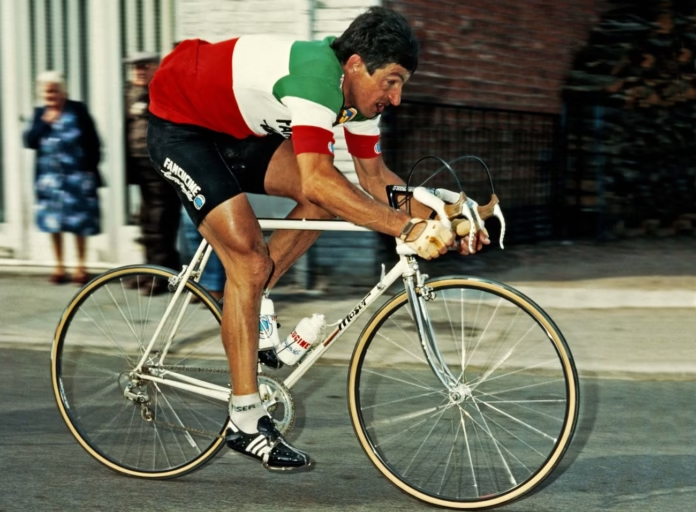
Francesco Moser was one of cycling’s great engines. He did not float up mountains in the way some Grand Tour champions did, nor did he build his legend around delicacy alone. His cycling was built on force, rhythm, control and the ability to make huge power look almost inevitable.
That was the contradiction that made him so compelling. Moser was a rider of strength, but not a crude one. He could bully a race with his legs, but he did it with a smoothness that made the effort feel refined. On the cobbles, against the clock, in the final kilometres of a Classic or across the long pressure of the Giro d’Italia, he looked like a rider who understood how to turn physical authority into style.
Known as “Lo Sceriffo”, The Sheriff, Moser became one of Italy’s defining riders of the 1970s and 1980s. He won the 1977 world road title, three consecutive editions of Paris-Roubaix, Milan-San Remo, two editions of the Giro di Lombardia, the 1984 Giro d’Italia and the Hour Record. His career was not only long and successful. It was distinctive.
For more on the races that shaped his era, our Giro d’Italia coverage, Paris-Roubaix coverage and Milan-San Remo coverage follow the events where riders like Moser built their reputations.
From Trentino to the professional peloton
Moser was born in Palù di Giovo, in Trentino, a region that gave him both physical toughness and a strong rural grounding. He came from a cycling family and a landscape where hard roads, work and endurance were part of the culture. That background mattered. Moser’s career always felt rooted in effort rather than spectacle for its own sake.
He turned professional in 1973 and made an immediate impact. He won a stage of the Giro d’Italia in his debut professional season, a result that announced him as far more than a promising Italian rider. He had the power, confidence and racing intelligence to compete straight away at the top level.
By the mid-1970s, Moser had become one of the most consistent winners in the sport. He was not restricted to one type of race. He could win Italian semi-Classics, time trials, stages, one-day races and major international events. That range became one of the defining features of his career.
The mountains were his limitation, but they did not define him entirely. He was a big, powerful rider by the standards of his era, and the longest climbs could expose him against lighter specialists. Yet he was so strong elsewhere that he built one of the most complete palmarès of any Italian rider.
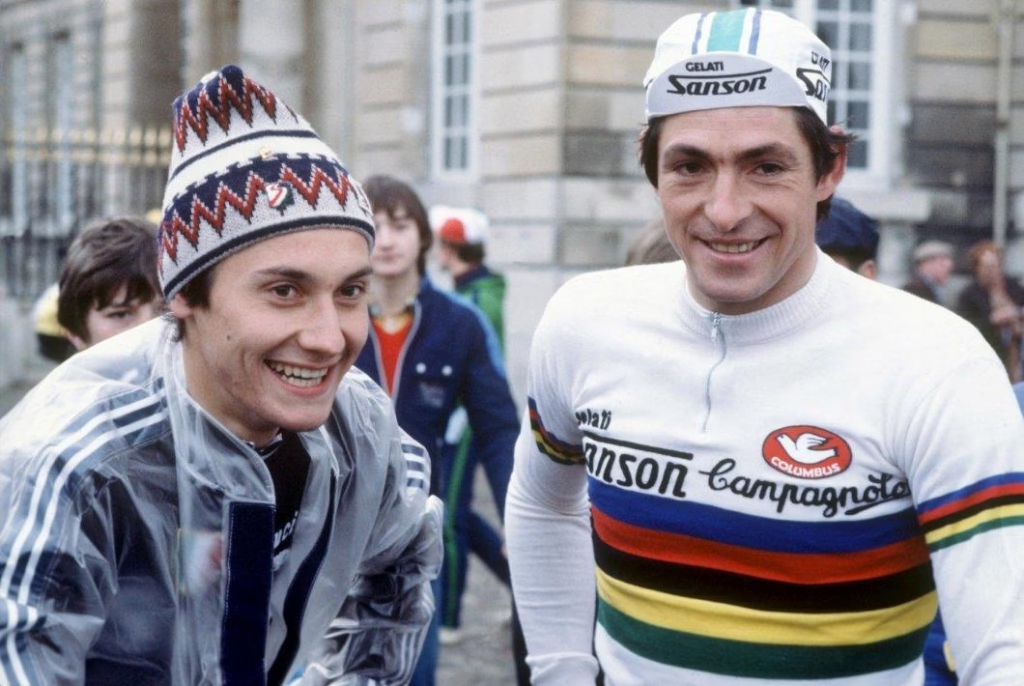
The making of “Lo Sceriffo”
Moser’s nickname, The Sheriff, suited him. He rode with authority. He had a presence in the bunch, a way of imposing himself on races that made him feel like a controlling figure even when he was not attacking.
That authority came partly from his physique. Moser was powerful, broad and built for sustained effort. He looked made for time trials, cobbles and long chases. But the nickname also reflected his leadership. He was not a rider who disappeared quietly into the bunch. He shaped races.
That leadership was especially important in Italian cycling. Moser rode in an era when cycling still carried enormous public weight in Italy, and when the great domestic riders were expected to be more than specialists. They had to win, carry pressure, handle rivalries and become public figures.
Moser did all of that. He was serious, driven and often direct. His style did not rely on romantic fragility. It relied on command.
World champion in 1977
Moser’s world title came in 1977 in San Cristóbal, Venezuela. It was one of the major confirmations of his class and gave him the rainbow jersey at a time when he was already one of the sport’s strongest riders.
The victory was not isolated. Moser had finished 2nd in the World Championship road race in 1976 and would finish 2nd again in 1978. That three-year run showed how consistent he was in one of the hardest races to predict. World Championships are rarely won by accident. They demand form, timing, endurance and tactical sharpness on a single day when the strongest national teams are trying to control the race.
For Moser, the rainbow jersey added prestige to a career already filled with wins. It also deepened his status within Italian cycling. Italy has always valued the world title intensely, and Moser winning it placed him in a line of riders judged not only by stage wins or domestic success, but by global authority.
His year in the rainbow jersey also carried symbolic weight. He was no longer just a powerful Italian winner. He was the world champion, and that made every race he entered feel bigger.
 Photo Credit: BettiniPhoto
The king of Paris-Roubaix
If one race explains Moser better than any other, it is Paris-Roubaix. He won it three years in a row, in 1978, 1979 and 1980, a sequence that places him among the greatest cobbled riders in history.
Roubaix suited him almost perfectly. It rewarded strength, stability, repeated acceleration and the ability to keep producing power when the road surface tried to break rhythm. Moser did not need the race to be elegant in the traditional sense. He created his own elegance through control.
His first victory in 1978 came after previous near misses, including runner-up finishes in 1974 and 1976. Once he finally won, he did not let go. The 1979 and 1980 editions confirmed that his Roubaix success was not a one-off but a form of domination.
What made Moser so effective there was not only his engine. It was his ability to ride the cobbles with authority. Paris-Roubaix punishes indecision. Riders who hesitate lose position, momentum and confidence. Moser seemed to impose himself on the race. He could drive through the worst sectors, absorb the impacts and still have enough left to finish.
For a rider often associated with brute force, Roubaix showed the refinement inside the power. The strongest rider does not always win there. The rider who best manages strength, equipment, positioning and fatigue usually does. Moser did that better than anyone for three consecutive years.
Our brief history of Paris-Roubaix looks more closely at why the race has become such a defining test for riders of Moser’s profile.
Beyond the cobbles
Moser’s career was not built around Paris-Roubaix alone. He also won Milan-San Remo in 1984, two editions of the Giro di Lombardia, Flèche Wallonne, Gent-Wevelgem and Paris-Tours. That range is important because it shows how broadly effective he was.
Milan-San Remo was perhaps the most symbolically satisfying of those wins. For an Italian rider, winning La Classicissima carries a special weight. Moser finally did it in 1984, the same year he would win the Giro d’Italia and break the Hour Record. It was the kind of season that turned a great rider into a legend.
The Giro di Lombardia victories showed a different side of him. Lombardia is hillier and more selective in a way that did not always naturally suit Moser’s build, but he won it twice, in 1975 and 1978. Those wins matter because they push back against the simple idea that he was only a flat-power rider. He could handle hard terrain, especially when the race demanded endurance, timing and tactical control rather than pure high-mountain climbing.
His one-day record remains one of the strongest of his generation. Moser could win on cobbles, in long sprints, in rolling Classics and in races of attrition. He was not universal in the Eddy Merckx sense, but he was much broader than a single label.
The 1975 Tour de France and the road not taken
Moser rode the Tour de France only once, in 1975. It was an extraordinary appearance. He won two stages, wore the yellow jersey and took the young rider classification, finishing 7th overall.
For many riders, that would have been the start of a long relationship with the Tour. For Moser, it became the exception. He never returned. The reason was simple enough: the Tour’s highest mountains were not his best terrain, and Italian cycling still gave the Giro d’Italia a central importance that suited him better.
That decision says a lot about Moser’s career. He did not need to define himself through the Tour de France. In the modern era, that can be difficult to understand because the Tour dominates global cycling attention so completely. But Moser belonged to a period when Italian riders could build enormous prestige through the Giro, the Classics, the World Championships and the great national calendar.
His 1975 Tour still remains a fascinating glimpse of what he could do in July. He was strong enough to lead the race, win stages and make an immediate impression. But he was also realistic enough to know that the Tour’s structure did not offer the same route to greatness as the races that better matched his strengths.
The 1984 Giro d’Italia
Moser’s 1984 Giro d’Italia victory remains one of the defining moments of his career and one of the most debated editions of the race. He won the overall ahead of Laurent Fignon, using his time-trial power and consistency to turn the race in his favour.
The route suited him more than many Giro editions would have done. It included enough terrain for climbers to attack, but also enough time trialling for Moser to use one of his greatest weapons. The final time trial in Verona became central to the story, with Moser overturning Fignon’s lead and taking the maglia rosa.
That victory completed a long pursuit. Moser had been a repeated Giro protagonist, winning stages and points classifications, but overall victory had remained difficult because of the highest mountains. In 1984, the balance of the race finally aligned with his abilities.
The win also came in the same year as his Hour Record and Milan-San Remo victory, making 1984 the great late-career peak. Moser was already established as a champion, but that season gave him a new scale. He was no longer only the great rouleur and Classics rider who had sometimes fallen short in the Grand Tours. He was a Giro winner.
The debates around that Giro have never fully disappeared, especially around route decisions, race management and the circumstances of the final week. But the historical result remains central to Moser’s legacy. It was the moment when his power, prestige and national importance came together.
The Hour Record and the science of speed
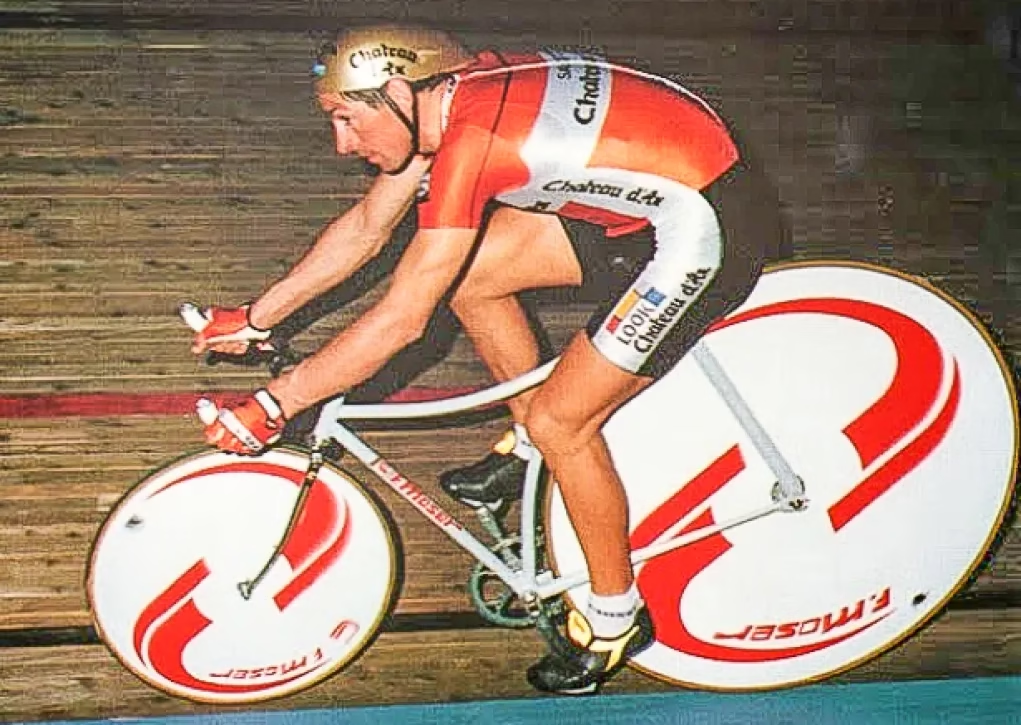
Moser’s Hour Record in Mexico City in January 1984 was one of cycling’s great technological moments. He broke Eddy Merckx’s 1972 mark using a radically different approach, with aerodynamic thinking, disc wheels and a more modern understanding of performance.
The Hour Record had always been a test of purity in cycling mythology: one rider, one bike, one hour, one distance. Moser’s ride complicated that idea. It was still a monumental physical effort, but it also showed how equipment, altitude, preparation and science could change what was possible.
That made the record both celebrated and controversial. Moser’s achievement helped push cycling towards a more technologically aware age, but it also raised questions about how to compare records set under different conditions and with different equipment. Later rule changes around the Hour Record reflected that tension.
For Moser, the ride added another layer to his legend. It was not just that he broke the record. It was that he did it in a way that matched his character: prepared, forceful, technically ambitious and unafraid of pushing beyond cycling’s older traditions.
The Hour Record was never separate from his road career. It was an extension of it. Moser had always been about sustained power. Mexico City turned that quality into a measured distance.
Rivalry with Giuseppe Saronni
No history of Moser feels complete without Giuseppe Saronni. Their rivalry defined Italian cycling across the late 1970s and early 1980s, giving the country a modern version of the old internal sporting divide that had once shaped the Coppi-Bartali era.
Moser and Saronni were different in style and personality. Moser was the powerful northerner, built around strength, work and long effort. Saronni was more explosive, sharper in the finish and often more suited to punchy racing. Their contrast gave Italian cycling a compelling narrative because fans could choose not just between riders, but between identities.
The rivalry was not always gentle. It carried pressure, media attention and tactical tension. Yet it helped both riders. Italian cycling thrives on rivalry, and Moser versus Saronni gave the sport a domestic drama that stretched across the Giro, the Classics and the national imagination.
Moser’s prestige was partly sharpened by that rivalry. He was not winning in an empty era. He was winning against one of Italy’s most gifted riders, at a time when Italian cycling still had extraordinary depth.
Why Moser’s style mattered
Moser’s style mattered because it challenged a narrow idea of beauty in cycling. Some riders look elegant because they seem light and effortless. Moser looked elegant because his power was so controlled.
He was not a fragile climber dancing away from the bunch. He was a rider who could sit on the front and make the race bend. His upper body, cadence and posture all communicated strength. But there was nothing random about it. He did not look like a rider throwing force at the road without thought. He looked like a rider converting force into speed with remarkable efficiency.
That is why he remains so memorable. Cycling often romanticises suffering, but Moser romanticised power. He made the time trial, the chase and the cobbled sector feel like high art. His racing suggested that elegance could come from pressure, not only lightness.
In modern terms, he was the kind of rider teams would build around for Classics, time trials, flat Grand Tour stages, rolling one-day races and controlled GC campaigns on routes without extreme climbing. He had the engine of a rouleur, the mentality of a leader and the finish of a champion.
-
 Photo Credit: Lezyne
 -
 Photo Credit: David Pintens / BELGA MAG/AFP via Getty Images

Life after racing
Moser retired in 1987, leaving behind one of the largest winning records in cycling history. Like many great Italian riders, he did not disappear from public life. He remained a visible figure in cycling, business and regional life.
His family’s wine business became a major part of his post-racing identity. The Moser winery, founded by Francesco and his brother Diego in Trentino, connected neatly with his background. It kept him close to the land and region that had shaped him before cycling made him famous.
That post-career path feels fitting. Moser’s racing was always connected to place, work and tradition, even when he was at the cutting edge of technology. The winery gave him another way to remain rooted in Trentino while still carrying the prestige of his sporting name.
He has also remained part of cycling’s memory through public appearances, interviews and retrospectives on the sport’s great eras. For Italian cycling, he is not simply a former rider. He is part of the reference system, a name that still comes up whenever power riders, Giro champions, Roubaix specialists or Hour Record attempts are discussed.
Moser’s legacy
Francesco Moser’s legacy is built on range and force. He was world champion, Giro winner, Hour Record holder, Milan-San Remo winner, double Lombardia winner and three-time Paris-Roubaix champion. He was one of those rare riders whose palmarès can be read from several directions and still feel complete.
He was not the greatest climber of his era, and that limitation shaped his career. But it also made his achievements more distinctive. Moser did not win by becoming someone else. He won by maximising what he was: a rider of enormous sustained power, tactical command and competitive pride.
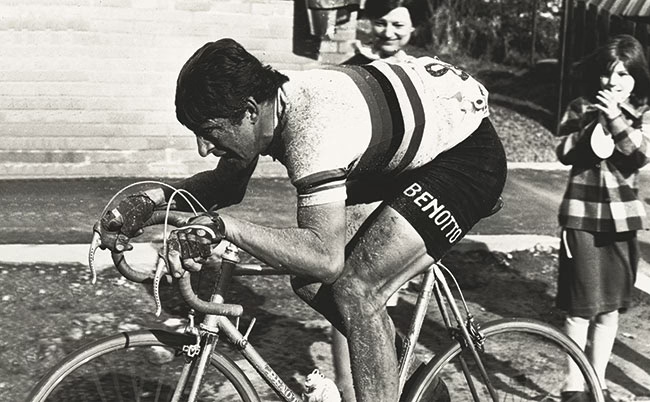
His best performances still carry a particular visual quality. The dust of Roubaix, the aerodynamic shape of the Hour Record bike, the pink of the Giro, the rainbow jersey, the long straight roads where he could pour pressure into the pedals. These are not separate images. They are parts of the same story.
Moser made brute force look elegant because his strength had structure. He did not simply overpower races. He organised them around his power until resistance began to weaken. That is why he remains one of Italian cycling’s great figures: not only a champion of results, but a champion of style, identity and controlled aggression.

