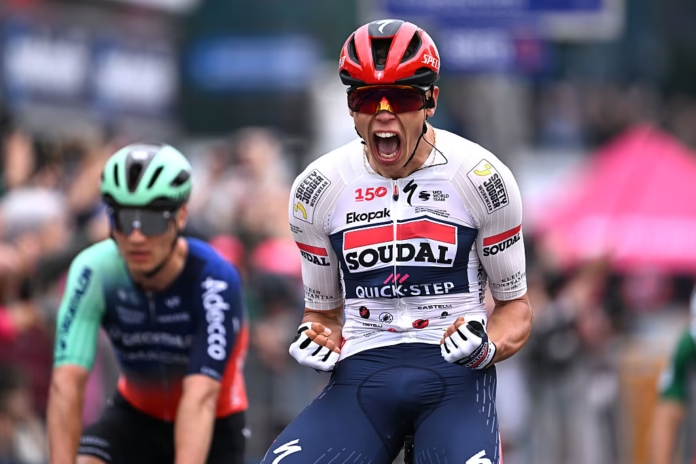
Paul Magnier won stage 1 of the Giro d’Italia 2026 in Burgas after a high-speed crash tore through the bunch inside the final kilometre, leaving only a small group clear to contest the sprint. The Soudal Quick-Step rider beat Tobias Lund Andresen and Ethan Vernon to the line and, with it, claimed the first maglia rosa of this year’s race.
The 147km opener from Nessebar to Burgas had been built as a likely sprint stage from the start. The terrain was gently rolling rather than flat in the strictest sense, but nothing on the route looked likely to trouble the fast men. What changed the shape of the day in the end was not the parcours, but the chaos of the finale.
The break goes early on the Black Sea coast
The 2026 Giro d’Italia rolled away from the Black Sea coast in warm, dry conditions, with the peloton given a short neutralised section out of Nessebar before the flag dropped for real. As expected, attacks went almost immediately, and it did not take long for the day’s break to form.
Manuele Tarozzi of Bardiani CSF 7 Saber and Diego Pablo Sevilla of Polti VisitMalta were the two riders who got clear. The peloton was happy enough with that combination and quickly eased, allowing the gap to drift out beyond two minutes as the sprinters’ teams settled into the familiar opening-stage calculation of how much work they really wanted to do.
Soudal Quick-Step, Uno-X Mobility and Unibet Rose Rockets all spent time on the front in those early kilometres, but nobody was interested in a hard chase. The aim was clearly to keep the move manageable while saving as much as possible for the final hour.
Tarozzi and Sevilla race for the early prizes
With the stage heading south and then looping around the circuits near Burgas, Tarozzi and Sevilla turned their break into a proper contest for the day’s secondary prizes. The first significant battle came on the category 4 Cape Agalina climb, where Sevilla proved the quicker of the two and moved into prime position for the blue mountains jersey.
Tarozzi had his moments too. He took the intermediate sprint uncontested when the duo were still clear, and later beat Sevilla at the Red Bull kilometre sprint. That section mattered because the peloton also accelerated there, with UAE Team Emirates-XRG notably showing interest in the time bonus on offer, suggesting they had no intention of letting any GC rivals take free seconds even on the opening day.
The sprinters also began to stretch their legs at the intermediate sprint. Lidl-Trek led Jonathan Milan into it and he took the points ahead of Kaden Groves, an early sign that the Italian team intended to make their presence felt whenever the road flattened out.
The bunch keeps the race under control
For long stretches, the stage unfolded exactly as a first-day sprint stage often does. The break hovered around one to two minutes, the pace stayed sensible, and the bunch used the day to settle into the rhythm of a Grand Tour. There were small moments along the way, but the overall direction of the stage never really changed.
The circuits south of Burgas gave the race a little more texture. The roads rolled more than the stage profile first suggested, and the peloton twice passed the finish area before the decisive closing run. But still the central question remained the same: who could beat Milan in a clean sprint?
The answer, as it turned out, would depend less on pure speed than on simple survival.
The catch leads straight into the sprint fight
With around 25km to go, the breakaway was finally living on borrowed time. Tarozzi and Sevilla kept fighting, but the bunch had begun to gather in formation and the chase was becoming more deliberate. By 22km to go, the two leaders were caught and the stage moved fully into sprint mode.
From there, the tension rose sharply. At 15km to go, the main sprint teams began to show themselves, with Lidl-Trek especially prominent around Milan. Soudal Quick-Step, Decathlon, Picnic, Astana, UAE and Uno-X were all visible too, while Visma | Lease a Bike sensibly stayed near the back, trying to avoid trouble rather than fight for a sprint they were never going to contest.
Inside the final 10km, the bunch was fully lined out. Speed went up towards 60km/h, shoulders were knocking, and the trains were battling for the best side of the road. Uno-X led into one corner, Lidl-Trek moved alongside Soudal, and Magnier’s Soudal Quick-Step team massed on the left-hand side as the roads narrowed and reopened.
A huge late crash turns the stage upside down
The stage was turned upside down with around 600 metres to go. In the thick of the bunch, a high-speed touch of wheels behind the leading riders triggered a major crash that blocked much of the peloton. Dylan Groenewegen and Kaden Groves were among the riders caught up, while Matteo Moschetti also went down in the pile-up.
Only a handful of riders managed to avoid the incident and continue their sprint uninterrupted. Milan was still there, but the crash and the bunching behind him left him boxed in and unable to launch properly. Tobias Lund Andresen got to the front and opened up the sprint, but Magnier came around him at just the right moment to take the victory.
Ethan Vernon finished third, while the rest of the field arrived in dribs and drabs after the crash. Riders caught behind the incident were given the same time as the front group, so the general classification did not immediately split on day one. But the stage result and the first maglia rosa were decided by the few who stayed upright and clear.
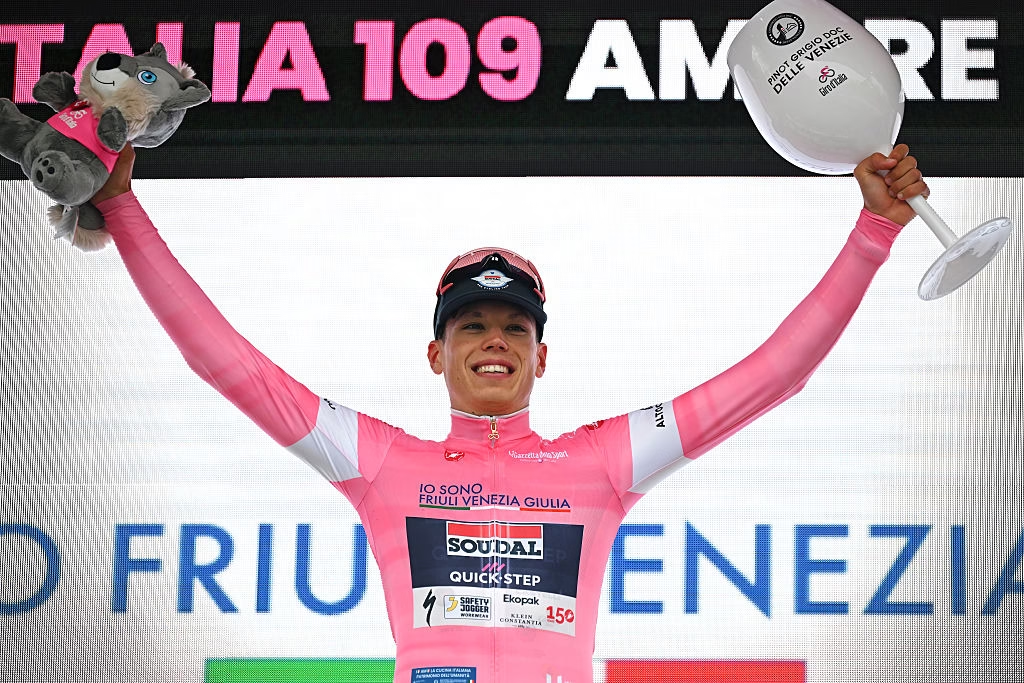 Photo Credit: Getty
Magnier gives Soudal Quick-Step the ideal start
For Soudal Quick-Step, it was a huge result. The team had endured a frustrating start to the 2026 season, but Magnier changed the mood in one afternoon. He not only won the stage and took the pink jersey, but also pulled on the cyclamen points jersey and the white jersey as best young rider.
It was his first Grand Tour stage win and, naturally, his first maglia rosa. He had worn pink at the Under-23 Giro before, but this was a different level entirely.
Just as important was the work done around him. Jasper Stuyven’s positioning in the finale was especially valuable, and Magnier himself made clear afterwards how crucial that support had been on such a hectic run-in. Soudal were up front before the road narrowed, exactly where they needed to be when the sprint broke apart.
A dramatic first day in Bulgaria
Stage 1 had looked like a routine Grand Tour opener for most of the afternoon, but the final kilometre changed everything. What should have been a clean sprint between the biggest names became a race of elimination, timing and luck, with Magnier the rider who took full advantage.
The Giro d’Italia always has a way of finding drama early, and this year’s race did not need long. The first maglia rosa is on Magnier’s shoulders, the first sprint went to Soudal Quick-Step, and several of the other fast men will head into stage 2 with road rash, frustration or both.
Giro d’Italia 2026 stage 1 result
Results powered by FirstCycling.com
Main photo credit: Getty