In the annals of cycling history, few stories captivate quite like that of Graeme Obree. Born in an era when cycling innovation meant incremental gains measured in wind tunnels by corporate teams, this Scottish maverick arrived with a bike built from washing machine parts and an unshakeable belief that convention was merely a suggestion. His journey wasn’t paved with academy systems or corporate sponsorship; it was forged in a small bike shop in Ayrshire, hammered out by a mind that refused to accept the limitations others readily embraced. This is the story of the Flying Scotsman, a man who didn’t just race bikes but reimagined them entirely.
Early Life: The Crucible of Adversity
Born on 11 September 1965 in Nuneaton, Warwickshire, England, to Scottish parents, Graeme Obree moved to Scotland as a child and has always considered himself Scottish. His early life was marked by challenges that would shape both his character and his unconventional approach to cycling.
Growing up in Ayrshire, Obree struggled with what he later recognised as undiagnosed learning difficulties and severe social anxiety. School was a battlefield where traditional methods proved largely ineffective. He experienced persistent bullying and developed debilitating depression from a young age. In his teens, he attempted suicide by gassing himself, but was saved only when his father returned home early from work.
Yet cycling became his escape. Riding bikes with his brother offered a reprieve from his troubles, a sanctuary where he could process the world on his own terms. This experience of finding answers outside the textbook would later define his revolutionary approach to bike design and racing.
His first race epitomises his unconventional start. Arriving at a 10-mile time trial wearing shorts, an anorak, and Doc Marten boots, he thought the start and finish were at the same place and stopped 100 meters short of the end. Even while changing, he managed to finish in around 30 minutes. It was hardly an auspicious beginning, but it marked the start of an extraordinary journey.
The Bicycle as Laboratory: Innovation Born of Necessity
For Obree, the bicycle was never just a piece of sporting equipment to be used as prescribed. It was a complex mechanism ripe for reimagining, a puzzle to be solved through first principles thinking rather than accepted wisdom.
The Genesis of “Old Faithful”
In 1992, when the bicycle shop Obree owned went bust, leaving him deeply in debt and depressed, he faced what he described as a choice: fight or flight. He chose to fight, and he did it with style.
Unable to afford cutting-edge equipment like rival Chris Boardman’s £250,000 Lotus bike, Obree decided to build his own. Using approximately £70 of scrap metal and spare parts, he created “Old Faithful,” a bike that would change cycling forever.
The innovations were radical:
- A deliberately narrow bottom bracket (68mm instead of the standard measurements) that brought his legs closer together, creating a more natural pedalling position
- Washing machine bearings, which Obree reasoned must be higher quality than standard bike bearings to withstand the forces of a spin cycle
- A single-bladed front fork to reduce aerodynamic drag
- No top tube, preventing his knees from making contact with the frame
- Shoes bolted directly to the pedals to prevent foot slippage
Obree later regretted revealing the washing machine bearing detail to journalists, as media fixation on this minor component often overshadowed his more significant innovations and athletic achievements.
The Revolutionary Riding Positions
Obree’s genius extended beyond the bike itself to how the human body interacted with it. He developed riding positions that challenged a century of cycling convention:
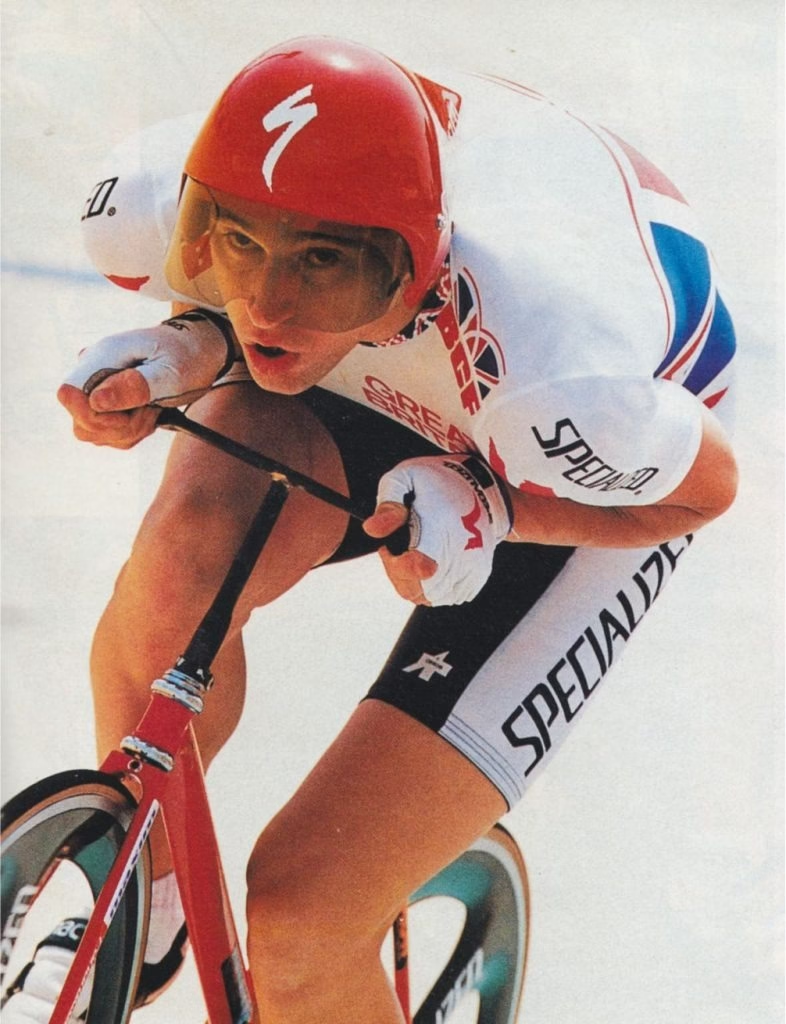
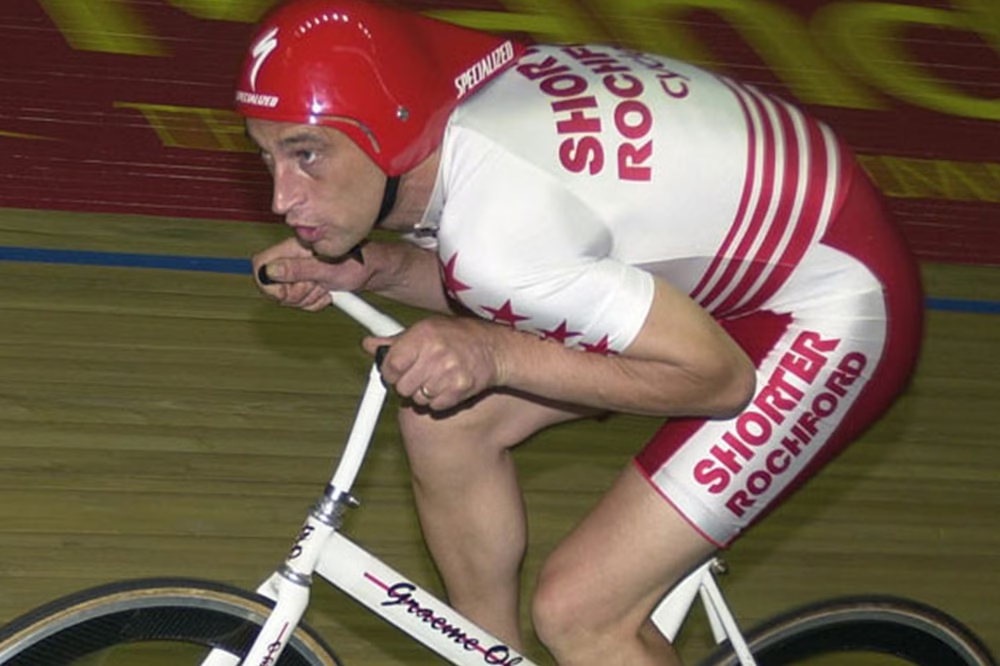
The “Tuck” Position: His first innovation involved tucking his arms beneath his chest while crouching over narrow handlebars. This dramatically reduced his frontal area and aerodynamic drag by approximately 15%. The position demanded immense core strength and flexibility but offered unprecedented aerodynamic advantages.
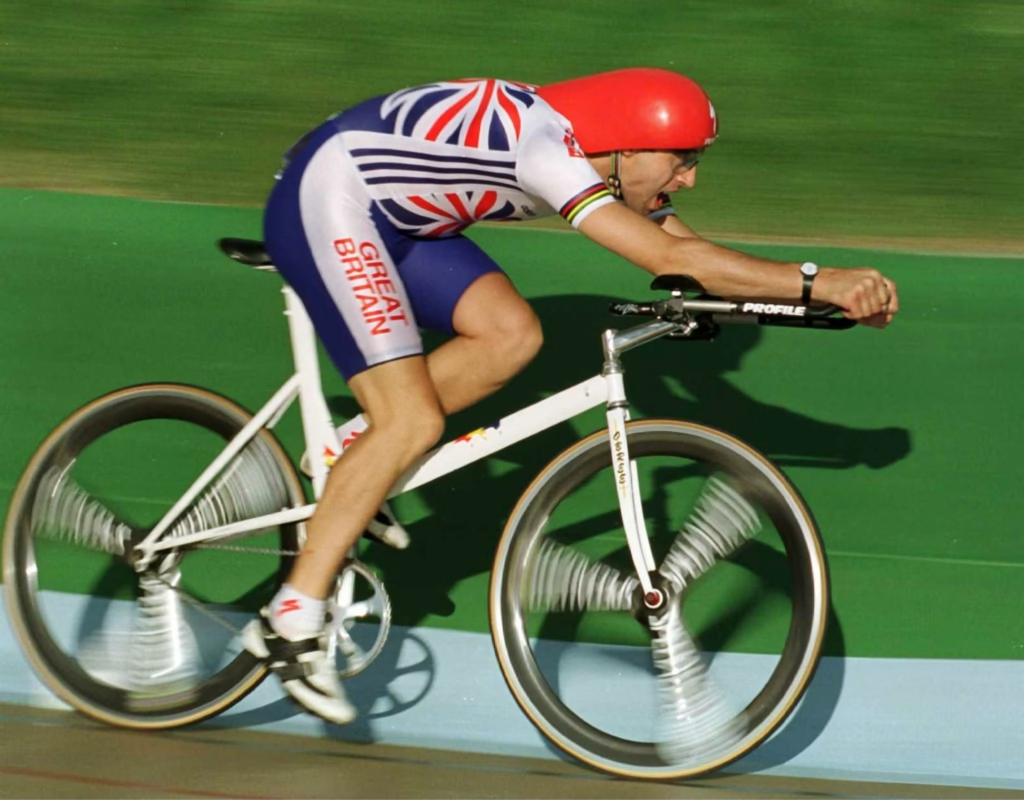
The “Superman” Position: After the UCI banned the tuck position, Obree responded with an even more extreme innovation. For pursuit racing, he extended his arms fully forward, resting them on handlebars positioned well ahead of the frame. This created an extraordinarily narrow profile, resembling Superman in flight. The position offered such significant advantages that it would eventually be adopted by other riders before the UCI banned it too.
These weren’t arbitrary postures. They were the direct result of an analytical mind dissecting aerodynamics and biomechanics without expensive wind tunnels or computer simulations, relying instead on intuition, experimentation, and countless hours of testing on the road.
The Hour Record: A Tale of Triumph and Rivalry
The hour record, cycling’s most prestigious time trial, is simple in concept but brutal in execution: ride as far as possible in 60 minutes on a velodrome. When Obree set his sights on Francesco Moser’s nine-year-old record of 51.151 kilometres, few outside the UK gave this relatively unknown amateur any chance of success.
The Historic 1993 Attempt
On 16 July 1993, Obree travelled to the Vikingskipet velodrome in Hamar, Norway. The attempt ended in heartbreaking failure, falling short by nearly a kilometre. Most journalists packed up and left, assuming the story was over.
But Obree had booked the velodrome for 24 hours. He decided to try again the next morning.
To prevent his punished body from seizing up overnight, he employed an ingenious strategy: drinking pints of water before sleeping so he would naturally wake every couple of hours to use the bathroom, giving him opportunities to stretch his tortured muscles.
On the morning of 17 July 1993, having barely slept, Obree returned to the track at 7:55 AM. About his mental transformation, he later said: “The day before, I had been a mouse. Now I was a lion.”
He set a new record of 51.596 kilometres, surpassing Moser’s mark by 445 meters. The cycling world was stunned. An amateur on a homemade bike had conquered one of sport’s most demanding challenges.
The Boardman Rivalry
Obree’s triumph lasted exactly six days. On 23 July 1993, during a rest day of the Tour de France, Chris Boardman broke Obree’s record in Bordeaux, riding 52.270 kilometers on a high-tech carbon monocoque Lotus bike backed by major sponsors.
The media eagerly stoked rivalry between the two British cyclists, but Obree got his revenge. At the 1993 UCI Track Cycling World Championships in Norway, he knocked Boardman out in the semi-finals of the individual pursuit before winning the title, becoming the first Briton to claim the pursuit world championship in 35 years.
Reclaiming Glory: 1994
On 27 April 1994, Obree travelled to the same Bordeaux velodrome where Boardman had beaten his record. He had bolted his shoes to his pedals to avoid a repeat of the national pursuit championship, where he’d pulled his foot off during his starting effort.
He rode 52.713 kilometers, reclaiming the hour record. This mark would stand until 2 September 1994, when Spanish Tour de France winner Miguel Induráin pushed it to 53.040 kilometers.
The UCI’s War on Innovation
Obree’s success attracted the attention of cycling’s governing body, the Union Cycliste Internationale (UCI), in ways that would profoundly shape the rest of his career.
The 1994 World Championships Controversy
At the 1994 UCI Track Cycling World Championships in Sicily, Obree arrived as defending individual pursuit champion. He had modified his bike and position to comply with new UCI regulations.
Then, approximately one hour before his qualifying run, officials informed him of an additional rule change so new it hadn’t even been written down. The rule effectively banned his tuck position. When Obree understandably chose to ignore this last-minute regulation and rode in his customary style, he was disqualified despite the red flag waving. Cycling Weekly blamed the decision on “petty-minded officialdom.”
The Superman Ban
Undeterred, Obree developed his Superman position and returned to the 1995 World Championships. Using this new innovation and Old Faithful, he won his second individual pursuit world championship.
The UCI subsequently banned the Superman position as well, citing safety concerns. However, before the ban took effect, Italian rider Andrea Collinelli used a similar outstretched position to win the individual pursuit gold medal at the 1996 Atlanta Olympics, setting a world record in the process.
The Atlanta Olympics
At the 1996 Summer Olympics in Atlanta, Obree competed in the men’s individual pursuit. However, placed 12th in qualifying and didn’t advance to match racing. His rival, Boardman, had elected to ride only the road time trial, depriving fans of the head-to-head battle they craved.
The disappointment highlighted the toll that years of fighting cycling authorities had taken on Obree’s career and mental health.
The Professional Cycling Attempt & Doping Refusal
Following his 1993 world championship victory, Obree took out a professional license and joined French team Le Groupement. His professional career was short-lived and troubled from the start.
The French riders gave him the cold shoulder, and the situation deteriorated when team management made it clear he would be expected to participate in the team’s program of “medical backup”, a euphemism for performance-enhancing drugs.
Obree refused outright. As he later explained: “I was signed up to ride in the prologue of the Tour back in 1995, but it was made very obvious to me I would have to take drugs. I said no, no way, and I was sacked by my team.”
He was fired before riding his first race. The team subsequently fell apart amid accusations that it was a pyramid-selling scheme, with riders claiming unpaid wages.
Years later, sitting in Paris watching the Tour de France pass by, Obree reflected: “I feel I was robbed by a lot of these bastards taking drugs. I also hate the way that people think anyone who has ever achieved anything on a bike must have been taking drugs.”
His principled stand cost him his professional career, but it preserved his integrity and his records’ legitimacy.
The Darkness: Mental Health Struggles
Behind Obree’s remarkable achievements lay a profound personal battle with mental illness that would nearly claim his life multiple times.
The Descent
After his brother Gordon died in a car crash in October 1994, Obree slid deeper into depression. The loss of structure and purpose following his retreat from elite cycling, combined with undiagnosed bipolar disorder, created a perfect storm of mental anguish.
In the 1990s, he took an overdose of aspirin washed down with water from a puddle. He sniffed the gas he used to weld bicycles. These weren’t merely difficult times, they were life-threatening crises.
In 2001, he was found unconscious at Bellsland Farm in Kilmaurs, 12 kilometres from his Ayrshire home. The Obree family’s horse was stabled there, and it was discovered by a woman checking the barn. He had tried to hang himself.
His wife Anne reported he had been diagnosed with severe bipolar disorder three years earlier. Thirteen years of therapy followed his suicide attempts.
Coming Out: The Hidden Burden
In January 2011, Obree disclosed in an interview with the Scottish Sun that he is gay and that his difficulty with coming to terms with his sexual orientation contributed to his earlier suicide attempts.
“I was brought up by a war generation; they grew up when gay people were put in jail. Being homosexual was so unthinkable that you just wouldn’t be gay. I’d no inkling about anything, I just closed down,” he explained.
He came out to his family in 2005 after working with a psychologist who helped him realise he had been emotionally shut down since around age 13. He has since divorced his wife, with whom he has two children.
Coming out was difficult for his family, particularly his parents, but Obree says it ultimately improved his relationship with them. “It was difficult and there were lots of tears. It wasn’t easy. But the relationship with my parents has been improved by it. We talked about it and discussed things and we’re a lot happier.”
Finding Peace
In recent years, Obree has found ways to manage his bipolar disorder and live with greater contentment. In a 2018 interview with The Big Issue, he revealed he hadn’t used anti-depressants for four years.
“I became world champion and found that my sense of fulfilment faded like the centre of a flower. But now, these days, I’ve finally learned to live in the moment,” he said. “Everything I’ve done to get to this place is to do with how I handled adversity.”
He has become an advocate for openness about mental health in sports, using his experiences to encourage other athletes to seek help and talk about their struggles.
Continuing the Quest: Later Innovations
Obree’s drive to innovate never ceased, even after his competitive career wound down.
The 2009 Athlete’s Hour Attempt
In May 2009, Obree announced he would attempt the “Athlete’s Hour” record on a bike he had built himself. However, by October 2009, he cancelled the attempt, stating the bike wasn’t suitable for the conditions.
The Battle Mountain Speed Record
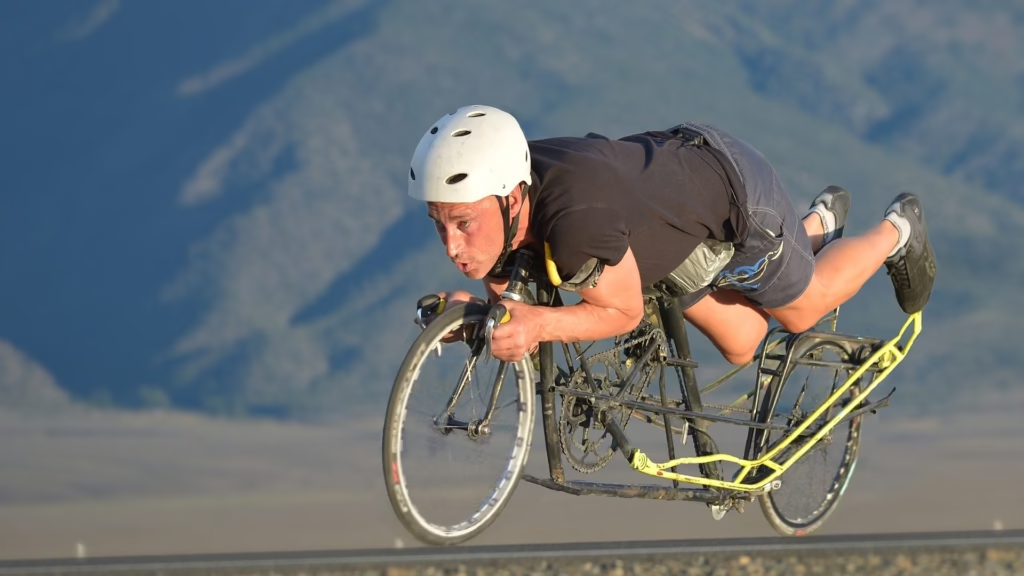
In December 2011, Obree announced an attempt at the human-powered vehicle (HPV) land speed record, aiming to hit 100 mph. He built a prone bike for the attempt.
In September 2013, at the World Human Powered Speed Championships in Battle Mountain, Nevada, he achieved a speed of 56.62 mph (91.12 km/h). While he didn’t break the overall HPV land speed record (then 82.8 mph), he set a new record for a rider in the prone position.
This quest became the subject of the 2015 documentary “Battle Mountain: Graeme Obree’s Story,” directed by David Street and crowdfunded through Kickstarter. The film premiered at the Edinburgh International Film Festival and went on public release in March 2016, with screenings featuring Q&A sessions with Obree.
Honours and Recognition
Despite the obstacles placed in his path, Graeme Obree’s achievements have earned significant recognition:
- 1993: Won Bidlake Memorial Prize, UK cycling’s highest honour
- 1993: Named BBC Sportscene Personality of the Year
- 2003: Published autobiography Flying Scotsman: Cycling to Triumph Through My Darkest Hours
- 2006: Film The Flying Scotsman, starring Jonny Lee Miller and Billy Boyd, premiered atthe Edinburgh International Film Festival
- 2009: Inducted into the British Cycling Hall of Fame
- 2010: Inducted into the Scottish Sports Hall of Fame
His autobiography provides a searingly honest account of his cycling career and his battles with depression and bipolar disorder. As he explained: “It started with the psychologist saying it would do me good and ended up as my life story.”
In May 2014, the UCI finally relented, acknowledging that fixing the kind of equipment to be used was hindering technical progress. It restored previously banned world records from 2000, now described as “Best Hour Performance.”
The Enduring Legacy
Obree’s impact on cycling extends far beyond his record books and medal count.
Aerodynamic Revolution
Before Obree, aerodynamic considerations in cycling were evolutionary, not revolutionary. His radical positions forced a wholesale re-evaluation of rider aerodynamics and inspired serious scientific research into fluid dynamics as applied to cycling.
Modern time trial bikes, with their extreme aerodynamic frames and tucked riding positions, owe a significant debt to Obree’s pioneering spirit. He proved that radical innovation could yield dramatic results, even if the cycling establishment initially rejected it.
The Philosophy of Innovation
Obree taught the cycling world that boundaries are often self-imposed. His career stands as a constant reminder to question accepted wisdom and challenge the status quo.
He proved that a single individual, driven by a clear vision and unyielding determination, could fundamentally alter the landscape of a sport dominated by well-funded teams and corporate interests.
Inspiration to Outsiders
For cyclists without access to elite development programs or corporate backing, Obree’s story remains profoundly inspiring. It demonstrates that with enough dedication, ingenuity, and mental fortitude, one can make a significant impact on the world stage.
His refusal to dope, even when it cost him his professional career, stands as a powerful testament to integrity in an era when cycling was rife with performance-enhancing drug use.
Mental Health Advocacy
Perhaps the most important legacy of Graeme Obree is his openness about mental health struggles. In an era when athletes rarely discussed depression, bipolar disorder, or sexuality, his honesty helped break down stigma and encouraged others to seek help.
As he told Big Issue: “People who are fully content with life don’t get up at 6 am and ride up and down a dual carriageway. Being discontent means you always want more.”
When asked what motivates him to continue, he offers simple wisdom: “There are only three reasons to do anything: because you need to, because you want to, or because you feel you ought to. Never do something just because you ought to. Whether it’s going out on the bike, entering a race or attending a funeral, do it because you want to. Do it because you love it!”
Graeme Obree Quick Facts
| Category | Details |
|---|---|
| Full Name | Graeme Obree |
| Nickname | The Flying Scotsman |
| Born | 11 September 1965, Nuneaton, Warwickshire, England |
| Nationality | Scottish (by upbringing and identity) |
| World Hour Record | 51.596 km (17 July 1993); 52.713 km (27 April 1994) |
| World Championships | 2 individual pursuit titles (1993, 1995) |
| Famous Bike | “Old Faithful” (built with washing machine parts) |
| Innovations | Tuck position, Superman position, narrow bottom bracket |
| Hall of Fame | British Cycling (2009), Scottish Sports (2010) |
| Mental Health | Openly discusses bipolar disorder, depression, suicide attempts |
| Sexuality | Came out as gay in 2011 |
| Book | Flying Scotsman: Cycling to Triumph Through My Darkest Hours (2003) |
| Films | The Flying Scotsman (2006), Battle Mountain: Graeme Obree’s Story (2015) |
Frequently Asked Questions
Who is Graeme Obree?
Graeme Obree, nicknamed “the Flying Scotsman,” is a Scottish racing cyclist who twice broke the world hour record (1993, 1994) and won the individual pursuit world championship twice (1993, 1995). He’s renowned for his innovative bike designs and riding positions, built largely from scrap materials, including washing machine parts.
What made Graeme Obree’s bike “Old Faithful” so special?
Old Faithful featured radical innovations, including a narrow 68mm bottom bracket, washing machine bearings, a single-bladed front fork, no top tube, and shoes bolted directly to the pedals. These modifications, combined with Obree’s revolutionary “tuck” riding position, reduced aerodynamic drag by approximately 15%.
Why did the UCI ban Graeme Obree’s riding positions?
The UCI banned both Obree’s “tuck” position and later, his “Superman” position, officially citing safety concerns and a desire to ensure records reflected human performance rather than technological advances. Many critics, including Cycling Weekly, described the bans as “petty-minded officialdom” aimed at curtailing Obree’s unconventional innovations.
Did Graeme Obree use performance-enhancing drugs?
No. Obree was fired from his professional team Le Groupement in 1995 after refusing to participate in the team’s doping programme. He has been outspoken about his refusal to use drugs and his belief that doping robbed him of opportunities in professional cycling.
What mental health challenges has Graeme Obree faced?
Obree has been diagnosed with bipolar disorder and has openly discussed three suicide attempts (in his teens, 1998, and 2001). He has also spoken about how his difficulty accepting his sexuality as a gay man contributed to his mental health struggles. Since 2005, he has worked with therapists and has become an advocate for mental health awareness in sports.
What is Graeme Obree doing now?
Obree continues to race occasionally in individual time trials for Fullarton Wheelers cycling club. He has attempted various speed records, including a 2013 bid at the human-powered vehicle land speed record, where he set a prone position record. He also works as a motivational speaker, sharing his experiences overcoming adversity and innovation.
Further Graeme Obree Reading and Resources
- Cycling UK: Graeme Obree Biography
- National Museums Scotland: Breaking Records on a Homemade Bicycle
- The Big Issue: Cycling Is My Way Out of My Struggles
- Book: Flying Scotsman: Cycling to Triumph Through My Darkest Hours by Graeme Obree (2003)
- Book: The Obree Way: A Training Manual for Cyclists by Graeme Obree
- Film: The Flying Scotsman (2006), starring Jonny Lee Miller
- Documentary: Battle Mountain: Graeme Obree’s Story (2015)