
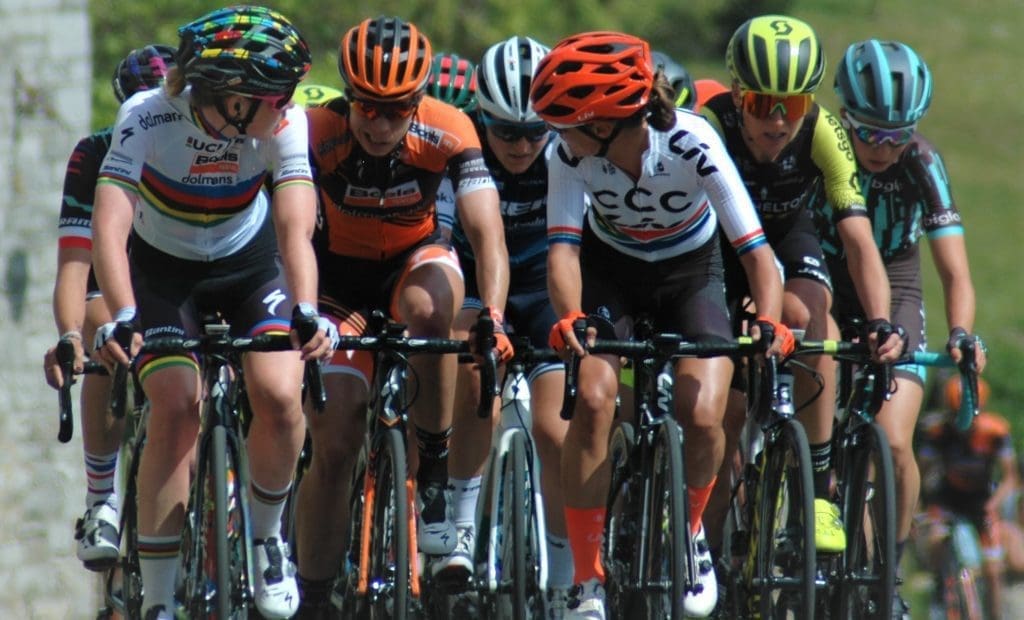
Flèche Wallonne Féminine has one of the clearest identities in women’s cycling. Many races evolve through route changes, surface changes or shifting tactical patterns. This one, more than almost any other, still comes back to the same brutal truth: who can survive the race well enough to produce the best effort on the Mur de Huy. That consistency has helped make it one of the most recognisable and historically rich one-day races in the women’s calendar.
That is also why the race holds its place so securely in the spring. It may not be the longest Monument-style test, and it does not have the rolling unpredictability of the Tour of Flanders or Liège-Bastogne-Liège Femmes, but it asks a very specific and very difficult question. Riders need climbing power, patience, positioning and the kind of punch that can only really be judged on a finish as steep and unforgiving as Huy.
How Flèche Wallonne Féminine began
Flèche Wallonne Féminine first took place in 1998, which gives it a relatively long and important history in the context of modern women’s racing. That longevity matters because the race has not survived by accident. It has lasted because it offers something distinctive. Even in its earliest years, the uphill finish immediately gave it a clear personality and a reliable way of producing worthy winners.
The first era of the race belonged to Fabiana Luperini, who won three times in the opening four editions. That made perfect sense. Luperini was one of the defining stage-race climbers of her time, and the Mur de Huy suited the same kind of explosive uphill effort that often separated the best mountain specialists elsewhere. Those early editions helped establish the central truth of Flèche Wallonne Féminine: if you are one of the best uphill finishers in the sport, this race gives you a very real chance to build a legacy.

How the race evolved
The interesting thing about Flèche Wallonne Féminine is that, in one sense, it has barely changed at all. The race still revolves around the Mur de Huy, and the final uphill sprint remains the sport’s most recognisable exam in pure uphill punch. Yet within that fixed framework, the winners tell the story of changing eras. Nicole Cooke won three times between 2003 and 2006. Marianne Vos then took over, winning in 2007, 2008, 2009, 2011 and 2013. After that came Anna van der Breggen’s extraordinary seven-win run.
What changed around that basic structure was the attempt to make the run-in more open to aggression. The addition of the Côte de Cherave to the finale gave riders one more chance to attack before the Mur itself, especially those unwilling to wait for a pure uphill showdown. It did not transform the race into something totally different, but it did create a more nuanced tactical build-up and made editions such as 2017 more memorable than a simple wait-for-the-wall finish.
The riders who shaped Flèche Wallonne Féminine history
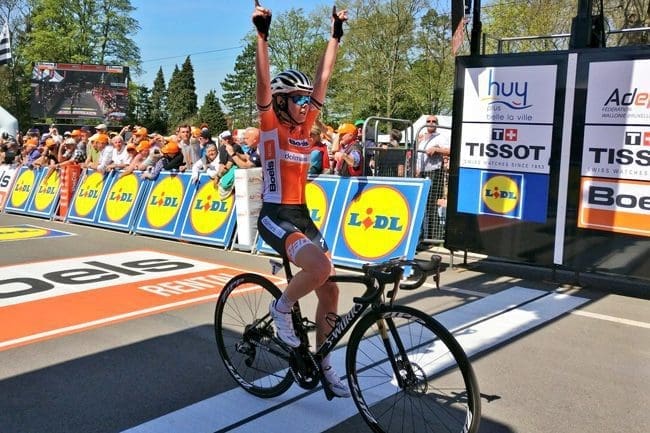
Few races have been shaped so strongly by a small number of riders. Fabiana Luperini dominated the earliest phase. Nicole Cooke then turned the race into one of the cornerstones of her own great spring career. Marianne Vos’s five victories underlined how perfectly the Mur de Huy matched her mix of climbing sharpness and finishing speed. Then Van der Breggen took the relationship between rider and race to another level altogether.
Van der Breggen’s seven victories from 2015 to 2021 are what now define the race historically. Plenty of elite riders have arrived at Flèche Wallonne Féminine as favourites. Almost none have managed to turn that status into repeated victories. Van der Breggen not only won repeatedly, she did so across different race situations and against different generations of rivals. That makes her the single most important figure in the race’s history.
The years since her retirement have made the race feel more open again. Marta Cavalli won in 2022, Demi Vollering in 2023, Katarzyna Niewiadoma in 2024 and Puck Pieterse in 2025. That sequence has given the event a fresh edge, because Flèche Wallonne Féminine is once again a race where no single rider seems to own the Mur in the way Van der Breggen once did.
The greatest Flèche Wallonne Féminine edition
There is still a strong case for 2017 as the most interesting edition of the modern era.
What made it stand out was that it did not follow the purest possible Flèche Wallonne script. The Côte de Cherave had only recently been added to the finale as an extra launch point for riders unwilling to wait until the Mur de Huy, and in 2017 it genuinely changed the race. Katarzyna Niewiadoma attacked first, Lizzie Deignan followed, and Anna van der Breggen joined them just before the summit. That set up a three-rider move with enough quality and enough tactical tension to make the race feel open in a way the event often does not.
The decisive move then came on the flat between Cherave and the Mur. Deignan attacked, Niewiadoma chased, and Van der Breggen used the hesitation perfectly. It was a classic teammate situation, with Deignan and Van der Breggen able to play off a rival who had fewer options. By the time Van der Breggen reached the foot of the Mur, she already had a gap, and from there the race was effectively hers. It was still won on the final climb, but not only on the final climb, which is what makes that edition memorable.
The defining section of Flèche Wallonne Féminine
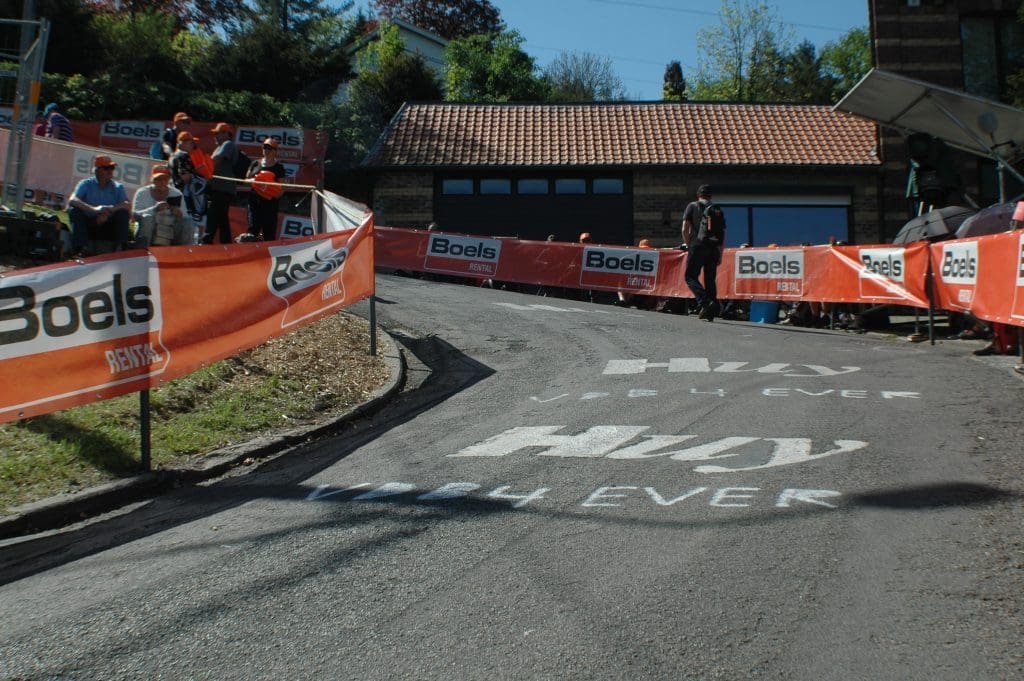
The defining section is, unmistakably, the Mur de Huy. Few finishes in cycling are as instantly recognisable or as tightly bound to one race. The climb is only 1.3km long, but the average gradient sits above 9 per cent and the steepest ramps are much sharper than that. It is a finish that magnifies every mistake. Riders who go too early can stall. Riders who start too far back often never see daylight again.
That is what makes it such a compelling finish year after year. Everyone knows the final answer will probably be written there, yet the Mur still resists being reduced to a formula. The best rider does not always win the race, but the rider who wins almost always has to produce one of the finest uphill efforts of the spring. In that sense, the Mur de Huy does not just define Flèche Wallonne Féminine. It is Flèche Wallonne Féminine.
Flèche Wallonne Féminine previous winners
- 1998 – Fabiana Luperini
- 1999 – Fabiana Luperini
- 2000 – Joane Somarriba
- 2001 – Fabiana Luperini
- 2002 – Mirjam Melchers
- 2003 – Nicole Cooke
- 2004 – Sonia Huguet
- 2005 – Nicole Cooke
- 2006 – Nicole Cooke
- 2007 – Marianne Vos
- 2008 – Marianne Vos
- 2009 – Marianne Vos
- 2010 – Emma Pooley
- 2011 – Marianne Vos
- 2012 – Evelyn Stevens
- 2013 – Marianne Vos
- 2014 – Pauline Ferrand-Prévot
- 2015 – Anna van der Breggen
- 2016 – Anna van der Breggen
- 2017 – Anna van der Breggen
- 2018 – Anna van der Breggen
- 2019 – Anna van der Breggen
- 2020 – Anna van der Breggen
- 2021 – Anna van der Breggen
- 2022 – Marta Cavalli
- 2023 – Demi Vollering
- 2024 – Katarzyna Niewiadoma
- 2025 – Puck Pieterse
Who has won Flèche Wallonne Féminine the most times?
Anna van der Breggen is the outright record holder with seven victories. Marianne Vos is next with five, while Fabiana Luperini and Nicole Cooke each won the race three times. That spread tells you how rare sustained dominance is here. Even with such a predictable finish in theory, very few riders have managed to convert suitability into repeated wins at the top level.
Why Flèche Wallonne Féminine matters so much
Flèche Wallonne Féminine matters because it is one of the purest specialist races in women’s cycling. It does not pretend to be more open than it is. It does not need artificial complexity to create drama. Instead, it leans fully into the brutality of the Mur de Huy and asks the peloton to solve the same problem every year. That clarity is part of its strength.
It also matters because of where it sits in the spring. By the time the peloton reaches Huy, the season is already beginning to separate the good from the exceptional. Riders come to Flèche Wallonne Féminine either hoping to confirm their climbing credentials or to prove they can survive long enough to matter in an uphill sprint of the highest level. In 2026, it remains one of the clearest tests of explosive climbing ability in the whole calendar.

