Omloop van het Hageland has become one of the fixtures that helps define the opening weekend of the women’s European season. It may not carry the same prestige as Omloop Het Nieuwsblad, but it has built a valuable identity of its own – a race that sits between a pure cobbled Classic and a hard sprinters’ test, where positioning, repeated effort and the ability to finish after a stressful day all matter.
That is why the race has remained relevant. For years, Omloop van het Hageland has offered the women’s peloton a Sunday challenge that feels recognisably Belgian without needing the same scale as the biggest spring races. It has cobbles, short climbs, narrow roads and enough tactical uncertainty to keep the script open. Some editions have ended in reduced bunch sprints. Others have tilted towards solo attacks or smaller moves. That mix is what gives the race its staying power.
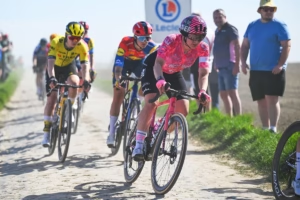
 Photo Credit: Cor Vos
How Omloop van het Hageland began
Omloop van het Hageland first took place in 2005 as Tielt-Winge. The race went through several naming phases before settling into its current identity from 2011 onward. That changing title can make the history look a little untidy at first glance, but the race itself has stayed recognisable – an early-season Belgian one-day event with a route built around repeated laps, short climbs and roads that reward riders who can stay sharp from start to finish.
Its rise in status matters too. After beginning as a lower-ranked event, Omloop van het Hageland moved up to 1.1 level in 2016 and has stayed there ever since. That change reflected the growing quality of the race and its increasingly important role within the women’s opening weekend. It may sit just outside the very top tier, but it has repeatedly attracted fields strong enough to give the race real weight.
How the race found its place in opening weekend
One of the most important shifts in the race’s history came in 2016, when Omloop van het Hageland was brought into the same weekend as Omloop Het Nieuwsblad Women. That gave the women’s opening weekend a more coherent shape. Instead of the spring beginning in a more scattered way, riders and teams had a proper Belgian double-header to start the European road season.
That scheduling helped the race find a clearer identity. It became the Sunday test after Omloop Het Nieuwsblad, but not simply a copy of it. Omloop van het Hageland is generally less selective than the biggest cobbled Classics, which keeps the door open for faster finishers, yet it is still hard enough to punish riders who arrive with only sprint speed and not enough resilience. It has often worked as a race for strong finishers rather than pure specialists.

How the route shapes the race
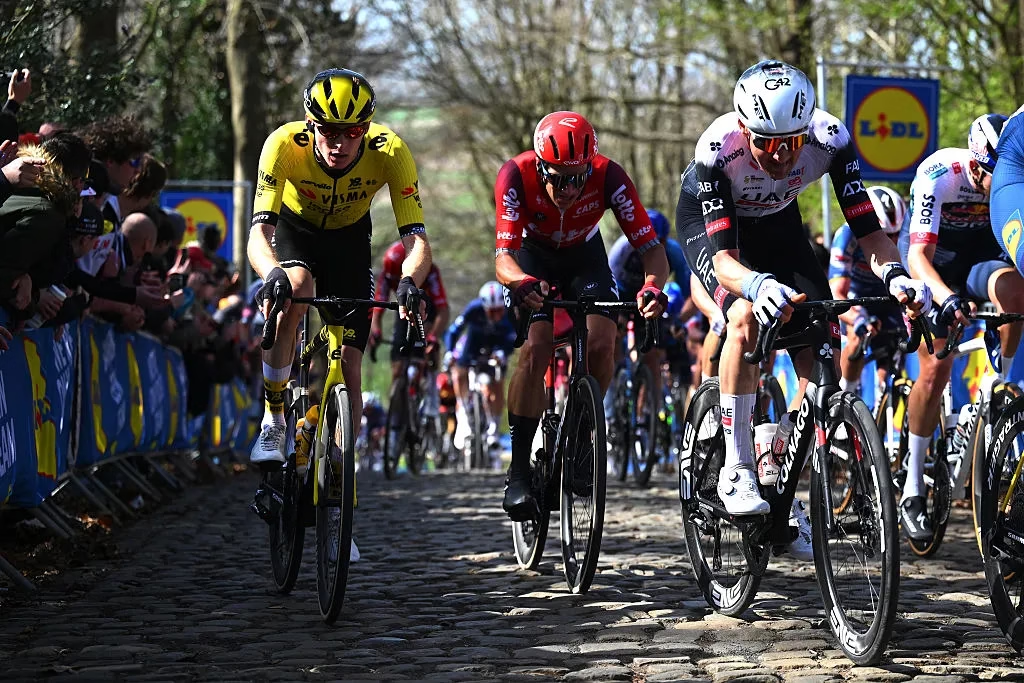
The race has stayed fairly consistent in its broad structure. A longer opening section leads into a finishing circuit around Tielt-Winge, and it is there that the race starts asking the same questions repeatedly. The Roeselberg gives riders a chance to attack, while the cobbles on Kerkstraat add another layer of pressure. Neither is huge in isolation, but their repeated use means the race is often shaped by accumulation rather than one single decisive blow.
That is why Omloop van het Hageland so often sits in an interesting middle ground. If the weather is not too severe and the pace control is strong enough, a reduced bunch can still make it to the finish. If teams race more aggressively or the conditions sharpen things, the race can break apart into smaller groups or even tilt towards a late solo move. It is not a race of one fixed pattern, and that flexibility is one of its strengths.
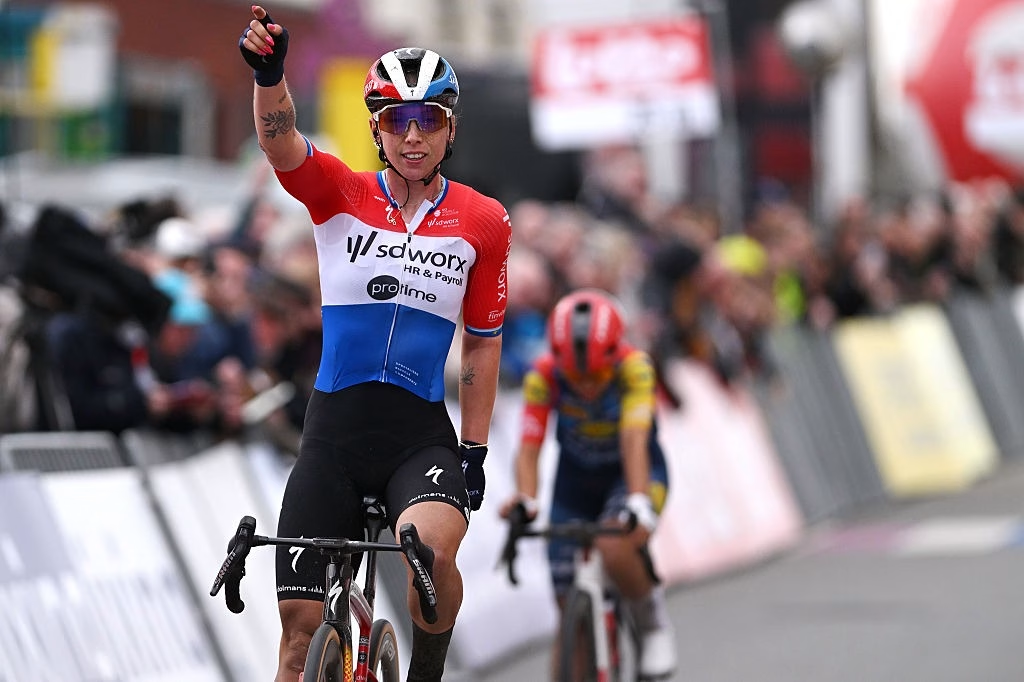
The modern editions underline that point quite well. Femke Gerritse won in 2025 from a breakaway after a hard race, while Charlotte Kool won in 2026 from a sprint after the final attacks were reeled in. Omloop van het Hageland can reward different styles of winner, but usually only after the course has forced the field through several rounds of selection.
The riders who shaped Omloop van het Hageland history
For a long time, the race looked unusual for how evenly success was shared. Emma Johansson won back-to-back in 2010 and 2011. Lizzie Deignan won in 2012 and 2014. Jolien D’Hoore won in 2015 and 2017. Marta Bastianelli then matched that with victories in 2016 and 2019. The race seemed to resist producing one clear dominant rider.
That changed when Bastianelli won again in 2021. Her third victory made her the most successful rider in Omloop van het Hageland history, and that feels fitting because her skill set matched the race so well. She had sprint speed, race toughness and the ability to survive repeated pressure better than many pure finishers. In a race like this, that combination matters more than outright speed alone.
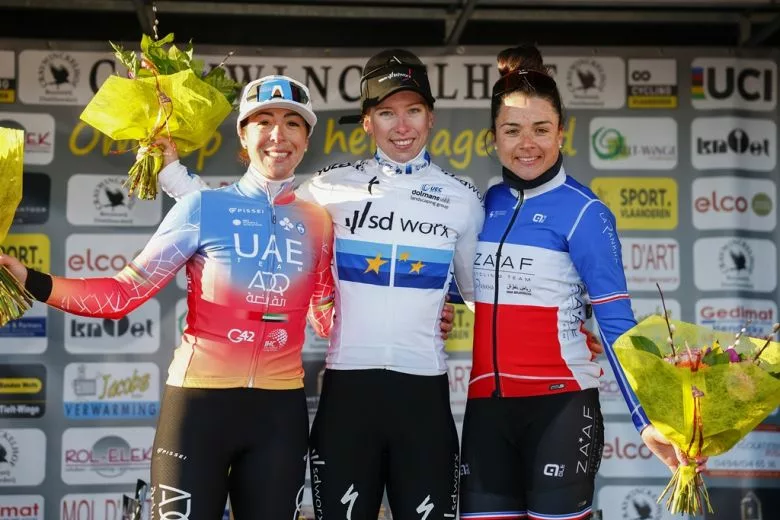
The winners from the more recent period have also reinforced the race’s identity. Lorena Wiebes won in 2020, Barbara Guarischi in 2023, Femke Gerritse in 2025 and Charlotte Kool in 2026. That sequence shows how often Omloop van het Hageland rewards riders who can finish fast after a hard day rather than simply the fastest rider in the field on paper.
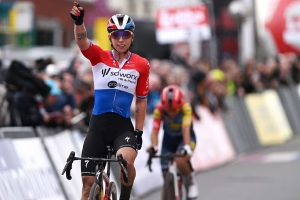
 Photo Credit: Velofocus
The greatest Omloop van het Hageland edition
There is still a strong case for 2018 as the most memorable edition.
It was a bitterly cold day, one of those opening-weekend races where the weather itself seemed determined to become part of the story. The early break of Marjolein van ’t Geloof and Femke Geeris gained a little room before the peloton, driven in part by Sunweb, brought them back. Once that initial move was closed, the race went through the familiar process of splitting and reforming, which often happens here when teams are strong enough to force the pace but not quite strong enough to make the break decisive immediately.
Then the race changed shape again. A six-rider move featuring Eri Yonamine, Amanda Spratt, Dani Rowe, Natalie van Gogh and Karol-Ann Canuel got clear, only for that attack to be pulled back as well. Just as that regrouping happened, Ellen van Dijk made her move. Her attack came late, decisively and at exactly the right moment. Despite the crosswinds and the pressure behind, she stayed clear to win solo by 12 seconds.
That edition captured something essential about Omloop van het Hageland. It is a race where repeated efforts can leave the field just vulnerable enough for one final attack to stick. Van Dijk’s win showed that the race is not only for reduced sprints. It is also a race for riders who know when the bunch is tired enough to stop believing in the chase.
The defining section of Omloop van het Hageland
The Roeselberg is the most distinctive climb in the race, even if it would barely register in some of the bigger spring Classics. It is not especially long, and it is certainly not one of the defining hills of Belgium as a whole. What matters is what it does within this race. It arrives often enough, and with enough sting, to expose riders whose legs are already fading.
That is what makes it such a useful symbol of Omloop van het Hageland itself. The race is not usually won by one devastating climb or one iconic sector. It is won through repeated pressure, small selections and the sort of constant stress that turns a manageable route into a harder race than it first appears. The Roeselberg embodies that well. It is just difficult enough to matter, and that is often exactly what decides this race.
-
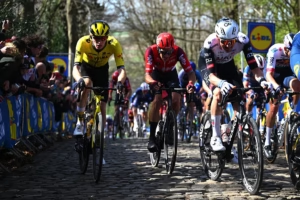
 Photo Credit: Getty

Omloop van het Hageland previous winners
- 2005 – Regina Schleicher
- 2006 – Loes Markerink
- 2007 – Suzanne de Goede
- 2008 – Alexandra Burchenkova
- 2009 – Kirsten Wild
- 2010 – Emma Johansson
- 2011 – Emma Johansson
- 2012 – Lizzie Armitstead
- 2013 – Chloe Hosking
- 2014 – Lizzie Armitstead
- 2015 – Jolien D’Hoore
- 2016 – Marta Bastianelli
- 2017 – Jolien D’Hoore
- 2018 – Ellen van Dijk
- 2019 – Marta Bastianelli
- 2020 – Lorena Wiebes
- 2021 – Marta Bastianelli
- 2022 – not held
- 2023 – Barbara Guarischi
- 2024 – not held
- 2025 – Femke Gerritse
- 2026 – Charlotte Kool
Who has won Omloop van het Hageland the most times?
Marta Bastianelli is the most successful rider in Omloop van het Hageland history with three wins. That gives her a clear edge over Emma Johansson, Lizzie Deignan and Jolien D’Hoore, who each won the race twice. It is a useful reflection of the sort of rider this race has often rewarded – someone fast enough to win a reduced sprint, but strong enough to survive the repeated pressure that comes before it.
Why Omloop van het Hageland matters
Omloop van het Hageland matters because it gives the women’s opening weekend another kind of Belgian test. It is not as severe as the biggest cobbled races, but it is also not soft enough to be reduced to a simple sprint event. It asks for a very specific balance of qualities: positioning, toughness, adaptability and finishing speed after a hard day.
That is why it has remained a worthwhile race. It sits in the calendar at exactly the point where teams and riders are still showing what shape they are in, and where a race can still shift quickly between caution and aggression. Omloop van het Hageland has become one of those events that says a lot about the early spring. Not everything, but enough to matter.