Rik van Looy belongs near the front of any serious discussion about the greatest Spring Classics riders in cycling history. Long before the sport moved into the era of Eddy Merckx, Roger De Vlaeminck, Tom Boonen or Fabian Cancellara, Van Looy had already built the template for what a dominant one-day rider could look like. He had speed, authority, tactical awareness and, crucially, a team built to work for him in a way that felt ahead of its time. He was the first man to win all five Monuments, a rider whose best years turned the Classics into his personal stage, and a champion whose influence stretched beyond the results themselves.
That is why Van Looy deserves more than a short profile or a list of wins. His career tells the story of a rider who helped modernise the way the Spring Classics were raced, while also compiling a palmarès strong enough to secure his place among the very best. If you read him alongside Ronde van Vlaanderen, Paris-Roubaix, Amstel Gold Race and Liège-Bastogne-Liège, his significance becomes even clearer. He was not simply winning big races. He was shaping the meaning of them.

Rider history
Born in Grobbendonk on 20th December 1933, Rik van Looy emerged from the Belgian amateur scene with a strong reputation before turning professional in 1954. He had already shown his quality at a young age, including racing at the 1952 Olympic Games, and that early development mattered because it underlined the range he would later bring into the professional peloton. He was not just a fast finisher. He already had the endurance, positioning sense and bike handling that would define his Classics career.
His rise in the pro ranks was quick. By 1956, he was already making his mark in the Belgian one-day races, winning Gent-Wevelgem and Scheldeprijs. Those victories were repeated in 1957, which immediately established a pattern. Van Looy was becoming the kind of rider who could endure a hard race and still be fast enough to finish it off. That combination, so valuable in the Spring Classics, would become the foundation of his greatness.
The real leap into the highest tier came in 1958, when he won Milan-San Remo. That was his first Monument, but it also felt like the start of something much bigger. In 1959 he added the Tour of Flanders and Il Lombardia, showing that his range went well beyond one race type or one terrain profile. He was no longer just a Belgian star. He was becoming the dominant one-day rider of his era.
The defining milestone came in 1961. Van Looy won Paris-Roubaix and Liège-Bastogne-Liège, completing the set of all five Monuments and becoming the first rider ever to do so. That remains one of the most important achievements in Classics history. Others have matched it since, but he was the first, and that matters. He set a benchmark no rider before him had reached.
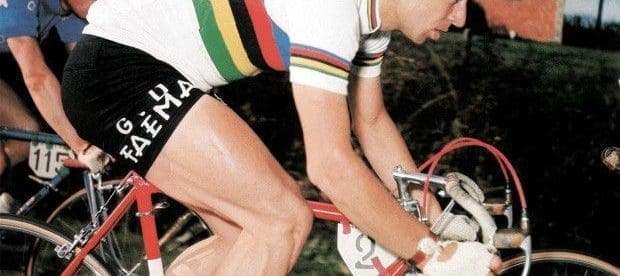
His peak years also coincided with victories at the World Championships in 1960 and 1961. That part of his career often gets slightly overshadowed by the Monument story, but it should not. Two rainbow jerseys in consecutive years confirmed that Van Looy was not merely a specialist who could target a handful of races. He was, for a period, the best one-day rider in the world.
Van Looy was also more than a Classics rider in the narrow sense. He won stages in all three Grand Tours, took the points classification at the Tour de France and the Vuelta a España, and even won the mountains classification at the Giro d’Italia. Across his career, he collected 7 Tour stages, 12 Giro stages and 18 Vuelta stages. That speaks to just how unusual his skill set really was. He had the sprint to win, the resilience to last, and the engine to survive far harder terrain than a pure finisher normally would.
By the end of the 1960s, the rise of Eddy Merckx inevitably reduced the number of truly dominant wins available to every other Belgian star. Van Looy was still capable of major results, including more success in races such as E3 and Flèche Wallonne, but the phase of complete control was passing. He retired in 1970, leaving behind one of the richest one-day records the sport had seen.
Rider type
Van Looy was a true Classics all-rounder. That phrase can be used too loosely, but in his case it fits perfectly. He could sprint from reduced groups, survive a race of attrition, win on cobbles, handle rolling roads and impose himself in races that demanded both strength and patience. He was not reliant on one perfect climb or one highly specific finish. He could win in several different ways.
That versatility was one of his greatest advantages in the spring. The Classics of his era were already selective and often chaotic, but Van Looy’s ability to remain dangerous after a hard day made him a constant threat. He could absorb the damage, trust his speed if it came to a finish, or attack at the right moment when the race was starting to break apart.
How Rik van Looy changed the Spring Classics
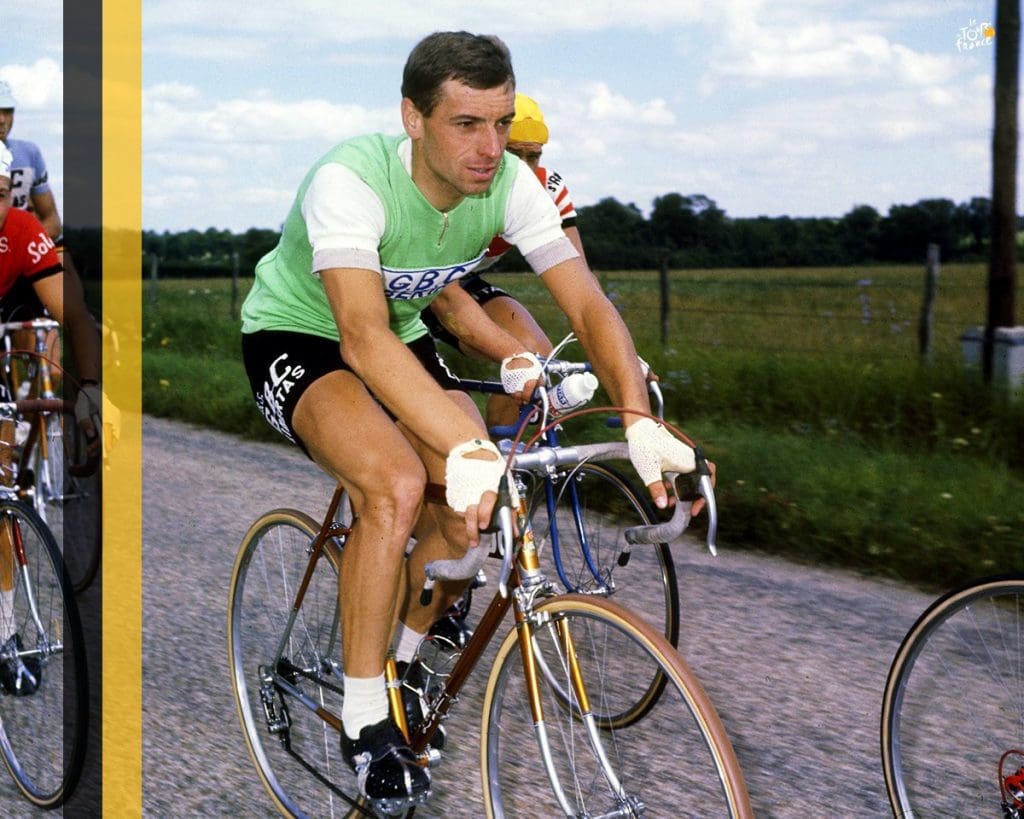
Part of Van Looy’s importance lies in how he won, not only in what he won. His teams increasingly revolved around him with a degree of organisation that felt more modern than much of what the peloton was used to. The famous “Red Guard” around him became one of the defining images of his era, with loyal domestiques riding to protect him, position him and help control the race in a structured way.
That sounds ordinary now, but it was not ordinary then. Van Looy helped move the Classics towards a more deliberate model of leadership, where a top rider was not only expected to win, but to have a race built around him. In that sense, he is an important bridge figure between the earlier, more fluid style of one-day racing and the more tightly controlled team structures that became common later.
This is one reason he still matters historically. He was not only a winner. He was also part of a shift in the way major races could be dominated.
Greatest race victory
If one race best captures Rik van Looy at his peak, it is probably the 1962 Tour of Flanders. There is a strong argument for his 1961 Paris-Roubaix because it completed his Monument set, and another for Liège-Bastogne-Liège that same year for the same reason. But the 1962 Ronde van Vlaanderen combines almost everything that made Van Looy such a formidable force.
He arrived as the reigning world champion and as the focal point of a highly organised team. The race itself was hard, shaped by crosswinds, attrition and the kind of chaotic selection that always makes Flanders feel bigger than the road book alone. Van Looy was protected through the decisive moments, just as a leader of his status needed to be, and once the race reached its critical phase he delivered.
On the Oude Kwaremont, the front of the race broke apart further. Van Looy eventually emerged from the decisive group and attacked late to win solo by 9 seconds. It was not only a Monument victory. It was a statement of control, strength and race authority on home roads, in the rainbow jersey, in the biggest Flemish Classic of them all.
If you want one result that explains why Van Looy was feared, that is probably the one.
His Spring Classics victories
Monument wins
Van Looy’s Monument record is the clearest shorthand for his greatness.
Milan-San Remo – 1958
Tour of Flanders – 1959, 1962
Liège-Bastogne-Liège – 1961
Paris-Roubaix – 1961, 1962, 1965
Il Lombardia – 1959
The most important part of that list is not just the volume, but the breadth. He won across Italy, Belgium and France, on cobbles, rolling roads and attritional terrain. Becoming the first rider to win all five Monuments remains one of the defining achievements in Classics history.
Paris-Roubaix in particular became central to his legend. Three wins there underlined just how well his resilience and finishing speed matched the race. But the victories in Flanders and Liège matter just as much when assessing his range. He was not a specialist. He was a ruler of the entire one-day season.
Other major spring victories
Van Looy’s authority in the spring was never confined only to the Monuments.
Gent-Wevelgem – 1956, 1957, 1962
Scheldeprijs – 1956, 1957
E3 Harelbeke – 1964, 1965, 1966, 1969
Flèche Wallonne – 1968
These races help explain the depth of his spring dominance. Gent-Wevelgem marked his early arrival. Scheldeprijs showed his finishing speed. E3 Harelbeke demonstrated that even as the years moved on, he was still strong enough to win on proper Flemish terrain. Flèche Wallonne late in his career proved he could still take a major Ardennes-style result as the balance of power in the sport began to shift.
Together, those wins make the point even more strongly than the Monuments alone. Van Looy was not simply peaking for one or two major days. He was repeatedly shaping the whole spring.
Why Rik van Looy still stands among the greatest
Van Looy still deserves a place among the greatest Spring Classics riders because his case rests on more than nostalgia. The numbers are there. The Monuments are there. The breadth is there. The world titles are there. And the historical significance is there too.
He was the first rider to conquer the full Monument set. He did it in an era when the sport was changing. He brought a more organised team structure into the biggest one-day races. He won in Belgium, France and Italy, on cobbles and climbs, through force and through speed. There are very few riders in history whose spring palmarès can be read in that way.
For ProCyclingUK readers, he belongs in the same long historical conversation as the legends who followed him. If you trace the line through Merckx, De Vlaeminck, Museeuw, Boonen and Cancellara, Rik van Looy is one of the essential starting points. He was not just one of the greats of his era. He was one of the riders who helped define what greatness in the Spring Classics would come to mean.