Dylan Groenewegen of Unibet Rose Rockets won Ronde Van Brugge 2026 on Wednesday, coming past Jasper Philipsen in the final metres of a reduced bunch sprint after a cold, tense and wind-affected day around Bruges. Max Kanter of XDS Astana completed the podium after a race shaped by repeated echelon threats, crashes, wet roads and late attacks, but ultimately settled by pure speed in the closing straight.
Wind and nerves stop the race from ever really settling
From the moment the flag dropped, this new-look midweek Classic felt less like a race waiting for a breakaway and more like a long fight for survival in the right place. The route itself was not especially selective in the traditional Flemish sense. The Brieversweg cobbles were only modest and tackled three times, and there was no sequence of major climbs to strip the bunch apart. Instead, the main threat came from the wind, the exposed roads and the constant changes of direction.
That was obvious early on. Even after more than 30km of racing, no proper move had formed. Attacks came and went, but the bunch refused to relax. Soudal-QuickStep were hit by early misfortune when Dries Van Gestel and Fabio Van den Bossche were caught in a crash, while Alex Kirsch also fell. Later, Julius Johansen briefly tried to go clear, but the peloton brought him back quickly.
Eventually Gonzalo Serrano and Floris Van Tricht managed to edge away, but they never had much freedom. With the wind already threatening to split the race and the peloton repeatedly reshaping itself, their move always looked fragile. Once they were reeled in, the race returned to its nervous default setting, riders strung across the road, teams edging forward whenever the direction changed, and nobody fully trusting that the next lull would last.
That uncertainty only deepened when the peloton hit the Brieversweg for the first time. The cobbles themselves were not enough to decide the race, but they added to the instability. Brief splits opened and closed. UAE Team Emirates-XRG showed themselves near the front, as did Ineos Grenadiers and Lidl-Trek, while Jasper Philipsen remained the standout sprint favourite if the race stayed together.
Echelons begin to define the contenders
The decisive pressure began to build properly in the second half of the race. With around 80km to go, the pace lifted and the bunch finally broke under the strain. Echelons formed, crashes disrupted the groups behind, and suddenly the race had a genuine front selection rather than just a nervous peloton waiting to split.
The first key front group numbered around 50 riders, then briefly fewer, then swelled again as a second group made contact. Philipsen was there. So too were Groenewegen and Juan Sebastián Molano, along with other fast finishers such as Matteo Moschetti? No, he is not in the notes, so better stay precise: Mozzato, Lamperti, Wærenskjold, Pavel Bittner, Laurenz Rex, Hugo Hofstetter, Ben Turner, Madis Mihkels, Max Kanter and Cees Bol were all reported in the front selection at various points.
That mattered because once the front group settled at roughly 40 to 50 riders, the race changed from open chaos into a more recognisable Flemish chase between those who had made the split and those trying to repair the damage behind. TotalEnergies did much of the work in pursuit because Emilien Jeannière had missed the move, while Flanders-Baloise also helped, suggesting Tom Crabbe was caught out too.
For a time, it looked as though the race might yet come back together. The second group reduced the gap and, with around 40km to go, the catch was finally made. But even that did not produce calm. Vito Braet attacked immediately after the junction, a sign that riders knew the road and wind would offer more chances. Soon enough, the front group was being stretched and split all over again.
Crashes and crosswinds thin the race before the sprint
The closing 30km were a constant cycle of acceleration, hesitation and renewed pressure. Molano, last year’s winner, was caught up in an incident towards the front and went down hard enough to be effectively removed from contention. Vincenzo Albanese also crashed. The final passage of the Brieversweg added another layer of tension, and Lidl-Trek pressed on the cobbles to keep the pace high.
The roads were wet too, which only sharpened the sense that the race could still turn on positioning rather than just speed. Around 20km to go there were still about 50 riders in the front group and no team was able to fully impose itself. Soudal-QuickStep lifted the pace in search of another split. Astana then began to feature more prominently, with Davide Ballerini especially active. The Italian attacked several times, forcing the others to react and helping ensure the race remained uncomfortable right to the end.
Inside the final 10km, the front group was cut again. Philipsen was briefly caught out by one split but an Alpecin-Premier Tech team-mate dragged him back. Groenewegen then suffered a flat tyre with around 60km to go, but crucially he had two team-mates to pace him back, and that rescue ended up being one of the most important details of the day. Without it, the winner would likely have been watching the final from behind.
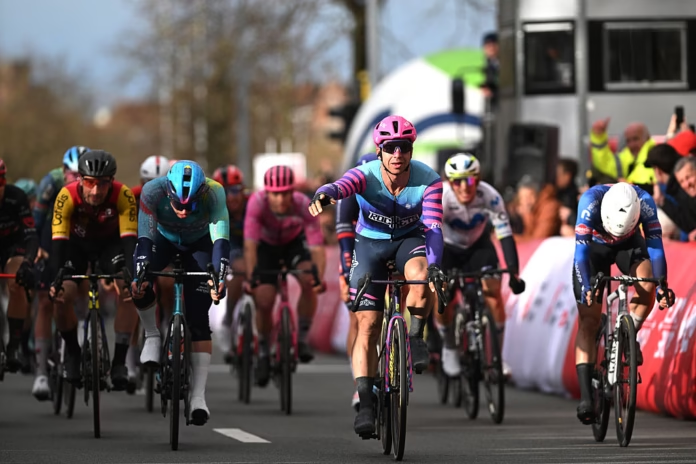
By 7km to go, Ballerini was still trying to force something on the front, and a small group of chasers briefly slipped clear behind him. That danger was shut down, but Max Walscheid then launched another move inside the final 3km. Astana were also visible in the chase, leading with a line of four riders, which helped ensure that the race came back to the script many had expected at the start, a reduced bunch sprint between the fastest men still left standing.
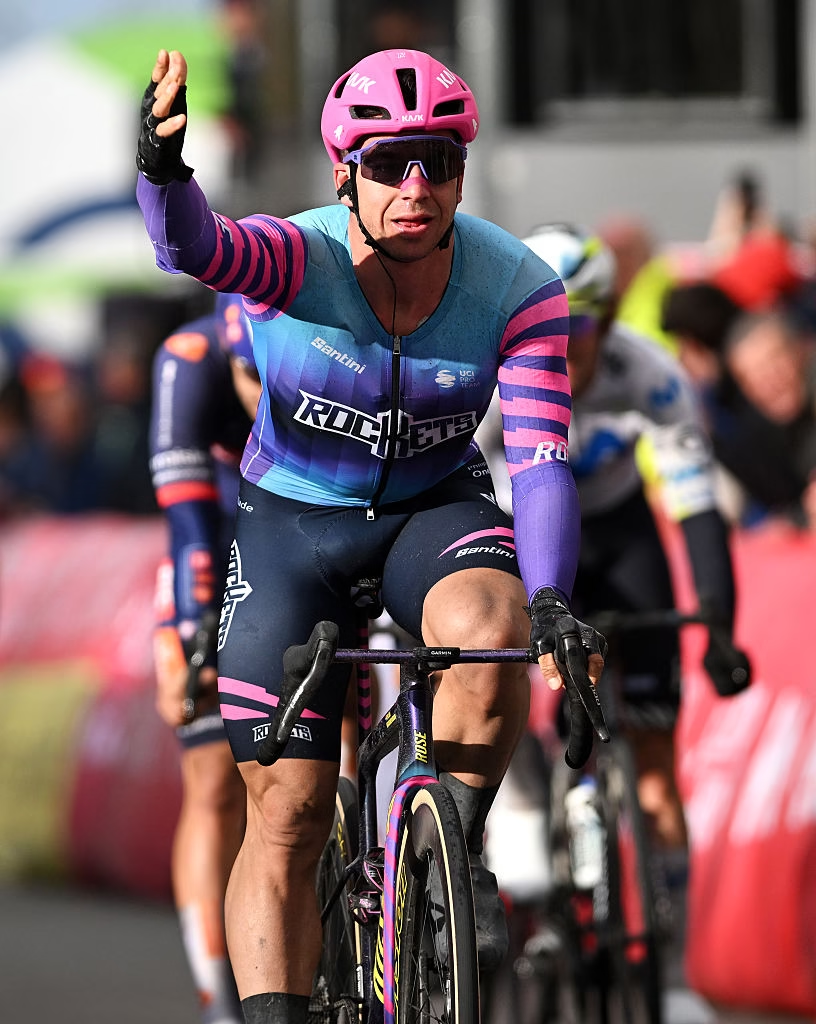 Photo Credit: Getty
Groenewegen finishes it off after Philipsen opens first
The final kilometre was built on nerves as much as speed. Astana took over with 500m to go, while Philipsen and Groenewegen were both well placed near the front. Philipsen had a rider ahead of him and sat third in line before beginning his sprint early enough to look, at first glance, like the likely winner.
That was the key tactical moment. Philipsen launched first and quickly gained the advantage, but the effort was a long one in cold conditions after a day that had forced repeated accelerations and constant positioning. Groenewegen, having survived the crosswinds, the splits and his earlier puncture, was able to come over him before the line.
It was a clean, powerful finish from the Dutchman, and a significant one. Philipsen held on for second, with Max Kanter taking third, but the day belonged to Groenewegen and to Unibet Rose Rockets. There was a crash during the sprint, with Amaury Capiot hitting the deck, which added one more late incident to a race already full of them, but it did not alter the result at the front.
For Groenewegen, the victory continued what the live notes described as an exceptional start to the season. It was his third consecutive win and fourth of 2026, while for Unibet Rose Rockets it represented the biggest success since the team’s inception and their first race win at WorldTour level.
Ronde Van Brugge 2026 Result
Results powered by FirstCycling.com
Main photo credit: Getty