Beating Lorena Wiebes is rarely about finding a clever trick in the final 200 metres. It is about changing the shape of the race so the sprint never becomes the pure, controlled contest she is built to win. That is why André Greipel’s line, delivered with the blunt clarity of someone who has won at the very highest level, matters.
Speaking at the 2026 UAE Tour Women while working with UAE Team ADQ, Greipel put the safest solution on the table immediately: “The best is to drop her before the sprint, that’s the safest way.” He was not offering theory. He was there to sharpen UAE Team ADQ’s sprint set-up and help their fast finishers take on SD Worx-Protime’s dominance. The early stages showed how narrow the margins are. You can arrive with a strong lead-out, you can get a rider onto the right wheel, you can even come close, and still watch Wiebes convert the opportunity.
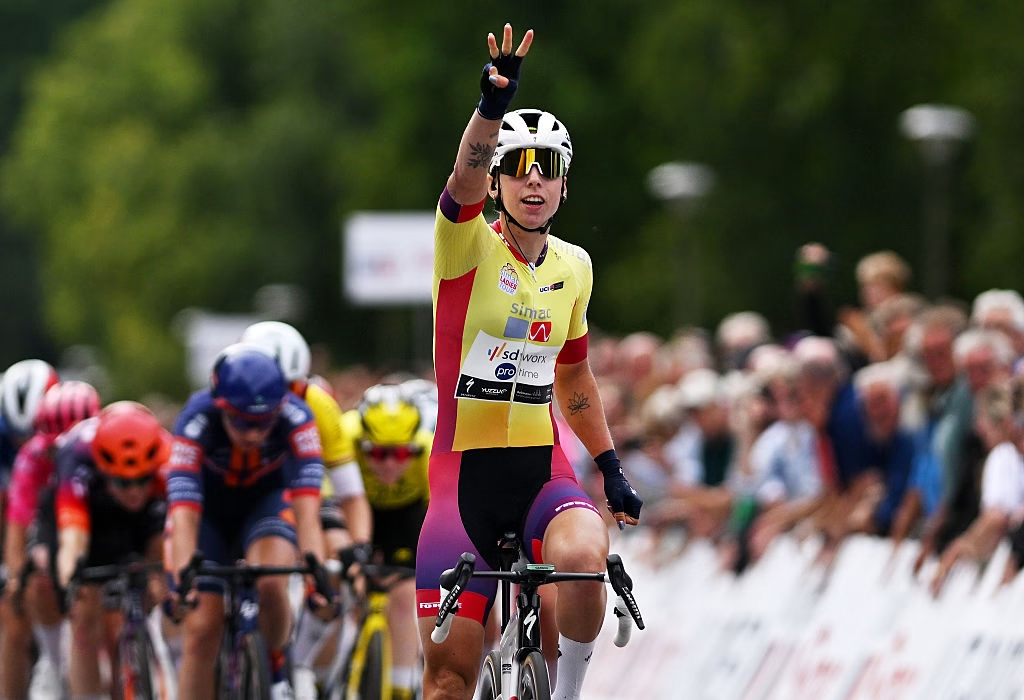
That conversion rate is the point. In 2025, when Wiebes reached the final 150 metres in contention in a sprint that suited her, she was almost never beaten. There were very few visible openings, very few off days, and almost no sense that she was leaving wins on the table. If the finale fitted her characteristics, she was there, positioned, and ready to finish it off.
And crucially, she is not a sprinter who always waits politely for a bunch kick. She will win from more than one script, and that makes the job of beating her harder than simply building a better lead-out.
 Photo Credit: Getty
Why Wiebes is so hard to beat
Wiebes’ dominance rests on three pillars that reinforce each other.
- Top-end speed: when she launches cleanly, very few riders can match her final kick.
- Repeatable positioning: she rarely misses the sprint through poor timing or a bad choice. Even messy finales tend to bring her into contention.
- Multiple winning scenarios: she can win from a textbook train, but she can also win from reduced groups, chaotic run-ins, and selective moves where the legs are already burning.
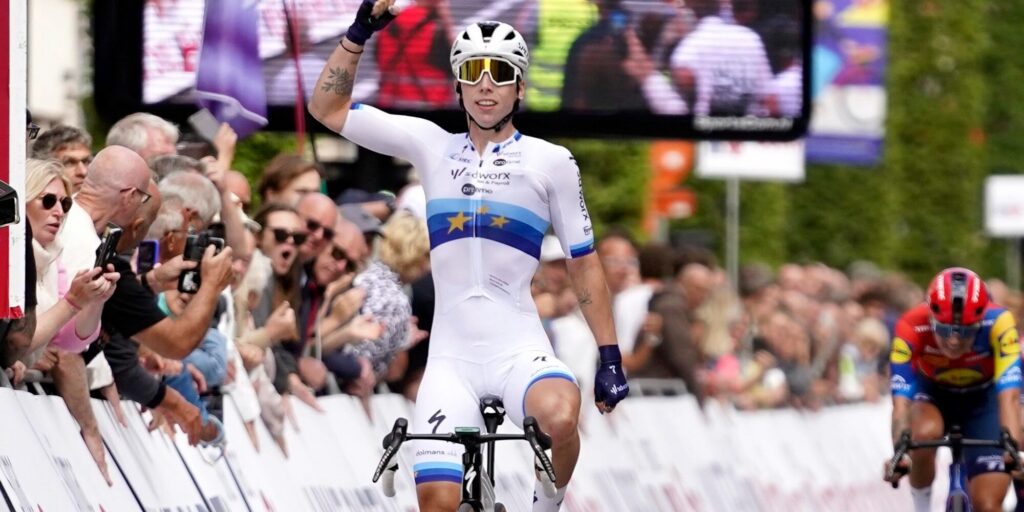
Stage 2 of the 2025 UAE Tour Women is a useful case study of that third pillar. Wiebes did not simply wait for a lead-out. She got into a five-rider breakaway and still proved untouchable at the line. UAE Team ADQ had three riders in that move and could not turn their numerical advantage into leverage. They could not force a decisive split, and they could not manoeuvre her into a compromised position. Even with numbers, the move never became tactical control, because Wiebes is comfortable letting others do the work and still backing her finish.
The two ways races actually get won against her
There are only two reliable categories of Wiebes defeat.
You remove her from the sprint
This is Greipel’s “safest way” in practice. It does not always mean dropping her on a climb. It means making the race selective enough that she is no longer there when it matters, or she is there without the support and freshness she normally enjoys.
How teams try to do that:
- Crosswind aggression with commitment, not hope
If you want echelons, you must treat them like a sprint lead-out. Early positioning, full team buy-in, and the willingness to keep pushing even when it hurts. - Repeated surges on rolling terrain
One acceleration rarely breaks her. Five or six changes of pace across an hour can. - Late technical stress
Corners, pinch points and road furniture do not beat Wiebes by themselves, but they increase the cost of staying perfectly placed. Make her fight for every wheel, and you start to create small cracks.
The goal is not long-range attacking for its own sake. The goal is to arrive at the final kilometres with Wiebes either gone, or isolated and forced into decisions she usually gets right when she has a full train.
She is present, but the finish is decided by disruption rather than raw power
When Wiebes looks human, it is usually not because she has been outpowered in a straight drag race. It is because something interrupts her normal control: positioning, an incident, a wrong side of the road, or a moment where the final kilometre becomes about survival rather than launching.
If you want genuine examples, you are mostly looking at 2024. Her 2025 season offered very few obvious openings.

The few times Wiebes looked beatable came through disruption, not watts
Charlotte Kool beating her in 2024 Tour de France Femmes sprints
Kool beating Wiebes twice matters because it shows the bar required. It is not enough to be fast. You also need a finish that suits your launch, a lead-out that keeps you in the right place, and the confidence to go head-to-head without blinking.
The lesson is that the anti-Wiebes plan can still be sprint-based, but only if you can meet her in the same part of the road at the same moment, repeatedly, without conceding the best lanes.
The crash-affected finish at the 2024 Vuelta a Burgos
A crash-affected run-in on stage 1 of the Vuelta a Burgos underlined how quickly a sprint can shift from pure speed to pure survival, a day that left Elisa Balsamo with a broken nose and broken hand. Disorder increases variance. It creates openings that do not exist in a clean, controlled sprint.
But it is not a repeatable plan. No team can build its season around hoping for chaos. The value of this example is tactical: it shows why teams must make the finale uncomfortable on purpose, because comfort is where Wiebes is at her most inevitable.
2024 Baloise Ladies Tour stage 2 and the “wrong side” moment
The Baloise Ladies Tour incident is the clearest illustration of how rare and specific Wiebes vulnerabilities are. It was not a case of simply being slower. It was a line choice and road position problem that forced her onto the grass in the final kilometres. She still fought back to finish 8th, which is its own warning.
The lesson here is not that Wiebes can be rattled. It is often the way to beat her that begins with taking away the clean strip of road she wants.
 Photo Credit: LaPresse
The most common mistake teams make: boxing her in, then gifting the exit
This is where a lot of sprint plans collapse. Teams regularly do the hard part; they get Wiebes boxed in, they momentarily deny her clean air, and then they release the pressure at the exact moment when the lane choice should be most controlled. A rider drifts half a metre. A lead-out swings off the front and leaves a gap. A team hesitates through caution. Suddenly, the fastest finisher in the race has exactly what she needs: a lane, clear air, and a two-second window to launch.
If the plan is to box Wiebes in, it has to be decisive and legal, built on controlling lanes and holding position through the last corners so there is no sudden gift of space. The aim is not contact, it is containment. Corner her, keep her in the wrong place, and make the escape route someone else’s problem. If she sees daylight, the sprint is often over.
There is also a more specific version of the same principle that sprint teams sometimes ignore. If Wiebes is forced to launch from the windward side, or from the front without shelter, her speed advantage becomes harder to express. That is not a guarantee of beating her. It is simply another way of making her sprint in worse air than she wants.
 Photo Credit: Cor Vos
What happened to the rivalries that once looked capable of challenging her?
Charlotte Kool and the rivalry that never fully arrived in 2025
The wider sprint landscape in 2025 suffered because the one rider who had shown she could trade blows with Wiebes did not spend the season at full capacity. Concussion issues after a crash at the Baloise Ladies Tour, surgeries over the winter into 2025, and later plantar fasciitis meant the rivalry never sustained.
The tactical consequence was obvious. With Kool compromised, fewer teams could force SD Worx-Protime into uncomfortable finales. That left more races where Wiebes could ride the standard script: control, positioning, launch, win.
Elisa Balsamo
Balsamo used to have her moments too, and for a time, she was the most credible head-to-head answer in clean sprint finishes. But she has not beaten Wiebes since stage 1 of the Simac Ladies Tour in 2023. Since then, the best winning chances against Wiebes have more often come from different race shapes rather than a straightforward outkick.
Chiara Consonni
For Consonni, the timeline is even starker. If the last head-to-head victory over Wiebes came back in 2019, it shows how long Wiebes has been setting the terms. It is not an indictment of Consonni’s quality. It is a reflection of how narrow the window is for beating the dominant sprinter when the finish is normal. It’s often notable now that Consonni gets her best results in major races by directly following Wiebes.
 Photo Credit: Getty
The realistic “how to beat Wiebes” toolkit
If a team is building a plan, it has to be honest about what Wiebes is and what she is not.
- Do not gift her a normal sprint
If the day is flat, make it hard anyway. If it is windy, commit. If it is technical, use it. - Race the last 30 kilometres, not the last 300 metres
Wiebes becomes most inevitable when everyone waits. - Strip her support before the finale
Isolation does not guarantee she loses, but it increases the chance she is boxed, delayed, or forced into the wind. - Attack the lead-out lanes early
Win the road first. Do not try to squeeze in late and hope. - If you box her in, deny the exit
Containment only works if the pressure is held, not released. - Force her into worse air
Make her launch from the windward side or from the front without shelter whenever possible. - Treat her as a threat in breakaways too
The UAE Tour example should be a warning. If she is in the move, the sprint has already started.
Many of these things are obvious, but rival teams are guilty of not fully employing them to gain the best advantage. And even when they do, Wiebes is often just good enough to win anyway.
The bottom line is that Lorena Wiebes is not just the fastest sprinter. She is the most complete sprint racer in the peloton, and that completeness is why 2025 offered so few visible openings. If you want to beat her, you do not start by asking who is the second fastest. You start by asking how to stop the race from becoming a Wiebes finish at all.