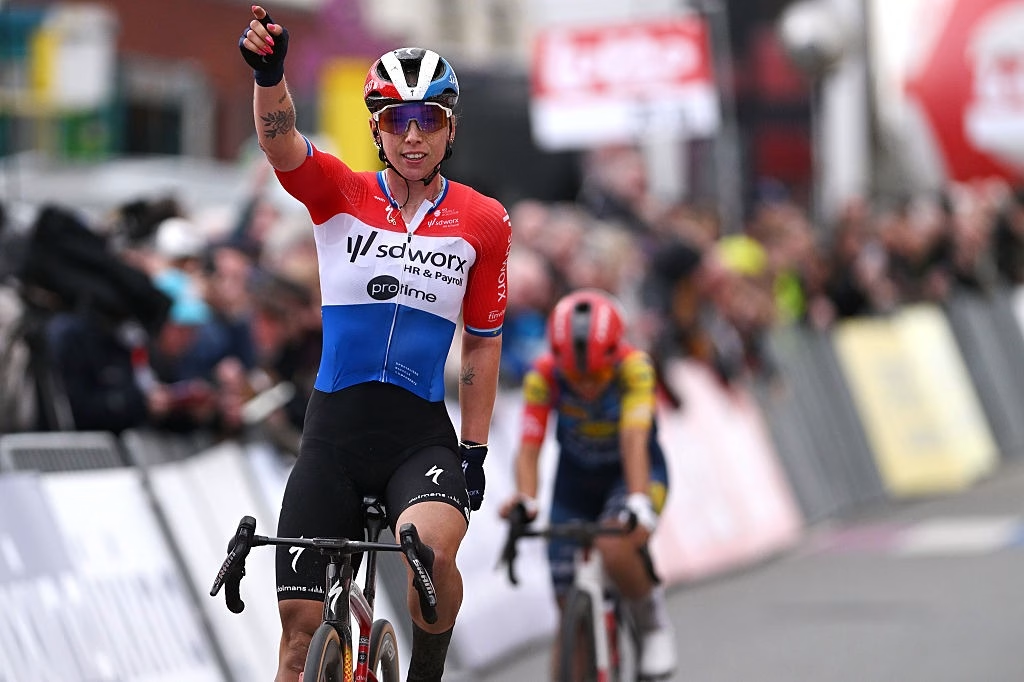
Lorena Wiebes found a new way to underline her grip on this race, and it was arguably the most telling version yet. The Dutch champion sealed a third victory at IXINA Leeuw-Oetingen p/b Lotto, but rather than waiting for the expected drag race to the line, she turned the final climb into the launchpad for a decisive move. Wiebes accelerated on the Zavelberg inside the final three kilometres. Fleur Moors was the only rider able to match her, and the pair carried their advantage all the way to Oetingen, where Wiebes still had too much speed in the head-to-head sprint.
Behind, the race splintered in classic fashion. Megan Jastrab won the sprint for third from a small chase group, ahead of Ilse Pluimers, as the bigger bunch arrived in fragments after one last round of cobbles, corners, and fatigue.
A tense race that refused to give a clean early shape
The 140-kilometre 1.Pro contest started in Sint-Pieters-Leeuw and quickly settled into the familiar pattern of these early-season Belgian races, fast but guarded. The opening kilometres were surprisingly controlled for a course with 19 cobbled sectors and repeated loops on narrow roads. No breakaway was given the kind of freedom that can force the favourites into a long chase, and whenever a small group tried to edge clear, the peloton kept the elastic tight.
That restraint did not mean the race was calm. The pace remained high, and the positioning battles were relentless, particularly as the first passages of the local circuits brought the cobbled sectors and short climbs back into the foreground. Teams with a sprint interest, and teams with riders looking to disrupt a sprint, were all fighting for the same real estate at the front.
Echelons bring the race to life and start the attrition
Around the middle portion of the race, the Belgian wind finally began to shape the day. Echelons formed across exposed roads and the peloton briefly split, the kind of moment that can decide these races long before the final climb. The gaps did not last, but the message did. From that point onward, the race became more selective, less forgiving, and more chaotic as riders had to repeatedly fight back into position after each surge.
The constant accelerations over the cobbles and into the climbs steadily thinned the bunch. It never quite snapped in half for good, but the group grew smaller, more nervous, and more vulnerable to the sort of late move that can turn a predicted sprint into an ambush.
Late attacks fail, and the sprint scenario starts to look inevitable
As the race entered the final 20 kilometres, the pattern was clear. SD Worx-Protime were attentive, Lidl-Trek were present, AG Insurance-Soudal were organised, and every climb became a moment where riders tested legs and nerve. Attacks did come, including a late move that briefly gained daylight, but nothing stuck for long. The combination of crosswinds, narrow roads, and repeated technical sections meant that chasing was often messy, yet the teams with the most to gain kept bringing the race back to a reduced group.
At that point, Wiebes still looked perfectly comfortable. Even with the peloton shrinking and the pace surging repeatedly, she remained in the right places, never panicking, never overextending. The expectation was simple: survive the final loop, deliver her to the last kilometre, and finish it in the sprint.
The Zavelberg changes everything as Wiebes goes early and Moors matches it
The final loop, though, rarely rewards predictability. The group was already reduced and jagged by the time the road tilted up for the Zavelberg. It is not a long climb, but it comes at exactly the wrong moment, when legs are heavy and positioning is everything.
Wiebes chose that moment to attack, accelerating sharply on the Zavelberg with less than three kilometres to go. It was not a case of her dropping everybody cleanly in one brutal blow, but it was decisive all the same, because only one rider could respond. Moors matched the acceleration and latched onto Wiebes’ wheel, while the riders behind hesitated, then fragmented, then tried to reorganise into a chase.
That delay was enough. Wiebes and Moors quickly established a workable gap, and with the peloton splitting behind them on the narrow roads, the two rider move became the race.
A head-to-head sprint, and Wiebes still has the final word
With the finish approaching and the gap holding, the tactical question was straightforward: could Moors force a longer sprint and use the element of surprise, or would Wiebes simply do what she has done so often and win the final acceleration?
In Oetingen, it was the second scenario. When Wiebes opened her sprint in the final metres, she was immediately clear. Moors could not come around, and Wiebes crossed the line with enough room to celebrate a victory that felt like a statement, not just of speed, but of growing versatility ahead of the spring’s biggest appointments.
Behind, the race had splintered beyond repair. Jastrab produced the best sprint of the chasers to secure third place, with Pluimers next, while the remaining riders arrived in smaller groups after a finale that never allowed anyone to settle into a clean, controlled run-in.
IXINA Leeuw-Oetingen p/b Lotto 2026 results
Results powered by FirstCycling.com
Main photo credit: Getty