
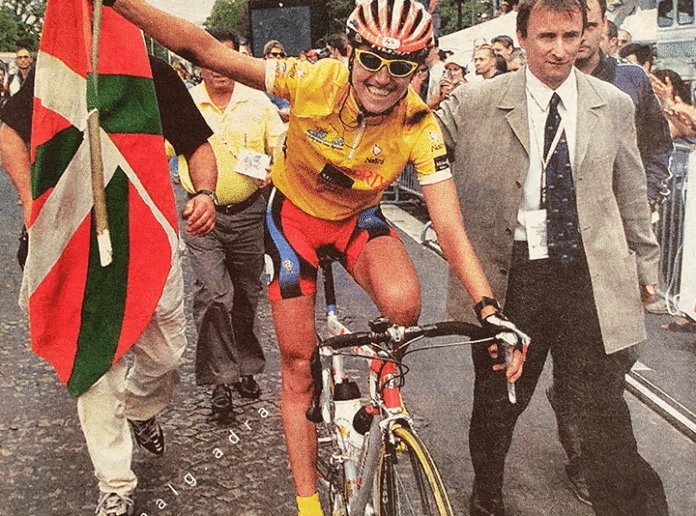
Joane Somarriba belongs among the most important stage-race riders women’s cycling has produced. She won the Giro d’Italia Femminile in 1999 and 2000, the Grande Boucle in 2000, 2001 and 2003, took the world time trial title in 2003, and added a world road race bronze in 2002 plus world time trial silver in 2005. That record alone makes her one of the defining riders of her era.
What makes Somarriba especially significant in Spain is that she was doing this before the current women’s cycling landscape existed. She was not winning inside a mature, fully developed system with broad visibility and stable opportunities. She was one of the riders helping prove that a Spanish woman could dominate the sport’s biggest stage races at all.
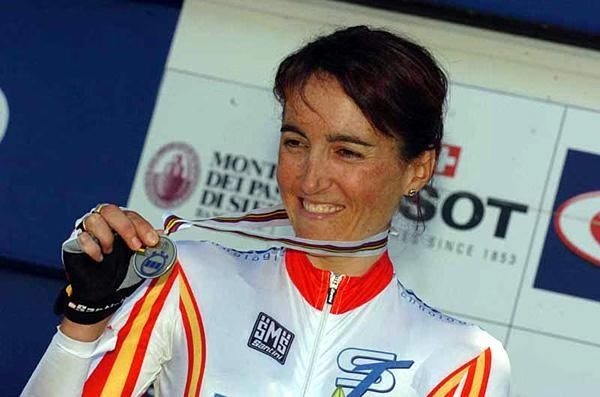
Her career nearly ended before it properly began
Somarriba came through the Basque cycling world, born in Gernika in 1972 and already winning junior national road titles before she had fully reached senior level.
But the early defining episode of her career was not a victory. It was survival. In the early 1990s, she suffered severe complications after surgery for a herniated disc, including an infection that damaged a nerve centre and left open the possibility that she might never ride again.
That matters because it changes how the rest of her results should be read. Somarriba did not move smoothly from talent to greatness. She rebuilt a career that had once looked close to disappearing altogether. That makes the later Grand Tour wins feel even more substantial.
The Giro d’Italia Femminile is where she first became a major force
If one race made Somarriba feel like a true international stage-race rider, it was the Giro. She won the overall in 1999 and again in 2000, and she did not vanish after that peak. She came back for 3rd overall in 2003 and 2nd overall in 2005, which shows how long she remained relevant in the sport’s hardest multi-day race environments.
Those Giro results are important because they define the core of what she was. Somarriba was not simply a rider who caught one big race at the right moment. She was a proper stage-race specialist, someone who could manage repeated climbing, hold form over a full week or more, and survive the cumulative pressure that decides overall classifications.
The detail of the results helps too. In 1999 she won the race and took stage 10b. In 2000, she won the overall again and added stage 6b. These were not passive GC wins built only on defence. She was capable of shaping the race directly.

The Grande Boucle made her historically significant
Somarriba’s wider fame rests above all on the Grande Boucle. She won it three times, in 2000, 2001 and 2003. Those victories were important because the race was, for that era, the closest thing women’s cycling had to a Tour de France-style structure and symbolism. Winning it once would have been enough to define many careers. Winning it three times made Somarriba one of the central stage-race riders of her generation.
The race detail is what really sharpens the picture. In 2000, she won the overall and stages 4 and 6. In 2001, she defended her title and won stages 1a, 2 and 10. In 2003, she won the overall again and took stages 2 and 13. That pattern tells you she was not scraping through these races. She was repeatedly one of the strongest riders in them.
She also finished 3rd overall in the 2002 Grande Boucle, wedged between her second and third victories, which underlines how consistently she sat near the very top of that race over several years.
She was not only a stage-race rider
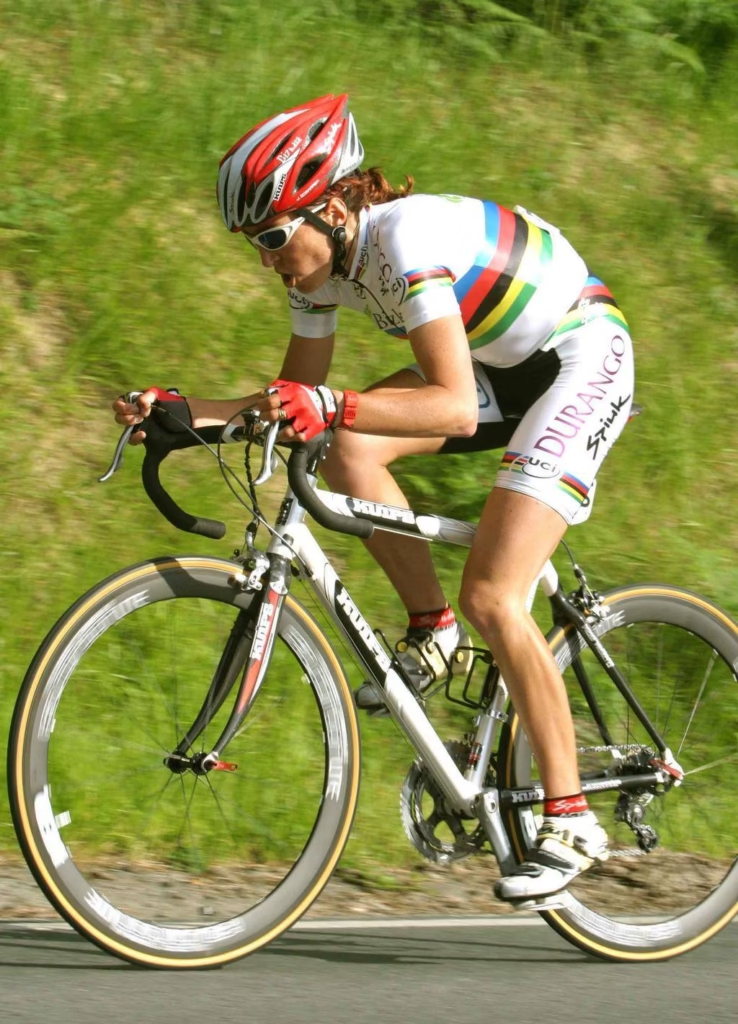
It would be too narrow to remember Somarriba only as a GC specialist. She won the world time trial title in 2003, then followed that with silver in the same discipline at the 2005 World Championships. She also won bronze in the elite women’s road race at the 2002 World Championships.
Those wins are important on the palmares because it shows range. Time trial champions do not always become great stage-race riders, and great stage-race riders do not always win world titles against the clock. Somarriba could do both. Her world title in 2003, in particular, gave her career a broader shape. She was not only Spain’s Grand Tour pioneer. She was also a rainbow jersey winner.
Emakumeen Euskal Bira was another race she kept returning to
Somarriba’s record was not built only in the Giro and Grande Boucle. She also had a deep history in Emakumeen Euskal Bira, a race that mattered especially for a Basque rider. She won the overall there in 1991, 2001 and 2004, and earlier in her career also took podium places and stage victories.
Those results matter because they show continuity across a very long span. Winning a race in 1991 and then again in 2004 says something about durability as much as class. The 2004 edition was especially strong on paper, with Somarriba winning the overall and taking stages 2, 3a and 3b. That is not the record of a rider clinging on through reputation. It is the record of someone still driving races late into her career.
She kept winning outside the biggest headlines
Another useful way to understand Somarriba is to look beyond the biggest marquee results. She won Emakumen Saria in 2002, 2003 and 2004, took the Spanish national road title in 1994, the Spanish national time trial title in 1996, and won the Trophée d’Or Féminin overall in 2005 with a stage victory.
Those results matter because they stop the career from being reduced to a few famous peaks. Somarriba was not only appearing for the biggest stage races and championships. She was winning steadily across the calendar and across different phases of her career.
The Olympics showed both her level and her limits
Somarriba raced the Olympics three times, in 1996, 2000 and 2004. She never won a medal, but her results were still strong: 5th in the time trial at Sydney 2000 and 7th in both the road race and time trial in Athens 2004.
Those finishes help explain her profile quite well. She was an elite rider across several formats, but she did not need to win every type of event to justify her stature. Her greatness came through repeated excellence in the races that suited her best, above all the longer stage races that demanded consistency and resilience.
She retired at the top, not on the margins
Somarriba retired after the 2005 season, but she did not drift away as a fading veteran. That year, she was 2nd overall at the Giro, 2nd in the World Time Trial and 1st overall at the Trophée d’Or Féminin. She was still producing major results right to the end.
That gives the career a particularly satisfying shape. Her final seasons did not exist only on past prestige. She was still racing at a very high level and left with her status intact.
What she is doing now
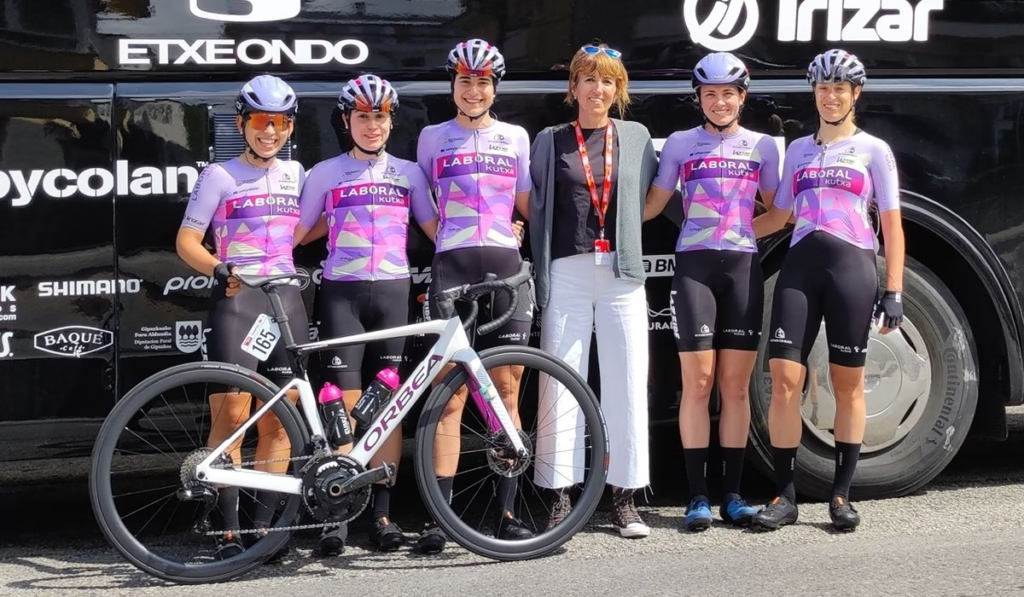
Somarriba has remained connected to the sport since retiring. In recent years, she has returned to women’s cycling in visible and meaningful ways, first as a commentator and then in a more direct ambassadorial and advisory role.
That matters because it keeps her connected to the current shape of the sport rather than leaving her only as a historical reference point. She is not simply a former champion looking back on an earlier age. She is still part of the wider conversation around women’s cycling and, more importantly, part of the effort to strengthen what comes next.
Her role with Laboral Kutxa – Fundación Euskadi feels especially appropriate. Somarriba helped prove that Spain could produce a woman capable of winning the sport’s biggest stage races. Now she is involved in helping support a structure that can guide later generations. In that sense, her place in cycling has changed, but not really diminished. She is no longer shaping races from the front of the road. She is helping shape the environment around them.
-
 Photo Credit: quentinphotographiebe
 -
 Photo Credit: Getty
How Joane Somarriba should be remembered
Joane Somarriba should be remembered first as one of women’s cycling’s great stage-race riders. The specific record is too strong to blur: Giro wins in 1999 and 2000, Grande Boucle wins in 2000, 2001 and 2003, Giro podiums again in 2003 and 2005, the world time trial title in 2003, world road bronze in 2002, world time trial silver in 2005, and repeated major results in races like Emakumeen Euskal Bira and Trophée d’Or Féminin.
The larger meaning follows from that record. She was Spain’s Grand Tour trailblazer because she repeatedly won the races that most closely resembled the sport’s biggest traditional tests. And she was one of the sport’s quiet giants because she did it without needing constant mythology around her. The results themselves were strong enough.
That is what gives her career its lasting weight. Somarriba was not simply an important Spanish rider. She was one of the women who helped define what elite stage racing looked like in her era, and one of the few whose record still feels substantial from almost any angle you choose to approach it.

