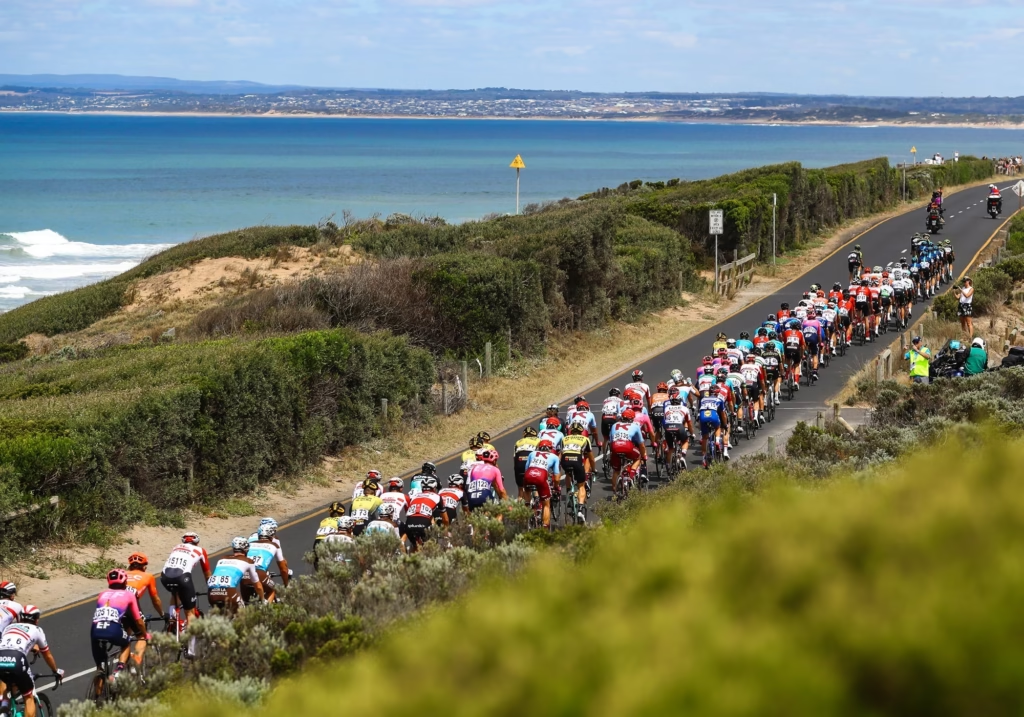
The Cadel Evans Great Ocean Road Race is Australia’s modern one-day classic, not because it copies Belgium, but because it follows the same logic: repeated pressure, narrowing options, and a finale that rewards timing as much as strength. Raced around Geelong and the Surf Coast, it has become the sharp, unpredictable punctuation mark at the end of Australia’s opening WorldTour block.
Its character is shaped by two distinct phases of racing. First comes the exposed travel through the Bellarine Peninsula and Surf Coast, where wind and heat can quietly sap legs and thin team resources. Then the race tightens onto the Geelong finishing circuit, used for the 2010 Road World Championships, and begins asking the same question on repeat: who can still accelerate when everyone is already tired?
At the centre of that question is Challambra Crescent, short, steep, and perfectly placed to turn an orderly chase into a scramble. It is not a climb that creates huge time gaps. It is a climb that creates hesitation, missed wheels, and snap decisions. Across a decade, that has produced a winners list that swings from reduced sprints to late solo raids and two-up coups.
The race has also grown beyond one day. Around the elite events sits a broader festival week of riding and community participation, with crowds now numbering well into six figures across the event footprint. That atmosphere matters. It raises intensity, lifts risk, and encourages teams to race, not simply tune up.
How the Great Ocean Road Race is usually won
Most editions resolve in one of three ways, and the route makes all three plausible at once.
A reduced sprint is always on the table, but it is rarely a sprinters’ sprint. The Geelong circuit forces repeated efforts, and the decisive groups are typically built from riders who can climb Challambra well enough to stay in the front selection, then still produce speed on the flat run-in.
A late solo move is the race’s purest thriller format. Challambra is steep enough to create a split, but short enough that riders can convince themselves they will bring it back. The hesitation that follows is often the winning margin.
A two-man or small-group coup is the classic Geelong outcome: a late attack, a moment of uncertainty behind, then a sprint that feels like the last match being struck rather than a planned finish.
Heat is the extra layer that turns all of this up. In the most extreme recent edition, temperatures pushed beyond 41°C on the finishing circuit, and the winning move landed at around 10km to go. In that kind of furnace, “who is strongest” and “who can function” are not always the same thing.
2015: a farewell race that immediately proved it was real
The inaugural edition in 2015 carried emotional weight because it was designed around Cadel Evans’ final professional appearance, and Evans finished fifth on the day. The racing itself did not play along with any ceremonial mood. A strong group arrived together, and Gianni Meersman won the sprint ahead of Simon Clarke and Nathan Haas, establishing the event’s tone from the first finish: selective, fast, and decided by riders who could survive the circuit and still finish.
That first edition also made clear what would become a theme. The Geelong laps do not simply provide a backdrop. They actively shape the result, turning “good legs” into “good legs after repeated stress”, which is a different, rarer currency.

2016: Kennaugh’s solo turns the finale into a blueprint
A year later, the race produced the kind of narrative that would become a calling card. British rider Peter Kennaugh committed to a late solo attack and held off the chase, while Leigh Howard won the sprint for second six seconds behind, with Niccolò Bonifazio third.
It was an early lesson in how this race behaves. You do not need an enormous advantage over Challambra. You need a gap, a clean line through the final corners, and just enough disorder behind to turn “almost caught” into “never caught”.
2017: WorldTour elevation and a finish decided on the line
In 2017, the men’s race stepped onto the UCI WorldTour calendar for the first time, and the effect was immediate: deeper teams, tighter control, and a more ferocious fight for position on every circuit lap.
The finish matched the new status. Nikias Arndt timed his sprint to perfection to beat Simon Gerrans, with Cameron Meyer third after a late flyer that almost held. It was a reminder that this race can reward both the attacker and the finisher in the same finale, often separated by a single decision on the last rise.
2018: Jay McCarthy gives Australia its first home winner
The 2018 edition delivered a defining moment in the event’s story: Jay McCarthy became the first Australian to win the elite men’s race, sprinting from a selective group after a hard day where conditions and circuit pressure did much of the filtering.
McCarthy described how much the finish occupied his thoughts all week, looking at the line repeatedly and imagining the final moment. The quote works because it captures the psychology of this event. Riders do not drift into a win here. They rehearse it, often for days, because the finale is so dependent on timing and placement.
 Photo Credit: Getty
2019: Viviani vs Ewan, and the sprint that still had teeth
In 2019, the race tilted more decisively towards a sprint, but it remained a sprint earned through attrition rather than delivered on a plate. Elia Viviani won ahead of Caleb Ewan, with Daryl Impey third, continuing the theme that the podium here often belongs to riders who can do more than one job in the finale.
This is also where the event’s relationship with Quick-Step style organisation becomes obvious. Even when it ends in a sprint, it is a sprint after the team has spent riders surviving circuit pressure and reassembling a workable lead-out with fewer pieces than they would ideally have.
2020: Devenyns and Sivakov make the “late move” stick
The 2020 edition delivered a classic Geelong coup. Dries Devenyns and Pavel Sivakov escaped late, refused to be reeled in, and Devenyns won the two-up sprint for the line. Daryl Impey was third again, completing a remarkable run of three consecutive podium finishes from 2018 to 2020.
It was the race’s identity in miniature: survive the repeated stress, pick the moment when others are watching each other, then finish the job before the chase regains clarity.
2021-2022: the COVID cancellations that halted momentum
The event’s early growth was interrupted when the men’s race was cancelled in 2021 and again in 2022. For a young race still building its rhythm, losing two consecutive editions mattered, not only for continuity but for the wider “Australia block” identity that had begun to form around Tour Down Under and Geelong.
When the race returned, it did not feel like a simple continuation. It felt like a reopening, with teams and fans treating it as a renewed target rather than a routine date.
 Photo Credit: Getty
2023: Mayrhofer’s breakthrough after chaos in the final kilometre
The return in 2023 brought back the race’s favourite trick: late drama that looks settled until it is not. Late attackers almost got away before being caught inside the final kilometre, and Marius Mayrhofer sprinted to his breakthrough win ahead of Hugo Page and Simon Clarke.
It was the sort of finale that suits Geelong perfectly, because the circuit encourages a constant tug-of-war between those trying to force a split and those gambling on a sprint from a thinned group.
2024: Laurence Pithie edges a thriller and announces himself
By 2024, the race felt like a mature classic: high speed, constant attacking, and a finale where the strongest riders also needed the cleanest timing. Laurence Pithie took his first WorldTour victory, narrowly beating Natnael Tesfatsion, with Georg Zimmermann third.
The significance was not only the name on the trophy. It was what the win represented. The Great Ocean Road Race increasingly favours riders who can survive repeated accelerations, then sprint after the last hard effort, rather than pure sprinters arriving fresh.
2025: Mauro Schmid’s solo in extreme heat
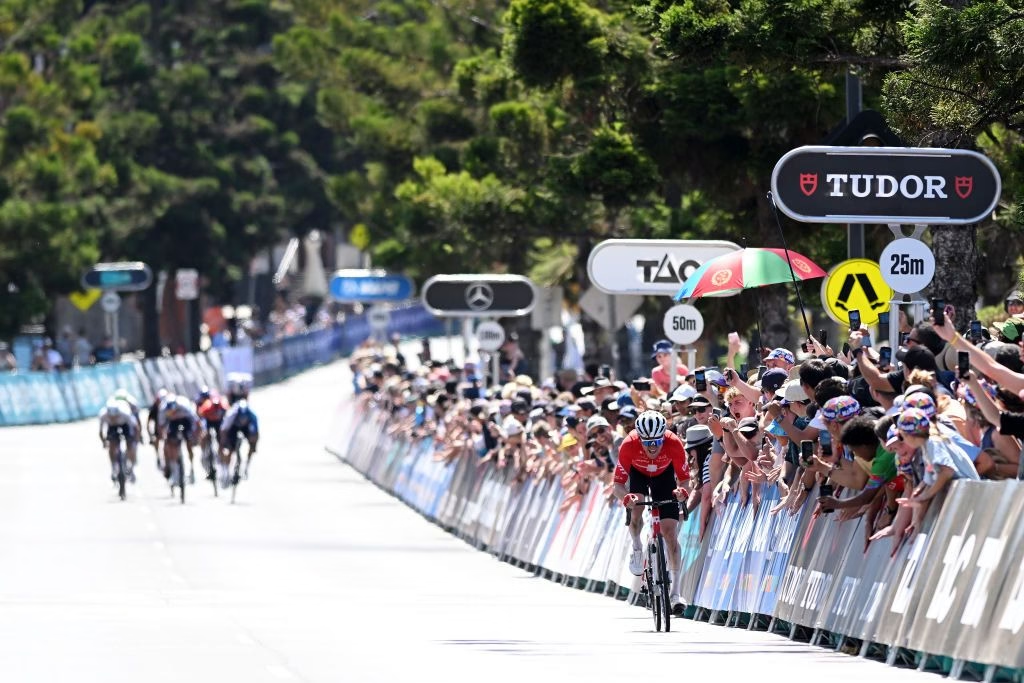
In 2025, the race leaned fully into its most dramatic script. Mauro Schmid attacked late and went solo to the line, winning in brutal conditions ahead of Aaron Gate and Laurence Pithie.
The numbers tell the story: temperatures beyond 41°C on the circuit and a winning move launched at roughly 10km to go. It was not a day for cautious riding. It was a day for making the decisive choice while others were still calculating.
2026 and “present day”: a new title partner and a bigger event week
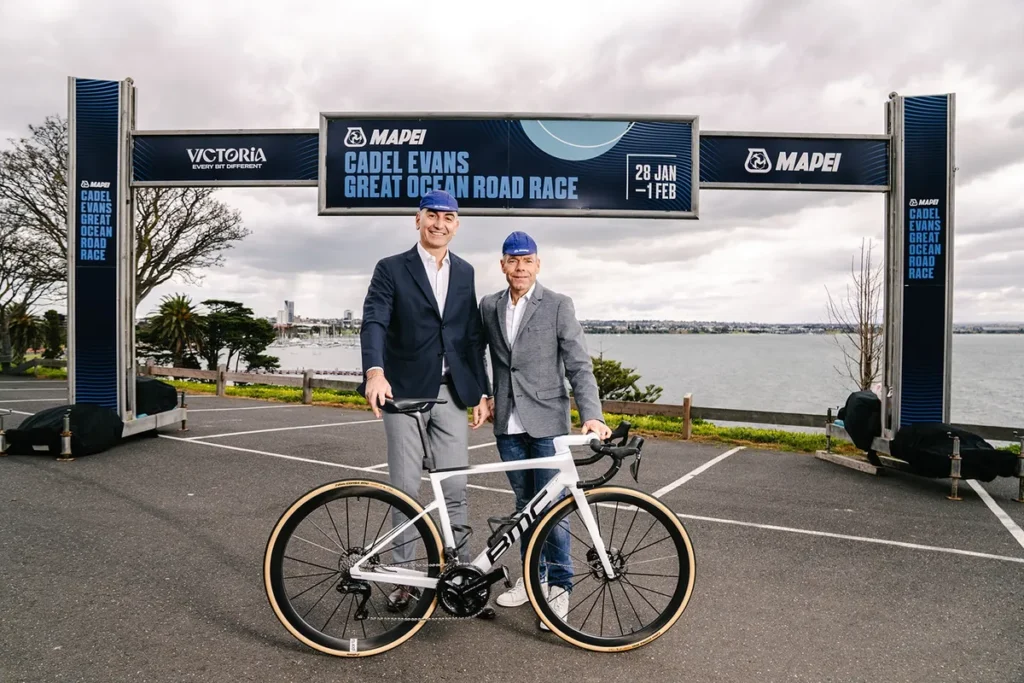
From 2026, the event is set to be officially titled the Mapei Cadel Evans Great Ocean Road Race, reflecting a new title partnership and the event’s continued growth.
The broader week structure remains central to its identity: elite racing anchored by the Surf Coast roads and the Geelong WorldTour showpiece, supported by a community programme that has helped turn the race into a destination rather than a standalone sporting fixture.
Notable moments and defining snapshots
- 2015: the farewell edition, with Evans fifth and a selective sprint establishing the race’s identity.
- 2016: Kennaugh’s late solo and a six-second margin that proved how fragile the chase can be here.
- 2017: WorldTour arrival and a line-tight finish that rewarded perfect timing.
- 2018: the first Australian men’s winner, turning the race into a true home target.
- 2020: a two-up escape for the win, and Impey’s third consecutive podium.
- 2025: a late solo in furnace conditions, the modern “Geelong classic” in one day.
Men’s winners and podiums by year
| Year | Winner | Second | Third |
|---|---|---|---|
| 2015 | Gianni Meersman | Simon Clarke | Nathan Haas |
| 2016 | Peter Kennaugh | Leigh Howard | Niccolò Bonifazio |
| 2017 | Nikias Arndt | Simon Gerrans | Cameron Meyer |
| 2018 | Jay McCarthy | Elia Viviani | Daryl Impey |
| 2019 | Elia Viviani | Caleb Ewan | Daryl Impey |
| 2020 | Dries Devenyns | Pavel Sivakov | Daryl Impey |
| 2021 | Not held | – | – |
| 2022 | Not held | – | – |
| 2023 | Marius Mayrhofer | Hugo Page | Simon Clarke |
| 2024 | Laurence Pithie | Natnael Tesfatsion | Georg Zimmermann |
| 2025 | Mauro Schmid | Aaron Gate | Laurence Pithie |
Records and stats that define the Great Ocean Road Race
Most wins
- No repeat winners yet across all staged editions (2015-2020, 2023-2025).
Most wins by team
- Quick-Step and its team-name variants: 3 wins
- Meersman (2015), Viviani (2019), Devenyns (2020)
Most podium finishes
- Daryl Impey: 3 podiums
- Third in 2018, 2019, 2020
Most successful nations
- Belgium: 2 wins (2015, 2020)
- Germany: 2 wins (2017, 2023)
- All other winning nations currently sit on one each.