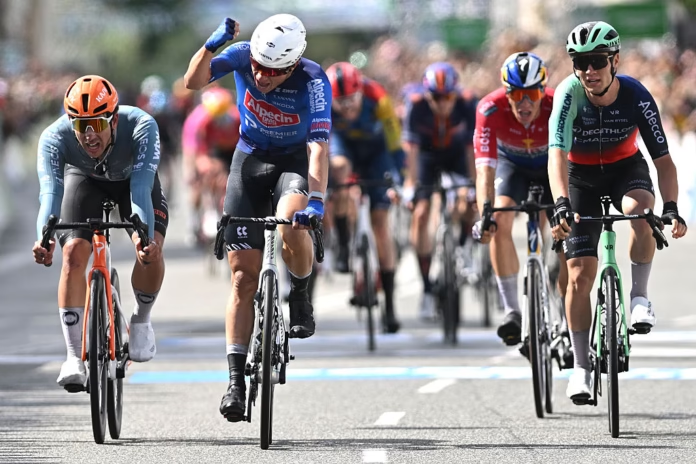
Jasper Philipsen won the 2026 Men’s Copenhagen Sprint after a chaotic finale in the Danish capital, timing his sprint perfectly after the last surviving breakaway riders were caught within sight of the line. The Alpecin-Premier Tech sprinter came through late, jumped onto Tobias Lund Andresen’s wheel, then launched with around 150 metres remaining to take victory in the second edition of the race.
Lund Andresen finished second for Decathlon CMA CGM after briefly looking like he might deliver a Danish home win, while Sam Welsford took third for Netcompany INEOS after his team had done much of the work to close down the breakaway on the final lap. It was a finish that looked straightforward on paper only once the result was known. In reality, Copenhagen delivered a tense, messy and sometimes dangerous finale, shaped by crashes, splits and a breakaway that came desperately close to surviving.
The 228.2-kilometre race from Roskilde to Copenhagen had been expected to end in a sprint, but the route’s technical city-centre circuit and wet conditions made the finale far less predictable than the profile suggested. The decisive four-man move of Anders Foldager, Rune Herregodts, William Blume Levy and Mads Andersen almost stole the race before the sprint teams finally caught them in the last few hundred metres.
Breakaway builds the race around the sprints
The second edition of the Men’s Copenhagen Sprint again used the structure that has quickly given the race its identity. A long run from Roskilde across Zealand was followed by finishing laps in Copenhagen, with the final circuit designed to reward sprinters but also punish poor positioning. On a dry day, that would already have been tense. In damp conditions, with repeated corners and narrow sections, it became much more fragile.
The early race settled around a breakaway rather than immediate peloton control. Several riders made the day’s main move, with the escape taking the intermediate sprints and forcing the sprint teams to stay engaged long before the race entered Copenhagen.
Rodenberg was active in the intermediate sprint phase, taking points at Ganløse before later losing contact with the break and being caught with 55 kilometres remaining. That left the final four attackers to continue towards the city: Foldager, Herregodts, Blume Levy and Andersen.
The quartet had the balance needed to make the peloton work. None of them were obvious favourites for the win if the race came back together, but together they had enough strength to hold the gap into the final circuits. The chase behind never looked relaxed, especially with so many sprint teams carrying ambitions into the race.
Sprint teams begin the chase
As the race approached Copenhagen, the gap began to fall. Unibet Rose Rockets, Alpecin-Premier Tech and Soudal-QuickStep were all visible in the chase, with the sprinters’ teams trying to make sure the day did not drift into another near-miss for the bunch.
The break still had just over a minute as the finishing laps approached, enough to keep the pressure on. The problem for the peloton was not just the gap, but the circuit itself. Copenhagen’s city-centre roads asked for constant positioning, repeated accelerations and a calm lead-out. Any loss of structure would help the riders in front.
Philipsen’s Alpecin-Premier Tech teammates worked to keep him near the right end of the bunch. After a spell away from racing since Paris-Roubaix, Philipsen needed both legs and timing, but he also needed to stay out of trouble. That became more important as the final laps unfolded.
The race was still open approaching the penultimate lap. The break’s gap was smaller, but not gone, and the peloton was having to chase hard while also preparing for a sprint that might still involve several of the fastest riders in the race.
Crashes split the peloton
The key complication came with around 18 kilometres remaining, when a crash on a tight corner took down several riders and split the bunch. That changed the chase immediately. What had been a large peloton trying to organise itself for a sprint became a reduced front group of roughly 30 riders, with teams suddenly needing to work out which leaders had made the split and which had been caught behind.
That disorganisation almost played into the breakaway’s hands. The four leaders still had 20 seconds around the end of the penultimate lap, and although the gap was small, the peloton behind was no longer moving as one fully organised unit. Some teams had riders missing. Others had sprinters present but not enough helpers. The city circuit magnified every hesitation.
Alpecin-Premier Tech and Decathlon CMA CGM continued to work in the front group, while Netcompany INEOS also became increasingly important in the chase. Their interest was clear, with Welsford still in contention and the win there to be rescued if the catch could be made.
Inside the final lap, the break still had enough of a gap to make the sprinters nervous. With 4 kilometres remaining, the advantage was around 10 seconds. On a straight road, that might have looked manageable. On a technical circuit after a crash-hit finale, it was much less certain.
Breakaway nearly holds on
Foldager, Herregodts, Blume Levy and Andersen continued to work well together deep into the final lap. The peloton could see them, but seeing the break is not the same as catching it when the road keeps turning and the bunch has already been split by crashes.
The quartet carried their lead into the final corners, and for a brief moment it looked as though Copenhagen might be about to produce a major upset. The sprint teams had expected a bunch finish, but the break’s persistence and the late chaos had pushed the catch to the absolute limit.
Netcompany INEOS led the final pursuit on the last straight, pulling the reduced bunch towards the four leaders. The catch came just before the sprinters opened up, leaving no time for a conventional lead-out or clean reset. Riders had to react instantly, find the right wheel and launch from whatever position they had managed to salvage.
That suited the most instinctive sprinters. Philipsen had stayed upright, stayed near the front and still had teammates around him when it mattered. Lund Andresen was also in position, and as a Danish rider with a fast finish, he suddenly had a real chance to turn the chaos into a home victory.
Philipsen times it right
Lund Andresen opened the sprint and briefly looked capable of completing the perfect Danish finish. Philipsen, though, was on the right wheel. The Belgian waited until around 150 metres to go, then came around with the sharper final kick.
Once Philipsen launched, the race was effectively decided. He had enough speed to move past Lund Andresen and hold the line, taking a valuable WorldTour victory in his first race back since Paris-Roubaix. Welsford finished third, giving Netcompany INEOS a podium after their late chase work, while several other sprint names were either caught behind the crashes or never properly placed after the final-lap disruption.
The finish also underlined the difference between a sprint race and an easy sprint race. Copenhagen may be built for fast men, but the way the race entered the city, the wet roads, the narrow corners and the late crash meant the final kilometre was more about survival and decision-making than a textbook train.
Philipsen did not need the cleanest sprint of his career to win. He needed to avoid the problems, trust his positioning, and pick the right moment when the break was finally caught. That was exactly what he did.
Philipsen returns with a WorldTour win
For Philipsen, this was an important return. His absence since Paris-Roubaix meant there were still questions about rhythm before the Tour de France, but Copenhagen gave him a demanding test rather than a simple drag-strip sprint. He came through the chaos and still had the speed to win.
Lund Andresen’s second place will carry mixed feelings. A home sprint victory was within reach, and he was close enough to force Philipsen into a full effort. Still, finishing second in a chaotic WorldTour sprint after a late catch confirmed again that he belongs among the race’s leading fast finishers.
Welsford’s third was also a strong result, particularly given Netcompany INEOS’ role in shutting down the break. Without their work, the quartet up front might well have survived. Instead, the race came back just in time, even if it gave Welsford only a narrow window to sprint for the win.
The Copenhagen Sprint has quickly found a clear identity. It looks like a pure sprinters’ race from the profile, but the final circuit adds enough tension to make the outcome less predictable. In 2026, the breakaway almost survived, the peloton split, and the fastest riders had to fight through disruption rather than simply wait for a lead-out.
Philipsen came through it best. The Belgian avoided the chaos, read the final metres correctly, and turned a late, messy catch into another major sprint victory.
Men’s Copenhagen Sprint 2026 result
| Position | Rider | Team | Time/gap |
|---|---|---|---|
| 1 | Jasper Philipsen | Alpecin-Premier Tech | 4:48:21 |
| 2 | Tobias Lund Andresen | Decathlon CMA CGM Team | same time |
| 3 | Sam Welsford | Netcompany INEOS Cycling Team | same time |
| 4 | Tord Gudmestad | Decathlon CMA CGM Team | same time |
| 5 | Danny van Poppel | Red Bull-BORA-hansgrohe | same time |
| 6 | Max Walscheid | Lidl-Trek | same time |
| 7 | Frits Biesterbos | Team Picnic PostNL | same time |
| 8 | Jason Tesson | TotalEnergies | same time |
| 9 | Rune Herregodts | UAE Team Emirates-XRG | same time |
| 10 | Søren Kragh Andersen | Lidl-Trek | same time |
Main photo credit: Getty