
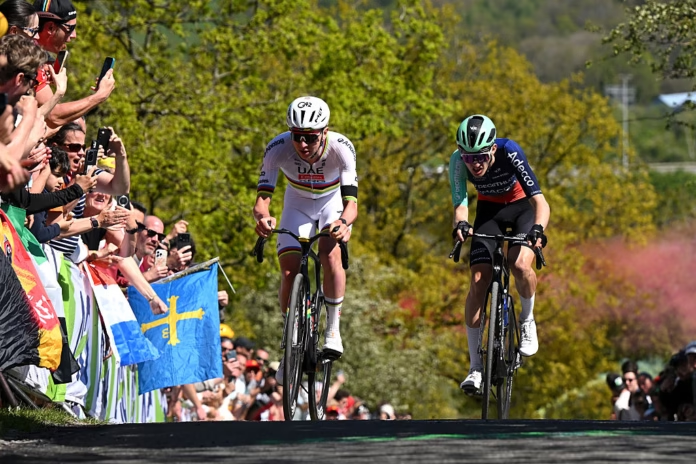
Tadej Pogačar won Men’s Liège-Bastogne-Liège 2026 after a decisive move on the Côte de la Roche-aux-Faucons finally shook off Paul Seixas, with the French teenager finishing a hugely impressive second and Remco Evenepoel winning the sprint for third from the main chase group.
What looked for much of the day like another carefully controlled UAE Team Emirates-XRG performance turned into something more fascinating in the final 35km. Pogačar still got the win, and a fourth Liège-Bastogne-Liège title to draw level with Moreno Argentin and Alejandro Valverde, but he was forced to race hard by Seixas, who followed the world champion’s move on La Redoute and stayed with him deeper into the finale than anyone else could manage.
Evenepoel, after being part of the huge early attacking group that shaped the race, had to settle for third at 1:42. He still showed his class by leading out and winning the sprint from a strong chase group that also included Emiel Verstrynge, Egan Bernal, Pello Bilbao and Romain Grégoire.
-
 Photo Credit: Canyon SRAM (supplied media release)
 -
 Photo Credit: Park Tool
A huge early move changes the race
The race took an unexpected turn very early. Rather than the usual pattern of a small break going clear and the favourites’ teams settling into a long day of control, a huge front group of around 50 riders forced the issue and gained real time on the peloton.
That move contained major names and key domestiques, most notably Remco Evenepoel, Egan Bernal and several strong support riders from multiple teams. Nico Denz was there for Red Bull-BORA-hansgrohe, Laurens De Plus for INEOS Grenadiers, while other teams also had enough representation to keep the move committed. With so many squads present in the front group, UAE Team Emirates-XRG and Decathlon-CMA CGM were left with the awkward job of trying to manage the chase behind.
At one point, the gap pushed out beyond three minutes. The unusual shape of the race made it tactically fascinating. Evenepoel could sit in and let others contribute. UAE had to decide how much energy to spend pulling back such a large and dangerous move, while Decathlon had the same problem because Paul Seixas had missed it too.
For a long stretch heading south towards Bastogne, it felt like the race was being played on two levels. Up front, the attackers had numbers and incentive. Behind, UAE and Decathlon had hierarchy on their side but were burning through riders earlier than they would have wanted.
UAE squeeze the race back under control
The race began to turn when the road tilted upwards more regularly and the stronger teams in the peloton started to squeeze harder. The climbs before the decisive sequence mattered more than usual because of what had already happened.
The Côte de Saint-Roch and Col de Haussire started to erode the front group. Riders were spat out, the smooth rhythm disappeared, and the tactical advantage of the attack began to weaken. Tim Wellens, Pavel Sivakov and then Domen Novak all did major work for UAE, while Decathlon contributed too, knowing Seixas could not afford to start the final hour too far behind Evenepoel.
By the time the race headed towards the Côte de Wanne and then the Côte de Stockeu, the big early move had effectively been neutralised. Evenepoel’s group was caught, the break had been reduced and then absorbed, and the race was reset with around 80km to go.
That should have suited Pogačar. UAE had restored order, and the race now returned to a more familiar Liège-Bastogne-Liège shape. But the cost of doing that work was obvious. UAE had fewer riders than expected left around their leader. The team still had control, but it was no longer overwhelming control.
The final climbs strip the race down
From there, the race moved into the classic Liège-Bastogne-Liège sequence where the tension never really drops. UAE kept the pace firm on the Col du Rosier and Col du Maquisard, with Sivakov and then Novak doing the heavy lifting. Behind them, the familiar hierarchy of the race became visible. Pogačar sat tucked in close to the front. Evenepoel and Red Bull-BORA-hansgrohe tried to hold position behind him. Seixas and Decathlon shadowed both.
That phase mattered because there was almost no room for improvisation once the race reached the Côte de Desnié and then La Redoute. Everyone knew where the big move was likely to come. The only uncertainty was who could survive it.
UAE’s pace on the Col du Maquisard was already hurting the bunch. Riders began to disappear from the back. The steady pressure was not explosive, but it made the bunch smaller, took the edge off the legs of rivals and discouraged anticipatory attacks.
By the time the race dropped towards La Redoute, there was a real sense that the waiting was over. The wide-open early race had narrowed into a direct confrontation.
Seixas follows the decisive move
When the race hit the Côte de la Redoute, Benoît Cosnefroy led Pogačar into position and the world champion made the expected move. What was unexpected was the response.
Pogačar surged, Evenepoel cracked, and the rest of the favourites were blown away. But Paul Seixas held the wheel.
That changed the race. Instead of the usual image of Pogačar riding clear and everyone else immediately scrambling behind, Liège-Bastogne-Liège 2026 suddenly became a duel. Seixas matched him pedal stroke for pedal stroke on the climb, went over the top with him, and then took turns on the descent and valley roads that followed.
Behind them, the race split apart. Mattias Skjelmose briefly tried to chase alone. Evenepoel was pulled back into a larger group. The podium was still open, but the fight for victory was now at the front between two riders from different generations.
That was the most striking part of the day. Seixas was not just surviving. He was riding with composure. He did shorter turns than Pogačar, but they were real turns. He did not look intimidated by the occasion, by the terrain or by the company.
Roche-aux-Faucons settles it
The final answer came on the Côte de la Roche-aux-Faucons. By then the gap behind had grown to around a minute, and the race for third was becoming separate from the race for first. Up front, though, Pogačar still had work to do.
Seixas followed him onto the climb and initially responded to the first acceleration. For a few moments, it looked as if he might survive this one too. But around 500 metres from the top, Pogačar surged again and this time Seixas could not hold the wheel.
That was the decisive moment. Seixas had stretched his resistance further than anyone else had managed, but the repeated efforts finally told. Once Pogačar had daylight, even a small gap was enough. He crested the climb 22 seconds clear and from there the race was effectively won.
Seixas did not collapse. That was one of the most impressive parts of his ride. He limited the damage, held second securely and descended towards Liège knowing that, while he would not win, he had just produced the finest Monument performance of his young career.
Pogačar takes a fourth title, Evenepoel wins the sprint for third
From the summit of Roche-aux-Faucons to the finish, Pogačar rode with total control. He took a drink, sprayed water over his shoulders earlier in the finale, then later could begin to enjoy the run into Liège. By the final 5km, the win was secure. He entered the city alone, gave a thumbs up, eased through the last kilometre and then pointed to the sky on the line in tribute to former teammate Cristian Camilo Muñoz.
Seixas came in one minute later for second place, a result that still felt like a statement ride. He was the only rider who could truly go with Pogačar when the race exploded, and he backed up his recent Itzulia Basque Country and La Flèche Wallonne performances with another huge display.
Behind them, it became a sprint for third place. Evenepoel showed both pride and resilience there, launching a long sprint and beating the rest of the chase group to complete the podium. Emiel Verstrynge took fourth, Egan Bernal was fifth, with Pello Bilbao, Romain Grégoire, Christian Scaroni, Tobias Halland Johannessen, Filippo Zana and Mauro Schmid all finishing on the same time.
It made for a genuinely fascinating podium. Pogačar remained the benchmark. Seixas emerged as the clear young challenger. Evenepoel, after a complicated race and the demands of that early attack, still had enough to win the sprint for third.
Men’s Liège-Bastogne-Liège 2026 Result
Results powered by FirstCycling.com
Main photo credit: Getty

