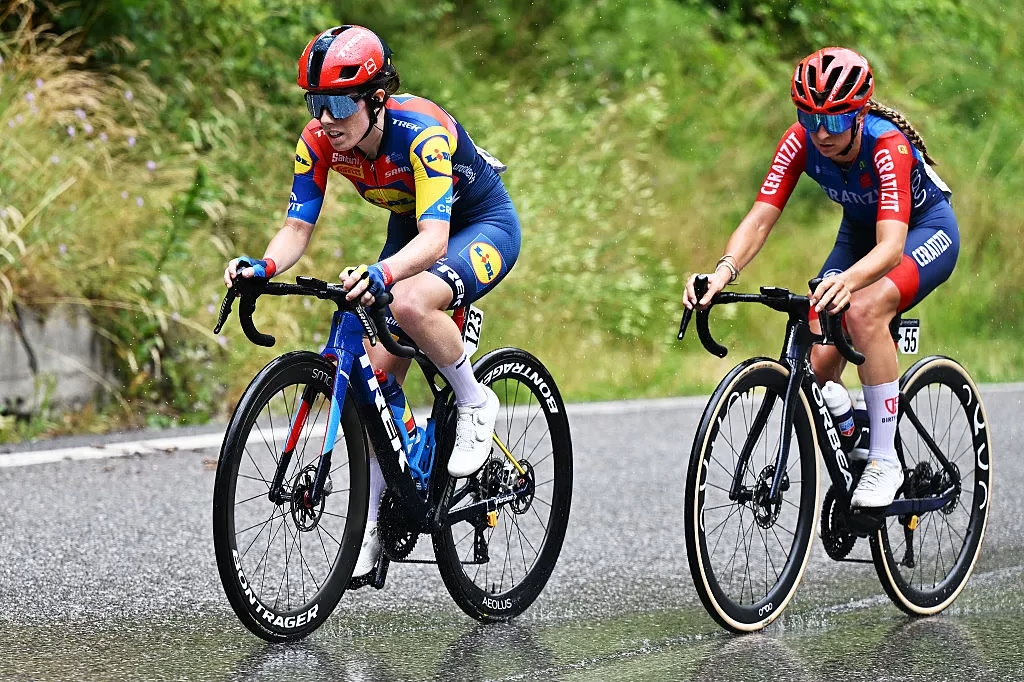
Nokere Koerse Women 2026 is one of those races that looks manageable on paper and usually becomes much harder in practice. For new fans, that is part of the appeal. This is not a Monument, but it has all the ingredients that make Belgian one-day racing so compelling: narrow roads, repeated rhythm changes, cobbles, short climbs, constant positioning stress and a finish that still demands something after a hard afternoon.
The 2026 edition takes place on Wednesday 18 March and covers 133.3 km. The race rolls out from Deinze before building steadily toward the decisive final run-in around Nokere. If you want the broader context for why races like this matter in spring, ProCyclingUK’s guide to the best women’s cycling races in 2026 for new fans is a useful place to start.
Where does Nokere Koerse Women 2026 start and finish?
The race begins in Deinze and finishes in Nokere on Waregemsestraat.
That is already useful context because this is not simply a local circuit race from the first kilometre. The opening phase gives the peloton space to settle, but not to relax. Once the route moves deeper into the Flemish lanes, the roadbook shows how the difficulty builds in layers rather than in one dramatic block.
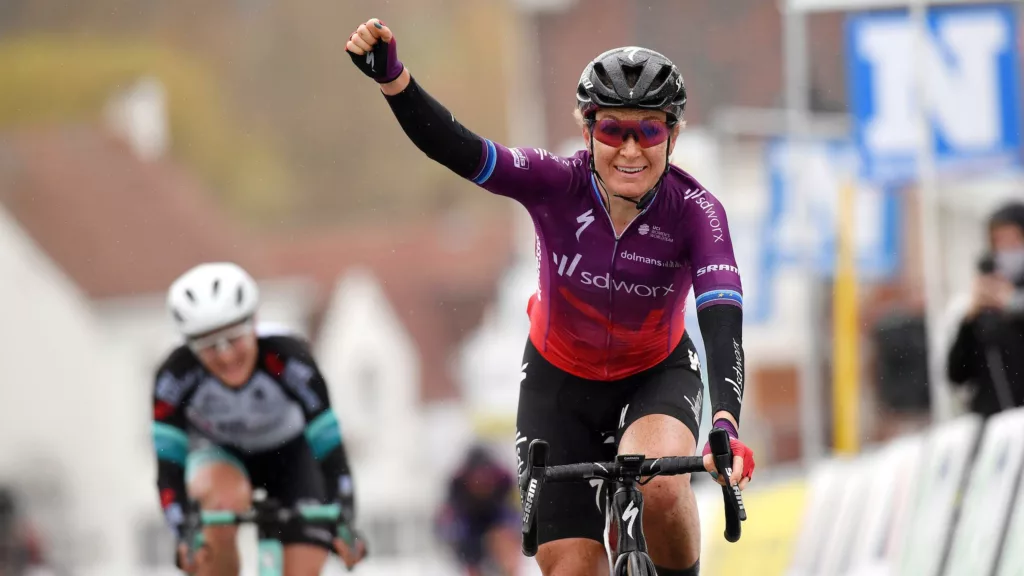
The finish remains on Waregemsestraat, which is now firmly established as the race’s safer uphill run-in. That means the finale is still demanding, but in a more controlled way than the old downhill drag into the cobbled Nokereberg finish. It rewards riders who can position well, survive the earlier pressure and still produce one last effort at the end of a tough race. ProCyclingUK previously covered that finish change in its piece on the new Nokere Koerse finish.
How is the 2026 route structured?
The 2026 course is best understood in three parts.
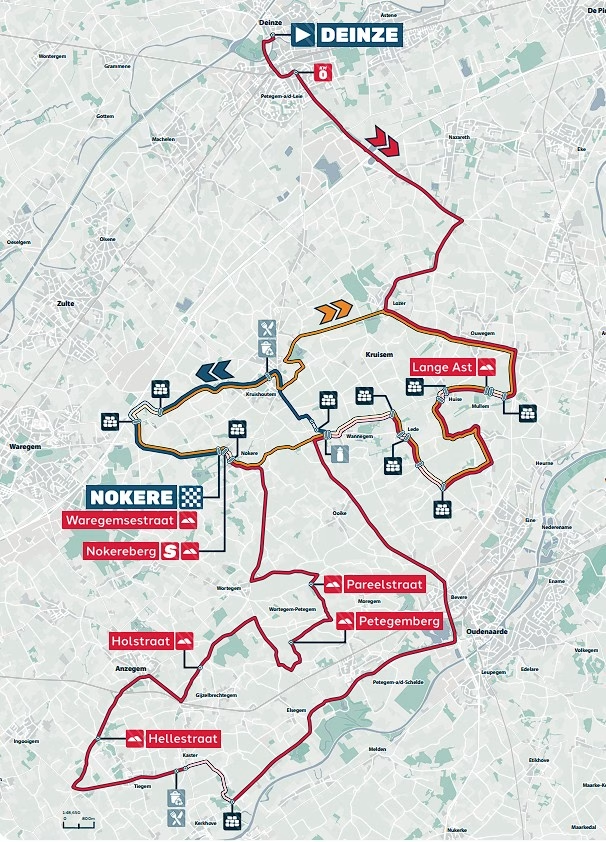
The first section takes the race out from Deinze and into the broader Flemish roads, where the bunch begins to feel the first selection points. The route is not brutal immediately, but it is active. Riders hit Lange Ast at 14.9 km, then Doorn at 20.6 km, which means the race is already introducing cobbled stress well before halfway.
The middle section is where the course begins to ask more serious questions. From roughly 45 km onward, the roadbook stacks key efforts closer together: Hellestraat at 46.3 km, Holstraat at 50.7 km, Petegemberg at 55.5 km, Pareelstraat at 57.9 km, and then the first passage of Nokereberg at 64.2 km. That is the point where the route stops being theoretical and starts shaping the likely contenders.
The final section is built around repetition and pressure. The riders come back through many of the same roads and hit more familiar stress points, including another passage of Lange Ast at 82.1 km, a second Nokereberg at 95.5 km, and a third Lange Ast at 113.4 km. From there, the race turns toward the closing phase, with the final run through Herlegemstraat beginning at 129.3 km, leaving just under 4 km to go.
What are the key sectors and climbs?
This is where the 2026 roadbook gives the clearest picture of how the race is supposed to unfold.
The numbered key points are:
- Lange Ast – 14.9 km
- Hellestraat – 46.3 km
- Holstraat – 50.7 km
- Petegemberg – 55.5 km
- Pareelstraat – 57.9 km
- Nokereberg – 64.2 km
- Lange Ast – 82.1 km
- Nokereberg – 95.5 km
- Lange Ast – 113.4 km
- Finish on Waregemsestraat – 133.3 km
That sequence tells you a lot. Nokereberg appears twice as a major focal point, but the race is not built around Nokereberg alone. Lange Ast appears three times, which is important because repeated cobbled stress often matters more than one famous sector. Hellestraat, Holstraat, Petegemberg and Pareelstraat also come in a fairly tight block in the middle of the race, helping create that sense of accumulation which usually defines Nokere Koerse Women.
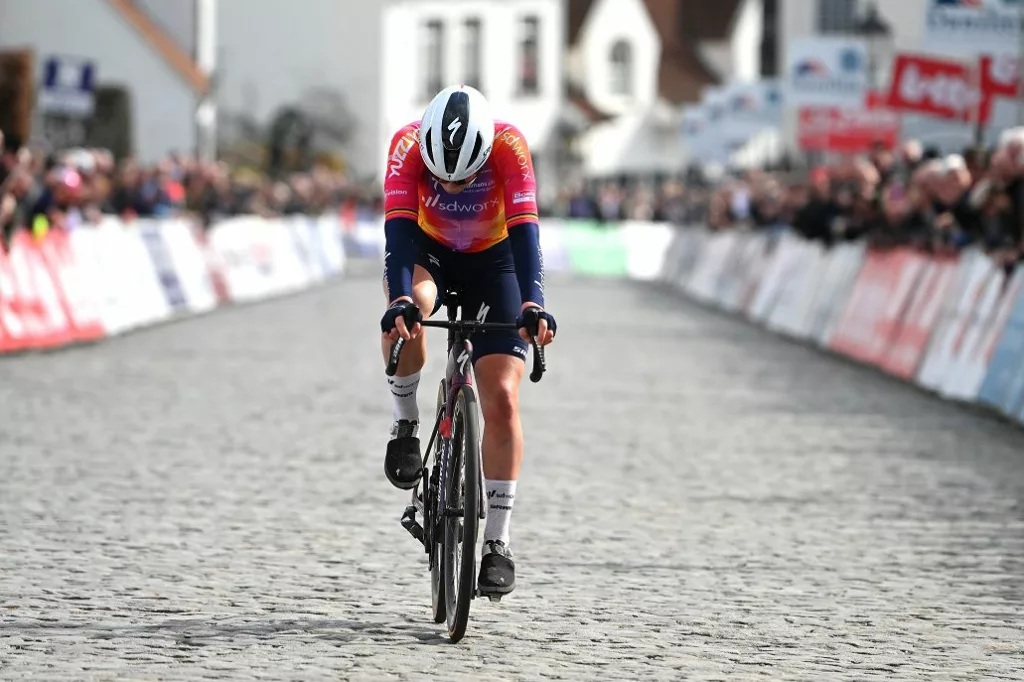 Photo Credit: Getty
What does the finale actually look like?
The final 10 km are more revealing than the simple profile might suggest.
At 123.7 km, the riders hit Nokerepontweg with 9.6 km remaining, then Hoevestraat at 123.9 km. By 124.6 km they are on Oudenaardsesteenweg, before turning onto Hoogstraat at 125.5 km and Waregemsesteenweg at 126.0 km. None of that sounds especially dramatic in isolation, but by this point the field will already have spent more than three hours fighting the route.
The truly decisive late marker is Herlegemstraat. The final passage begins at 129.3 km, with 3.9 km to go, and continues through 130.5 km, leaving 2.7 km remaining. Then come Nellekensstraat at 131.0 km, 2.2 km from the line, and Waregemsestraat at 131.3 km, which effectively means the riders are on the finishing road for the last 2 km.
That is a very useful detail for new fans. The race is unlikely to be won by one huge attack in the final 500 metres. It is much more likely to be shaped by what happens before the television pictures start screaming that the finale has begun.
Why does this route suit more than one rider type?
Because the course creates pressure without fully closing down the race.
A pure sprinter can still win Nokere Koerse Women, but only if she can survive repeated cobbles and accelerations. A classics rider can attack and succeed, but only if enough damage has already been done to make the chase behind disorganised. A punchy finisher can also thrive if the front group is reduced but not completely broken.
That is why this route is so instructive. The organisers have not designed a race that belongs to only one rider profile. They have designed a route that rewards resilience, awareness and the ability to keep making good decisions after the legs have already begun to fade.
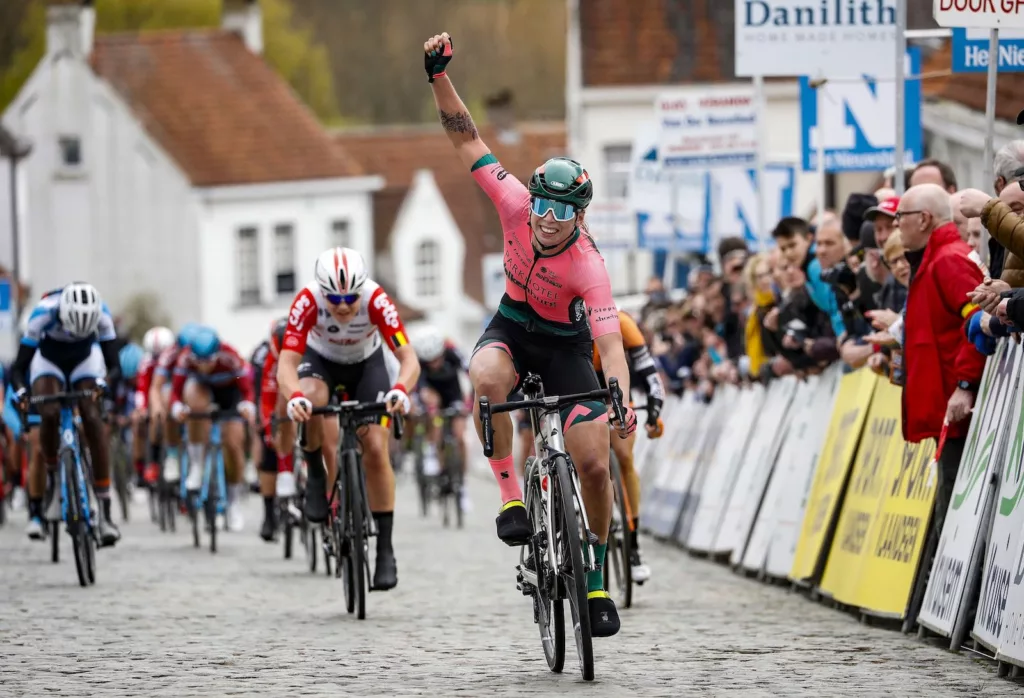 Photo Credit: Cor Vos
What should new fans watch for during the race?
Watch the race in phases, not just as one long line on a map.
Early on, focus on who is already guarding the front before the first cobbles at Lange Ast and Doorn. That tells you which teams understand the day.
In the middle phase, the block from Hellestraat to the first Nokereberg is where the race starts to become selective. Riders who are slightly out of place there can lose contact without any huge headline attack ever happening.
Late on, the second Nokereberg and the third Lange Ast matter because they keep draining the field before the final run-in. Then the closing trip through Herlegemstraat is where the race often becomes brutally clear. If a rider is too far back there, she may never see the front again.
That is one of the reasons races like this are so good for beginners. They teach that cycling is not only about watts. It is about reading the road before the critical moment arrives.
How is Nokere Koerse Women different from other Belgian spring races?
It sits in a useful middle ground.
It is not as sprawling or as prestigious as the Tour of Flanders Women. It is not as punishingly chaotic in reputation as Paris-Roubaix Femmes. It is not as obviously one-dimensional as a flat race built around a straightforward bunch sprint. Instead, Nokere Koerse Women offers a more concentrated lesson in how Belgian racing works.
That makes it especially good for newer fans. You still get the visual language of Flemish cycling: rough roads, repeated pressure, positioning battles and a finale where the strongest riders tend to rise naturally to the front. But the race remains compact enough to follow without needing years of background knowledge.
If you enjoy races like this, ProCyclingUK’s Beginner’s guide to Dwars door Vlaanderen Women 2026 is another useful read because it explains a similar style of Belgian one-day racing in a slightly bigger classics setting.
Why the 2026 route matters
Even before the racing starts, the route matters because Nokere Koerse Women is one of those events where small design choices have big tactical effects.
A safer uphill finish changes how teams commit. The placement of cobbled sections changes where riders fight for the front. The timing of the hardest sectors changes whether the race breaks apart gradually or snaps suddenly. In a Belgian one-day race, those details are never cosmetic.
That is why route guides for races like Nokere Koerse Women are useful even when the broad shape looks familiar. The exact sequence matters. The exact finish matters. The exact moment when the race becomes serious matters.
If you want to understand where Nokere Koerse Women sits in the broader season, ProCyclingUK’s guide to the 2026 Women’s WorldTour races, teams and points adds useful spring calendar context, even though Nokere Koerse itself sits just below that level.
So what should you expect from Nokere Koerse Women 2026?
Expect a race that becomes steadily more selective rather than exploding all at once.
Expect the first real signs of stress from the opening cobbles, but the strongest shaping block from around 46 km to 64 km.
Expect the final 40 km to matter because the repeated passages stop anyone from resetting properly.
And expect the last 4 km, especially Herlegemstraat into Nellekensstraat and then Waregemsestraat, to decide whether the race ends in a reduced sprint, a late solo move or a small group finish.
For a beginner, that makes Nokere Koerse Women 2026 a very useful race to watch. The roadbook shows exactly why Belgian one-day racing is rarely about one giant obstacle. It is about pressure, repetition and timing. This route does that very well.
-
 Photo Credit: Getty
 -
 Photo Credit: Flanders Classics