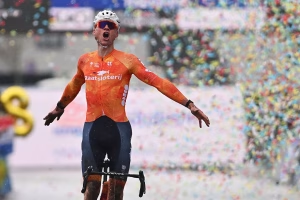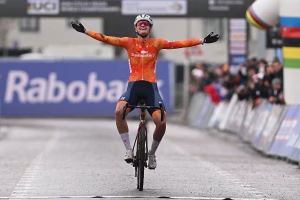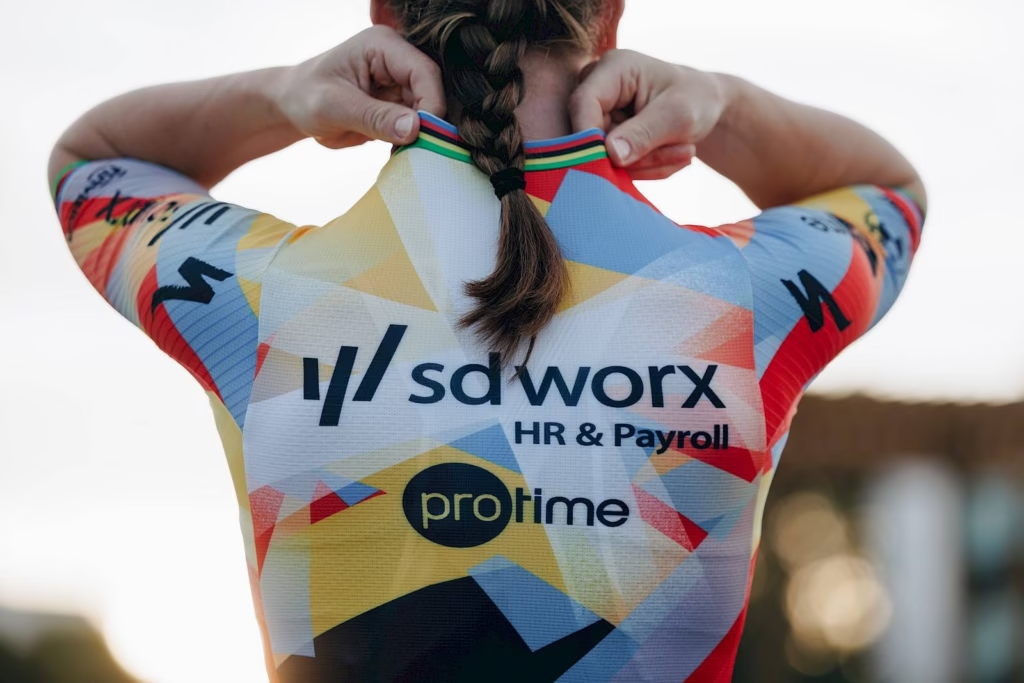
SD Worx-Protime arrive in 2026 still winning races, but with a more selective idea of where they want to lead the sport. After a 2025 season packed with victories yet short on Grand Tour overall success, team management has made its stance clear: the immediate priority is classics and day results, while general classification leadership is being rebuilt rather than forced.
Team manager Danny Stam summed up the shift neatly at the team presentation on January 8th, 2026, describing a return to what the squad does best and acknowledging that competing on every front has become harder as the women’s peloton deepens. “We are a bit back to the old roots,” he said, framing 2026 as a transition phase for stage-race ambitions.
That context matters. The team’s 2025 results were not framed as failure, far from it, but the biggest stage-race jerseys in France, Spain and Italy went elsewhere. SD Worx-Protime’s response is not to chase the same objectives with the same tools, but to sharpen what already wins them races and build the next generation of stage-race options alongside that.
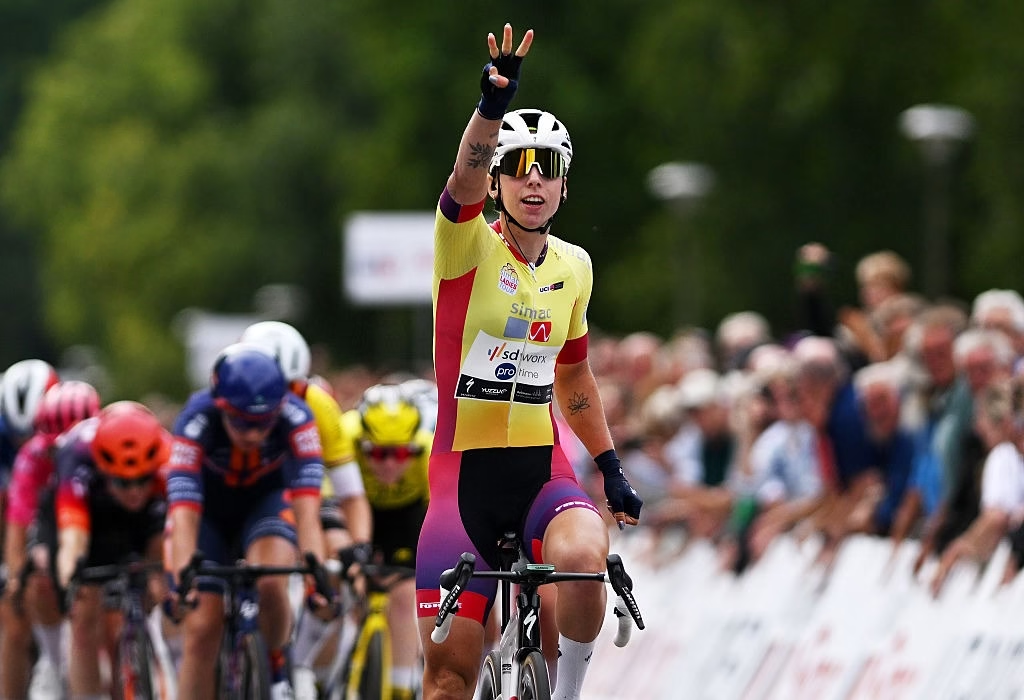
What changed after 2025, and why it matters
The most important internal lesson appears to be strategic as much as sporting. In recent years, SD Worx-Protime could plausibly dominate classics while also contesting overall victories in the biggest stage races. The team now argues that this dual supremacy is becoming less realistic, as more squads build depth across terrain types and race situations.
Stam also pointed to the team’s recent attempt to push Lotte Kopecky towards GC racing as a valuable experiment that did not deliver the hoped-for outcome. The conclusion was straightforward: it is time to stop forcing a model that does not fit, and to refocus resources on the areas where the roster remains unmatched.
Lorena Wiebes, sprint certainty with a new spring target
Lorena Wiebes remains the most reliable source of wins in the team, and the squad is not shy about continuing to build around that. But the most interesting detail for 2026 is the deliberate effort to widen her scope in the classics.
Wiebes has spoken openly about targeting the Amstel Gold Race as her main spring goal, describing it as the kind of challenge she needs. “I want to take on that challenge, to see how far I can go,” she said, suggesting SD Worx-Protime will not treat her as a pure sprinter project, but as a rider whose ceiling can keep rising in harder one-day races.

Lotte Kopecky, “back to basics” and back to where she wins
Kopecky’s message for 2026 is built around simplicity and relief. After a difficult 2025 shaped by setbacks and an ultimately unsuccessful GC push, she has described her focus as returning to what she loves and what she is best at.
Stam echoed that logic, arguing the team does not regret trying something different, but confirming the direction has changed. In practice, that points back to the races where Kopecky can be both the finisher and the force that makes selection, especially across the cobbled spring and the biggest one-day appointments.
Anna van der Breggen, leadership now and development for what comes next
Van der Breggen’s interviews have underlined how much the sport has changed during her time away from the peloton, particularly in positioning and the sheer number of riders capable of winning at the top level. For 2026, she has spoken about motivation, adaptation, and trying to add a final step rather than rewriting her identity.
Crucially, she has also indicated a heavy programme again, including the Ardennes classics and the three Grand Tours, which signals how central she remains to SD Worx-Protime’s stage-race structure even while the team publicly downshifts its GC expectations.
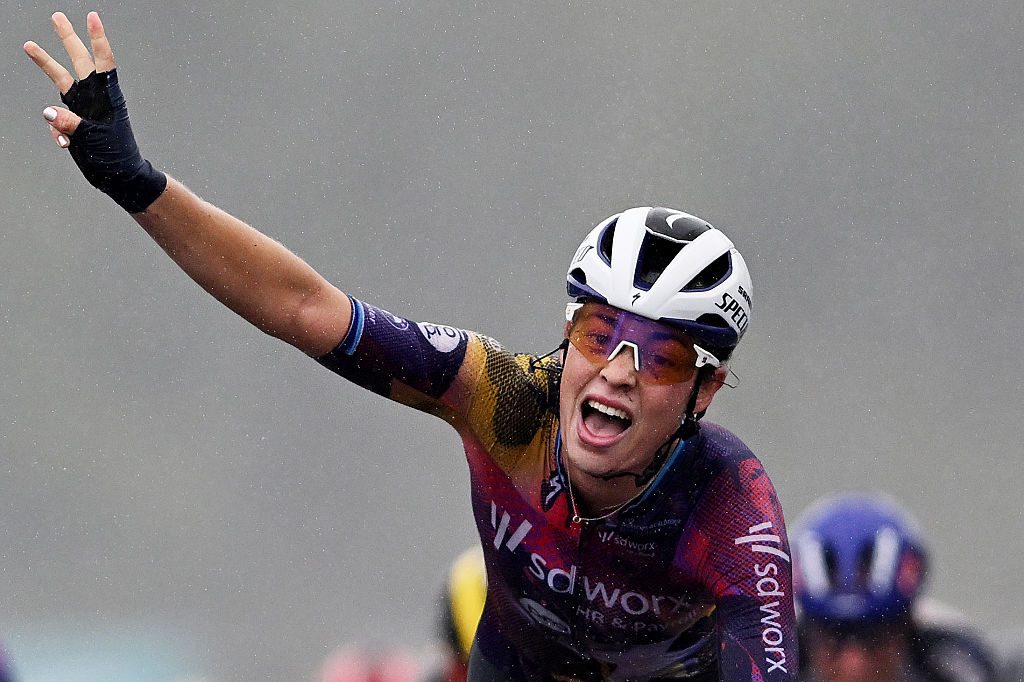 Photo Credit: Getty
Mischa Bredewold, confidence, freedom, and a wider spring role
Bredewold’s tone around 2026 is that of a rider who has learned what works mentally. After a season where she took a major win and grew in stature, she has explained why she does not want to lock herself into a single outcome and risk losing the instinctive racing that often decides the spring.
That mindset fits SD Worx-Protime’s renewed emphasis on day success. A squad built to win one-day races does not only need one leader, it needs multiple riders capable of reading the same finale in different ways, and Bredewold’s profile suits that approach.
Vinke and Cavallar, the stage-race project for the future
The team’s stage-race rebuild has names, even if it does not yet have a single headline objective. Stam has pointed to Nienke Vinke as a rider who can develop alongside Van der Breggen, while Valentina Cavallar has been referenced as a longer-term piece for the high mountains.
The key here is expectation management. SD Worx-Protime are not claiming these riders will immediately replace what the team once had in GC terms. They are saying they will invest time, build experience, and aim to “find that connection again,” as Stam framed it, rather than chasing instant Grand Tour dominance.
What success looks like for SD Worx-Protime in 2026
The team has been careful not to reduce 2026 to a win target. The clearer definition is thematic. If SD Worx-Protime have a successful 2026, it likely includes:
- A spring classics campaign built around Kopecky, Bredewold and the broader one-day unit, measured in big wins rather than presence.
- Another season of sprint volume from Wiebes, alongside a genuine attempt to move her deeper into harder classics.
- Stage racing approached realistically, with Van der Breggen carrying leadership duties while Vinke and Cavallar accumulate the experience the team believes it needs for future GC contention.