
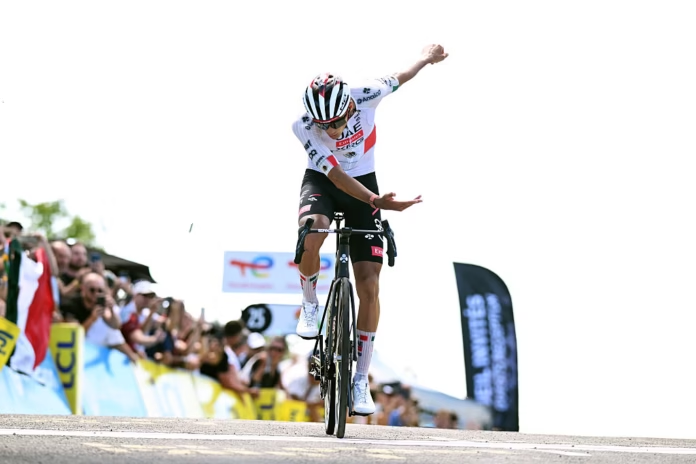
Isaac del Toro won stage 7 of the 2026 Tour Auvergne – Rhône-Alpes on the Grand Colombier, surging past Juan Ayuso in the final kilometres to take a major mountain-stage victory and move firmly back into the general classification fight. The UAE Team Emirates-XRG rider had looked measured while Ayuso attacked earlier on the final climb, but once he made contact with the Spaniard, he went straight over the top and rode alone to the finish.
Ayuso finished second, 25 seconds behind, after making the first major move of the final climb just under 7 kilometres from the summit. Tobias Halland Johannessen took third from the chasing group, with Matteo Jorgenson fourth and Cian Uijtdebroeks fifth after a race that repeatedly fractured under pressure from Lidl-Trek, Team Visma | Lease a Bike and UAE Team Emirates-XRG.
Luke Tuckwell survived the day in yellow, but only just. The Red Bull-Bora-Hansgrohe rider finished 2:33 behind Del Toro, enough to retain the race lead ahead of the final stage. Jorgenson moved up to second overall at 42 seconds, Del Toro to third at 49 seconds, Ayuso to fourth at 1:06, Johannessen to fifth at 1:33 and Paul Seixas to sixth at 1:54 after a dramatic day that included a costly crash for the Frenchman.
Nervous start and early crashes
The 133.6-kilometre stage from La Bridoire to the Grand Colombier was short, sharp and loaded with climbing. After Red Bull-Bora-Hansgrohe had taken control of the race on stage 6 through Maxim Van Gils’ stage win and Tuckwell’s move into yellow, the penultimate day offered the first real test of whether the Australian could defend the jersey under direct pressure from the main GC contenders.
There was disruption before the race had even properly started. Dani Martínez, Alex Díaz and Gal Glivar crashed in the neutralised section, delaying the official start. Martínez and Díaz were able to continue, but Glivar was forced to abandon. Oscar Onley was also a non-starter after his crash on stage 6, removing one of Netcompany INEOS’ major GC cards before the race reached the hardest climbs.
Once the flag dropped, the attacks came immediately. The road rose towards the Col du Banchet, the first of three climbs packed into the opening 25 kilometres, and several strong riders tried to go clear. Valentin Paret-Peintre was active again after attacking the previous day, while Kévin Vauquelin also tested the race early despite having lost time on stage 6.
Clément Braz Afonso, already in control of the mountains classification, joined the early action and took the points over the Col du Banchet. He then repeated the move on the Col de la Crusille, extending his lead in the KOM standings before the race reached the steeper Côte de Saint-Maurice-de-Rotherens.
Neutralised descent and Seixas crash
A six-rider move formed before the Côte de Saint-Maurice-de-Rotherens, with Paret-Peintre, Quinn Simmons, George Bennett, Raúl García Pierna, Jordan Jegat and Clément Berthet going clear. Berthet led the group over the climb ahead of Bennett, Jegat and Paret-Peintre, but the descent that followed was neutralised because of gravel on the road.
The neutralisation briefly paused the racing dynamic, but the biggest moment came soon after the stage resumed. Seixas crashed with around 90 kilometres still to race, and the consequences were immediate. Two Decathlon CMA CGM teammates waited for him, but he took time to get back on his bike and was soon more than 3 minutes behind the peloton.
That turned the stage on its head. Seixas had begun the day as one of the riders expected to challenge for both the stage and the general classification, but he was suddenly chasing across flat terrain with visible injuries and a long gap to close. Decathlon had to use their riders in waves, first to keep him moving, then to bring him back towards the convoy, and finally to reconnect him with the peloton before the decisive climbs.
Up front, the race was still refusing to settle. Simmons and Mathis Le Berre tried a move, then other combinations formed and dissolved as the peloton kept the speed high. Seixas’ problem was that no definitive break had been allowed to go, so the bunch was still racing hard while he was trying to chase.
Lacets du Grand Colombier thins the race
The first serious mountain test came on the Lacets du Grand Colombier, an 8.5-kilometre climb at around 10 per cent. By then, a front group of around 10 riders had formed, including Simmons, Paret-Peintre, Bennett, Braz Afonso, Pello Bilbao, Carlos Rodríguez, Sergio Samitier, Jegat, Laurens De Plus and Berthet.
Netcompany INEOS had numbers in that group, with De Plus working for Rodríguez, while Simmons was later called back from the move by Lidl-Trek to help Ayuso and Mattias Skjelmose behind. Berthet led the front group over the Lacets du Grand Colombier, while Seixas was still chasing behind, first with Paret-Peintre, then with Nicolas Prodhomme, and later with Léo Bisiaux dropping back to help.
The peloton was reduced to around 40 riders on the climb, but Tuckwell was still present and not yet showing major trouble. Bruno Armirail, who had started the day second overall, began to slip, while Vauquelin was also out the back on the lower slopes. The GC picture was changing even before the final climb.
Seixas gradually made his way closer. By the descent and valley road after the Lacets, he had reached the convoy and started reducing the gap more quickly. Simmons and Armirail were among those helping keep the peloton moving, making the chase harder, but Decathlon timed their support well. With 36 kilometres remaining, Bisiaux had helped Seixas return to the peloton.
Lidl-Trek and UAE tighten the race
The catch did not mean Seixas was back to normal. He had spent a huge amount of energy chasing and was visibly marked by the crash. Still, his return meant the GC favourites were together again before the final climbs, and the race briefly reset.
The front group still had a small advantage heading into the Col de Richemond, but the peloton was closing. UAE Team Emirates-XRG and Lidl-Trek both contributed to the pace behind, with Lidl’s Carlos Verona and then Simmons setting things up for Ayuso and Skjelmose. UAE also had clear interest in keeping Del Toro well positioned.
Berthet led the break over the Col de Richemond ahead of Bennett, De Plus and Paret-Peintre, but the gap had dropped to just 13 seconds with 20 kilometres to go. On the descent towards the foot of the Grand Colombier, the break was effectively finished. It was caught before the final climb, leaving the stage and the GC fight to be decided by the main favourites.
The final ascent was the Grand Colombier by its steeper side, 8.5 kilometres at more than 10 per cent. It was a climb made for direct separation rather than tactical waiting, and Lidl-Trek were the first to impose a plan. Simmons set the early pace, then Lennard Kämna took over. The aim was obvious: soften the group and launch Ayuso.
Ayuso attacks before Del Toro takes over
Ayuso attacked just under 7 kilometres from the finish, taking Ben Tulett with him initially. Behind, Jorgenson, Uijtdebroeks, Johannessen and Del Toro formed the main chase group, while Seixas was absent from the front selection. Tuckwell was already under pressure at the back of the yellow jersey group, with Seixas close by but clearly still feeling the cost of his crash and chase.
Ayuso soon dropped Tulett and led alone. With 5 kilometres to go, he had around 22 seconds on the Jorgenson, Del Toro, Uijtdebroeks and Johannessen group, and roughly 40 seconds on the group containing Tuckwell and Seixas. The move looked dangerous enough to threaten both the stage and the GC order.
Seixas then lifted the pace from the yellow jersey group, with Skjelmose glued to his wheel. He caught and passed Tulett, but his effort was now about limiting damage rather than winning the stage. Up ahead, Jorgenson initially did the work in the chase, before Del Toro came through and lifted the tempo.
That acceleration dropped Uijtdebroeks, then Del Toro went clear from the chase group. He could see Ayuso ahead on the steep gradients, but the gap hovered stubbornly above 10 seconds for a while. With 3 kilometres to go, Ayuso still led by 13 seconds, with Seixas and Skjelmose around 40 seconds back and Tuckwell somewhere further behind, battling to save yellow.
-
 Photo Credit: Getty
 -
 Photo Credit: Zac Williams/AusCycling
Del Toro storms to victory
The final kilometres changed quickly. Del Toro closed the gap to Ayuso, made contact, and immediately went past. Ayuso had spent a long time alone after his early attack and could not respond when the Mexican reached him.
Del Toro pulled clear with around 1 kilometre to go and kept extending his advantage all the way to the line. His victory was his first since winning Tirreno-Adriatico in March and came at exactly the right time for his Tour Auvergne – Rhône-Alpes ambitions. He started the day with time to recover on GC, but the Grand Colombier put him back within striking distance before the final stage.
Ayuso crossed second, 25 seconds behind, having animated the final climb but paid for launching too early. Johannessen then clipped away from the chase group to take third, while Jorgenson recovered well after being distanced to finish fourth ahead of Uijtdebroeks.
Seixas came in sixth, around 1:25 behind Del Toro. Given the crash, the chase and the time spent off the back, it was a resilient ride, but it likely ended his hopes of winning the overall. Tuckwell then arrived 2:33 down, gritting his teeth and just doing enough to keep the yellow jersey.
Tuckwell survives, but GC tightens again
The stage completely reshaped the general classification without removing Tuckwell from the lead. The Australian remains in yellow, but the gap has narrowed and the strongest climbers are now closer. Jorgenson is second overall at 42 seconds, Del Toro third at 49 seconds, Ayuso fourth at 1:06, Johannessen fifth at 1:33 and Seixas sixth at 1:54.
That makes the final stage to Plateau de Solaison finely balanced. Tuckwell has survived Crest-Voland and Grand Colombier, but the riders behind him now have clearer momentum. Jorgenson limited his losses well on the steepest gradients, Del Toro looked the strongest on the day, and Ayuso showed he has the legs to attack, even if his timing on Grand Colombier cost him the stage.
For Seixas, the day became one of damage limitation. He was later recognised with the combativity award after fighting back from a crash that could have ended his GC challenge entirely. He still finished in the top six on the stage, but with almost 2 minutes to recover and five riders ahead of him overall, the race has moved away from the scenario Decathlon would have wanted.
Stage 7 had everything: crashes before the flag, a neutralised descent, repeated attacks, a major crash for one of the favourites, a long chase, a collapsing breakaway, and a final climb that changed the entire race again. Del Toro took the win, Tuckwell kept yellow, and the Tour Auvergne – Rhône-Alpes goes into its final day with the overall still open.
Tour Auvergne – Rhône-Alpes 2026 stage 7 result
| Position | Rider | Team | Time/gap |
|---|---|---|---|
| 1 | Isaac del Toro | UAE Team Emirates-XRG | 3:41:41 |
| 2 | Juan Ayuso | Lidl-Trek | +0:24 |
| 3 | Tobias Halland Johannessen | Uno-X Mobility | +0:38 |
| 4 | Matteo Jorgenson | Team Visma | Lease a Bike | +0:41 |
| 5 | Cian Uijtdebroeks | Movistar Team | +0:41 |
| 6 | Paul Seixas | Decathlon CMA CGM Team | +1:17 |
| 7 | Mattias Skjelmose | Lidl-Trek | +1:21 |
| 8 | Cristián Rodríguez | XDS Astana Team | +2:29 |
| 9 | José Félix Parra | Caja Rural-Seguros RGA | +2:31 |
| 10 | Jan Castellon | Caja Rural-Seguros RGA | +2:33 |
Mian photo credit: Getty

