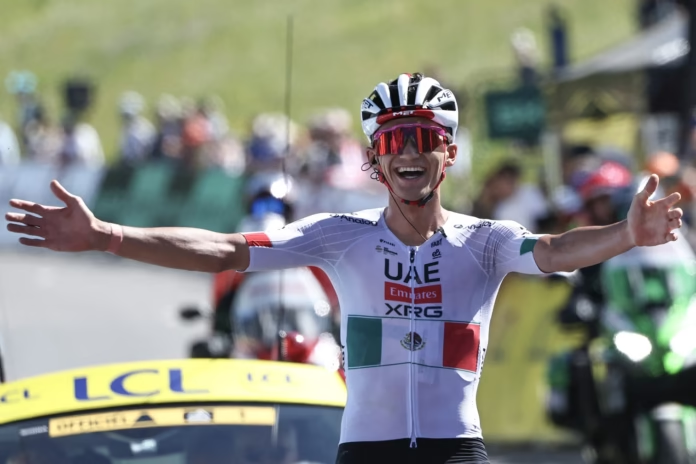
Isaac del Toro won the final stage of the 2026 Tour Auvergne – Rhône-Alpes at Plateau de Solaison, taking his second summit finish in two days and overturning Luke Tuckwell’s yellow jersey on the final climb of the race. The UAE Team Emirates-XRG rider attacked 9 kilometres from the summit, swept past the remaining breakaway riders and rode alone to the finish to complete a race-winning performance.
Juan Ayuso finished second for Lidl-Trek, 1 minute behind Del Toro, after trying to chase alone on the upper slopes. Tobias Halland Johannessen was third for Uno-X Mobility, almost catching Ayuso near the line after another aggressive ride in the mountains. Behind them, the general classification changed decisively. Tuckwell lost yellow but rescued second overall, while Ayuso completed the final podium after another attacking ride.
For Del Toro, this was the final act of a brutal mountain weekend. He had won on the Grand Colombier on stage 7, moving to within 49 seconds of Tuckwell, then finished the job on Plateau de Solaison with the strongest climbing display of the race. It gave him the overall title in the first edition of the race under its Tour Auvergne – Rhône-Alpes name, and his third WorldTour stage-race victory of 2026 after the UAE Tour and Tirreno-Adriatico.
A brutal final stage starts hard
The final stage from Beaufort to Plateau de Solaison covered just 120.1 kilometres, but there was very little room to breathe. The route climbed the Col du Pré almost from the start, followed by the Montée de Bisanne, the Col des Aravis and the hors catégorie finish at Plateau de Solaison.
The opening climb was the Col du Pré, 6.9 kilometres at 10.1 per cent, and it immediately made the day difficult for riders carrying fatigue or injuries from the previous stages. Paul Seixas, who had crashed hard on stage 7 before producing a remarkable chase back to the favourites’ group, started the stage but was in trouble almost immediately.
The Frenchman was dropped on the opening climb, still clearly affected by the previous day’s crash and the effort it took to salvage his race on the Grand Colombier. He made it over the top and began the descent, but the damage was obvious. After his fightback on stage 7, there was no repeat. Seixas climbed off, ending a race that had promised much but became defined by bad luck and resilience.
There were more non-starters too, including Luke Plapp, who was reported ill. By that point in the race, the attrition was obvious. The Tour Auvergne – Rhône-Alpes had already included breakaway chaos, a team time trial, crashes, summit finishes and repeated GC changes. The final stage simply started at the same intensity.
Breakaway forms over the early climbs
A strong breakaway formed on the Col du Pré, with Laurens De Plus and Carlos Rodríguez representing Netcompany INEOS, Léo Bisiaux up front for Decathlon CMA CGM, Clément Braz Afonso in the mountains jersey for Groupama-FDJ United, Georg Steinhauser for EF Education-EasyPost, Valentin Paret-Peintre for Soudal Quick-Step and Harold Tejada for XDS Astana.
Geoffrey Bouchard and Kévin Vauquelin later bridged across on the descent, briefly making the move even stronger. Vauquelin’s presence was significant after his earlier GC position in the race, but the pace and the climbing would gradually reduce the group.
Braz Afonso continued to control the mountains classification. He had been aggressive throughout the race, collecting points on repeated climbs, and he again took the maximum at the key summits. With the polka-dot jersey effectively secured, the break’s focus shifted towards stage survival, while the peloton behind began to organise for the final GC battle.
On the Montée de Bisanne, 11.4 kilometres at 7.7 per cent, the front group began to shrink. Bouchard and Vauquelin were dropped near the top, while Bisiaux also lost contact. UAE Team Emirates-XRG and Lidl-Trek kept the peloton within reach, with the gap around 2:30 after Bisanne and then falling sharply on the Col des Aravis.
UAE and Lidl-Trek keep the break close
The Col des Aravis, 7 kilometres at 6.8 per cent, was not the decisive climb of the day, but it helped set up the finale. Netcompany INEOS used their numbers in the break, with De Plus and Rodríguez still present, but the peloton was not prepared to let them ride too far clear.
UAE Team Emirates-XRG had the clearest reason to keep the race controlled. Del Toro had started the day third overall, 49 seconds behind Tuckwell and only 7 seconds behind Matteo Jorgenson. If he could isolate the yellow jersey on Plateau de Solaison, the race was still there to win.
Lidl-Trek also had a major stake in the final climb. Ayuso had attacked on the Grand Colombier the previous day and looked strong, even if Del Toro had caught and passed him. With Ayuso and Mattias Skjelmose both in the GC picture, Lidl-Trek had every reason to keep the pressure high and make the final ascent a pure climbing contest.
By the top of the Aravis, the break’s lead was down to around 40 seconds. The riders up front still had a chance of influencing the early part of the final climb, but the stage was clearly moving back towards the favourites. The long run down into the valley allowed the gap to settle, and the final ascent began with the remnants of the move around 50 seconds ahead.
Solaison begins with UAE pressure
The final climb to Plateau de Solaison was 11.3 kilometres at 9.1 per cent, a proper test at the end of three consecutive mountain stages. It was steep enough to expose anyone who had overreached on the previous two days, and long enough for the strongest rider to take back serious time.
UAE Team Emirates-XRG took over from Lidl-Trek on the lower slopes. Pavel Sivakov set a brutal tempo that immediately began to reduce the favourites’ group. Tuckwell, who had defended yellow on the Grand Colombier with a stubborn late recovery, began to struggle early. The Australian lost contact before Del Toro had even attacked.
That was the first sign that the race lead was slipping away. Tuckwell had started the day with 42 seconds over Jorgenson, 49 seconds over Del Toro and 1:06 over Ayuso, but those gaps looked fragile once the slope and the UAE pace began to bite.
Pablo Torres then took a shorter turn before Del Toro launched. The Mexican attacked 9 kilometres from the summit, far earlier than a rider simply protecting a podium would have needed to move. It was an attack to win the stage and the race in one go.
Del Toro attacks and rides away
Del Toro’s acceleration was decisive immediately. He bridged rapidly to the last two remaining breakaway riders, Rodríguez and Paret-Peintre, then went straight past them. There was no hesitation and no attempt to use the break as a stepping stone for long. He was alone and climbing at a rhythm no one else could match.
Within a kilometre, Tuckwell was already around 40 seconds down and close to losing the virtual race lead. Behind Del Toro, Jorgenson and Ayuso tried to organise the chase with support from Ben Tulett and Skjelmose, while Johannessen, Cristian Rodríguez and Carlos Rodríguez were also in the reduced group.
The gap kept growing. Del Toro’s attack had not been a short burst designed to force others to react. It was a long, sustained effort, and as the road continued upwards, the separation became more severe.
Ayuso eventually decided he had to go alone. With 5.5 kilometres remaining, the Lidl-Trek rider attacked from the chase group, trying to repeat the aggressive approach he had used on the Grand Colombier. For a short spell, he looked as though he might reduce the gap, but Del Toro remained in control and the difference drifted back towards a minute.
Tuckwell fights back but loses yellow
Behind the stage battle, Tuckwell’s ride became one of survival. He had looked in real danger of collapsing completely when first distanced on the lower slopes, but he recovered in the second half of the climb. Maxim Van Gils, who had won stage 6 and helped put Red Bull-Bora-Hansgrohe into yellow, played a key support role again, pacing Tuckwell back towards some of the riders who had initially gone clear.
Jorgenson, who started the day as the closest challenger to Tuckwell, unexpectedly faded on the upper slopes. That changed the podium fight. Tuckwell, rather than dropping through the standings, began to limit the damage. He even came back to Jorgenson, a crucial moment in preserving second overall.
Del Toro, meanwhile, finished the job with clear daylight behind him. He had time to enjoy the final metres, taking a second consecutive stage win and sealing the overall title in the same move. Ayuso held second on the stage, while Johannessen surged late and almost caught him before the line.
Skjelmose and Cristian Rodríguez were next, followed by Carlos Rodríguez. Van Gils then led Tuckwell home, not quickly enough to save yellow, but fast enough to preserve a breakthrough second place overall.
Del Toro wins the race after mountain takeover
Del Toro’s overall victory was built across the final two mountain stages. He won on the Grand Colombier by catching and dropping Ayuso, then repeated the performance on Plateau de Solaison with an even more decisive long-range attack. It was not simply a case of defending a good position. He had to take the race back, and he did it by attacking the two hardest summit finishes in consecutive days.
Tuckwell’s second overall was still one of the stories of the race. He had taken yellow from the huge stage 6 breakaway to Crest-Voland, survived the Grand Colombier by the narrowest of margins, and then fought back on Solaison after being dropped early. Losing yellow on the final day will sting, but second overall in a WorldTour stage race was still a major statement from the Australian.
Ayuso completed the final podium after two aggressive mountain stages. He attacked early on Grand Colombier and again chased hard on Solaison, but Del Toro was stronger at the decisive moments. Jorgenson, second overall at the start of the day, faded on the final climb and slipped out of the podium picture.
The race also ended with a sense of what might have been for Seixas. He had shown on stage 6 and even through the damage limitation ride on stage 7 that he had the climbing strength to shape the race, but the crash and the after-effects left him unable to contest the final stage.
A race transformed in the final weekend
The 2026 Tour Auvergne – Rhône-Alpes changed repeatedly across its eight days. Alex Baudin won from the break on stage 1 and held yellow through the team time trial and sprint stages. Red Bull-Bora-Hansgrohe blew the race open on stage 6, with Van Gils winning and Tuckwell taking yellow from a huge breakaway. Del Toro then used the Grand Colombier and Plateau de Solaison to turn the race back towards the strongest pure climber in the final weekend.
The final general classification reflected that last shift. Del Toro won overall, Tuckwell finished second at 54 seconds, and Ayuso rounded out the podium at 1:17. It was a race that rewarded aggression almost every day, but by the end the decisive factor was climbing strength on the two hardest summit finishes.
For UAE Team Emirates-XRG, it was a powerful statement before the Tour de France. Del Toro arrived with major stage-race wins already behind him in 2026, and left with another. His final weekend suggested not only strong form, but the confidence to attack early and sustain the effort when the race was on the line.
Plateau de Solaison gave the race its final answer. Tuckwell fought, Ayuso attacked, Jorgenson faded, Seixas abandoned, and Del Toro rode away from everyone.
Tour Auvergne – Rhône-Alpes 2026 stage 8 result
| Position | Rider | Team | Time/gap |
|---|---|---|---|
| 1 | Isaac del Toro | UAE Team Emirates-XRG | 3:35:07 |
| 2 | Juan Ayuso | Lidl-Trek | +1:00 |
| 3 | Tobias Halland Johannessen | Uno-X Mobility | +1:02 |
| 4 | Mattias Skjelmose | Lidl-Trek | +1:31 |
| 5 | Cristián Rodríguez | XDS Astana Team | +1:31 |
| 6 | Carlos Rodríguez | Netcompany INEOS | +1:36 |
| 7 | Maxim Van Gils | Red Bull-BORA-hansgrohe | +1:43 |
| 8 | Luke Tuckwell | Red Bull-BORA-hansgrohe | +1:43 |
| 9 | Cian Uijtdebroeks | Movistar Team | +1:43 |
| 10 | Matteo Jorgenson | Team Visma | Lease a Bike | +1:43 |
Tour Auvergne – Rhône-Alpes 2026 GC result
| Position | Rider | Team | Final time/gap |
|---|---|---|---|
| 1 | Isaac del Toro | UAE Team Emirates-XRG | 29:35:05 |
| 2 | Luke Tuckwell | Red Bull-BORA-hansgrohe | +0:54 |
| 3 | Juan Ayuso | Lidl-Trek | +1:17 |
| 4 | Matteo Jorgenson | Team Visma | Lease a Bike | +1:36 |
| 5 | Tobias Halland Johannessen | Uno-X Mobility | +1:46 |
| 6 | Mattias Skjelmose | Lidl-Trek | +2:41 |
| 7 | Cian Uijtdebroeks | Movistar Team | +3:11 |
| 8 | Cristián Rodríguez | XDS Astana Team | +3:15 |
| 9 | José Félix Parra | Caja Rural-Seguros RGA | +6:25 |
| 10 | Guillaume Martin | Groupama-FDJ United | +7:21 |