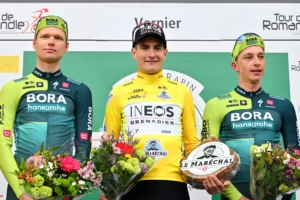
Ethan Vernon of NSN won stage 4 of the 2026 Volta a Catalunya on Thursday, timing his sprint perfectly in a tense uphill finish in Camprodon to beat race leader Dorian Godon of Ineos Grenadiers and Tom Pidcock of Pinarello-Q36.5. After a day of repeated breakaway reshuffles, bonus-second skirmishes and a technical finale that had several riders and teams on edge, Vernon delivered the cleanest finish when it mattered most.
Early breakaway plans keep changing on a shortened mountain day
Stage 4 began with a reduced field after Ivo Oliveira and Matthew Fox did not start. Oliveira’s absence was no surprise after his heavy crash the previous day, and the race rolled out with 153 riders left in contention for what was still a difficult mountain stage despite the route changes.
The first meaningful move formed quickly as Maxime Decomble, Mats Wenzel, Unai Aznar, José Luis Faura and Samuel Florez went clear as soon as the flag dropped. But the peloton never gave them much room. Decomble, sitting only 20 seconds behind Godon on general classification, was simply too close to be allowed any real freedom. That shaped the early phase of the race. The break reached the first climb, the Coll de Parpers, but was caught almost as soon as it had crested.
That opening sequence made one thing clear. This was not going to be a day when the bunch lazily allowed a harmless move to drift clear for six or seven minutes. Too many teams still believed in the stage, and too many riders still had reasons to think about time bonuses and GC opportunities.
There was also one notable absence from the very first move. Baptiste Veistroffer, who had turned the opening stages into his personal raid on every available KOM and intermediate sprint, was not in it. That absence lasted only briefly.
Veistroffer resumes normal service before the break finally sticks
After Diego Uriarte’s short-lived solo attempt, the race headed towards the first intermediate sprint in Granollers still together. That opened the door for the general classification riders, and Remco Evenepoel wasted no time taking advantage. He won the sprint ahead of Pidcock and David González, trimming three seconds from Godon’s overall lead and signalling immediately that stage 4 was not just about the finish.
Then Veistroffer returned to the front. He attacked again, this time with Wenzel, before a four-man counter move featuring Senna Remijn, Koen Bouwman, Merhawi Kudus and Samuel Fernandez came across. That arrangement did not last either, but eventually the race settled into a more durable shape with Veistroffer, Bouwman, Kudus and Fernandez clear.
This was the first move the peloton appeared willing to tolerate. The gap stretched beyond a minute, then two, and the race finally entered something closer to a normal breakaway phase. As the riders approached the Alt de Sant Feliu de Codines, the composition of that group mattered. Veistroffer was there for points, Bouwman added climbing pedigree, and Kudus and Fernandez gave the move enough strength to remain interesting if not outright threatening.
Veistroffer, unsurprisingly, took the KOM points at the top and further strengthened his grip on the mountains competition. Then his day changed. Having banked what he came for, he sat up. Bouwman did the same. That left Kudus and Fernandez alone out front, first with just over a minute, then unexpectedly with more.
Kudus and Fernandez force the peloton to work harder than expected
At 100km to go, the reduced break looked as though it might be about to fold. Instead, Kudus and Fernandez pushed on well and re-established a more useful advantage. Their effort gave stage 4 its middle-race shape. What had looked like a straightforward chase became a longer, more awkward grind for the peloton.
Ineos Grenadiers and Uno-X Mobility were the two teams most consistently visible at the front, working for Godon and Magnus Cort respectively, while NSN also contributed for Vernon. That told its own story. Several teams believed the finish would suit fast finishers who could survive the climbing and then still produce on the uphill drag into Camprodon.
Kudus and Fernandez never looked entirely safe, but they were strong enough to keep the bunch interested for longer than ideal. Even with 80km to go they still had over two minutes, and although that margin gradually fell, it did so unevenly rather than in one clean collapse. The pair were caught, then reprieved by a slight easing in the pace, then reeled in again. It was one of those breakaways that kept forcing the peloton to spend a little more than planned.
The race also retained a tactical edge because of the intermediate sprints. Fernandez took the sprint in Olost ahead of Kudus and Andrea Raccagni Noviero, and later, once the break was finally caught near Sant Joan de les Abadesses, the final intermediate sprint became a small GC battle in its own right.
Pidcock took that sprint ahead of Simone Gualdi and David González, adding three more bonus seconds to the two he had already collected earlier in the day. That mattered. By the end of the stage, those bonus seconds had helped lift him into second overall.
Late attacks fail as the stage turns back towards the sprinters
Just after that final intermediate sprint, there was a sharp counter from Lenny Martinez, Florian Lipowitz, Pidcock and Gualdi. It was an interesting move because it combined pure climbers and puncheurs with a rider in Pidcock who had already shown he was thinking about every available second. But it was closed down quickly, and from that point the teams behind returned to their original calculations.
The remainder of the stage became a fight for positioning into what many riders clearly felt was a dangerous final. The run-in to Camprodon included a fast descent, an uphill drag and a technical closing section, with narrow roads, dark tunnels and a tricky roundabout inside the final 150 metres. Ben O’Connor was visibly unhappy about something in that finale, and the race notes strongly suggest the road design and tunnel sequence were among the concerns.
A late crash involving Derek Gee-West and Bart Lemmen briefly added more tension, though both were able to continue. Then, inside the final 10km, another fall involving Michael Leonard and Anton Charmig again disrupted the flow. Neither crash altered the stage outcome directly, but both underlined how difficult it was for the teams to hold a clean train together.
Vernon gets it right in the last bend
By 6km to go, the front of the peloton was a mass of competing trains. NSN, Lotto-Intermarche, Bahrain Victorious, Groupama-FDJ United and Uno-X Mobility were all there, while Ineos Grenadiers kept trying to advance on the left. Modern Adventure and Jayco-AlUla also found gaps in the closing kilometres, which only increased the pressure on the established sprint teams.
Inside 2km, Modern Adventure briefly took over before being swamped again. EF Education-EasyPost, NSN and Ineos Grenadiers then moved up for Noah Hobbs, Vernon and Godon respectively. Bob Jungels hit the front for Ineos under the flamme rouge, with NSN perfectly placed behind and UAE Team Emirates-XRG starting to appear too.
That was the key phase of the finish. Vernon understood that the final bend was likely to decide the stage more than any pure drag-race speed. He knew he needed to be first or very close to first into that corner, and he held his nerve when Godon tried to muscle his way forward. In the end, the Brit had enough power to stay ahead, while Godon had to settle for second after another strong finish.
Pidcock’s reward for a very alert ride all day was third place, and more importantly more time bonuses. His positioning was excellent, and while he did not have the final kick to beat Vernon, he came away from the day as one of its most effective riders in terms of the overall picture.
Volta a Catalunya 2026 stage 4 Result
Results powered by FirstCycling.com