

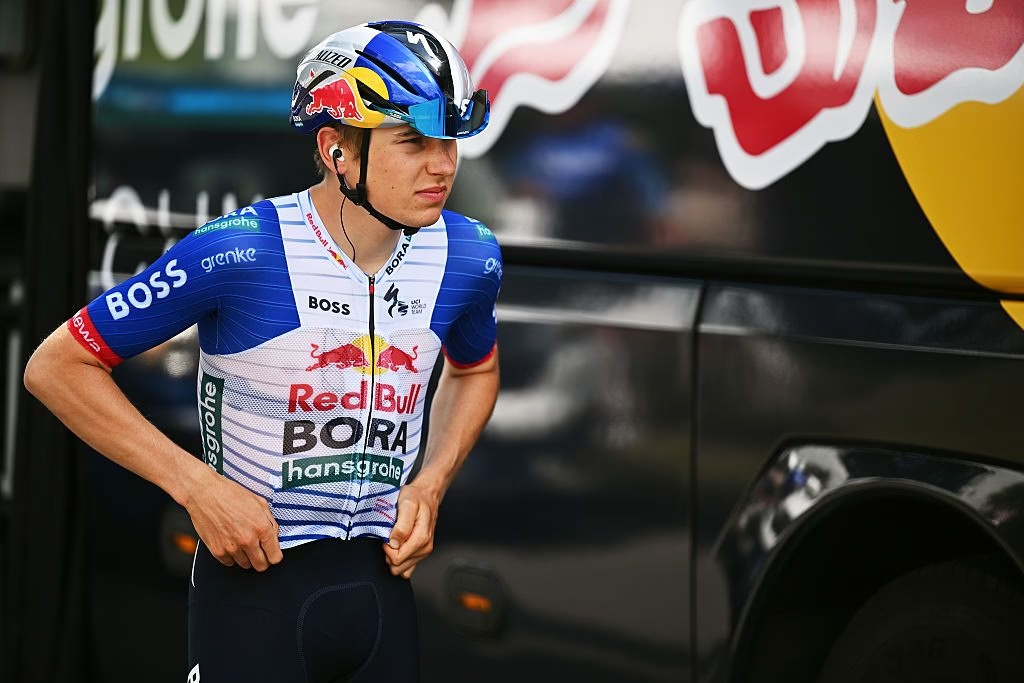
Men’s Amstel Gold Race 2026 gave the Ardennes week a clear reference point. Remco Evenepoel did not simply add another major one-day victory to his palmarès. He answered a specific question left hanging from 2025, beat Mattias Skjelmose in the rematch, and showed that his Red Bull-Bora-Hansgrohe environment already has the structure to support him in races that once felt slightly awkward for him.
That is the wider importance of the win. Evenepoel has always had the engine to win major Classics, but Amstel asks a slightly different question to Liège-Bastogne-Liège or the World Championships. It is not just about one long-range acceleration. It is about positioning, repeated short climbs, technical roads, changes of rhythm and the discipline to wait when the race invites impatience. In 2026, he got that balance right.
The decisive phase began when Evenepoel, Skjelmose, Romain Grégoire, Matteo Jorgenson and Kévin Vauquelin formed the key selection with around 42km remaining. Vauquelin’s crash on a damp corner brought down Jorgenson and changed the shape of the finale. Grégoire later lost contact on the Cauberg, leaving Evenepoel and Skjelmose to settle the race in a two-up finish. After losing out in last year’s three-rider sprint, Evenepoel made no mistake this time.
That makes this result more than a strong Sunday in Limburg. It changes the reading of Evenepoel’s spring, confirms Skjelmose’s place among the most reliable Ardennes riders in the peloton, and sharpens the tactical picture for the rest of the week. The right riders can still get into the winning move. Staying there, and then beating Evenepoel, is the harder part.
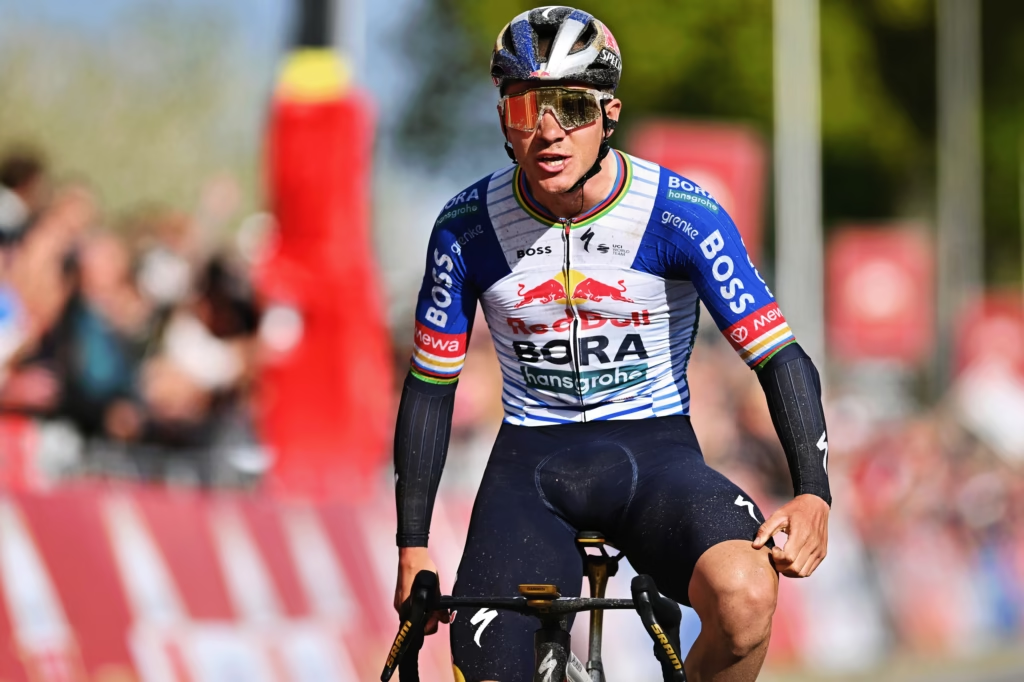 Photo Credit: Getty
Evenepoel looks more complete in the Ardennes than before
The main conclusion is that Evenepoel looks increasingly complete in this terrain. That does not mean he has suddenly become a conventional Ardennes puncheur. He is still at his most destructive when he can stretch a race with sustained power. But Amstel Gold Race 2026 showed a calmer version of his one-day racing, one less dependent on making the race explode from impossible distance.
That matters because Amstel is rarely won by brute force alone. The climbs are too short to reduce everything to pure climbing strength, the roads are too technical to allow easy control, and the finale often rewards riders who can judge hesitation better than riders who simply feel strongest. Evenepoel’s victory came from strength, clearly, but also from patience and discipline.
He did not have to prove that he could ride hard. That has never been in doubt. What he proved was that he could absorb the rhythm of Amstel, make the right selection, cooperate when needed, and still have enough left to win the sprint against the defending champion. That is a different type of authority.
For Red Bull-Bora-Hansgrohe, that is significant too. This was not just a rider winning despite the team. It was a rider benefiting from a structure that placed him well, helped manage the race, and gave him the platform to decide it. The move to Red Bull-Bora-Hansgrohe was always going to be judged partly on whether the team could sharpen his biggest targets rather than simply surround him with resources. Amstel was a positive answer.
The 2025 rematch gives the win extra weight
The finish mattered because of what happened twelve months earlier. In 2025, Skjelmose won Amstel Gold Race after a three-rider sprint against Tadej Pogačar and Evenepoel. That result stuck because it showed that Evenepoel could be in the perfect position late in the race and still lose if the final metres were not handled correctly.
This year felt like a deliberate correction. Once Skjelmose and Evenepoel were together again, the race naturally became a rematch. Skjelmose had the confidence of the defending champion and the memory of having finished the job before. Evenepoel had the stronger current form line and the visible determination not to repeat the same mistake.
That psychological layer matters in one-day racing. The strongest rider does not always win Amstel, and the finale can become awkward when two riders know each other’s strengths too well. Evenepoel handled that tension better this time. He did not overplay the sprint, did not let the finish become a repeat of 2025, and delivered the kind of closing acceleration that made the result feel decisive rather than fortunate.
For the rest of the season, that is useful evidence. Evenepoel is not just accumulating wins. He is correcting previous weaknesses. That makes him harder to read and harder to beat, because rivals can no longer rely on the same tactical assumptions that might have worked against him before.
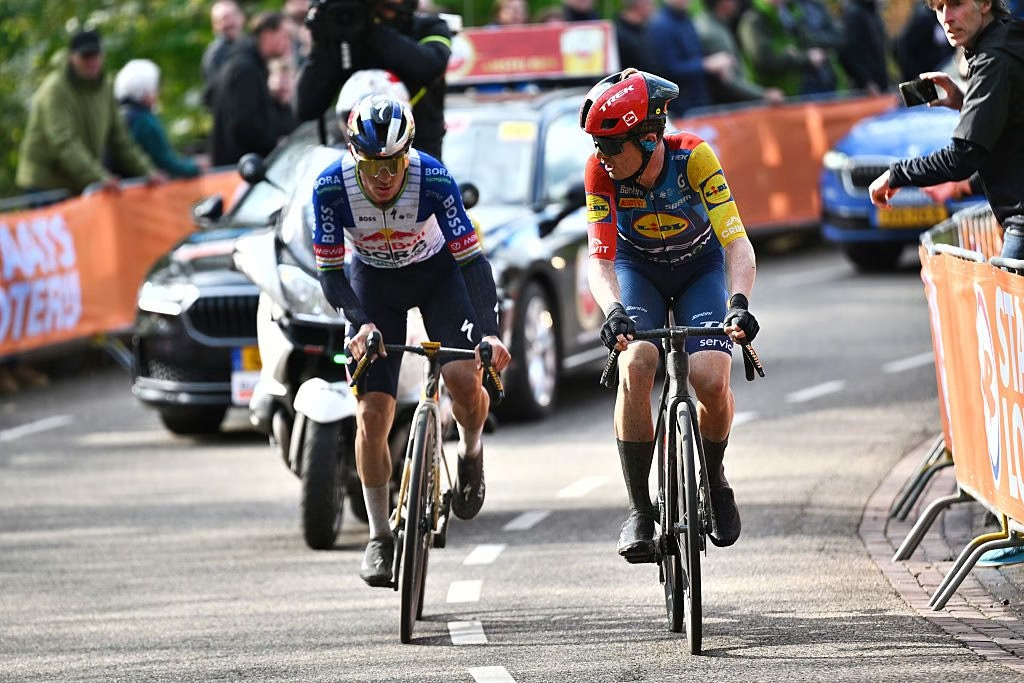
Skjelmose is now one of the safest Ardennes references
Skjelmose did not win, but his 2nd place may still say something important about the season. He has now won Amstel, finished 2nd in the rematch, and repeatedly shown that this type of racing suits him. He is no longer simply a dangerous rider on the right day. He is one of the most dependable references in the Ardennes.
That reliability matters for Lidl-Trek. The team has built a strong one-day identity across both the men’s and women’s squads, and Skjelmose gives them a clear option in races where the decisive selection comes from repeated accelerations rather than one long climb. He can survive the attrition, work in small groups, and still finish with enough punch to threaten victory.
The slight issue is that he was beaten clearly once the sprint opened. That does not undermine the performance, but it does define the next challenge. Skjelmose can get to the final. He can make the right move. He can force the best riders to carry him deep into the race. But when the opponent is Evenepoel at this level, being there is not enough.
For La Flèche Wallonne and Liège-Bastogne-Liège, that keeps Skjelmose firmly in the conversation. He may not have the single most explosive kick on the Mur de Huy, and he may not want a pure endurance war against Evenepoel in Liège. But he is now too consistent to be treated as a secondary contender. If a race becomes selective and tactical, he belongs in the first group of names.
Red Bull-Bora-Hansgrohe have a Classic-winning version of Evenepoel
The result also says a lot about Red Bull-Bora-Hansgrohe. Signing Evenepoel was always about more than stage races. He brings immediate authority to Monuments, week-long races, time trials and the biggest one-day events. But having a rider of that profile also creates pressure. A team has to prove it can improve the margins around him, not simply admire the engine.
At Amstel, the signs were good. The team kept him close enough to the action, helped him arrive at the decisive phase without unnecessary panic, and allowed him to use his strength at the right moment. That sounds simple, but it has not always been the case for Evenepoel in chaotic Classics. A rider with his power can sometimes appear to be solving problems alone. Here, the team helped prevent some of those problems from forming.
That could become one of the defining developments of 2026. If Red Bull-Bora-Hansgrohe can consistently deliver Evenepoel into the right zones of big one-day races, his range expands further. He does not have to attack from 60km out. He does not have to ride as if the only safe tactic is to remove everyone. He can race with more patience because the structure around him is stronger.
That makes him more dangerous for Liège-Bastogne-Liège in particular. Amstel is not Liège, but the message is transferable: Evenepoel can now win a complicated Ardennes Classic without turning it into a solo exhibition. That gives him more than one route to victory.
The crash changed the race, and the rest of the week
The crash involving Jorgenson and Vauquelin inevitably shaped the finale. Both riders had the quality to influence the winning move, and their removal from the front group narrowed the tactical picture. That is part of the story and should not be ignored.
Jorgenson’s presence would have given Team Visma | Lease a Bike a serious card in the final. He has become one of the most adaptable riders in the peloton, with the climbing strength, tactical calm and finishing resilience to make him dangerous in precisely this kind of scenario. His broken collarbone also removes him from the rest of the Ardennes week, which is a significant loss for both rider and team.
Vauquelin, meanwhile, had already marked himself out as one of the riders to watch across these races. His suitability for the Mur de Huy remains obvious, assuming there are no lingering effects from the crash. Amstel denied him a clean result, but it did not change the underlying point: on this terrain, he has the right mix of punch, climbing strength and confidence.
The crash does not make Evenepoel’s win feel diminished. It changed the race, but it did not create an easy path. He still had to deal with Skjelmose, distance Grégoire, commit to the move and finish the job. The broader lesson remains intact: when Evenepoel reaches the decisive phase with good position and controlled energy, very few riders can beat him.
Grégoire and Cosnefroy keep France in the Ardennes conversation
Romain Grégoire’s ride deserves attention because he was part of the decisive selection before being distanced late. That is still a strong marker. He did not have the final answer when Evenepoel and Skjelmose pressed on, but he was present when the race was being made. For a rider whose best performances often come from aggression and timing, that matters.
Grégoire looks increasingly like a rider who can shape these races rather than merely chase them. The next step is converting that presence into the final result. At Amstel, he was strong enough to make the move but not strong enough to stay with the two best riders. That is not a failure. It is a clear measurement point.
Benoît Cosnefroy’s 3rd place also keeps him highly relevant. He won the sprint from the chasing group, which is often a useful indicator in Amstel. It means he still had enough speed and composure after a race that had already been stretched by the favourites. Cosnefroy’s problem is rarely suitability. He is built for this terrain. The challenge is being on the right side of the decisive split.
For the rest of the Ardennes, both riders have a clear route forward. Grégoire needs to keep trusting his aggression, particularly in races where hesitation can open a window. Cosnefroy needs to stay close enough to the first move that his sprint still matters for victory rather than the final podium place.
The Ardennes hierarchy is clearer now
Amstel Gold Race rarely gives a perfect forecast for La Flèche Wallonne or Liège-Bastogne-Liège, but it does reveal condition, confidence and tactical relationships. In 2026, the hierarchy looks clearer than it did before the weekend. Evenepoel is the strongest reference. Skjelmose is the most reliable challenger. The next group is strong, but has work to do.
That does not mean the rest of the week is closed. La Flèche Wallonne is more specific, more compressed and more brutally tied to the final ascent of the Mur de Huy. A rider who cannot beat Evenepoel over the final kilometres of Amstel might still have the right climbing punch for Huy. Liège is broader again, with longer climbs, more distance and more room for endurance to take over.
Still, Amstel changes how rivals must race. If Evenepoel is allowed into a small group with one or two major contenders, he now has evidence that he can win that way. If teams wait too long, they risk giving him control. If they attack too early, they risk spending riders before the decisive climbs. That is the strategic problem he creates when he is in this kind of form.
For Red Bull-Bora-Hansgrohe, that is exactly the position they want. Their rivals now have to decide whether to race against Evenepoel’s engine, his improved patience, or his increasingly credible sprint from a reduced group. None of those options is comfortable.
What it means beyond the Ardennes
The result also reaches beyond one week of racing. Evenepoel’s season already had momentum, but Amstel adds a different kind of legitimacy. Winning stage races or time trials shows one version of dominance. Winning a messy, technical, heavily contested Classic shows another. It makes his 2026 campaign feel less like a collection of strong performances and more like a rider expanding the ways he can win.
That has implications for the summer. Evenepoel does not need to become a rider who wins every type of race in the same way. The more important development is flexibility. If he can win from a long solo, a reduced group, a sprint against a specialist puncheur, or a controlled team-supported finale, he becomes much harder to plan against.
For the broader peloton, Amstel also reinforced the growing importance of complete riders. The winning move was not made by pure climbers, pure sprinters or one-dimensional Classics specialists. It was made by riders who can climb repeatedly, handle technical positioning, commit to long efforts and still finish. That is where the top end of men’s one-day racing continues to move.
Skjelmose, Jorgenson, Vauquelin, Grégoire and Cosnefroy all fit parts of that trend. Evenepoel, at his best, sits above it because his engine gives him a larger tactical margin. But the direction is clear. The riders who shape the biggest races are those with more than one solution.
The season feels more dangerous for everyone else
The simplest reading of Men’s Amstel Gold Race 2026 is that Evenepoel got his revenge on Skjelmose and finally won the Dutch Classic. The more useful reading is that he has become a more complete problem for his rivals.
He did not need the race to be perfect. He did not need a solo procession. He did not need to avoid the tactical uncertainty that usually defines Amstel. He made the right move, handled the strongest direct rival, and won in a way that should travel well into the rest of the season.
Skjelmose leaves with confirmation rather than damage. He remains one of the best Ardennes riders in the peloton and will continue to be central whenever the race is selective but not fully controlled. Cosnefroy, Grégoire and Vauquelin all leave with reasons to believe they can still shape the week ahead, while Jorgenson’s injury removes one of the most important American storylines from the rest of the Ardennes.
But the main message is clear. Evenepoel is no longer just the rider who can destroy a race from distance. At Amstel Gold Race 2026, he showed he can also wait, measure, cooperate and finish. That makes the rest of the season feel more dangerous for everyone else.

