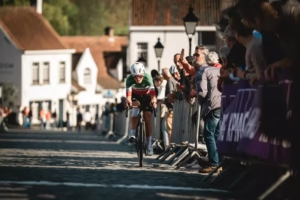
The 2026 season begins with women’s cycling operating under a markedly different set of constraints. Not because of a single reform, but because several regulatory, structural, and competitive changes take effect at the same time. Together, they reshape how Women’s WorldTour teams plan seasons, build rosters, and approach races on a week-by-week basis.
Most notably, 2026 opens a new three-year WorldTour licence cycle under stricter participation rules. Teams can no longer pick and choose which races suit them. Calendar coverage is now close to mandatory, penalties for absence are severe, and squad depth has become a decisive competitive factor rather than a luxury.
This is not a season defined by expansion or experimentation. It is defined by obligation. Teams must race more often, across more terrain, with fewer escape routes. Riders must contribute value more consistently. And decisions made early in the year will carry weight well beyond a single season.
Understanding what has changed in 2026 is essential to understanding how the Women’s WorldTour will be raced from here on. The differences may not always be visible in a single finish photo, but they are already shaping behaviour across the peloton.
 Photo Credit: Unipublic/Antonio Baixauli/Cxcling Creative Agency
Mandatory participation and the end of selective calendars
The most important change for 2026 is also the simplest to explain: Women’s WorldTour teams are now required to race almost the entire WorldTour calendar.
From this season onward, every Women’s WorldTeam must take part with a competitive squad in all Women’s WorldTour events, with only one permitted opt-out per season. That opt-out cannot be used on the same race in each year of the three-year WorldTour cycle. Participation in the Giro d’Italia Women, Tour de France Femmes and Vuelta España Femenina is mandatory for all teams, without exception. WWT teams rarely skip these major Grand Tours but there have been cases in previous seasons.
This marks a clear break from previous practice. In earlier seasons, teams could quietly skip races that did not suit their strengths, trim travel-heavy blocks, or prioritise specific parts of the calendar. That flexibility has now disappeared. In 2026, teams must build squads capable of racing sprint events, hilly classics, stage races, and late-season fixtures, whether they suit them or not.
The consequences are immediate. Calendar planning now starts from obligation rather than preference. Teams can no longer hide weaknesses by avoiding certain race types, and depth across the roster matters more than peak strength at the top.
The rules are also backed by meaningful enforcement. Unjustified absence brings heavy financial penalties, points deductions equivalent to a race winner’s haul, and escalating sanctions that can ultimately lead to licence suspension or revocation. These are not symbolic measures. They are designed to make non-participation more costly than poor performance.
There are implications beyond the teams themselves. Organisers now have guaranteed access to the full WorldTour peloton, improving start list quality and competitive consistency. If teams decline participation within the rules, organisers are required to replace them with Women’s ProTeams, widening exposure without diluting standards.
For viewers, the effect will be subtle but significant. Smaller races, transitional events, and late-season fixtures will no longer be populated by second-choice line-ups. The WorldTour becomes a genuinely unified series rather than a loose collection of priorities.
In 2026, presence is no longer optional. It is part of the licence.
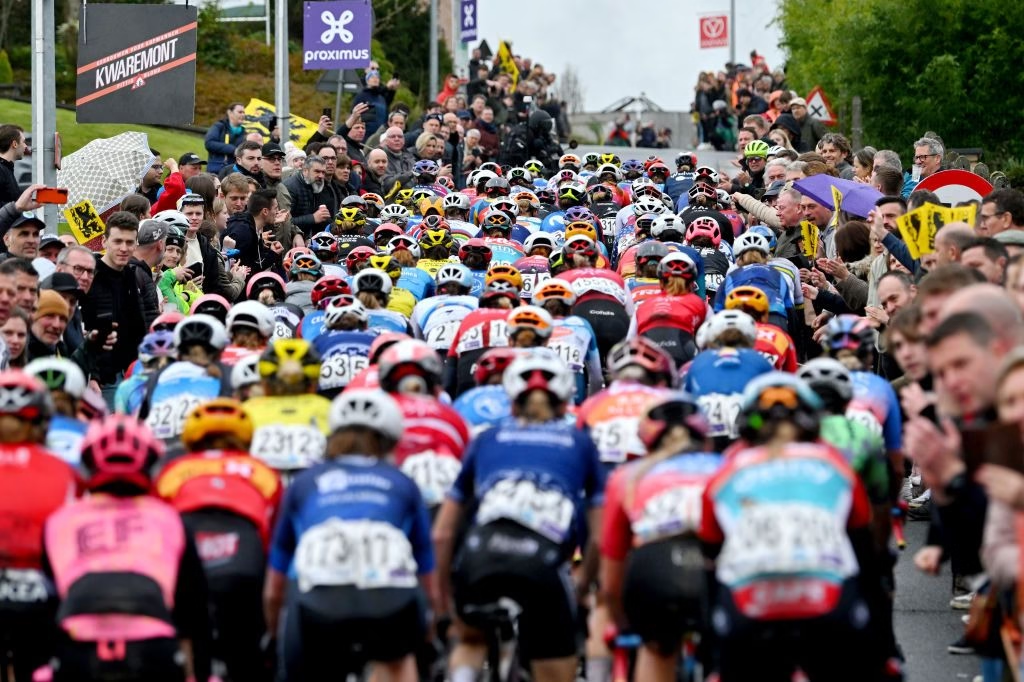
A new three-year licence cycle begins
The 2026 season also marks the start of a new three-year Women’s WorldTour licence cycle, and that timing matters more than it might initially appear.
While points accumulated this season will not immediately decide licence allocations, they establish the foundation for the entire cycle. Teams that start strongly in 2026 give themselves room to absorb setbacks in later seasons. Teams that fall behind early face two years of pressure, where every race becomes a recovery exercise rather than a strategic choice.
This reset changes incentives. In previous cycles, teams could afford uneven seasons, compensating for a weak year with a strong one later on. At the start of a new cycle, there is no buffer. Early underperformance lingers, shaping recruitment decisions, calendar priorities, and in-race behaviour long after the initial results are forgotten.
The effect is most visible in how teams value consistency. Regular top tens, steady general classification placings, and repeated contributions across different race types carry more strategic weight than isolated victories. A single win cannot offset months of low-level scoring when viewed across a three-year horizon.
In combination with mandatory calendar participation, this new licence cycle encourages a more defensive form of ambition. Teams still chase wins, but they do so within a framework that prioritises sustained relevance. Riders who can deliver reliable points across multiple terrains become central to long-term planning, particularly in the opening year of the cycle.
For 2026, the message is clear. It may not decide licences outright, but it decides who spends the next two seasons racing from security and who races under constant pressure.

Licence stability, and one notable exception
One of the defining characteristics of the Women’s WorldTour entering 2026 is licence stability. The vast majority of teams have been granted three-year WorldTour licences, providing a level of organisational security that was rare even a few seasons ago.
That stability allows teams to think beyond immediate survival. Recruitment can be planned across seasons, leadership structures can be developed gradually, and short-term setbacks can be absorbed without forcing reactive decisions. In a sport where uncertainty has historically shaped behaviour, this represents a significant shift.
There is, however, one notable exception. Team Picnic PostNL enters 2026 on a one-year licence, granted in the context of financial constraints. While the team remains part of the WorldTour, the shortened licence changes its operating reality.
A one-year licence removes margin. Every race matters, not just in terms of points but in demonstrating organisational credibility and competitive relevance. Long-term planning gives way to immediate validation. Decisions around race selection, rider deployment, and resource allocation are made under sharper pressure than for teams operating with multi-year security.
This distinction matters on the road. Teams with three-year licences can afford calculated risks, developmental race programmes, and selective peaks. Teams on one-year licences are more likely to prioritise visible consistency, defensive racing, and reliable finishes that protect their position in the rankings.
In a season where participation is compulsory and calendar demands are heavier than ever, the difference between security and vulnerability becomes magnified. Picnic PostNL’s situation is a reminder that while the Women’s WorldTour has stabilised, it has also raised the bar. Licence security is no longer assumed. It must be continuously earned.
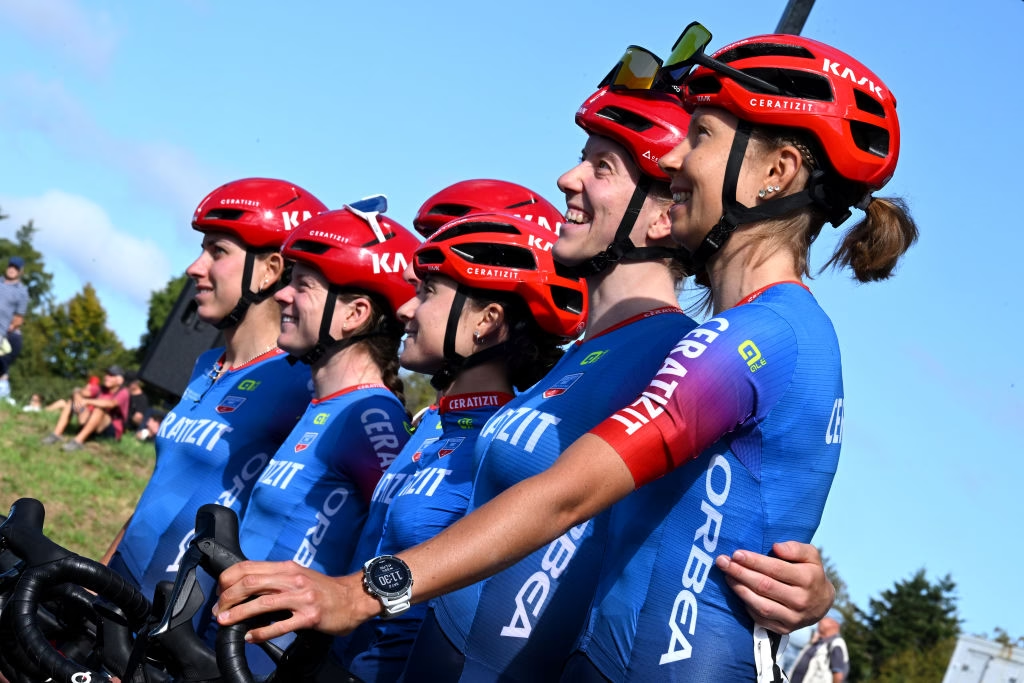
A reshaped peloton: teams exit, others consolidate
The Women’s WorldTour peloton looks materially different in 2026, not because of expansion, but because of contraction.
Ceratizit WNT has closed entirely, removing one of the longest-running programmes from the top tier. Roland Le Dévoluy, after four seasons at WorldTour level, steps back to Continental status. These changes are not isolated incidents. They reflect a sport that has raised its minimum operational standards and is now enforcing them.
Running a Women’s WorldTour team in 2026 requires more than competitive riders. Financial resilience, logistical capacity, and the ability to field credible squads across a near-mandatory calendar are now baseline requirements. Teams unable to meet those demands are increasingly squeezed out.
The impact on racing is immediate. Fewer WorldTour teams mean fewer predictable race roles and fewer soft points. Start lists become more competitive by default, and opportunities that once existed at the margins are harder to find. Transitional races and late-season events, in particular, are less forgiving when the overall depth of the peloton increases.
There is also a redistribution effect. Riders leaving teams that exit or step down do not disappear. They are absorbed elsewhere, often strengthening squads already operating at WorldTour level. Experience that once anchored mid-tier teams now reinforces depth across the remaining peloton.
In combination with mandatory participation rules, this consolidation accelerates a broader shift. The Women’s WorldTour is becoming less tolerant of fragility. Teams are expected not just to exist at the top level, but to sustain performance across the entire calendar.
For 2026, the message is unambiguous. The WorldTour is smaller, harder, and less forgiving than it was even two seasons ago.

Rule changes prompted by real-world failure
Not all of the changes entering force in 2026 are strategic. Some are corrective.
Following the chaotic start to the team time trial at La Vuelta Femenina, the UCI has amended its start and bike check procedures. The revised rule requires riders to complete the final mandatory equipment check no later than 10 minutes before their scheduled start time, after which they must remain within a controlled area until the race begins.
The intention is straightforward. The previous system created ambiguity around timing, access, and enforcement, which contributed directly to confusion at one of the season’s most visible events. The updated rule removes that ambiguity by tightening control and standardising procedure.
While this may appear minor, its significance lies in what it represents. As the Women’s WorldTour becomes more commercially valuable and structurally demanding, operational failures carry greater consequences. Teams are no longer judged solely on performance, but on their ability to meet procedural expectations under pressure.
For riders, this means fewer grey areas and less tolerance for improvisation. For teams, it reinforces the need for precise logistical planning and clear internal communication. In a calendar where participation is compulsory and margins are tighter, avoiding preventable errors is now part of competitive competence.
The lesson is clear. As the sport professionalises, small administrative details increasingly matter, because the environment they operate in no longer allows room for disorder.
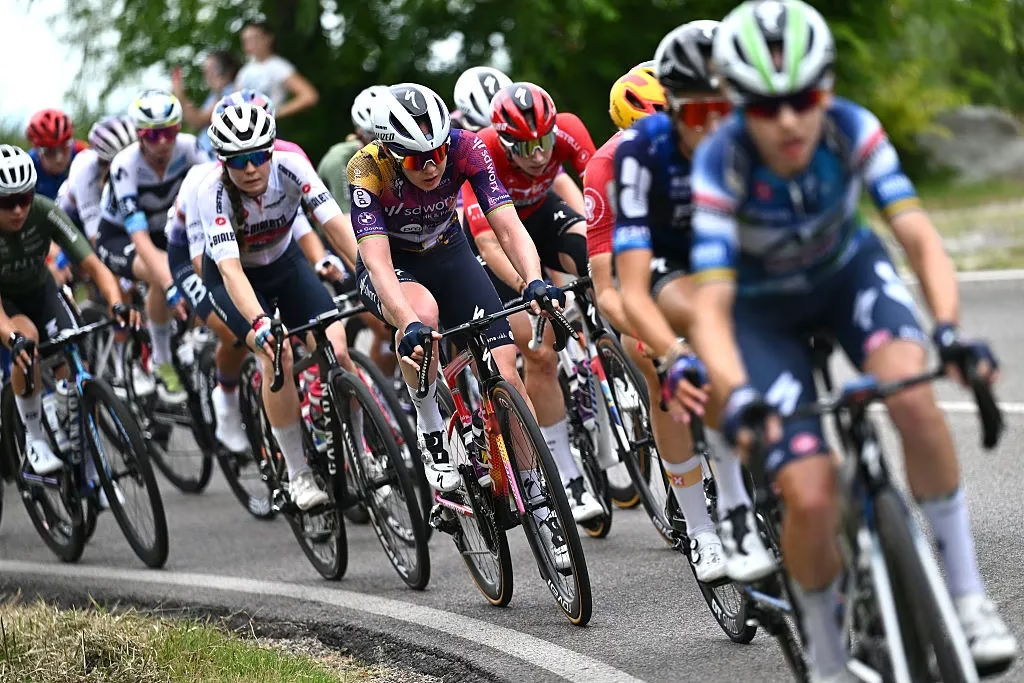
Points now reward deeper squads
Another significant change entering force in 2026 concerns how team points are counted over the three-year WorldTour licence cycle.
Previously, only the top eight riders per team contributed points to the cumulative Women’s WorldTour ranking. From 2026, that number increases to ten. On paper, this is a small adjustment. In practice, it alters how teams value depth, reliability, and internal contribution.
Under the previous system, teams could concentrate resources around a narrow group of high scorers, with riders outside the top eight effectively operating as support without measurable licence impact. That approach is now less efficient. Points scored by a team’s ninth and tenth-ranked riders actively contribute to licence security.
This change rewards teams that distribute responsibility across the roster. Riders who consistently finish races, place in the top 20, or contribute minor results across different race types now carry tangible value. It also reduces the risk of over-reliance on a single leader or small core group, particularly in a season where calendar participation is close to mandatory.
The timing matters. At the start of a new three-year licence cycle, early points accumulation sets the tone for the period that follows. Teams entering 2026 with greater functional depth are better placed to absorb injury, illness, or underperformance without falling behind in the rankings.
For riders, the implication is equally clear. Roles deeper in the roster now matter. Consistency is no longer invisible, and contribution is no longer limited to those fighting for podiums. In 2026, depth is no longer just a tactical advantage. It is a structural one.
A transfer market shaped by structure, not speculation
The 2026 transfer market reflects the structural changes now embedded in the Women’s WorldTour. This is not a market driven by opportunism or headline signings. It is shaped by obligation, depth, and readiness.
Across the peloton, teams have prioritised riders who can contribute immediately across full calendars rather than specialists suited to narrow race blocks. Mandatory participation rules and deeper points counting have reduced the appeal of high-risk recruitment. Teams need riders who can race often, finish reliably, and adapt to different terrain.
Several clear patterns emerge. Promotions from development teams are widespread. Riders such as Mackenzie Coupland, Noä Jansen, Matilde Vitillo, and Federica Venturelli step into WorldTour roles with the advantage of familiarity and low integration risk. These are not speculative signings. They are controlled progressions designed to strengthen depth without destabilising existing structures.
There is also a notable redistribution of experience following the exit or restructuring of WorldTour teams. Riders moving from Ceratizit WNT and Roland Le Dévoluy have been absorbed into established squads, immediately reinforcing mid-roster strength rather than altering leadership hierarchies. That redistribution contributes to the overall tightening of competition across the peloton.
Teams like EF Education-Oatly, Human Powered Health, Liv AlUla Jayco, and UAE Team ADQ have clearly recruited with calendar coverage in mind. The focus is on riders capable of contributing across multiple race types rather than being tied to a single objective. This approach aligns directly with the expanded points contribution rules and the demands of compulsory participation.
What stands out most in 2026 is the absence of speculative churn. Transfers are deliberate, functional, and aligned with regulatory reality. The Women’s WorldTour market has matured into one where recruitment reflects system demands rather than short-term opportunity.