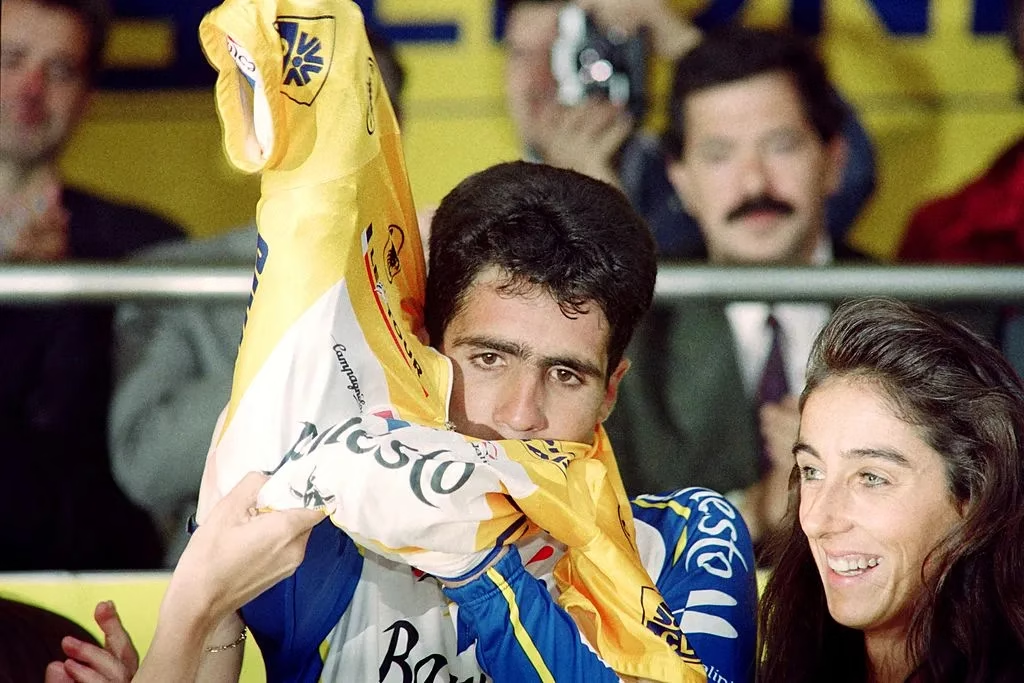
Miguel Indurain remains one of the most important figures in cycling history. He did not build his legend through noise, confrontation or showmanship. Instead, he did it through control, consistency and a level of stage race domination that still feels extraordinary today. For many fans, the Miguel Indurain career is summed up by one remarkable number: five straight Tour de France wins from 1991 to 1995. No rider before or since has matched that feat.
Yet reducing Indurain to those yellow jerseys alone would miss the wider scale of his achievements. He won the Giro d’Italia twice, claimed Olympic gold, became world time trial champion and set the Hour Record. He was not just a Tour specialist. He was one of the great Grand Tour riders and one of the defining time triallists of any era.
For Spain, Indurain became a sporting landmark in the 1990s. Even so, he never seemed especially interested in celebrity. He remained a quiet, grounded figure from Navarre, loyal to his roots and far more comfortable with results than attention.
Who is Miguel Indurain?
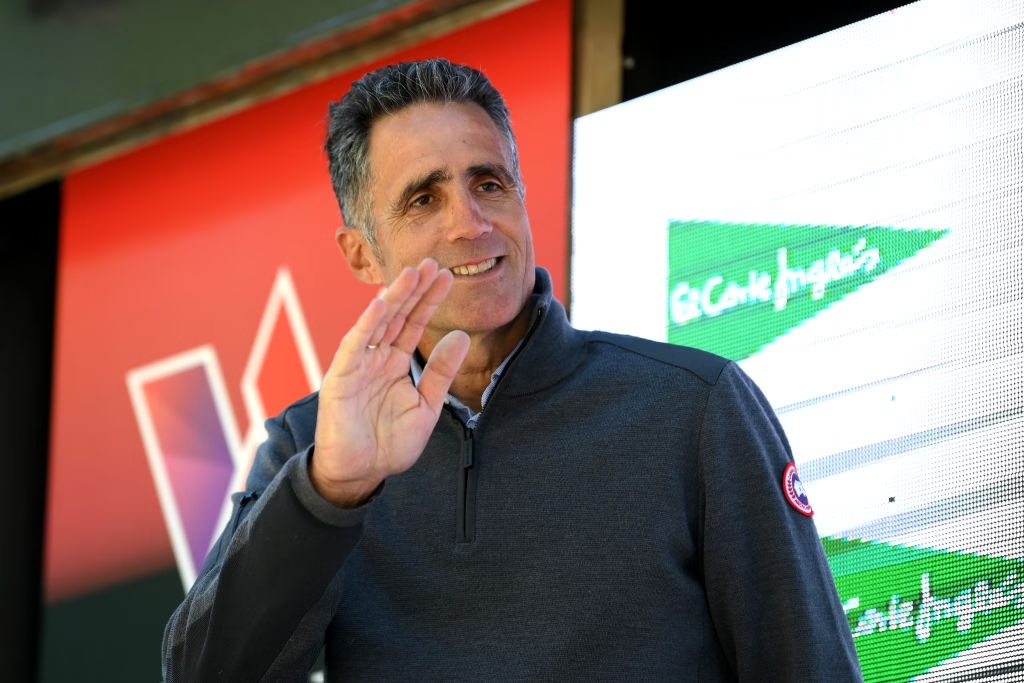
Miguel Indurain is widely regarded as one of Spain’s greatest ever cyclists and one of the finest stage racers the sport has produced. Born in Villava, in Navarre, he developed into a rider whose greatest strengths were patience, discipline and huge power against the clock.
What made him stand out was not flamboyance. Indurain was shy, modest and almost unusually composed for a rider carrying so much expectation. In a sport that often celebrates emotion and aggression, he became iconic through calm. He could absorb pressure, measure effort and take control of races without wasting energy.
That made him devastating over three weeks. Miguel Indurain won the Tour de France five years in succession from 1991 to 1995, and added Giro d’Italia victories in 1992 and 1993. Those back-to-back Giro-Tour doubles remain one of the most impressive achievements in stage racing history, and his place among the great Tour de France past winners has long been secure.
Miguel Indurain’s early career and rise
Indurain’s route to the top was not immediate. He started cycling as a youngster in Navarre, famously drawn in part by the free sandwiches and soft drinks on offer after races at his first club, CC Villavés. It is a modest beginning for a rider who would go on to dominate the biggest races in the sport.
The raw talent showed itself early. In 1985, he became the youngest ever leader of the Vuelta a España, a record that stood until 2023. Even so, his development into a true Grand Tour contender took time. He had to lose weight, refine his racing and work out exactly how to turn potential into sustained success.
Banesto were cautious in handling him. For a while, he raced in support of Pedro Delgado, and there is a strong argument that the team were too conservative in the 1990 Tour de France when it became clear that Indurain was on the rise and Delgado was beginning to fade. By the following year, though, the leadership question had effectively answered itself.
Miguel Indurain Tour de France wins and how he built them
The foundation of Miguel Indurain’s Tour de France wins was his time trialling. He did not simply take seconds from his rivals. He often built advantages large enough to shape the rest of the race. Once he had that lead, he was exceptionally difficult to dislodge.
That can make his reign look straightforward in hindsight, but it was anything but. Indurain understood pacing, restraint and race psychology at a very high level. He rarely panicked, rarely chased unnecessary moves and almost never looked rushed. It was often said that he only lost his temper at the Tour de France three times in his whole career, which tells you a lot about the emotional control he brought to racing.
His climbing was also better than his reputation sometimes suggests. Because his time trials were so overwhelming, it was easy to think of him as merely a rider defending gains in the mountains. The reality was more complete. At Val Louron in 1991, Luz Ardiden in 1994 and La Plagne in 1995, he produced mountain performances that mattered deeply to his final victories in Paris.
Indurain was tactically sharp as well. He knew how to manage alliances in a Grand Tour, when to allow a break, some freedom and when to rely on the wider dynamics of the race. He could be generous when it suited him, giving smaller teams opportunities, and that often paid him back when a genuine threat emerged later in the race. His era also sits in an interesting place in the sport’s wider development, especially when you look at how the Tour de France has changed over time.

Luxemburg 1992 and one of cycling’s great time trials
If one performance captures Indurain at his most crushing, it is the 65-kilometre time trial in Luxembourg at the 1992 Tour de France.
This was not just a strong ride, but one of the most emphatic time trial performances in Tour history. Indurain put three minutes into his own team-mate Armand de las Cuevas. Gianni Bugno, one of the major riders of the era, lost almost four minutes. In a single afternoon, Indurain bent the race to his will.
The 1992 Tour was not officially over at that point, but in practical terms, it came very close. Claudio Chiappucci later launched a spectacular long-range attack to Sestriere, yet even that was not enough to seriously endanger Indurain’s hold on yellow. The damage had already been done.
That ride also helped define how people saw him. His time trialling seemed to embody control, efficiency and technical superiority. Before cycling fully embraced the language of aerodynamics and marginal gains, Indurain already looked like a rider from a different era.
Giro d’Italia success and the double-double
A full account of the career of Miguel Indurain has to give proper weight to his Giro d’Italia wins. He took the title in 1992 and 1993, and in doing so became the only rider in history to complete the Giro-Tour double in back-to-back seasons.
That achievement matters because it goes beyond simple dominance. Winning one Grand Tour is difficult enough. Winning two in the same year demands recovery, resilience and a team able to sustain form across months. Doing it twice in a row places Indurain in especially rare company.
It also confirms that his greatness was not confined to the Tour de France. The Tour was the defining stage of his career, but the Giro proved that his control and consistency travelled well beyond one race. His standing there is reflected in the race’s official Hall of Fame, where his back-to-back wins remain a central part of his legacy.

Why the Vuelta a España never suited him
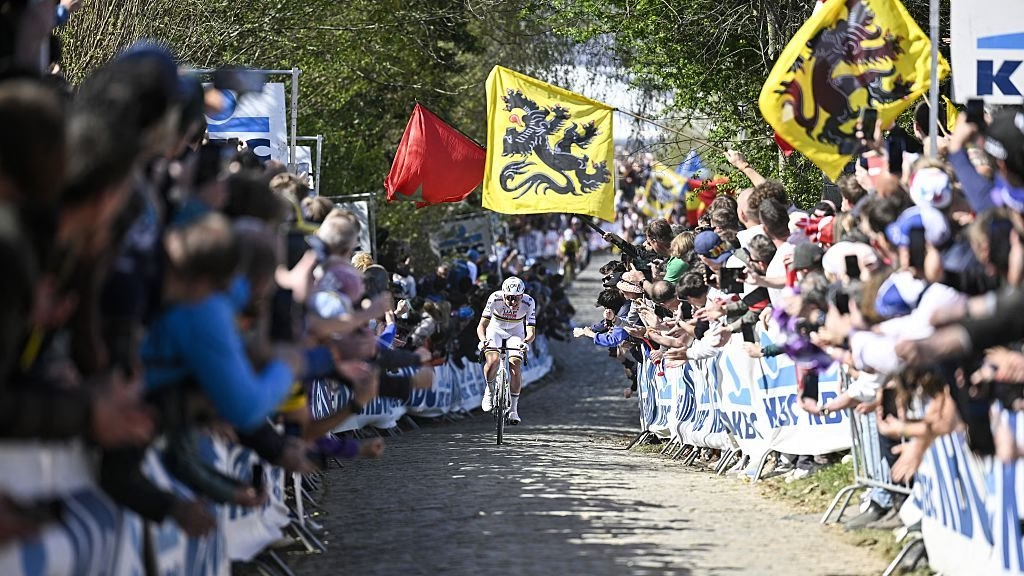
One of the more striking elements of Indurain’s palmarès is how relatively little he achieved at the Vuelta a España compared with the Tour and Giro. He finished second in 1991, but that was his only podium in his home Grand Tour.
There were a few reasons for that. Banesto’s priorities were heavily centred on the Tour de France, and the Vuelta’s old place in the spring calendar did not help either. Indurain often said he functioned on solar power, and there was clearly some truth in it. Cold conditions did not suit him, and the Vuelta in its old April slot could leave him exposed in a way the summer Tour often did not.
By the time the Vuelta moved to September, the moment had largely passed. In 1996, with his team insisting he ride the race, he never looked comfortable and eventually abandoned. For Spanish fans, it remained one of the few major gaps in an otherwise immense career. That contrast is part of what makes the race’s mountain mythology so interesting too, especially in places such as Lagos de Covadonga, where the Vuelta has built so much of its identity.
Olympic gold, the world title and the Hour Record
Indurain’s reputation was not built only through Grand Tours. His ability against the clock translated into major one-day and standalone honours too.
He set the Hour Record in 1994, won the World Time Trial Championships in 1995 and then took Olympic gold in the time trial at the 1996 Atlanta Games. That Olympic victory was particularly significant because it became the last win of his professional career, and one of the most important.
Those results gave extra depth to the Miguel Indurain legacy. They showed that his time trialling was not simply a useful tool in stage races, but one of the defining athletic strengths of the era. Even now, his official Olympics.com profile captures the same broad outline that cycling fans have long understood – that most of his major stage race success was built on his extraordinary power against the clock.
The collapse of the sixth Tour bid
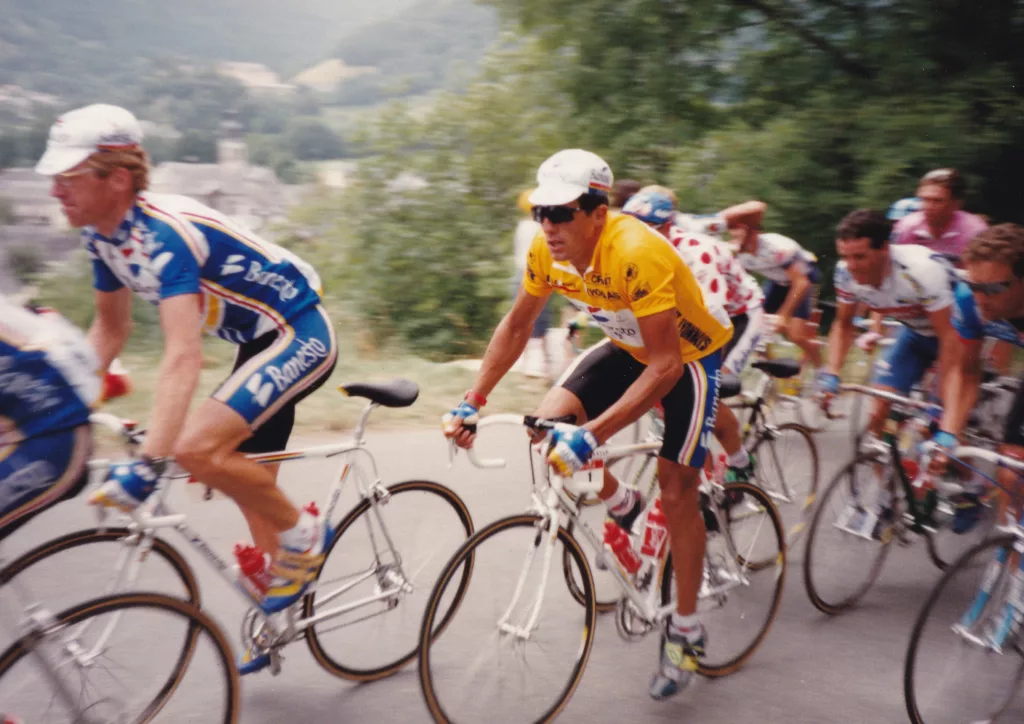
After five straight Tours, the obvious next question was whether Indurain could become the first rider to win six in succession. For a while, that looked realistic. Then came the 1996 Tour de France.
A cold, wet and unsettled first week left him more vulnerable than usual. In the Alps, Bjarne Riis attacked hard and repeatedly, and Indurain could not respond in the way he once had. At Les Arcs, the race tilted decisively away from him. This was not a brief bad day. It was the moment his era at the top ended.
The symbolism only deepened in the Pyrenees. At Luz Ardiden, where he had been so strong two years earlier, the possibility of another overall win finally slipped away. Then Jan Ullrich beat him in the final time trial at Saint-Émilion, another sign that the sport had already begun to move on.
Five months later, on January 2 1997, Indurain announced his retirement from professional racing at the age of 32.
Why Miguel Indurain mattered beyond results
Indurain’s importance reached beyond the bike. In Spain, he became a major public figure during the 1990s, a period when the country was presenting itself with increasing confidence on the world stage. His precision, consistency and technical strength came to symbolise, for many, a more modern Spain.
That connection felt especially strong in 1992, when his greatest Tour triumph came in the same year as the Barcelona Olympics and the Seville Expo. Indurain became part of a broader national story, whether he wanted that role or not.
The paradox is that he never seemed entirely comfortable with such symbolism. He stayed close to Navarre, remained loyal to Villava and never tried to turn himself into a glossy public personality. That tension between enormous public significance and private modesty is part of what still makes him such a compelling figure.

Miguel Indurain legacy in cycling
Miguel Indurain’s legacy rests on both what he won and how he won it. He did not dominate through constant aggression or theatrical racing. He dominated through discipline, strength and an ability to make chaos look manageable.
His record still commands respect:
- Five consecutive Tour de France wins
- Two Giro d’Italia victories
- Olympic time trial gold
- World time trial title
- Hour Record
But numbers only tell part of the story. At his peak, Indurain created a sense of inevitability. Rivals knew where he was strongest and still struggled to do anything about it. He could take control of a Tour with one monumental time trial, then defend that control with intelligence and calm through the mountains.
That is why he remains one of the sport’s enduring reference points. Not simply because of the titles, but because of how completely he understood the demands of winning stage races.
Why Miguel Indurain still matters today
Modern cycling is different in many ways, yet Indurain still feels relevant. His five straight Tour wins remain unmatched. His riding style also speaks directly to qualities the sport still values now: pacing, aerodynamics, recovery, precision and emotional control under pressure.
He remains central to Spanish cycling history too. Later champions added new chapters, but they did not replace his place within the story. Miguel Indurain still stands as the benchmark for one particular kind of Grand Tour greatness, calm, methodical and almost machine-like when it mattered most. His name still appears prominently in lists of cycling records that may never be broken, which feels entirely fitting given how long his Tour sequence has stood untouched.
For newer fans asking who Miguel Indurain is, the answer is simple. He was one of the most dominant stage racers the sport has ever seen, and one of the calmest champions it has known. For older fans, he remains the rider who made control look unbeatable.