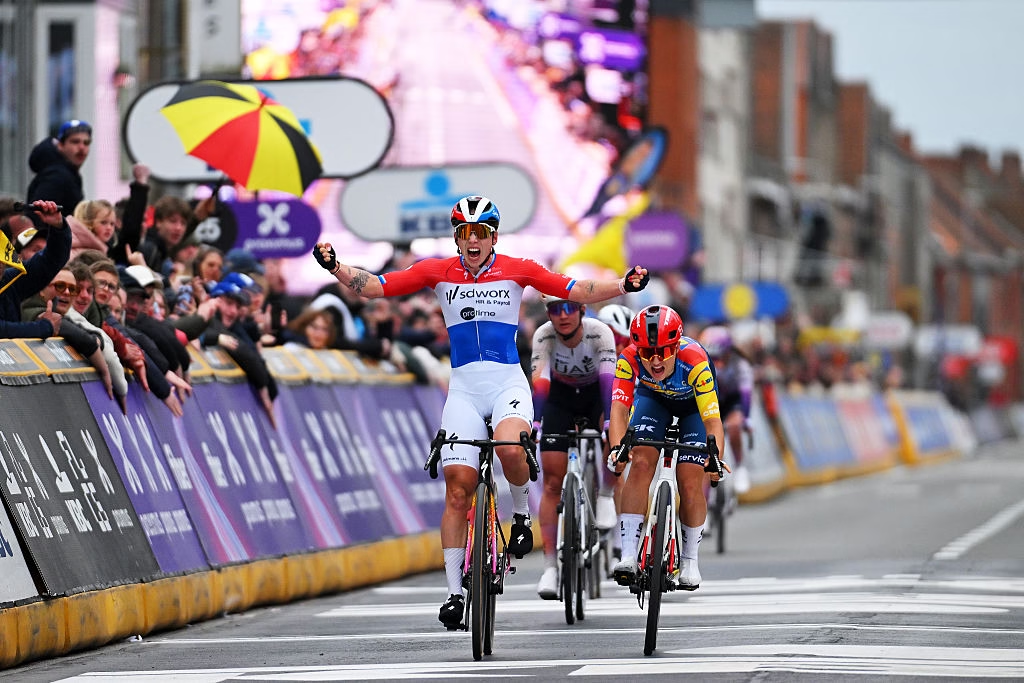
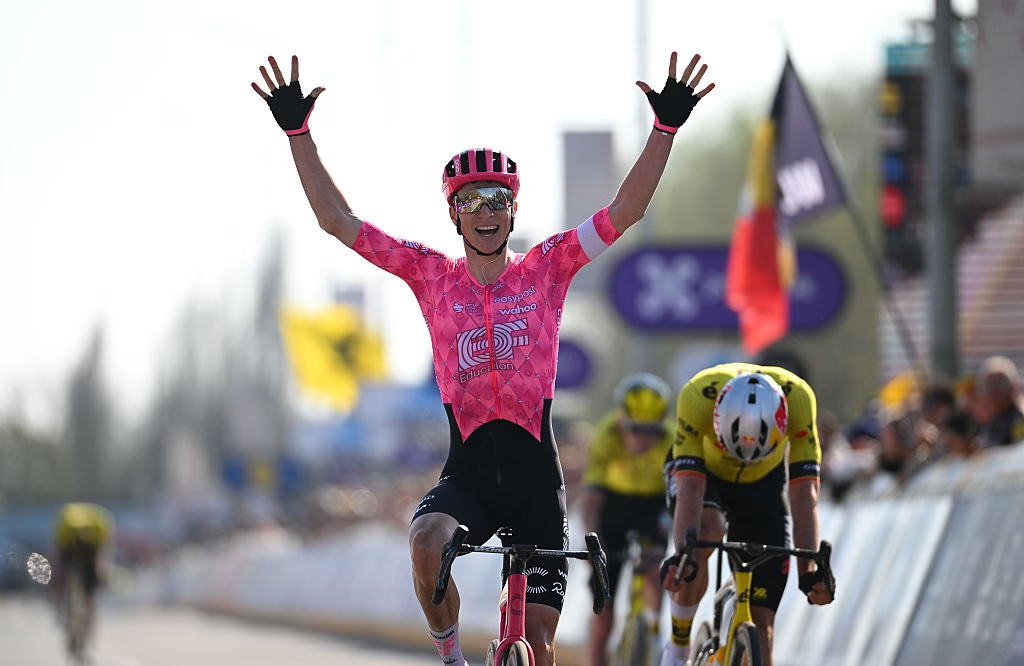
Lorena Wiebes of SD Worx-Protime won In Flanders Fields Women 2026 on Sunday, taking a record third consecutive victory in the race after surviving a tense tactical finish from a five-rider lead group in Wevelgem. The Dutch champion was pushed all the way by Fleur Moors of Lidl-Trek, with Karlijn Swinkels of UAE Team ADQ finishing third, after a selective Kemmelberg split finally proved decisive on a day when the breakaway nearly forced the favourites into a more complicated chase than expected.
The early escape asks a serious question
The first phase of the race was more awkward for the peloton than many of the major teams would have wanted. After a lively opening, a four-rider break finally established itself through Idoia Eraso, Lea Lin Teutenberg, Yona van Dam and Heidi Antikainen. On paper it looked manageable enough, with Eraso and Teutenberg coming from ProTeams and the other two riders from Continental level squads, but the quartet quickly earned far more freedom than most breakaways get in a 135.2km Women’s WorldTour race.
Their lead grew beyond a minute almost immediately, then pushed out towards five minutes as the bunch hesitated behind. That was the most striking detail of the early race. Despite the route being shorter than many spring one-day races, and despite the obvious danger of letting a committed move gain too much rope before the Plugstreets and climbs, the peloton never truly settled on an urgent response.
That made the break more than just a television move. Eraso, Teutenberg, Van Dam and Antikainen were riding strongly and with conviction, and for a while they exposed exactly the kind of collective uncertainty that can make this race unpredictable. Picnic PostNL were one of the first bigger teams to raise the pressure in the bunch, clearly aware that the move had gone too far from harmless to mildly inconvenient.
The Plugstreets bring the race to life
The race changed shape sharply on the approach to the Plugstreets. A large chasing move formed behind the break, with Lara Gillespie, Febe Jooris, Marta Lach, Josie Nelson, Lauretta Hanson, Georgia Baker, Noa Jansen and Sterre Vervloet all part of it. That changed the mood immediately. The peloton did not want such a sizeable and dangerous group to be allowed clear, and the response from behind slashed the leaders’ advantage.
By the time the race hit Hill 63, the four escapees had already seen their gap tumble. The break still led, but now under pressure, while behind them the bunch was stretched, riders were reacting to earlier crashes, and the race had moved out of its passive first phase and into something far more nervous and selective.
Wiebes, Elisa Balsamo and Franziska Koch were among the riders helping to drag the peloton across to the chase, which was a telling sign in itself. Rather than waiting for team-mates to do all the stabilising work, some of the biggest names in the race were already being forced into the action before the climbs had even begun.
Yet once the Plugstreets were done, the pace eased again for a while. That gave the original break a little breathing room and created a brief lull before the hilly phase. It also meant the race arrived at the Monteberg and Kemmelberg with the break still just ahead and the bunch still relatively broad in number, even if attrition had already started to thin the field.
-
 Photo Credit: Getty
The climbs strip the race down
The Monteberg did what it was supposed to do. It did not decide the race on its own, but it softened the front and exposed the break. Teutenberg and Eraso were the strongest of the original quartet at that point, while Célia Gery launched an attack from the peloton in an attempt to bridge forwards before the first ascent of the Kemmelberg.
That effort did not stick, but the race was now clearly cracking. On the Belvedere side of the Kemmelberg, the break was finally reeled in and the bunch was reduced to around ten riders on the descent. It was a classic moment in this race, the decisive terrain doing damage, but not yet enough to settle everything.
What followed was a short regrouping, then another period of tension as the remaining climbs approached. Georgia Baker and Laura Molenaar both tried to anticipate the final selection, but their move never gained enough traction to become the winning one. Instead, the decisive blow came on the Baneberg and final ascent of the Kemmelberg, where UAE Team ADQ drove the pace hard enough to split the race once more.
That move left around 14 riders at the front before the final climb. Then Wiebes did the most important thing of the day. On the hardest ascent of the Kemmelberg, she did not merely survive, she led. Over the top only five riders remained together – Wiebes, Moors, Swinkels, Eleonora Gasparrini and Elise Chabbey.
That was the winning move.
Five riders, one long run-in, and a difficult tactical balance
Once the leading five were clear, the race took on an intriguing shape. The obvious favourite was Wiebes. She was the fastest finisher in the group by some distance, and everyone there knew it. Yet that also created opportunities for the others.
UAE Team ADQ had two riders in the front through Swinkels and Gasparrini. Moors had the speed to make things uncomfortable in a reduced sprint. Chabbey could gamble on a long move. Wiebes, meanwhile, had the strongest reason to keep the group committed, because a head-to-head sprint from that quintet was exactly the outcome she wanted.
For a while, the group held together well and even extended its margin over the chasers. The bunch behind was not fully committed, perhaps because so many of the top teams were already represented at the front. That hesitation mattered. At 23km to go the gap was already 40 seconds, and although the chasers were gradually reabsorbed behind, the five leaders still had enough road in hand to believe the race would stay away.
The real tension came late. With 7km to go the gap remained over 40 seconds, but the body language in the front group began to change. Swinkels looked to be tiring, which slightly weakened UAE Team ADQ’s tactical hand. Behind them, Movistar and later Fenix-Premier Tech began to contribute more in the bunch, and the lead started to come down. It dropped from the low 40s to 37 seconds with 5km to go, enough to make the front group nervous, but not enough to fully bring the race back.
-
Photo Credit: Getty
Wiebes is forced to answer every move and still wins
From there, the finish became a tactical contest. Gasparrini attacked first, and that was the smart play. Wiebes had no choice but to respond. If she let the Italian go, she risked handing the race away. Gasparrini was caught, but the move showed where the pressure points lay.
Then came another attack from Gasparrini, again forcing Wiebes to react. Chabbey and Swinkels looked like they might try to take advantage of that repeated pressure, but neither launched the killer move in the moment when Wiebes was most exposed. That hesitation mattered.
Inside the final kilometre, the group was still clear by more than half a minute, and the bunch was no longer relevant to the win. The race was now a pure five-rider tactical finish. Gasparrini had made Wiebes work, but had not managed to detach her. Moors still had enough left to threaten in the sprint. Swinkels and Chabbey were there, but no longer looked best placed.
Wiebes was forced to the front under the flamme rouge, exactly where she did not want to be. That is usually the place where the others try to make her commit too early. In most races, that would be the opening they need. Here, it nearly was.
She launched a very long sprint and even appeared to celebrate slightly early, which briefly made the finish look tighter than she might have liked. But she had judged it just well enough. Moors came close, very close, yet Wiebes still reached the line first, winning by roughly a wheel. Swinkels finished third, with the bunch only 17 seconds behind by the finish.
It was not her simplest win in this race, and perhaps not her strongest in purely physical terms. But it may have been one of her smartest. She survived the climbs, read the attacks, covered the right moves, and then won from a tactically awkward position in the final kilometre.
In Flanders Fields Women 2026 Result
Results powered by FirstCycling.com
Main photo credit: Getty