Stage 3 was built to force a decision, and it did, but not in the neat, predictable way the profiles suggest. The 126.5km finale from Norwood to Campbelltown delivered a long fuse, a major mid-stage escape, and then a brutal, repeated examination on Corkscrew Road that flipped the general classification on its head.
After two days dominated by Ally Wollaston’s sprint strength, the final morning began with the leader carrying a 14-second advantage over Josie Nelson, with Noemi Rüegg 17 seconds back. With so many riders clustered within a handful of seconds, it was always going to be less about defending and more about who could withstand the first real climbing test of the week: two ascents of Corkscrew Road, and two technical five-kilometre descents that invited mistakes and rewarded nerve.
A nervous opening, then a break that changes the tone
The early kilometres were twitchy, with riders already thinking about where they needed to be before the first key moments. The first significant fight came on the day’s opening categorised climb, where Paula Blasi continued to ride aggressively for the mountains classification and took more points at the summit. Almost immediately, the race began to fracture with accelerations and counter-moves, as teams tried to plant riders up the road or force rivals into using domestiques too early.
That pressure eventually produced the day’s decisive long-range move: Carina Schrempf pressed on and established a gap, and Mikayla Harvey made the bridge. Once together, the pair committed fully, swapping turns smoothly and riding with the kind of clarity that makes a break dangerous even when it is not a direct threat to the overall standings.
The peloton, meanwhile, hesitated. For a time, nobody wanted to be the first team to take responsibility for a chase that would only set up others later on Corkscrew. The gap swelled dramatically, past four minutes, then beyond five, until the logic of the stage finally caught up with the bunch. With Corkscrew looming, and the race likely to be won and lost there, the chase started to organise with riders from multiple teams contributing rather than a single squad burning itself out.
Even as the break enjoyed its moment, the bunch was still racing. Intermediate sprints mattered, and Wollaston hunted for small time gains to protect her lead. It was a sign of just how tight the race remained: seconds were still being fought over before the decisive climbs had even begun.
The first ascent of Corkscrew blows the race apart
All the calm calculation of the mid-stage chase disappeared on the run-in to Corkscrew. Teams flooded the front in a classic squeeze for position. The break was still dangling ahead, but the real story was already forming behind: this was where riders would either cling on or be ejected from general classification contention.
When the gradient bit, the leader cracked. Wollaston could not hold the pace once the climbing began in earnest, and she was quickly dropped as the stronger climbers and punchy attackers pushed on.
Up front, the break was finally absorbed, but the catch did not reset the race, it detonated it. UAE drove the climb hard, with Mavi Garcia and Dominika Wlodarczyk among the key engines. Sarah Van Dam was prominent too, and the first selection formed across the steep ramps.
For Rüegg, it was a moment of genuine jeopardy. She struggled on the first ascent and required support from Magdeleine Vallieres, who dropped back to shepherd her through the damage. That help proved essential, not only physically but psychologically, because Rüegg’s defence of the title looked close to unravelling before the stage had even reached its second and decisive pass of the climb.
Over the top, the descent kept the race on edge. Gaps stretched and snapped, and the speed and technical difficulty encouraged bold riding. Vallieres drove the chase hard, and the groups behind tried to re-form with enough riders to keep the stage and the overall within reach.
Attacks, counter-attacks, and a finale built on pressure
The race then entered its most tactical and chaotic phase. Wlodarczyk struck out, forcing decisions behind. The dynamics were messy: riders were trying to work out whether to chase, sit on, or wait for the second Corkscrew ascent to settle everything. UAE’s strength offered them options, and they used them. They attacked repeatedly, seeking to isolate Rüegg and force her to respond with no teammates left.
By the time the road rose again for Corkscrew, it felt like a final exam rather than a second climb. Wlodarczyk was still pressing on, and crucially she was climbing without bottles, a small detail that underlined both the intensity of the phase and the thin margins riders were operating within.
On the climb, Rüegg finally found her best legs. She bridged back into contention, caught Wlodarczyk, and then endured the next wave of moves. Blasi accelerated close to the summit; Garcia hovered, ready to counter; Wlodarczyk remained a threat. It became three against one in the lead group as they crested, a scenario that usually ends with the isolated rider being cracked by relentless attacks.
But Rüegg did not break.
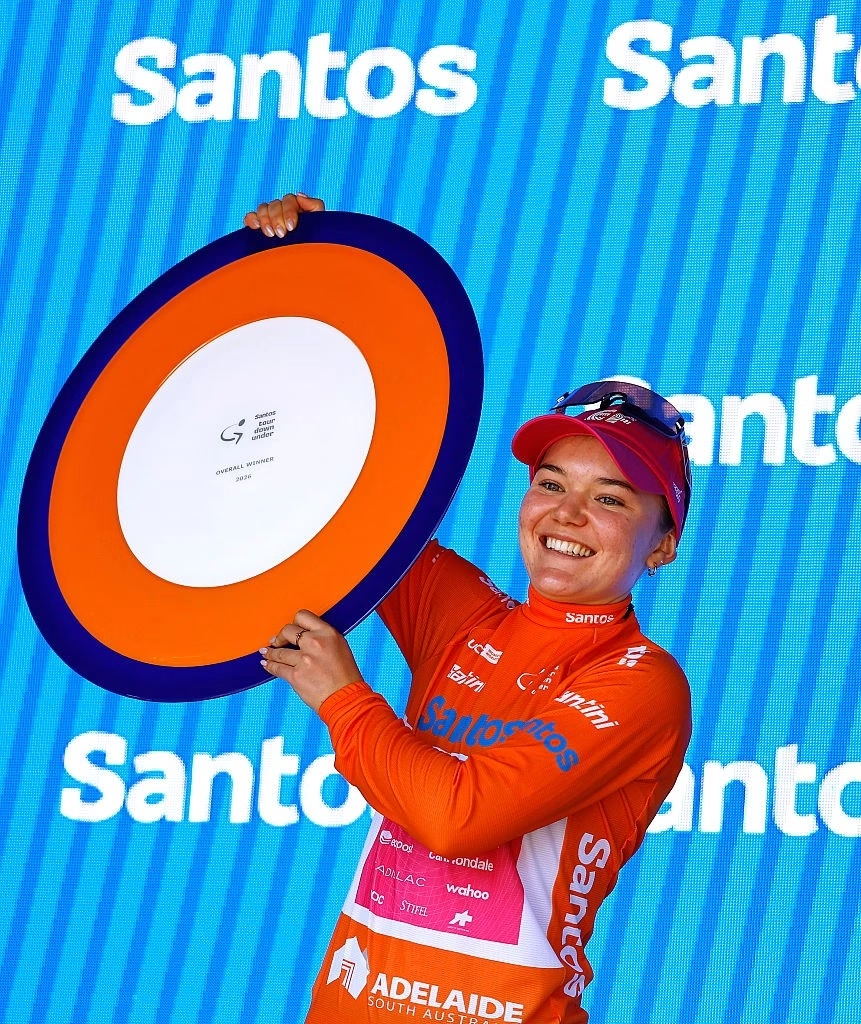 Photo Credit: Getty
One versus three: Rüegg keeps her nerve and turns the tables
The final kilometres were a masterclass in survival and timing. UAE attacked in sequence, Blasi, then Wlodarczyk, then another surge, each move designed to force Rüegg to close gaps and spend her last matches. Rüegg responded every time, snapping onto wheels quickly rather than letting gaps grow, and using the speed of the run-in to benefit from slipstream rather than trying to brute-force the effort alone.
Rüegg later admitted she had doubts during the first ascent and even thought her team might be better riding for Vallieres. Yet the second climb changed everything. Once she reached the front group with UAE’s trio, it became a matter of reading the attacks, refusing to panic, and backing her sprint.
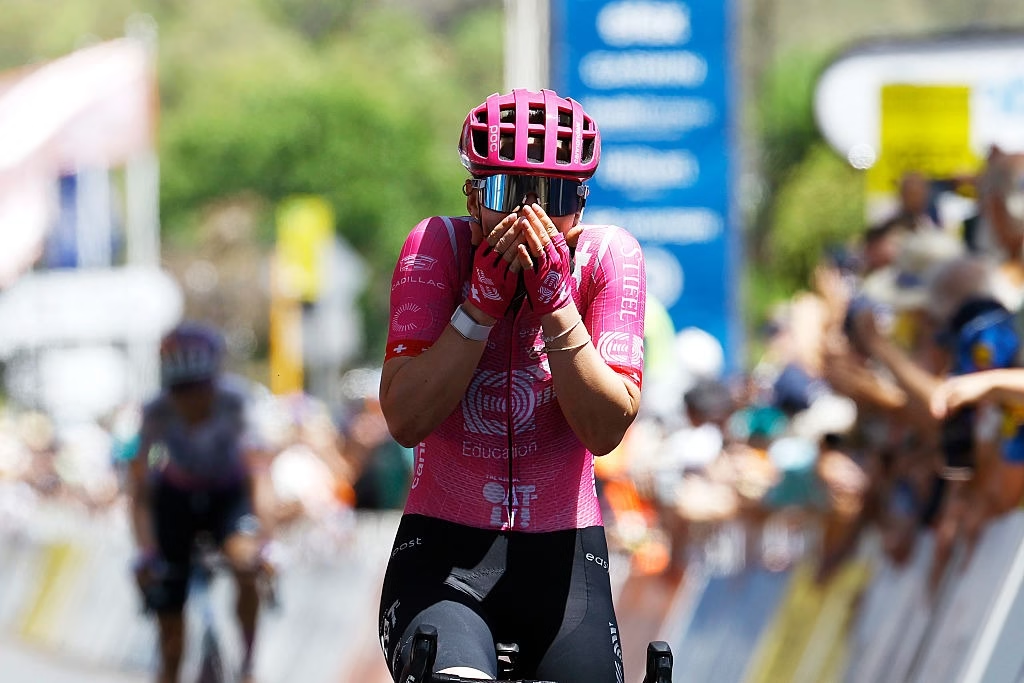
That is exactly what she did. In the final dash, UAE’s aggression effectively set the tempo, and when the last accelerations came, Rüegg still had the snap to come around and win, taking both the stage and the overall title for the second year in a row.
Behind her, Garcia finished second, Blasi third, and the general classification was rewritten by the climbs: the defending champion overcame early trouble, absorbed a barrage of attacks, and still found the decisive kick at the line.
Women’s Tour Down Under 2026 stage 3 result
Results powered by FirstCycling.com
Main photo credit: Getty