Wout van Aert finally claimed Paris-Roubaix after beating Tadej Pogačar in a dramatic two-up finish at the Roubaix velodrome, capping one of the fastest and most chaotic editions the race has seen. Jasper Stuyven took third after attacking clear of the main chase behind, while Mathieu van der Poel’s hopes of a record-equalling win were undone by a succession of incidents that left him chasing for much of the final 90 kilometres.
The 2026 edition never settled into a simple rhythm. Punctures, crashes and bike changes repeatedly reshaped the race, but by the final hour it had become a duel between Van Aert and Pogačar. On the cobbles, the Belgian matched the world champion sector for sector. In the velodrome, he finished the job.
A brutal race began to splinter before Arenberg
Paris-Roubaix was nervous from the start, but the real damage began as the race approached the early sectors. The break had its space, yet behind it the favourites were already fighting for position and trying to avoid the bad luck that so often decides this race.
That warning proved well founded. Crashes hit before the race even reached its most feared sections, and then the major incidents started to land among the favourites. Pogačar punctured on sector 22, a problem that could easily have ended his day. He had to chase back through a race already in pieces, but unlike some previous moments in his cobbled spring campaign, he stayed composed and regained contact.
Van der Poel’s race went in the opposite direction. He was repeatedly delayed by a bike change and then more time loss, leaving the defending champion on the back foot just as the race was moving towards its decisive phase. Filippo Ganna also endured a miserable afternoon, puncturing more than once and crashing out of contention despite repeatedly trying to fight his way back.
Pogačar forced the race open
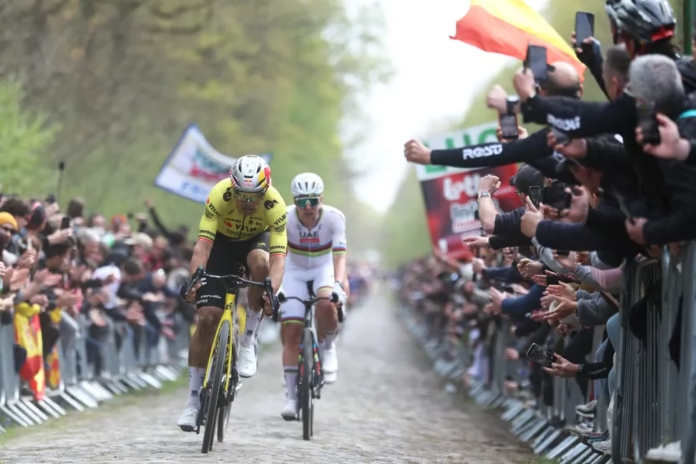
The turning point came as the race hit the five-star sectors. Pogačar began to accelerate with real intent, and only a select few could respond. Van Aert was there immediately. Mads Pedersen briefly held on, while Van der Poel tried to limit the damage from behind, but the front of the race was being shaped by the Slovenian.
On sector 12, Auchy-lez-Orchies à Bersée, Van Aert attacked first and Pogačar had to close him down. Soon after, Pogačar countered, with Van Aert glued to his wheel. That pattern continued through Mons-en-Pévèle. Pogačar kept trying to turn the screw. Van Aert kept answering.
It was not passive riding from Van Aert either. At one point he even came through and tried to use his own bike handling to put Pogačar under pressure. The two strongest riders in the race had separated themselves from everyone else, and from there Paris-Roubaix became a test of endurance, timing and nerve.
Van der Poel and the chasers never got back
Behind them, the race never fully stabilised. Van der Poel was still riding with enormous force, at one stage dragging a chase that included Ganna and later trying to split the group behind on Gruson. Pedersen, Stuyven, Laporte and the Van Dijke brothers all had moments in pursuit as well. But every time the gap looked manageable, it opened again.
That was partly because Pogačar kept pressing on the front, but also because Van Aert rode a highly intelligent race. He was strong enough to stay with the world champion, yet careful enough not to waste himself. When Pogačar attacked, Van Aert followed. When the pace eased fractionally on the asphalt, Van Aert took only what he needed. He was not interested in towing the race to anyone behind, but he was equally unwilling to let Pogačar ride away.
By the time the race reached the final sequence of sectors, the lead pair had made the winning move. The chase still contained huge names, but it was racing for third unless something dramatic changed.
Carrefour de l’Arbre did not break Van Aert
The decisive question going into the final 20 kilometres was simple: could Pogačar finally crack Van Aert on Carrefour de l’Arbre or one of the final sectors? The world champion tried. He attacked from the start of Carrefour de l’Arbre and again on Gruson. Each time Van Aert held the wheel.
That was arguably the moment the race tilted. Pogačar had done what he needed to do in principle. He had isolated the race to a two-man contest on terrain that should have favoured repeated pressure. But Van Aert was not only surviving, he was beginning to look more comfortable with the rhythm of the race. Pogačar was still stretching his back and shifting around on the bike. Van Aert, by contrast, looked increasingly settled.
The gap behind hovered around half a minute, with Van der Poel still driving the chase and Stuyven eventually launching clear of that group near the end. Yet the winner was now almost certainly going to come from the front two.
 Photo Credit: Getty
Van Aert finished it in the velodrome
Into Roubaix, the pair were still together. Van Aert led onto the final town cobbles as the chase erupted behind, with Stuyven attacking for third and Van der Poel trying to respond. Ahead, though, the focus was on the velodrome.
Pogačar entered first, forcing Van Aert to read the sprint perfectly. The Belgian stayed calm, waited for his moment, and then came around to win in the final metres. It was not just a sprint victory. It was the completion of one of the strongest Classics rides of his career.
When he crossed the line, Van Aert was overcome with emotion. Paris-Roubaix had long been one of the biggest prizes missing from his palmarès. To win it against Pogačar, after surviving the Slovenian’s repeated attacks and one of the fastest editions in race history, made it all the more significant.
What Paris-Roubaix 2026 showed
This was a race that underlined just how fine the margins are in modern Monument racing. Pogačar was brilliant again and aggressive throughout. On another day, without the punctures and with a slightly cleaner run through the race’s many moments of chaos, he might well have won. Van der Poel’s ride was similarly impressive given how much of it was spent in pursuit rather than control.
But Paris-Roubaix 2026 belonged to Van Aert because he combined everything the race demands. He had the legs to match the strongest rider in the world. He had the composure to deal with the race’s constant disorder. And when the winning moment came in the velodrome, he had the finish to seal it.
That is what made this more than a big victory. It was a complete Paris-Roubaix performance.
Wout van Aert finally has his Roubaix moment
For years, Van Aert has looked like a rider built to win Paris-Roubaix. This time he did it, and he did it the hard way. He beat Pogačar head to head, held firm through every attack, and delivered under pressure at the end of a race that never stopped asking questions.
Paris-Roubaix does not hand out easy wins. This one certainly did not. That is exactly why Van Aert’s victory will resonate so strongly.
Results powered by FirstCycling.com
Main photo credit: Getty